What is a sprint backlog? A complete guide for Agile teams
Introduction
Sprint backlog is where Agile intent meets execution. It is the team's working contract for a sprint: a focused, time-boxed list of tasks pulled from the product backlog and committed to within a single iteration. For Scrum teams, it captures not just what to build, but how to get there. Done right, sprint backlog management keeps engineering, product, and design aligned without micromanagement. This guide breaks down everything Agile teams need to know.
What is a sprint backlog?
A sprint backlog defines the exact work a team plans to complete within a single Agile sprint. It connects strategic priorities from the product backlog to day-to-day execution inside the sprint. For Scrum teams, it acts as a short-term operating plan that guides delivery for a fixed time frame.
In simpler terms, a sprint backlog is the set of product backlog items selected for a specific sprint, along with the detailed plan to deliver them and achieve the sprint goal.
It contains three essential elements:
- The sprint goal
- The selected product backlog items
- The execution plan created by the development team
Unlike the broader product backlog, which captures future possibilities, the sprint backlog represents a concrete delivery commitment for the current sprint. It translates priority into action and intent into measurable progress.
Sprint backlog in Scrum
In Scrum, the sprint backlog is one of the three core artifacts, alongside the product backlog and the increment. It emerges during sprint planning and evolves throughout the sprint.
The development team owns and maintains the sprint backlog. It includes the sprint goal that defines the objective, the selected backlog items that represent the scope, and the execution plan that outlines how the work will be completed. During daily scrums, the team inspects progress against this backlog and adapts the plan to ensure the sprint goal remains achievable.
Why a sprint backlog exists
A sprint backlog exists to provide clarity and operational focus during a sprint.
- First, it aligns the team around a clear sprint goal. Every selected item should contribute directly to that objective, creating coherence in delivery decisions.
- Second, it provides shared visibility into current work. Product managers, engineering managers, and stakeholders can see what the team is building and how progress unfolds.
- Third, it reduces scope confusion. By defining exactly what is selected for the sprint, the sprint backlog establishes boundaries that protect focus and support predictable delivery.
Where the sprint backlog fits in the Scrum cycle
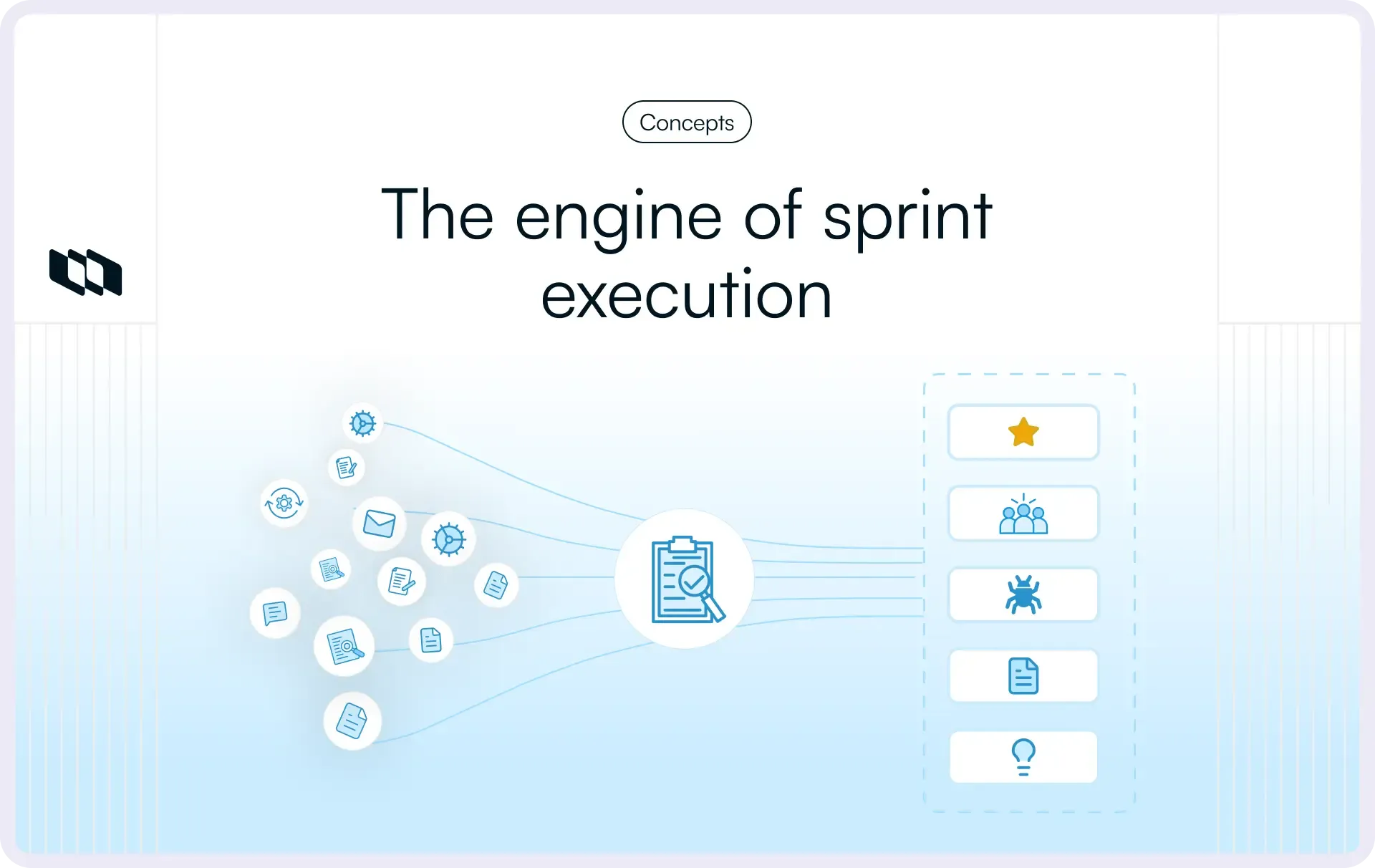
The sprint backlog sits at the center of the sprint execution loop. It connects sprint planning decisions to daily work and ultimately to the increment delivered at the end of the sprint. Understanding where the sprint backlog fits in Scrum helps teams maintain alignment between intent and execution.
1. Created during sprint planning
Sprint planning is the event where the sprint backlog takes shape. During this session, the team reviews the product backlog, defines a sprint goal, and selects the product backlog items that support that goal.
Selection depends on priority, readiness, and team capacity. Once items are chosen, the development team breaks them into actionable tasks and outlines how the work will be delivered within the sprint. At this point, the sprint backlog becomes the operational plan for the upcoming iteration.
2. Guided by the sprint goal
The sprint goal anchors the sprint backlog. It provides a unifying objective that guides the selection of backlog items and the handling of trade-offs.
When teams understand the purpose of the sprint, they make better scope decisions. If unexpected complexity emerges, the sprint goal helps determine whether adjustments support or dilute the intended outcome. A strong sprint backlog reflects this alignment, where every selected item contributes directly to the defined objective.
3. Updated throughout the sprint
A sprint backlog evolves as the team progresses through the sprint. As work advances, tasks are refined, effort estimates may shift, and new implementation details surface.
During the daily scrum, the team inspects progress toward the sprint goal and adjusts the plan as needed. This continuous inspection ensures the sprint backlog remains accurate and actionable. By keeping it current, teams maintain transparency, improve coordination, and protect delivery focus within the Agile sprint.
Sprint backlog vs. product backlog
These two artifacts are related but serve fundamentally different purposes in Scrum. Conflating them is one of the most common reasons sprint planning runs long, scope creep happens mid-sprint, and teams lose focus. Here is how they differ and how they connect.
What is a product backlog?
The product backlog is the single, ordered list of everything the product needs: features, bug fixes, technical debt, improvements, and experiments. It is owned by the product owner, continuously refined, and never fully complete as long as the product remains in existence. It represents the full scope of future work across all sprints, not just the current one.
Key differences
While both artifacts live within the Scrum framework, they operate at completely different levels of the planning hierarchy.
- On time horizon, the product backlog covers the entire product roadmap across multiple sprints and quarters, while the sprint backlog is scoped strictly to a single iteration, typically one to four weeks.
- On scope, the product backlog holds everything that could be built, ordered by priority. The sprint backlog holds only what the team has committed to building right now, broken down into executable tasks.
- On ownership, the product owner owns and maintains the product backlog. The development team owns the sprint backlog entirely. The product owner has no authority to add or change items in the sprint backlog once the sprint begins.
- On the level of detail, product backlog items are often high-level: epics, user stories, and feature briefs. Sprint backlog items are granular: specific tasks with effort estimates, assignees, and clear definitions of done.
How items move from the product backlog to the Sprint backlog
The transition occurs during sprint planning and is both a selection process and a commitment. The product owner walks the team through the highest-priority product backlog items, providing context on business value and acceptance criteria. The development team then assesses each item against their capacity for the sprint, asking whether they can deliver it to the definition of done within the time box.
Items that make the cut are pulled into the sprint backlog and immediately decomposed into tasks. This decomposition is critical: a user story sitting in the product backlog becomes a set of concrete, assignable work items in the sprint backlog. The team is committing to those tasks, and that commitment is what separates the sprint backlog from a wishlist.
What does a sprint backlog include?
A strong sprint backlog contains more than a list of user stories. It combines outcome clarity with execution detail. When structured properly, it answers three operational questions: What are we trying to achieve? What exactly are we building? How will we complete it within this sprint? Let's have a look at the components that are included in the sprint backlog:
1. Sprint goal
The sprint goal is the central objective that defines the sprint's purpose. It provides direction and coherence across selected work items.
A well-defined sprint goal describes the outcome the team aims to achieve, not a checklist of tasks. For example, instead of listing multiple feature updates, the sprint goal may state that the objective is to improve onboarding conversion. This goal then guides selection decisions, prioritization, and trade-offs throughout the Agile sprint.
In Scrum, the sprint backlog exists to deliver this goal.
2. Selected product backlog items
The sprint backlog includes a set of product backlog items chosen during sprint planning. These typically take the form of user stories, technical tasks, or defect fixes that align with the sprint goal.
Selection reflects priority, readiness, and team capacity. Each item should contribute directly to the defined objective. Including loosely related work fragments focuses and weakens delivery predictability.
This subset of work represents the team’s commitment to execution for the sprint.
3. Task breakdown
Selected backlog items are further decomposed into actionable tasks. This task breakdown transforms high-level user stories into executable work units.
For example, a user story to implement a new payment flow may be divided into API updates, database schema changes, UI components, test cases, and deployment steps. This level of detail improves coordination, highlights dependencies, and clarifies the distribution of effort across the team.
A sprint backlog without a task breakdown often lacks clarity on execution.
4. Estimates and priorities
Each item within the sprint backlog carries effort estimates and relative priority. Estimates support capacity planning and help teams maintain a realistic workload within the sprint.
Priority sequencing ensures the most critical items receive attention first, especially when complexity or unforeseen challenges arise. While the overall order reflects alignment with the sprint goal, intra-sprint prioritization supports efficient flow.
Clear estimates and sequencing strengthen predictability in Agile sprint delivery.
5. Ownership and status tracking
Ownership ensures accountability. Each task or backlog item has a clear assignee responsible for execution.
Status tracking provides transparency into progress. Teams typically track states such as planned, in progress, review, and done. Alignment with the team’s definition of done confirms that completion meets the agreed-upon quality standards.
When ownership, progress indicators, and definition of done are explicit, the sprint backlog becomes a living operational system rather than a static task list.
Who owns and manages the sprint backlog
Clear ownership of the sprint backlog strengthens accountability and execution discipline. In Scrum, authority over prioritization and authority over execution sit in different roles. Understanding this separation helps teams operate with clarity.
1. Development team ownership
The development team owns and manages the sprint backlog. Once product backlog items are selected during sprint planning, the team decides how the work will be delivered.
Developers break items into tasks, estimate effort, update status daily, and adjust the execution plan as new information emerges. The sprint backlog reflects their plan to achieve the sprint goal. Since they are responsible for delivering the increment, they maintain the backlog as a living execution system throughout the Agile sprint.
This ownership ensures that planning decisions remain grounded in technical reality and team capacity.
2. Product owner involvement
The product owner remains accountable for the product backlog and the overall value delivered. During sprint planning, the product owner clarifies requirements, defines acceptance criteria, and ensures that selected items align with business priorities.
Once the sprint begins, the product owner stays available for clarification and refinement. If scope discussions arise, alignment with the sprint goal and product priorities guides decisions. While the product owner influences what enters the sprint backlog, the development team controls how that work is executed.
3. Scrum master role
The Scrum master supports the team by facilitating Scrum events and ensuring that the sprint backlog process functions effectively.
This role helps remove impediments, protects the sprint goal, and reinforces healthy practices, such as clear task breakdowns and daily inspections. The Scrum master also coaches the team on maintaining transparency within the sprint backlog so that progress remains visible and measurable.
Together, these roles create a balanced governance model where strategy, execution, and process oversight remain clearly defined within Scrum.
Why teams use sprint backlogs
Teams adopt sprint backlogs to bring structure and discipline to short-term delivery. In Scrum, the sprint backlog transforms strategic priorities into an actionable plan that can be inspected daily. For product managers and engineering leaders, it creates alignment between intent, execution, and measurable outcomes.
1. Improves focus and alignment
A sprint backlog centers the team around a defined sprint goal. Every selected product backlog item should contribute directly to that objective.
This shared focus reduces fragmented effort and strengthens coordination across design, engineering, and product. When trade-offs arise, the sprint goal guides decisions. Alignment at this level improves execution quality and shortens decision cycles during the Agile sprint.
2. Prevents scope creep
Scope creep often begins with informal additions or unclear boundaries. A well-defined sprint backlog establishes explicit scope for the sprint.
Since the sprint backlog contains the selected work tied to the sprint goal, it provides clarity about what the team has committed to deliver. New ideas or urgent requests can be evaluated against current capacity and alignment with the goal. This structured evaluation protects delivery predictability.
3. Improves visibility
The sprint backlog acts as a shared source of truth. It shows what the team is building, who is responsible, and how work is progressing.
Daily updates ensure that stakeholders can track movement across tasks and backlog items. Transparent visibility strengthens accountability and enables faster identification of bottlenecks. Within an Agile sprint, this clarity supports smoother collaboration and more informed conversations.
4. Supports better forecasting
Over time, sprint backlogs generate historical data on capacity, throughput, and completion rates. Teams observe patterns in effort estimates, cycle time, and delivery consistency.
These insights improve future sprint planning and backlog selection. Accurate forecasting emerges from disciplined execution and inspection of past sprint backlogs. For engineering managers and founders, this predictability enhances release planning and resource allocation across the product roadmap.
How to create a sprint backlog: Step by step
A sprint backlog turns planning energy into a delivery plan that holds up mid-sprint. The goal remains simple: select the right work, make it executable, and keep it aligned with a single outcome. Here is a step-by-step sprint backlog process that works across most Scrum teams.
1. Prepare the product backlog
Sprint planning works best when the product backlog already looks “ready to select from.”
Use these quick pointers before the meeting:
- Refine the top items: keep the highest-priority product backlog items clear enough to estimate and build.
- Confirm acceptance criteria: each item should explain what “done” means in practical terms.
- Surface dependencies early: integration work, external teams, approvals, or technical constraints.
- Remove ambiguity: unclear items create planning churn and mid-sprint rework.
This prep reduces time spent debating intent and increases time spent building a realistic sprint backlog.
2. Define the sprint goal
Start sprint planning with the sprint goal, not the list of tickets. The sprint goal acts as the selection filter.
A strong sprint goal has three qualities:
- Outcome-based: It describes the result the sprint should produce, not a bundle of tasks.
- Specific enough to guide trade-offs: When something slips, the goal helps decide what to protect.
- Visible to the whole team, so daily decisions stay consistent.
Example framing that tends to work: “Enable X user to do Y without Z friction.” This keeps the sprint backlog cohesive.
3. Select items based on capacity
Capacity keeps the sprint backlog realistic. Overcommitment usually happens when teams plan for best-case conditions instead of actual availability.
Use these pointers during selection:
- Start with availability: account for planned leave, on-call load, support rotation, meetings, and review overhead.
- Use historical delivery as a guide: past sprints reveal what the team typically completes, not what it hopes to complete.
- Select for the sprint goal first: choose the smallest set of product backlog items that achieves the goal.
- Leave room for uncertainty: complex work expands. A sprint backlog should absorb reality, not collapse under it.
This is where the sprint backlog vs. the product backlog becomes operational. The product backlog can stay ambitious. The sprint backlog must stay executable.
4. Break items into tasks
Once items are selected, break them into tasks that a developer can start immediately. Task breakdown is the difference between “we planned it” and “we can ship it.”
Good task breakdown follows these pointers:
- Slice by workflow: build, test, review, deploy.
- Expose hidden work: edge cases, migration steps, docs, monitoring, and rollback plans.
- Keep tasks small: work units that move in a day or two improve flow and reduce half-finished work.
- Clarify ownership: assign or at least make responsibility clear for each task.
This is also where the definition of done comes into play. If “done” stays vague, status tracking becomes meaningless.
5. Finalize and share the sprint backlog
Before sprint planning ends, ensure the sprint backlog reads like a plan the team can execute.
Use this short checklist:
- The sprint goal is written and visible.
- Selected items clearly support the sprint goal.
- Tasks exist for each item, with owners and status states.
- Risks and dependencies are noted.
- Everyone understands the first step to start
When the sprint backlog is shared clearly, the daily scrum becomes sharper. Progress conversations shift from “what are we doing” to “how close are we to the sprint goal,” which is where strong Scrum execution lives.
How to manage a sprint backlog during the sprint
Creating the sprint backlog is the starting point. Managing it well through the sprint is what actually determines whether the team hits its sprint goal. A sprint backlog left untouched after day one is a planning document, not an execution tool. Here is how high-performing Scrum teams keep theirs alive and accurate.
1. Update it daily
A sprint backlog must mirror actual progress. Tasks move, scope clarifies, effort shifts, and new implementation details surface. When updates lag behind reality, coordination weakens, and forecasting loses accuracy.
Daily updates keep the backlog aligned with what is happening on the ground. Developers adjust task states, refine breakdowns if needed, and surface blockers directly inside the sprint backlog. This habit creates transparency across the team and builds confidence in progress reporting.
Consistency matters more than perfection. Accurate visibility drives better decisions.
2. Use it during daily scrums
The daily scrum revolves around progress toward the sprint goal, and the sprint backlog provides the evidence.
During the meeting, the team inspects:
- Which sprint backlog items are progressing as planned
- Which tasks require support
- Whether the sprint goal remains achievable
Instead of reporting status abstractly, teams anchor conversations to the sprint backlog. This keeps discussions focused on flow, dependencies, and goal alignment rather than individual activity.
A visible sprint backlog transforms daily scrums from routine check-ins into structured execution reviews.
3. Adjust responsibly
Adaptation is part of Scrum. Complexity surfaces during implementation, and execution plans evolve. The sprint backlog can change as long as the sprint goal remains intact.
Responsible adjustment follows a few principles:
- Refine the task breakdown when complexity increases
- Re-sequence work to manage risk
- Clarify acceptance criteria when ambiguity appears
- Reassess the effort if the discovery changes the scope
When adjustments support the sprint goal, the sprint backlog becomes more accurate and resilient. This disciplined flexibility allows teams to respond to reality while maintaining delivery focus within the sprint.
Common mistakes teams make
Many teams understand what a sprint backlog is, yet execution quality often breaks down in practice. These mistakes weaken predictability and dilute the value of the sprint backlog in Scrum.
1. Overcommitting to work
Overcommitment usually stems from optimism bias or external pressure. Teams select more product backlog items than capacity realistically supports. The result is spillover, rushed quality, and weakened trust in sprint forecasting. A sprint backlog should reflect achievable delivery aligned with actual team capacity, not ideal conditions.
2. Skipping task breakdown
High-level user stories without task decomposition create ambiguity. Developers spend time clarifying scope mid-sprint, coordination slows down, and hidden effort surfaces late. A sprint backlog without a detailed task breakdown limits clarity of execution. Breaking work into smaller tasks improves flow, ownership, and daily progress tracking.
3. No clear sprint goal
When a sprint lacks a coherent sprint goal, selected backlog items feel disconnected. Prioritization becomes reactive, and trade-offs lack direction. A clear sprint goal ties the sprint backlog together. It enables structured decision-making and ensures each selected item contributes to a defined outcome.
4. Treating the backlog as static
Some teams finalize the sprint backlog during sprint planning and then stop refining it. As complexity emerges, the backlog drifts away from reality. A sprint backlog in Scrum evolves throughout the sprint. It reflects updated task status, refined estimates, and clarified implementation details. Treating it as a living artifact preserves transparency.
5. Failing to update progress
When task status remains outdated, visibility erodes. Stakeholders rely on informal updates instead of the sprint backlog as the source of truth. Daily updates ensure alignment between reported progress and actual execution. Accurate tracking strengthens forecasting, accountability, and coordination across the Agile sprint.
Final thoughts
A sprint backlog represents the bridge between product strategy and engineering execution. It translates prioritized intent from the product backlog into a focused, time-bound delivery plan aligned with a clear sprint goal. When teams treat the sprint backlog as a living execution system, daily coordination improves, scope remains controlled, and forecasting becomes more reliable. The quality of a sprint often reflects the clarity of its sprint backlog.
For product managers, engineering managers, and founders, understanding what a sprint backlog is and how to manage it effectively strengthens delivery discipline. Strong sprint backlogs create predictable progress within each Agile sprint and build long-term confidence in execution across the product roadmap.
Frequently asked questions
Q1. What is a sprint backlog?
A sprint backlog is the set of product backlog items selected for a specific Agile sprint, along with the detailed plan to deliver them and achieve the sprint goal. In Scrum, it acts as the team’s short-term execution plan and is updated daily to reflect real progress.
Q2. What is the difference between sprint backlog and product backlog?
The product backlog contains all potential work for the product and reflects long-term priorities managed by the product owner. The sprint backlog is a subset of that work selected for the current sprint and owned by the development team. The product backlog represents strategic intent, while the sprint backlog represents committed execution within a defined time frame.
Q3. What are the three types of backlog?
In Scrum and Agile environments, teams typically work with:
- Product backlog – a prioritized list of all product work.
- Sprint backlog – selected items and execution plan for the current sprint.
- Release backlog – a grouping of backlog items planned for an upcoming release cycle.
These backlogs operate at different planning horizons but remain connected through prioritization and delivery flow.
Q4. Who makes the sprint backlog?
The sprint backlog is created during sprint planning. The product owner presents the highest-priority product backlog items, and the development team selects the work they can deliver based on capacity. The development team then breaks selected items into tasks and maintains the sprint backlog throughout the sprint.
Q5. What are the 5 stages of a sprint?
A typical Scrum sprint includes five structured stages:
- Sprint planning: Define the sprint goal and create the sprint backlog.
- Sprint execution: Build and test selected backlog items.
- Daily scrum: Inspect progress toward the sprint goal.
- Sprint review: Demonstrate the completed increment to stakeholders.
- Sprint retrospective: Reflect on process improvements for the next sprint.
These stages create a repeatable rhythm that connects planning, delivery, feedback, and continuous improvement.
Recommended for you




 Download for Mac
 Download for Android