What is the product development lifecycle? Stages, process, and best practices
Introduction
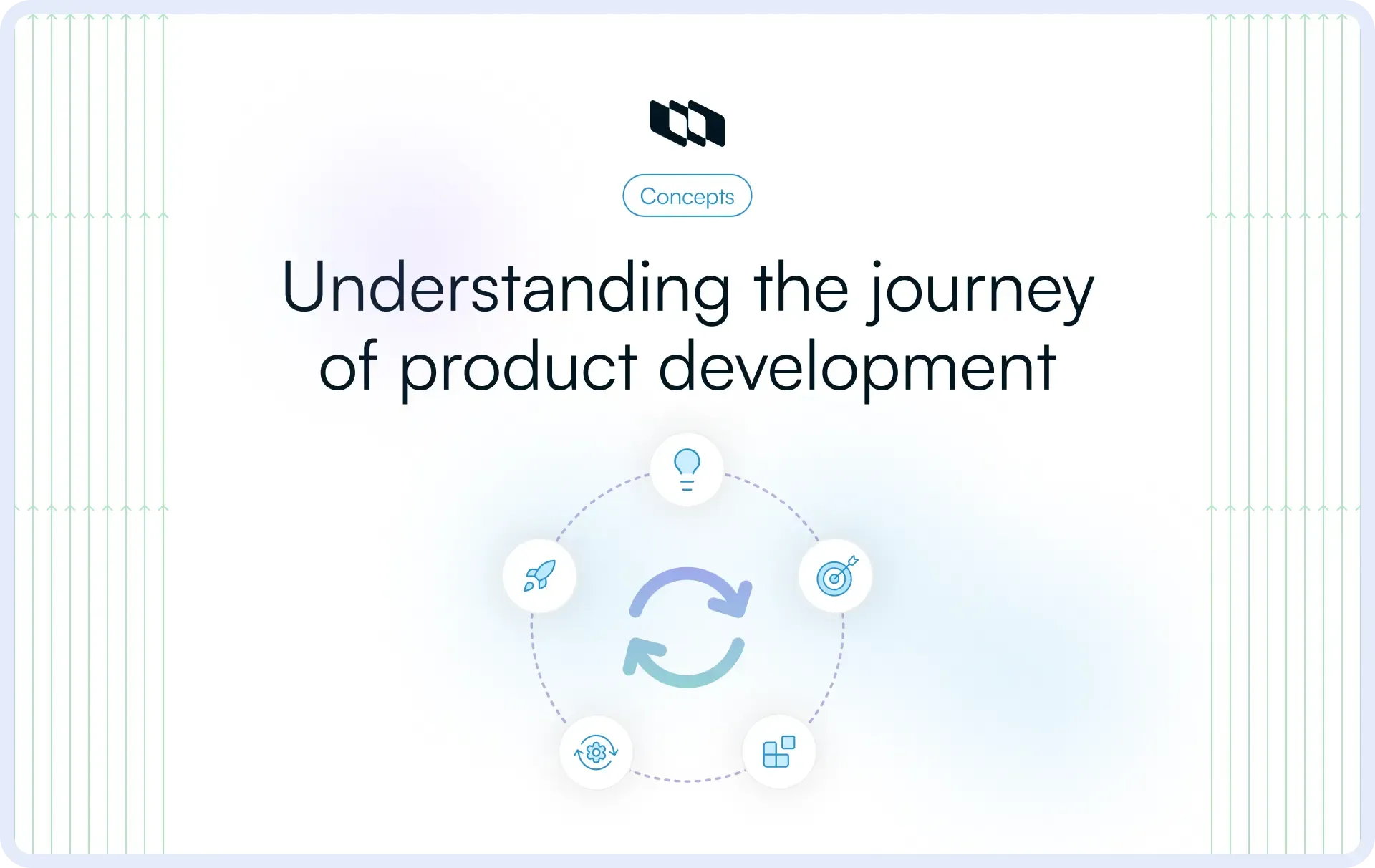
A product launch often looks simple from the outside. Users see a feature release, a new interface, or an updated version of an app. Behind that release lies a structured journey that teams follow from the first idea to continuous improvement. This journey is known as the product development lifecycle. The product development process helps teams validate opportunities, design solutions, build products, and learn from real customer usage. Understanding what the product development lifecycle is and the stages of the product development lifecycle helps organizations deliver products with clarity, discipline, and measurable impact.
What is the product development lifecycle?
The product development lifecycle refers to the structured framework teams use to turn an idea into a usable product and improve it through continuous learning. It provides a clear product development process that guides teams from early discovery to launch and ongoing refinement. Product managers, designers, engineers, and business leaders rely on this framework to align decisions, reduce uncertainty, and move products from concept to delivery with discipline and clarity.
A well-defined product development lifecycle helps teams organize work across several critical activities:
- Product discovery: Teams identify customer problems, analyze opportunities, and explore potential solutions through research and validation.
- Design and development: Designers and engineers collaborate to translate ideas into product experiences, technical architectures, and working functionality.
- Testing and validation: Teams evaluate usability, performance, and reliability to ensure the product delivers the intended value.
- Product launch: The product moves from development to real users with coordinated release planning, messaging, and distribution.
- Post-launch improvements: Teams analyze user feedback, product usage, and performance metrics to refine the product and guide future iterations.
Understanding how the product development lifecycle works helps organizations build products that address real user needs while continuously evolving through feedback and learning.
Why the product development lifecycle matters
Structured development processes exist because building products is an exercise in managing complexity. When multiple teams, timelines, and stakeholders converge on a single goal, a shared lifecycle keeps everyone oriented toward the same outcomes. Here is why organizations that take it seriously consistently outperform those that treat product development as a series of ad-hoc decisions.
1. Improves product quality
A defined lifecycle builds quality in at every stage rather than bolting it on at the end. Teams move through deliberate phases of design, development, and validation, each one creating a checkpoint that filters out weak assumptions and unresolved edge cases. The result is a product that reaches users in a state that reflects genuine refinement, not just completion.
2. Reduces development risks
Early-stage validation is one of the highest-leverage activities in the entire product development process. When teams invest time in discovery and feasibility checks upfront, they surface technical constraints, market mismatches, and scope risks before engineering cycles are spent. Catching a flawed assumption in week two costs far less than catching it post-launch.
3. Aligns cross-functional teams
Product managers, designers, engineers, and marketers all bring different priorities to the table. The product development lifecycle provides these teams with a shared operating structure, ensuring clean handoffs, explicit expectations, and no single team making decisions in isolation. Alignment at the process level translates directly into fewer delays, fewer miscommunications, and faster execution.
4. Enables continuous improvement
The lifecycle extends well beyond launch. Post-launch feedback, usage data, and support signals feed back into the product development process, giving teams a structured way to prioritize what to fix, improve, or build next. This feedback loop is what separates products that grow from products that stagnate.
What are the stages of the product development lifecycle?
The product development lifecycle moves through distinct stages, each one building on the last. The sequence below reflects how high-performing product teams structure their work from the first spark of an idea to continuous post-launch iteration.
1. Idea generation and opportunity discovery
The lifecycle begins with identifying opportunities worth solving. Teams gather insights from customer feedback, support requests, market trends, product analytics, and competitive research. Product managers synthesize these signals to surface problems that carry meaningful user impact and business value. This stage of the product development lifecycle focuses on discovering opportunities rather than immediately proposing solutions.
2. Idea screening and validation
Once potential ideas emerge, teams evaluate them through structured validation. Product leaders assess feasibility, technical constraints, customer demand, and alignment with strategic priorities. Early validation activities may include customer interviews, problem validation surveys, and market analysis. This stage of the product development process helps teams focus resources on opportunities that deliver measurable value.
3. Market research and customer insights
Product teams deepen their understanding of the problem space through detailed research. User interviews, competitor analysis, behavioral analytics, and customer journey mapping help clarify the context in which the product will operate. These insights guide decisions about target users, product positioning, and the core problem the solution addresses. Clear customer understanding strengthens every subsequent stage of the product development lifecycle.
4. Concept development and prototyping
Teams begin shaping potential solutions through concept exploration and early prototypes. Designers and product managers create wireframes, clickable prototypes, or simplified models that represent the intended product experience. These early artifacts help teams validate assumptions, gather user feedback, and refine the concept before significant engineering investment. Prototyping serves as a learning mechanism within the product development process.
5. Product planning and requirements definition
Once the concept gains validation, teams translate the idea into a clear execution plan. Product managers define requirements, outline product capabilities, and establish measurable goals for success. Engineering teams evaluate technical architecture, dependencies, and development timelines. Roadmaps, specifications, and milestone plans emerge during this stage of the product development lifecycle in product management.
6. Product design and development
Design and engineering teams collaborate to build the product. Designers refine interaction patterns, visual systems, and usability while engineers implement the underlying functionality. Product managers coordinate priorities, manage trade-offs, and ensure the product aligns with strategic objectives. This stage transforms plans into working product capabilities as part of the broader product development process.
7. Testing and quality assurance
Before release, the product undergoes thorough validation. Quality assurance teams perform functional testing, usability evaluations, and performance checks to confirm reliability. Product teams also assess whether the solution addresses the original user problem. This stage ensures that the product entering the market delivers a stable and valuable experience.
8. Product launch and commercialization
The launch stage introduces the product to users. Teams coordinate release planning, documentation, user onboarding, marketing communication, and distribution strategies. Product managers monitor adoption metrics and early feedback while ensuring that the release aligns with business objectives. Launch represents the transition from internal development to real-world usage.
9. Post-launch evaluation and iteration
After launch, the lifecycle continues through ongoing learning and improvement. Teams analyze product usage data, customer feedback, and performance indicators to identify areas for enhancement. Insights gathered during this phase inform future updates, feature improvements, and new development cycles. Continuous iteration is an essential part of the product development lifecycle, enabling teams to evolve products as user needs change.
Is the product development lifecycle always linear?
The product development lifecycle often appears as a sequence of stages, though real product development follows an iterative path. Teams move through the product development process while continuously learning from user insights, technical discoveries, and market signals.
Product teams revisit earlier stages of the product development lifecycle to refine ideas, update requirements, and improve solutions as new information emerges. This iterative approach helps organizations adapt quickly and build products that evolve with user needs.
Who is involved in the product development lifecycle?
The product development lifecycle involves collaboration across multiple teams rather than a single function. Successful products emerge when product leaders, designers, engineers, and business teams work together within the same product development process. Each role contributes a different perspective that helps teams identify the right problems, design effective solutions, and deliver products that succeed in the market.
1. Product managers
Product managers guide the product's direction throughout the product development lifecycle. They identify user problems, define product goals, prioritize features, and align teams around a shared roadmap. Product managers also balance customer needs, business objectives, and technical feasibility to ensure development efforts focus on meaningful outcomes.
2. Designers
Designers translate product ideas into user experiences that people can easily understand and use. They create user flows, wireframes, and prototypes that explore possible solutions before development begins. Designers also refine visual interfaces and interaction patterns so the product delivers a clear and intuitive experience.
3. Engineers
Engineers turn product concepts into working software or physical products. They design system architecture, implement features, resolve technical challenges, and ensure the product performs reliably at scale. Engineering teams collaborate closely with product managers and designers to build solutions that meet both technical and user requirements.
4. Quality assurance teams
Quality assurance teams focus on verifying that the product functions as expected. They test features, identify bugs, evaluate performance, and confirm the product works across different environments. Thorough testing helps teams deliver a reliable product experience before and after launch.
5. Marketing and sales teams
Marketing and sales teams prepare the product for market introduction. They define messaging, positioning, and launch strategies that communicate the product’s value to customers. Their insights also help product teams understand market expectations, customer segments, and competitive positioning.
Common challenges in the product development lifecycle
Even well-structured teams encounter friction throughout the product development lifecycle. Understanding where things typically break down is the first step toward building processes that hold up under real conditions.
- Unclear product requirements are the most upstream source of wasted effort. When requirements are vague, incomplete, or poorly documented, engineers build to assumptions rather than specifications. The resulting rework is expensive and demoralizing, and it compounds at every subsequent stage.
- Poor cross-team communication creates costly handoff failures. When product managers, designers, and engineers operate in silos, context gets lost between stages. Decisions made in one function without visibility into another lead to misaligned output, duplicated effort, and launch delays that could have been avoided with a shared source of truth.
- Skipping validation stages is a shortcut that reliably backfires. Teams under deadline pressure often compress or bypass discovery and prototyping to move faster into development. The result is products built on unvalidated assumptions, many of which surface as critical flaws only after significant engineering investment.
- Delays during development accumulate from poorly scoped work, shifting priorities, and unresolved dependencies. A single underestimated task can cascade into sprint failures and missed release windows. Teams that invest in thorough product planning and requirements definition at stage 4.5 consistently experience fewer mid-development derailments.
- Insufficient testing before launch puts real users in the position of discovering bugs that QA should have caught. Compressed testing cycles driven by launch pressure increase defect rates, damage user trust, and generate support volume that pulls engineering focus away from the next development cycle.
- Lack of feedback after release leaves the post-launch stage hollow. Teams that ship and move on immediately lose the signal that enables continuous improvement. Without structured mechanisms to collect, analyze, and act on user feedback, the product development lifecycle effectively ends at launch rather than maturing into an improvement loop.
Best practices for managing the product development lifecycle
The difference between teams that consistently ship great products and those that struggle comes down to process discipline. These best practices address the most common failure points across the product development lifecycle.
1. Validate ideas early
Early validation helps teams understand whether a problem is worth solving. Product managers and researchers explore user needs through interviews, prototypes, and experiments before significant development begins. Early learning improves decision-making and helps teams direct resources toward opportunities that create real value.
2. Maintain clear product documentation
Clear documentation creates shared understanding across the product team. Product requirements, specifications, and success metrics provide guidance for design and engineering teams throughout the product development lifecycle. Well-structured documentation also helps teams revisit earlier decisions and maintain alignment as development progresses.
3. Encourage cross-functional collaboration
Successful product development relies on collaboration between product managers, designers, engineers, and business teams. Close collaboration improves communication, accelerates decision-making, and ensures that product decisions reflect technical feasibility, user experience, and market positioning.
4. Prioritize continuous feedback
Customer feedback and product usage insights play a central role in refining products. Teams gather feedback through analytics, support interactions, and user research. These insights help teams evaluate product performance and guide improvements across future development cycles.
5. Adopt iterative development approaches
Iterative development helps teams refine solutions through incremental progress. Product teams build, evaluate, and improve features across multiple cycles rather than relying on a single release milestone. This approach supports learning, adaptability, and continuous improvement throughout the product development lifecycle.
Final thoughts
The product development lifecycle provides a structured framework for turning ideas into usable products and improving them through continuous learning. Each stage of the product development process helps teams understand user problems, design meaningful solutions, build reliable products, and refine them through real-world feedback.
Organizations that follow clear product development lifecycle stages bring greater alignment across product, design, engineering, and business teams. A disciplined lifecycle helps teams make better decisions, reduce development risks, and deliver products that evolve with changing customer needs.
Frequently asked questions
Q1. What are the 7 steps of a product life cycle?
The product life cycle typically includes seven stages that describe how a product evolves in the market. These stages include idea generation, concept development, market introduction, growth, maturity, saturation, and decline. Each stage reflects how customer adoption, competition, and product strategy change as the product moves through its market journey.
Q2. What are the 7 stages of new product development?
The seven stages of new product development generally include idea generation, idea screening, concept development, market research, product development, testing, and product launch. These stages form a structured product development process that helps teams validate opportunities, design solutions, and release products that address real user needs.
Q3. What are the 5 phases of product development?
The five phases of product development commonly include discovery, planning, development, testing, and launch. These phases represent the major steps within the product development lifecycle, guiding teams from identifying opportunities to delivering a working product and evaluating its performance.
Q4. What are the 7 stages of SDLC?
The software development life cycle (SDLC) includes seven stages that guide software creation. These stages typically include planning, requirement analysis, design, development, testing, deployment, and maintenance. While SDLC focuses on software engineering activities, it often operates within the broader product development lifecycle.
Q5. What are the 4 types of product life cycle?
The four primary stages of the product life cycle include introduction, growth, maturity, and decline. These stages describe how a product performs in the market over time, from its initial launch to eventual market saturation or replacement by newer solutions.
Recommended for you



 Download for Mac
 Download for Android