A manifesto for the age of adaptive systems
A steerable system for work
Product and engineering principles that guide how Plane is designed and built.
Plane is a steerable system of record for execution. It maintains a shared operational picture as teams grow, which allows priorities, workflows, and scope to change without requiring migrations, retooling, or accumulating process debt. The system remains stable at both 10,000-person and 100,000-person scale. Control over direction stays with the team.

Principles
01
Keep one system of record
The last generation of project tools optimized for tracking objects, not preserving the operating picture. So teams built an auxiliary system: docs in one place, decisions in another, updates in chat, and "truth" in a spreadsheet.
Context retention should be inexpensive.
Plane treats execution and context as canonical in one workspace.
The point is not consolidation for its own sake. It's removing the fragmentation overhead that forces status meetings just to reconstruct what's going on.
02
Be flexibly opinionated
Two failure modes repeat across tools. One gives you unlimited configurability, but it produces chaos. The other prescribes a single methodology and produces bureaucracy.
Plane is opinionated about guardrails, not doctrine.
The core primitives stay consistent, so work remains legible, but teams can tune workflows, properties, states, and layouts to match how they actually operate. Structure should constrain ambiguity, not constrain teams.
03
Make it legible for machines
Agents change the interface layer of work. But they don't change the need for something canonical underneath. If your system is a pile of fragments, an agent can't reason over it. It can only autocomplete around gaps.
High-performing AI requires structured, intelligible systems.
The missing layer in most orgs is not data. It's structure and decision trace. Plane is architected as a machine-readable work graph: consistent primitives, explicit links, durable history, real state. It is the substrate that makes agentic execution possible without turning autonomy into guesswork.
The future of work is human and AI, together. The foundation has to serve both.
04
Never coerce deployment
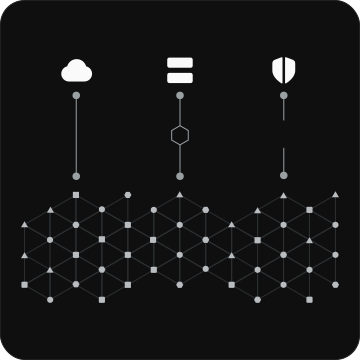
Infrastructure constraints must be treated as first-class concerns. Products that force a hosting decision to unlock capability are using deployment as leverage. That creates the wrong incentive: teams trade control for features, then spend years paying the security and compliance debt.
For many orgs, cloud is nonviable. Trust boundaries, residency policy, audit scope, threat model, and network architecture determine what's deployable. Self-hosted and air-gapped become requirements.
05
Scale without adding complexity
All this while tools have added scale by adding surface area: new concepts, new roles, new administration. Eventually, the tool becomes its own operational function.
Build for the team. Let the teams compose.
Scalability should arise from composability, not added complexity. The same primitives should work for 10,000-person teams and 100,000-person teams.
06
Surface operational truth at every layer
Most project-tracking tools operate from the bottom up. While they may be effective for certain teams, they often fail to serve the broader organizational context.
Visibility for the organization should never be a side quest; it is the system's core function.
They also do not produce a credible 30,000-foot view. As a result, teams spend hours building reports, curating dashboards, and maintaining rollups that degrade without constant attention. These representations often reflect effort, not absolute truth.


 Download for Mac
 Download for Android