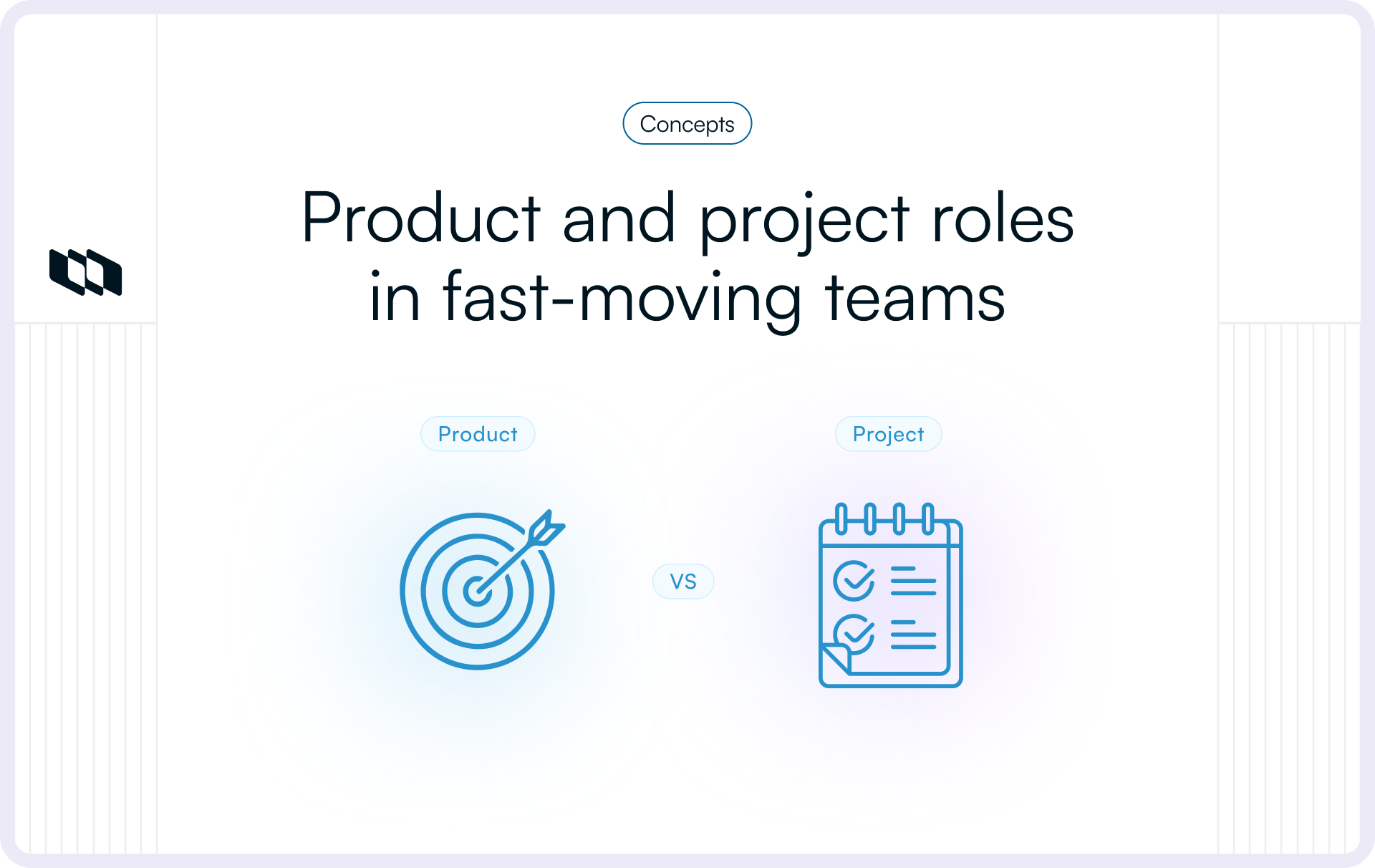
Product Manager vs. Project Manager: What's the difference?
Introduction
Most teams don’t question the overlap between product managers and project managers… until things start breaking. Priorities shift, timelines slip, and no one is sure who’s responsible for what. Before we get into responsibilities, it’s important to understand one thing clearly: these two roles aren’t built to solve the same problems — and treating them as interchangeable is where the slowdown begins.
This guide clearly breaks down the differences. You will learn what each role owns, the skills they need, how they collaborate, and when your company should hire one or both for sustainable product execution.
Products and Projects: A simple distinction
Before comparing the roles, it helps to separate the two things they manage. Many teams mix these terms, but they describe very different types of work.
What is a product?
- A product is something built to solve a real user problem. It has a target audience, a clear value proposition, and an evolving lifecycle.
- A product continues to grow, improve, and adapt based on customer feedback and business strategy. It does not “end” once launched — it requires ongoing discovery, prioritization, and iteration.
This is the foundation of product management: understanding the user, shaping the product's direction, and deciding what creates long-term value.
What is a project?
- A project is a structured, time-bound initiative designed to achieve a specific goal. It has a defined beginning, a planned scope, clear milestones, and a predictable end.
- Once the project is completed, the work transitions to the next initiative, even if the underlying product continues to evolve.
This is where project management fits in: coordinating timelines, managing risks, and ensuring the work is delivered reliably and within scope.
Why this distinction matters
- Product managers guide a product's direction throughout its lifecycle.
- Project managers guide the delivery of a project from start to finish.
Understanding the difference prevents role overlap, reduces confusion in agile teams, and ensures that strategy and execution remain aligned rather than competing.
What does a product manager do
A product manager is responsible for defining what the team should build and why it matters. This role is strategic, deeply customer-focused, and anchored in long-term product outcomes rather than short-term execution. In any agile team structure, the product manager provides direction, clarity, and prioritization, acting as the connective tissue between users, engineering, design, and business stakeholders.
1. Defines the product vision
The product manager sets the long-term north star for the product. This includes identifying the target audience, articulating the value proposition, and aligning product goals with business strategy. Their job is to ensure the team is building something that solves real, validated problems — not just implementing requests.
2. Owns the product roadmap
The roadmap expresses strategic intent. The product manager determines what should be built and when, using frameworks like opportunity scoring, RICE, or outcome-driven planning. In cross-team collaboration setups or agile matrix teams, the roadmap provides alignment across engineering managers, tech leads, and design leads.
3. Understands the user
The product manager is the voice of the user. They deeply understand customer needs through interviews, data analysis, usage patterns, and competitive insights. They translate this understanding into clear product decisions, increasing the quality of agile collaboration among teams.
4. Manages and prioritizes the backlog
While the backlog is executed through agile team roles like product owner or scrum master roles, the product manager remains accountable for prioritization. They evaluate features, technical investments, UX improvements, and fixes based on:
- Customer value
- Business impact
- Strategic fit
- Engineering effort
- Risk and dependency considerations
This ensures the team focuses on meaningful work rather than loud stakeholder requests.
5. Measures product success
A strong product manager uses metrics to understand whether the product is working. They track KPIs such as:
- Adoption
- Retention
- Engagement
- Activation
- Revenue impact
- Customer satisfaction
These metrics help them refine the roadmap, work with analytics teams, and communicate outcomes to leadership.
The core question they answer
At every stage, the product manager’s guiding question is: “What problem are we solving, and is this the right product to solve it?” This clarity prevents teams from chasing features without understanding impact — a standard failure mode in fast-growing companies.
What does a project manager do?
A project manager is responsible for how the work gets done and when it gets delivered. Unlike a product manager who defines strategic outcomes, the project manager ensures predictable execution, efficient coordination, and risk-free delivery across agile cross-functional teams. This role is tactical but mission-critical, especially as organizations scale and projects span multiple squads, stakeholders, and dependencies.
1. Defines project scope
The project manager creates clarity around what the project will include — and what it will not. This prevents scope creep, misaligned expectations, and constant reprioritization. In agile team roles, this clarity allows scrum masters, engineering managers, and tech leads to plan accurately and maintain focus throughout execution.
2. Manages timeline and schedule
Project managers own the project timeline. They:
- Build detailed schedules
- Identify milestones
- Set delivery targets
- Track progress across cycles and sprints
This requires strong coordination with engineering teams, especially in agile matrix teams where work spans multiple components and squads. Their ability to maintain predictable delivery is essential for healthy agile team communication and stakeholder trust.
3. Manages resources and budget
Project managers allocate:
- People
- Funding
- Tools and systems
- External vendors or partners
This ensures that the project has the right capabilities at the right time.
In organizations where capacity planning intersects with agile collaboration rituals, the project manager keeps teams balanced and avoids overcommitment.
4. Identifies and mitigates risks
Risk management is one of the most underappreciated project manager responsibilities. They proactively identify:
- Timeline risk
- Dependency conflicts
- Technical uncertainties
- Compliance or security issues
- Cross-team bottlenecks
Then they work with engineering managers, product managers, and scrum master roles to define corrective actions. This is essential for cross-team collaboration, especially in fast-moving software teams.
5. Coordinates the team
Project managers maintain alignment across contributors, stakeholders, leadership, and adjacent teams. They ensure that:
- Blockers are escalated quickly
- Updates flow consistently
- Teams remain unblocked
- Dependencies are resolved
- Quality standards are met
This coordination is especially crucial in agile team structures with distributed squads, where communication breakdowns are the biggest source of delays.
6. The core question they answer
Their guiding question is simple but powerful: “How will we get this done on time, within budget, and to the required quality?”
While the product manager answers what and why, the project manager ensures that the team can deliver those priorities successfully and predictably.
What is the main difference between a product manager and a project manager?
A simple analogy explains the distinction clearly: “The product manager is the architect designing the house; the project manager is the general contractor building it.”
Both roles are essential in agile cross-functional teams, but they handle different dimensions of product delivery. One provides strategic clarity; the other provides operational execution. Confusing these roles leads to unclear priorities, weak agile collaboration, and gaps in ownership, slowing down engineering teams.
What skills do product and project managers need
Both product managers and project managers work at the center of agile cross-functional teams, which means they share several core competencies: communication, leadership, problem-solving, and the ability to influence without authority. However, their specialized skills reflect the different questions they answer — what and why (product manager) versus how and when (project manager).
Understanding these skill differences is essential for clear agile roles and for designing an effective agile team structure that avoids bottlenecks, duplication, and unclear ownership.
1. Core product manager skills
Product managers operate in a strategic, outcome-driven role. They work closely with engineering managers, tech leads, design, analytics, and sometimes scrum master roles to guide direction. Their skill set reflects this strategic focus.
- Strategic thinking: They understand the broader market, identify long-term opportunities, and translate customer needs into product direction.
- Market research and data analysis: They use qualitative and quantitative inputs to validate problems, prioritize opportunities, and refine roadmaps. This is critical in competitive environments defined by tools like Plane.
- User empathy: Great product managers deeply understand user behavior and context. This helps them create solutions that fit real workflows, strengthening agile collaboration during design and development.
- Prioritization and decision-making: They balance customer value, business impact, engineering cost, and strategic fit — ensuring the team works on problems that matter.
- Business acumen: They connect product outcomes to revenue, retention, adoption, and long-term viability, ensuring the product’s success across its lifecycle.
2. Core project manager skills
Project managers anchor execution. Their skill set centers on predictability, risk control, and cross-team collaboration — essential in agile matrix teams where multiple squads and stakeholders must move together.
- Organization and planning: They create structured plans, align teams, and maintain predictable delivery across sprints, cycles, and milestones.
- Risk management: They anticipate delays, surface dependency conflicts, and create mitigation plans — often collaborating with scrum master roles to unblock teams.
- Budgeting and scheduling: They manage resources, constraints, and financial limits to prevent overcommitment and manage capacity effectively.
- Process management (Agile, Waterfall, hybrid): They understand when to use lightweight agile workflows versus more structured project governance, especially in enterprise or compliance-heavy environments.
- Leadership and coordination: They maintain momentum by coordinating updates, escalations, and cross-team decisions — a key skill in large-scale agile team communication.
3. Essential shared skills
Despite their differences, both roles require a foundational set of leadership and collaboration skills, especially when working within agile frameworks, roles and responsibilities charts, or cross-team delivery models.
- Stakeholder communication: Both roles manage expectations across engineering, design, leadership, and customers. Clear communication is essential for alignment.
- Problem-solving: They identify issues early, recommend solutions, and drive collaborative decisions.
- Leadership and influence: Neither role traditionally has direct authority over engineering teams. They must lead through clarity, trust, and alignment, not command.
How product managers and project managers work together
Product managers and project managers have distinct responsibilities, but their work may intersect depending on how a team is structured. Not every organisation has both roles, and not every initiative requires both. When they do work together, the product manager sets the direction — the “what” and “why” — while the project manager focuses on the “how” and “when.” This separation is not mandatory, but it can make complex initiatives easier to coordinate.
1. The hand-off and collaboration loop
Step 1: The product manager sets the direction
The product manager defines the problem to solve, the user's need, and the expected outcome. They clarify the “what” and the “why,” helping the team understand the purpose behind the work.
Example: “User research shows high friction during onboarding. Improving activation is a Q3 priority.”
Step 2: The project manager plans the execution
If a project manager is part of the team, they translate this direction into a workable plan. They look at timelines, capacity, dependencies, and risks to ensure the initiative can be delivered predictably.
Example: “This work requires design, backend, and QA support. We can start on July 5 and complete it in six weeks.”
Step 3: Coordination during delivery
During execution, both roles may stay involved but in different ways.
- The project manager tracks progress, highlights delays, and manages blockers across teams.
- The product manager clarifies requirements, reviews iterations, and ensures decisions align with user needs and strategy.
This coordination helps keep both value and delivery on track without blurring responsibilities.
Step 4: Launch and follow-up
The project manager ensures the initiative reaches completion smoothly — coordinating QA, release planning, and stakeholder updates. Once the work is shipped, the product manager measures whether it achieved the intended outcome, looking at indicators such as adoption, activation, retention, and satisfaction.
These insights shape future iterations or follow-up work, regardless of whether the next cycle involves a project manager.
2. Why this collaboration matters
Clear separation between direction and delivery can make complex work easier to manage, especially when multiple teams, stakeholders, or dependencies are involved. When a product manager and a project manager are both on a team, each can focus on their core responsibilities without switching contexts.
- The product manager stays anchored to user needs, strategy, and outcomes.
- The project manager ensures that the work moves through the organisation predictably and without unnecessary friction.
This structure can reduce priority conflicts, improve communication, and stabilize the flow of work. Smaller teams may combine these responsibilities into one role, and the same principles still apply — clarity around “what and why” versus “how and when” helps teams stay aligned, regardless of titles.
Should my company hire a product manager or a project manager?
One of the most common questions leaders ask is: “Which role do we need right now, a product manager or a project manager?”
The answer depends on whether your company is struggling with strategic clarity or execution consistency. Each role solves a different problem, and hiring the wrong one first often leads to a mismatch in expectations, unclear priorities, and inefficiencies across agile cross-functional teams.
1. Hire a product manager when
You need clarity on what to build and why it matters. This is especially true when,
- Your product direction feels reactive instead of strategic
- Customer insights are weak or inconsistent
- The backlog grows without clear prioritization
- Different teams interpret the vision differently
- You lack outcome-focused metrics like activation, retention, or satisfaction
Early-stage startups and product-led companies typically hire product managers first because they need strong strategic thinking, user empathy, and business acumen to shape the product roadmap. This role strengthens agile collaboration by giving engineering managers, tech leads, and scrum masters a clear north star to deliver against.
2. Hire a project manager when
You know exactly what needs to get done, but you need help driving predictable delivery. Typical signals that you need a project manager include,
- Large initiatives consistently slip
- Cross-team collaboration becomes chaotic
- Dependencies slow down execution
- Communication breaks down as teams scale
- Deadlines exist, but no one is responsible for managing them
- Execution requires structured planning and coordination
Common examples include:
- Implementing a new CRM
- Launching a redesigned website by Q4
- Migrating infrastructure
- Opening a new office
- Running multi-team technical programs
Research also supports the growing importance of this role. According to the 2021 PMI (Project Management Institute) report, the world will need 25 million new project professionals by 2030 to meet global demand. This surge reflects the growing importance of project managers in complex, fast-paced environments.
If you want a deeper breakdown of how project managers structure timelines, resources, and delivery workflows, explore What is a project management plan?
3. When you need both
Most established companies eventually need both roles. They complement each other within agile team structures:
- The product manager defines the product strategy, customer value, and long-term roadmap.
- The project manager ensures that large initiatives, programs, and cross-team dependencies are executed reliably and on schedule.
This alignment is essential to clear role definition in agile teams. When different experts have their own strategy and execution, teams:
- Reduce context switching
- Improve predictability
- Strengthen agile team communication
- Prevent priority churn
- Deliver meaningful outcomes faster
- Support better collaboration between engineering, design, data, and operations
Hiring both roles, when the timing is right, creates a stable loop of clear direction and consistent delivery.
Conclusion
The distinction between a product manager and a project manager is simple but powerful: product managers own the product’s success — the what and the why — while project managers own the project’s success — the how and the when.
One defines the vision and ensures the team is solving the right problems. The other creates the conditions for predictable delivery and cross-functional alignment.
Teams that treat these roles as interchangeable struggle with unclear priorities and unstable execution. But when each role operates at its strength, teams gain sharper decision-making, faster delivery, cleaner collaboration, and healthier communication. Companies that empower both visionaries and executors build products that move with clarity, momentum, and long-term impact.
Frequently asked questions
Q1. Is a product manager higher than a project manager?
Not necessarily. Seniority depends on the company’s structure. A product manager typically drives strategy and long-term outcomes, while a project manager drives execution and delivery. Both roles can exist at junior, mid, or senior levels, depending on the scope.
Q2. Is a TPM better than a PM?
Neither is “better” — they solve different problems. A technical program manager (TPM) focuses on complex, technical, cross-team initiatives and system-level execution. A product manager (PM) focuses on customer needs, strategy, and product direction. Their responsibilities overlap, but the intent and skill sets differ.
Q3. Can a project manager become a product manager?
Yes. Many project managers transition into product roles, especially if they develop skills in customer research, strategic thinking, prioritization, and business analysis. Execution experience helps, but the shift requires comfort with ambiguity, discovery, and product decision-making.
Q4. What pays more — a product manager or a project manager?
In most tech companies, product managers typically earn more because they own strategy, business outcomes, and product direction. However, compensation varies widely by company, industry, and seniority level. Senior project managers and TPMs can earn at comparable levels.
Q5. Are PO and PM the same?
No. A product owner (PO) manages the backlog and ensures the team builds the right increments during development. A product manager (PM) owns a broader strategy — vision, roadmap, market understanding, and long-term product success. In smaller teams, one person may play both roles, but they are distinct.
Recommended for you



 Download for Mac
 Download for Android