Hybrid project management: Combining Agile and waterfall for flexibility
Introduction
If your team plans quarterly but ships weekly… congratulations, you’re already working in a hybrid model, just without calling it that. And that’s exactly why hybrid project management matters. It puts structure around what teams are already doing: planning predictably, delivering iteratively, and adjusting intelligently.
This guide breaks down what a hybrid project management methodology actually looks like, when you should use it, and how to combine Agile and waterfall without ending up with an accidental mess of conflicting processes.
What is hybrid project management?
Hybrid project management is an approach that combines Agile and waterfall methodologies within a single project. Teams use waterfall project management for parts of the work that need upfront planning and predictability, and Agile project management for parts that benefit from iteration, feedback, and change. The goal is not to follow two methodologies at once, but to apply each where it fits best.
What combining Agile and waterfall looks like in practice
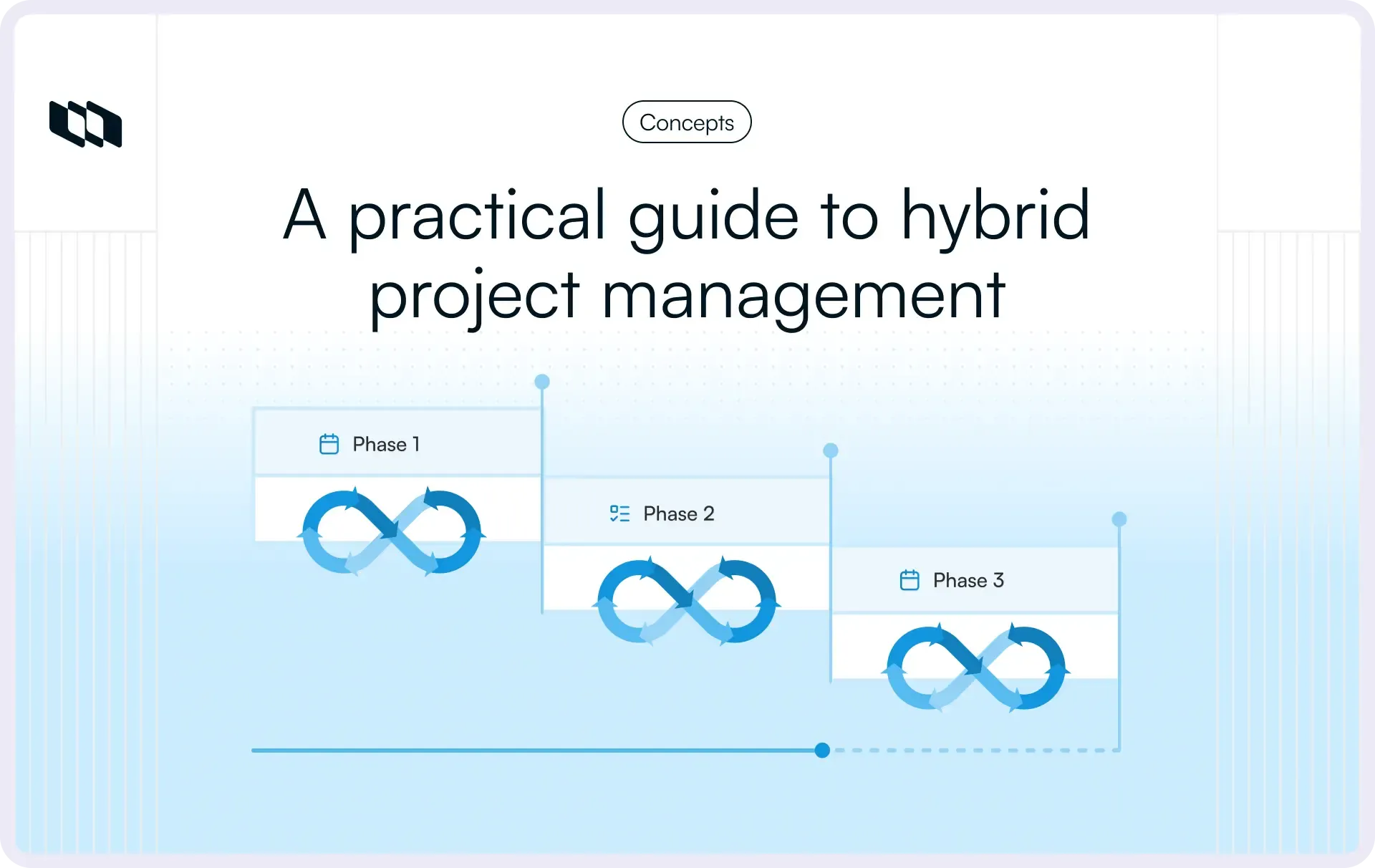
In real projects, hybrid rarely means “half agile, half waterfall.” A hybrid Agile waterfall approach often starts with structured planning for scope, timelines, and dependencies, followed by iterative delivery in short cycles. Milestones, approvals, and release dates may follow a waterfall model, while day-to-day execution uses agile practices such as backlogs, sprints, and regular reviews. This creates a hybrid project management methodology that balances control with adaptability.
What hybrid project management is not
Hybrid project management is not a random mixing process. It is not running waterfall planning and agile delivery in isolation. And it is not “Agilefall,” where teams pretend to be Agile but still follow rigid, linear execution. A successful hybrid project management model is intentional, designed around project constraints, team maturity, and stakeholder needs.
Agile vs waterfall: A quick refresher
Before understanding a hybrid project management methodology, it helps to revisit what Agile and waterfall are designed to optimize, and where each starts to break down.
What is Waterfall project management?
Waterfall project management follows a linear, phase-based approach. Work moves sequentially from planning to design, development, testing, and release. Each phase is completed before the next begins, with limited room for change once execution starts.
This approach works well when requirements are stable, dependencies are clear, and outcomes can be defined upfront. Infrastructure projects, regulated environments, and initiatives with fixed scope and approval-heavy governance often rely on the waterfall because it provides predictability, documentation, and clear milestones.
What is Agile project management?
Agile project management focuses on iterative and incremental delivery. Instead of locking everything upfront, work is broken into small, manageable units and delivered in short cycles. Teams continuously learn from feedback and adapt priorities as they go.
Agile works best in environments where requirements evolve, uncertainty is high, and fast feedback improves outcomes. Product development, software teams, and innovation-focused work benefit from agile practices because they allow teams to respond quickly without waiting for long planning cycles.
Why teams struggle to choose one
Most real-world projects sit between these two extremes. Leaders want predictability around timelines, cost, and outcomes, while teams need flexibility to adjust as they learn. Stakeholders expect plans and commitments, but delivery realities demand iteration. This tension is why many teams adopt a hybrid Agile-waterfall approach rather than committing fully to a single methodology.
Why teams adopt hybrid project management
Teams rarely adopt a hybrid project management methodology by choice alone. Most move toward it because their constraints make pure Agile or pure waterfall impractical.
1. Real-world constraints don’t fit single methodologies
Projects operate under multiple constraints at once. Business commitments may fix timelines. Budgets may be approved upfront. At the same time, requirements evolve as teams learn more. A hybrid Agile waterfall approach allows teams to respect these constraints without sacrificing adaptability.
2. Fixed timelines and budgets, evolving requirements
Many initiatives start with non-negotiable deadlines or cost limits. Waterfall project management helps establish these boundaries early. However, the solution within those boundaries is often not fully defined upfront. Agile project management fills this gap by enabling iterative delivery, continuous learning, and course correction during execution.
3. Cross-functional teams move at different speeds
Not all teams operate the same way. Engineering may work in sprints, while design, operations, or compliance teams follow longer planning cycles. Hybrid project management provides a shared framework where different teams can use methods that suit their work, without losing alignment at the project level.
4. Governance and compliance alongside fast execution
Leadership and external stakeholders often require documentation, approvals, and progress reporting. At the same time, delivery teams need speed and flexibility. A hybrid project management model supports governance through structured planning and milestones, while allowing agile execution where rapid feedback and iteration are critical.
When hybrid project management is a good fit
Hybrid project management works best when a project needs both planning discipline and room to adapt. The following situations are where a hybrid Agile waterfall approach typically makes the most sense.
1. Projects with partially defined requirements
Some parts of the project are clear from day one, while others become clearer only after work begins. Hybrid project management allows teams to plan what is known upfront using waterfall, and iterate on uncertain areas using Agile. This avoids over-planning without losing direction.
2. Products that combine software with hardware or compliance steps
When projects involve software development alongside hardware delivery, legal reviews, or regulatory checks, not everything can move in short iterations. A hybrid project management model helps teams follow structured, sequential steps where required, while still delivering software incrementally.
3. Organizations transitioning from waterfall to Agile
Teams moving away from traditional waterfall often cannot switch to Agile overnight. Hybrid project management provides a practical transition path. It lets teams introduce agile practices gradually, without disrupting existing planning, reporting, or governance structures.
4. Large or cross-team initiatives
As projects grow, coordination becomes harder. Leadership needs visibility and control, while teams need flexibility to execute. Hybrid project management creates a shared structure through milestones and plans, while allowing individual teams to work iteratively within that structure.
When hybrid project management may not work well
Hybrid project management is not a universal solution. In some situations, it can add unnecessary complexity or create more confusion than clarity.
1. Very small or low-risk projects
For short, straightforward projects, a hybrid Agile waterfall approach is often overkill. The effort required to balance planning, iteration, and governance may outweigh the benefits. In these cases, a simple agile or waterfall approach is usually more effective.
2. Teams with low Agile maturity
Hybrid project management assumes teams understand how Agile project management works. If teams lack experience with agile practices, a hybrid approach can quickly turn into rigid planning with superficial iteration. Without agile fundamentals, the hybrid project management methodology breaks down.
3. Projects without strong ownership or decision clarity
Hybrid projects require clear decisions about what is planned upfront and what is allowed to evolve. When ownership is unclear or decision-making is slow, teams risk running two disconnected processes. This leads to misalignment and delivery delays.
4. When “hybrid” becomes an excuse for an unclear process
Hybrid should be a deliberate choice, not a fallback. When teams label a project as hybrid without defining how Agile and waterfall are combined, it often leads to confusion, inconsistent execution, and the worst aspects of both methodologies rather than their benefits.
Common hybrid project management models
Hybrid project management does not follow a single fixed template. Most teams use a few common patterns based on the level of certainty they need upfront and the level of flexibility they need during execution.
1. Waterfall planning, Agile execution
This is one of the most widely used hybrid project management models. Teams invest time upfront to define scope boundaries, key milestones, timelines, and dependencies using waterfall project management. Once execution begins, delivery shifts to Agile project management, with work completed in short iterations.
This approach works well when deadlines and budgets are fixed, but the solution can evolve. Planning creates alignment and predictability, while agile execution allows teams to adapt based on feedback and learning.
2. Agile in the middle, waterfall at the ends (the “sandwich” model)
In this hybrid Agile waterfall approach, the project begins and ends with a waterfall-style structure, while the core build phase runs iteratively. Initial phases focus on requirements, architecture, and approvals. Final phases handle stabilization, testing, and release.
The middle phase uses agile delivery to build and refine the product. This model provides a predictable start and finish, while keeping the most complex work flexible.
3. Different teams, different methods
Some projects involve teams with very different operating styles. Engineering teams may run Agile sprints, while compliance, operations, or external vendors follow predictive plans. Hybrid project management allows each team to use the method that fits their work, as long as coordination happens through shared milestones, dependencies, and review points.
The success of this model depends on strong alignment and visibility across teams, not forcing everyone into the same process.
How to run a hybrid project step by step
A hybrid project only works when it is designed on purpose. If you simply “add sprints” inside a waterfall plan, you often end up with two parallel systems: one for reporting and one for actual work. The steps below help you build a hybrid project management methodology that stays coherent from planning to delivery.
1. Understand your project constraints
Start by making constraints explicit. Hybrid is a response to constraints, not a preference.
- Scope stability: Ask what is genuinely stable and what is likely to change. For example, “we must support SSO” might be stable, but the exact flows, UI, and edge cases often evolve after feedback. Stable scope elements can be planned predictively. Unstable parts should be handled iteratively.
- Time and budget flexibility: Identify what is fixed and what is negotiable. If the release date is tied to a launch, contract, or seasonal window, the timeline is fixed. If the budget is capped, resourcing is fixed. These are signals to use waterfall project management for milestone planning and dependency management, while using agile project management to make trade-offs within those constraints.
- Stakeholder expectations: Stakeholders usually want clarity on three things: what will ship, when it will ship, and what risks exist. If you do not clarify how progress will be communicated, hybrid projects become frustrating. Align early on what “done” means, what changes are allowed, and how decisions will be made when trade-offs appear.
A useful output of this step is a simple constraint summary: what is fixed, what is flexible, and what must be reviewed before changing.
2. Decide what stays predictive and what becomes iterative
Hybrid project management is about choosing which parts need certainty and which parts need learning.
What must be fixed upfront: These are areas where change is expensive or risky later:
- Regulatory, security, and compliance requirements
- Architecture decisions that affect many teams
- External dependencies, such as vendor contracts or procurement timelines
- Release windows, integration milestones, and operational readiness steps
For these, a predictive approach helps. You define milestones, approvals, and clear sequencing early.
What can evolve over time: These are areas where learning improves outcomes:
- Product details that require user feedback
- UX flows that need iteration
- Feature prioritization based on new information
- Performance tuning and edge cases discovered during delivery
These should run using agile practices: backlog refinement, short cycles, demos, and regular re-prioritization.
Think of it as designing “fixed rails” for the project, and letting the work inside those rails evolve through iteration.
3. Build a single, integrated plan
This is where many teams get hybrid wrong. They create a waterfall plan for leadership and run sprints separately for the team. That creates constant reconciliation work and broken trust.
Align milestones with sprints or iterations: Create a plan that connects the two layers:
- Milestones represent outcomes that stakeholders care about (integration-ready, security review complete, beta release, GA release).
- Sprints or iterations represent how the team delivers those outcomes in increments.
Each milestone should map to a set of sprint goals or iteration outcomes. This makes it easier to explain progress and adjust scope without pretending nothing changed.
Avoid running two disconnected processes: To keep one reality:
- Use one source of truth for scope, status, and dependencies
- Link sprint work to milestone outcomes
- Make changes visible, not hidden inside sprint boards
A good hybrid project management model makes progress traceable from daily work to strategic commitments.
4. Set review and governance checkpoints
Hybrid works when feedback loops exist at two levels: delivery feedback and governance feedback.
Progress reviews: Set a cadence in which the team and stakeholders review real progress, not just status reports. Good reviews focus on:
- What was delivered and validated
- What is blocked and why
- What changed in scope or assumptions
- What decisions are needed next
This is where Agile project management adds value in a hybrid context: frequent inspection and adaptation.
Release readiness and approvals: Some checkpoints should be explicit because they reduce risk:
- Security and compliance sign-offs
- Performance and reliability readiness
- Documentation, training, and support readiness
- Go-live approvals and rollback plans
These are often waterfall-style controls, but they do not need to slow delivery if they are planned as milestones and integrated into the execution flow.
The key principle is simple: use governance to reduce risk, not to create friction. When governance checkpoints are predictable, teams can move faster because they are not surprised late in the project.
What to track and communicate in hybrid projects
Hybrid project management only works when everyone looks at the same reality, even if they care about different details. Tracking and communication should bridge the gap between strategic oversight and day-to-day delivery.
What leadership and stakeholders care about
Leadership typically focuses on outcomes and risk. In a hybrid project management model, they need visibility into:
- Milestone progress and slippage
- Budget usage and forecast
- Major risks, dependencies, and decision points
- Release readiness and delivery confidence
These signals usually come from the waterfall side of the hybrid Agile waterfall approach. Clear milestones and status summaries help stakeholders understand whether the project is on track without forcing them into sprint-level detail.
What delivery teams need day to day
Delivery teams operate closer to the work. They need:
- A clear, prioritized backlog
- Short-term goals for each sprint or iteration
- Visibility into dependencies that could block progress
- Fast feedback on completed work
This is where Agile project management provides value. Teams need frequent updates, not long reports, so they can adjust quickly and keep momentum.
How to avoid reporting mismatches
Problems arise when leadership tracks milestones while teams track sprints, with no connection between the two. To avoid this:
- Link sprint goals to milestone outcomes
- Use shared metrics that show progress at different levels
- Surface changes early, instead of hiding them in the delivery detail
A strong hybrid project management methodology creates alignment by making it easy to trace daily work to project-level commitments.
Simple examples of hybrid project management in practice
Examples make hybrid project management easier to understand because they show how Agile and waterfall come together in real situations.
Example 1: Product launch with a fixed deadline
A company plans a product launch tied to a public event. The launch date cannot be moved.
Marketing, sales, and support teams need clear timelines and commitments.
The team uses waterfall project management to plan the launch milestones: feature freeze, security review, documentation, training, and go-live. These milestones create predictability and alignment across functions.
Within this structure, engineering uses Agile project management. Features are delivered in short iterations, feedback is reviewed in demos, and scope is adjusted when trade-offs are needed. If something slips, the team revisits priorities instead of extending the deadline. This hybrid Agile-waterfall approach keeps the launch on track while allowing flexibility during the build.
Example 2: Platform rebuild with evolving requirements
A team is rebuilding an internal platform that supports multiple products. The end goal is clear, but many technical and usability decisions will emerge only after testing and feedback.
High-level architecture, migration phases, and integration points are planned upfront using waterfall project management. This reduces risk and coordinates work across teams.
Execution happens iteratively. Teams use agile practices to experiment, validate assumptions, and refine requirements over time. As new insights emerge, priorities shift without breaking the overall plan. The hybrid project management model provides enough structure to manage complexity, while allowing learning to drive better outcomes.
Conclusion
Hybrid project management exists because real projects rarely fit neatly into a single methodology. Teams need structure to plan, align, and commit, but they also need flexibility to learn and adapt as work unfolds. A hybrid Agile waterfall approach brings these needs together by applying waterfall project management where predictability matters and Agile project management where iteration creates value.
When done intentionally, a hybrid is not a compromise. It is a designed system that reflects how modern teams actually work. The key is clarity, clear constraints, clear ownership, and clear connections between plans and execution. Teams that treat hybrid project management as a deliberate strategy, rather than an accidental mix, are better equipped to deliver complex projects with confidence and control.
Frequently asked questions
Q1. What is the meaning of hybrid management?
Hybrid management refers to combining different management approaches to fit real-world constraints. In project contexts, it usually means blending Agile and waterfall to balance predictability with flexibility, rather than following a single rigid methodology.
Q2. What is the difference between Agile and hybrid project management?
Agile project management relies on iterative delivery and continuous adaptation throughout the project. Hybrid project management combines Agile and waterfall, using predictive planning where certainty is required and agile execution where learning and change are expected.
Q3. What is an example of a hybrid approach?
A common hybrid approach is to plan milestones and deadlines upfront using waterfall project management, then deliver features in short, agile iterations. The project follows a structured plan, while day-to-day execution remains flexible.
Q4. What is the difference between hybrid and Agile working?
Agile working focuses entirely on iteration, feedback, and continuous change. Hybrid working introduces structure and fixed checkpoints alongside agile practices, making it suitable for projects with deadlines, dependencies, or governance requirements.
Q5. What is hybrid project management?
Hybrid project management is a methodology that combines Agile and waterfall approaches within a single project. It allows teams to plan what must be predictable and iterate on what needs to evolve, creating a balanced approach to delivery.
Recommended for you



 Download for Mac
 Download for Android