Agile vs. Scrum vs. Kanban: What's the difference?
Introduction
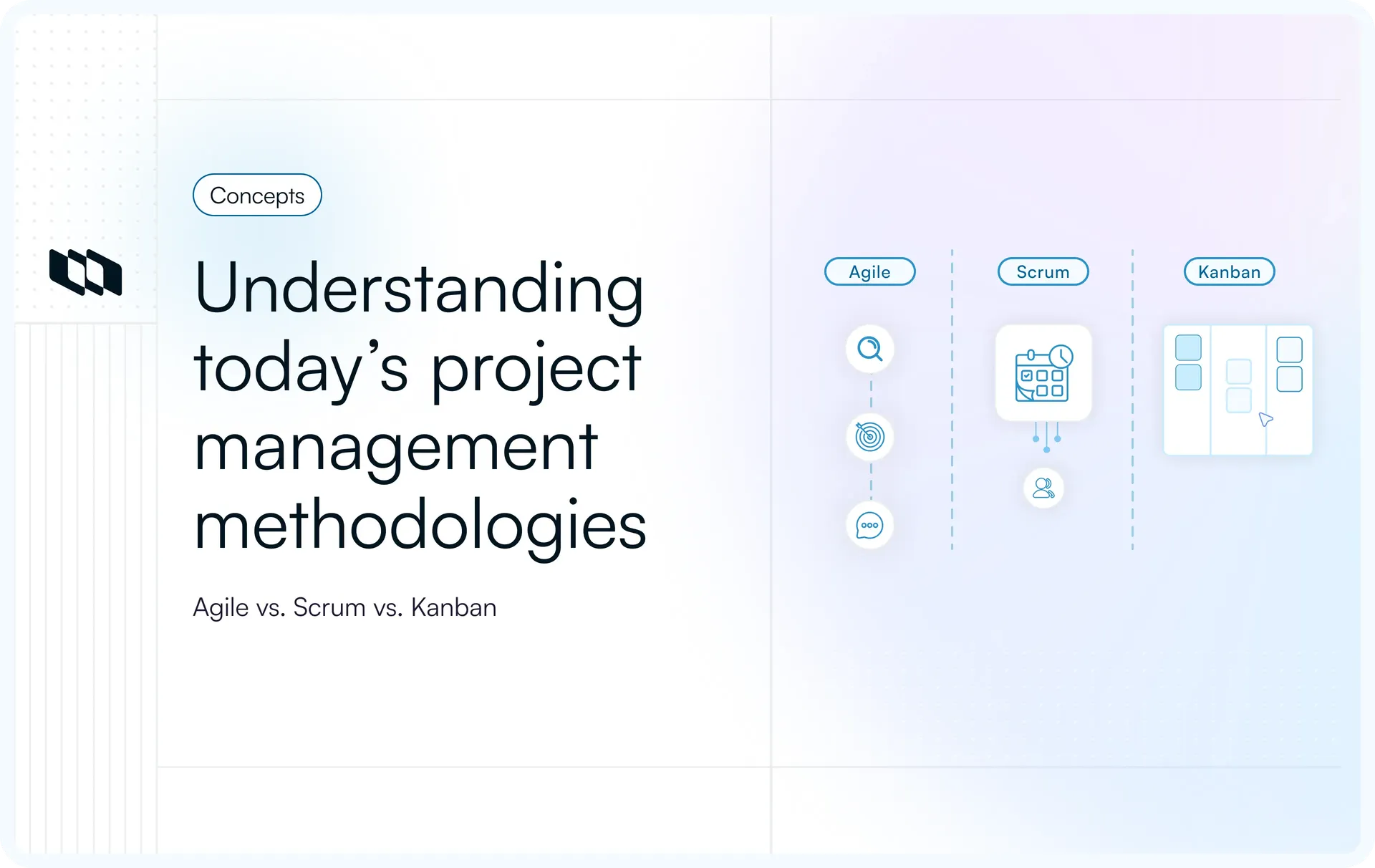
Many teams believe they are agile because they hold stand-ups or move cards across a board. But Agile isn’t a set of ceremonies or columns; it’s a mindset. Scrum and Kanban are simply structured ways to put that mindset into action, and choosing the right one can completely change how your team delivers work.
This guide explains Agile, Scrum, and Kanban in a straightforward way, helping you understand the trade-offs and decide what your team truly needs.
What is the Agile methodology in project management?
Traditional project management followed a predictable sequence: plan → design → build → test → launch. This waterfall model works well for stable projects, but modern software teams rarely work in stable environments. Requirements evolve, customer expectations change quickly, and new information surfaces mid-project. The challenge with waterfall is its rigidity — once a stage is complete, going back is slow, expensive, and often unrealistic. This is the gap that led to the rise of Agile.
At its core, Agile is a mindset, not a method.
Teams often confuse agile with specific frameworks like Scrum or a set of ceremonies. In reality, agile is a collection of values and principles that shape how teams plan, collaborate, and deliver work. It doesn’t dictate a process; it explains why iterative work, frequent feedback, and adaptability lead to better outcomes.
This is the fundamental difference between Agile and traditional project management. Waterfall optimizes for predictability upfront. Agile optimizes for learning, adjustment, and customer value throughout the project’s life. If you’re exploring Agile more broadly, our explanation of “what is Agile project management?” offers an easy introduction to Agile methods, principles, and real-world applications.
A quick look at the Agile Manifesto
Published in 2001, the Agile Manifesto captures four core values and twelve guiding principles. For today’s software teams, two values stand out:
- Individuals and interactions over processes and tools: Teams work better when communication is direct, simple, and continuous — not restricted by heavy processes.
- Responding to change over time, following a fixed plan: Agile teams expect change. They design their workflow so new information can be incorporated without slowing delivery.
Other principles—such as incremental delivery, sustainable pace, technical excellence, and continuous improvement—define how most modern product and engineering teams operate today.
What “being Agile” looks like in practice
Agile is not about running sprints, holding daily stand-ups, or using a specific board. It’s about behaviours that allow teams to adapt quickly, learn fast, and reduce risk.
Here’s what that looks like in everyday work:
1. Iterative development
Teams ship work in small, usable increments instead of large batches. This reduces unknowns, gathers feedback earlier, and keeps risk low. Many teams also use hybrid approaches — planning high-level stages like waterfall, but executing incrementally.
2. Customer collaboration and fast feedback loops
Customers aren’t only involved at the beginning or end; agile teams gather input continuously through user interviews, A/B tests, product analytics, and small releases. This is why agile practices are common in SaaS environments.
3. Flexibility and change-tolerance
Plans are intentionally lightweight. Teams adjust priorities based on new information, data, or market shifts. This contrasts with waterfall change control, which is formal, slow, and costly.
4. Continuous learning and reflection
Retrospectives and flow reviews help teams refine the way they work. Over time, this leads to smoother delivery, fewer handoff delays, and less rework, some of the most meaningful benefits of Agile.
Scrum and Kanban are implementations of Agile
Once the philosophy behind Agile becomes clear, the distinction is easy to see:
- Agile is the why, the mindset of working adaptively, iteratively, and with continuous focus on customer value.
- Scrum and Kanban are the ‘how’ practical systems that help teams apply those principles in their day-to-day work.
This is also why many organizations end up with hybrid workflows. They use agile practices for development and collaboration, while keeping some waterfall stages for areas that require strict sequencing or compliance — especially in large, regulated environments.
Key takeaway
Agile is the mindset. Scrum and Kanban are frameworks that operationalize that mindset. Choosing between them depends on how your team works, how much flexibility you need, and how predictable your workflow must be. Understanding this distinction is fundamental to selecting the right approach.
What is the Scrum framework?
Scrum is a structured framework for putting Agile principles into practice in a predictable, repeatable way. If Agile is the mindset of working iteratively and adapting to change, Scrum is the routine that gives this mindset shape. It provides a clear cycle of planning, building, reviewing, and improving — which is why it works especially well for complex software development.
Scrum is intentionally rule-based. It defines specific roles, ceremonies, artifacts, and timeboxes so teams have a shared rhythm and fewer ambiguities. This structure is one reason many teams use Scrum when transitioning from waterfall to Agile — the shift feels guided rather than chaotic. If you want to go deeper into how Scrum works in real teams, you may find our guide on “What is Scrum project management?” useful.
The core Scrum roles
Scrum defines three roles to help teams work in a self-organizing, accountable way,
- Product owner: Acts on behalf of the customer. They prioritize work, manage the product backlog, and ensure the team builds the highest-value items first.
- Scrum master: Owns the Scrum process. They remove blockers, coach the team on Agile principles, and help maintain a smooth workflow. Their focus is to reduce friction so the team can deliver consistently.
- Development team: A cross-functional group, including engineers, designers, QA, and others, that decides how to do the work and delivers a usable increment at the end of each sprint.
This clarity of roles is one of the biggest advantages of Scrum. It reduces context switching, speeds up decisions, and creates a stable heartbeat for planning and delivery.
The Scrum artifacts
Scrum uses three key artifacts to make work visible and keep the team aligned on intent, scope, and progress.
1. Product backlog
A single, evolving list of features, fixes, improvements, and technical work. It represents the product's long-term view and serves as input for future sprints.
2. Sprint backlog
A short-term plan for the sprint. It includes a subset of backlog items the team commits to completing during that sprint, based on capacity and priorities.
3. Increment
The usable product output is delivered at the end of each sprint. It shows real progress toward the product goal and reflects Scrum’s emphasis on delivering working value continuously, not just on documentation or plans.
The Scrum ceremonies
Scrum ceremonies create a predictable rhythm and give teams structured checkpoints throughout the sprint cycle.
- Sprint: A time-boxed iteration, usually two weeks, during which the team plans, builds, tests, and delivers work.
- Sprint planning: The team aligns on what to deliver in the sprint and why it matters. Scope is selected based on capacity, velocity, and product priorities.
- Daily scrum: A short daily meeting, about 15 minutes, where the team inspects progress, surfaces blockers, and adjusts plans as needed.
- Sprint review: A working session with stakeholders to demo the increment. It supports continuous collaboration and ensures customer feedback is embedded into future planning.
- Sprint retrospective: An internal team discussion focused on improvement. The team reflects on what worked, what didn’t, and what changes can help the next sprint run more smoothly.
When to use Scrum?
Scrum works best in environments where teams need structure, predictable cycles, and frequent opportunities to adjust their approach. It is most useful when:
- Requirements change quickly
- The work demands close collaboration across functions.
- The team can stay focused on one product or project.
- The product can be delivered in small, usable increments.
- Stakeholders expect predictable planning and regular visibility
Example of best fit
Consider a cross-functional team building a new set of mobile features. Customer feedback, usage data, and experiment results may shift priorities each week. The team needs a steady rhythm for planning, building, and reviewing work while still adapting to change. Scrum provides that structure, though it requires some overhead through its ceremonies and timeboxes.
Scrum is also a strong choice for teams moving from traditional project management to Agile ways of working. Its prescriptive rules offer clarity and guidance without the rigidity of a complete waterfall approach.
What is the Kanban method?
Kanban is a visual workflow management method that helps teams see how work moves, where it gets stuck, and how to improve flow over time. While Scrum is more prescriptive, Kanban is principle-based and flexible.
If Agile is the mindset, Scrum is the structured workout plan, and Kanban is the fitness tracker — helping teams monitor activity, reduce overload, and continuously improve performance. If you’d like to explore these approaches in more detail, you may find these guides helpful: What is Kanban project management?, a simple breakdown of Kanban boards, WIP limits, and how flow-based teams structure their work.
The core principles of the Kanban method
Originally developed within Lean manufacturing, Kanban adapts extremely well to modern software teams, DevOps, support functions, operations, and even marketing. It has no sprints, roles, or ceremonies. Instead, it provides a lightweight system that teams can adopt without heavy process overhead — a key difference in the Agile vs. Scrum vs. Kanban comparison.
Kanban is built on five core principles:
1. Visualize the workflow
Kanban boards show how work moves across stages such as “to do,” “in progress,” and “done.” This makes bottlenecks easier to spot — for example, cards piling up in one column or repeated delays in handoffs.
2. Limit work in progress (WIP)
WIP limits the number of items a team can actively work on at once. This reduces context switching, prevents overload, and exposes hidden flow issues that slow delivery.
3. Manage flow
Kanban teams track metrics such as cycle time, lead time, and throughput to understand how smoothly work flows. These data points provide a practical foundation for improving delivery — a key strength of Kanban in Agile project management environments.
4. Make policies explicit
Teams clearly define what it means for work to move from one stage to the next. This removes confusion, increases shared ownership, and sets expectations without needing defined roles or ceremonies.
5. Improve collaboratively
Kanban is designed for continuous evolution. Teams regularly inspect their workflow and adjust the system using real data. This supports Agile principles of learning, adapting, and improving incrementally.
The way Kanban differs from Scrum
The differences between Kanban and Scrum are not about which one is better. They simply represent two different operating models.
1. Cadence
Scrum works in fixed, time-boxed sprints. Kanban is a continuous flow system. It is often the better fit when priorities change daily — or even hourly.
2. Roles
Kanban does not prescribe any specific roles. There is no requirement for a Scrum master or product owner. This makes it easy to adopt within existing structures or as part of hybrid project management setups.
3. Change and work intake
In Kanban, teams can pull new work whenever capacity allows — they do not wait for a sprint boundary. This flexibility is valuable when the workload is unpredictable or when teams balance Agile and traditional processes.
When to use Kanban
Kanban is especially effective in environments where work arrives continuously and priorities shift quickly. It works best when:
- The team handles ongoing streams of work (support, operations, DevOps, infrastructure, IT)
- Priorities change frequently and need an immediate response
- Tasks vary widely in size, urgency, or complexity
- Visibility into the workflow is more important than structured ceremonies
- The current process feels unclear and needs transparency before any redesign
Best-fit example
Consider a platform engineering team managing incidents, service updates, and infrastructure improvements. New tasks arrive unpredictably, deadlines vary, and flow efficiency matters more than sprint velocity. Kanban gives the team visibility and control without the overhead of fixed sprint cycles.
Kanban is also helpful when teams are moving from Agile to traditional approaches or operating in hybrid models. It visualizes the current workflow without forcing disruptive structural changes, making it easier to understand and improve the process over time.
What are the major differences: Agile vs Scrum vs Kanban?
Teams often talk about Agile, Scrum, and Kanban as if they are interchangeable, but each one serves a different purpose. Agile is the philosophy. Scrum and Kanban are two different ways of putting that philosophy into action, depending on how a team works and what their workflow demands.
Here’s the hierarchy in simple terms,
1. Agile, the mindset
Agile is a set of values and principles that emphasise adapting to change, working closely with customers, and delivering in small, iterative cycles. It explains why teams avoid long, rigid waterfall stages and instead work in shorter, learning-driven loops.
2. Scrum, the structured approach
Scrum is a prescriptive, time-boxed framework designed for teams that need rhythm and clarity. It provides defined roles, ceremonies, and artifacts that help cross-functional teams apply Agile principles in complex product development.
3. Kanban, the flow-based approach
Kanban is a flexible method focused on visualizing work, limiting work in progress, and improving flow efficiency. It is ideal for teams handling continuous work or variable demand, where sprint cycles may not fit.
These distinctions help teams select the right approach based on their workflow, volatility, and the level of predictability they need.
The simple takeaway
- Agile = why (the mindset)
- Scrum = how (structured)
- Kanban = how (adaptive)
It’s not “Scrum vs Kanban.” Both are valid implementations of Agile. In many cases, teams use a hybrid approach that blends elements of both depending on the type of work they manage.
How to choose the right fit for your team
Scrum and Kanban both help teams improve how work moves, but they work in different ways. The real question isn’t “which one is better?” but “which method fits the work we actually do?” This is at the heart of the Agile vs. waterfall conversation: choosing an approach that delivers true agility rather than simply replacing one rigid system with another.
1. Choose Scrum when structure drives success
Scrum is a strong fit when the team needs predictability, clear roles, and a regular cadence.
Use Scrum when,
- A complex product is being built from scratch: New product development often involves rapid learning, shifting priorities, and tight collaboration. Scrum’s sprint rhythm supports this level of evolution.
- The team is cross-functional and dedicated: Scrum works best when designers, engineers, QA, and PMs focus on the same sprint goals with minimal interruptions.
- Uncertainty needs to be managed through structure: Time-boxed sprints provide predictable cycles for planning, development, and feedback. They create stability while still allowing the team to adapt to changing requirements.
This is why Scrum is often the starting point for organizations moving from traditional project management to Agile. It provides structure without the rigidity of waterfall stages.
2. Choose Kanban when flow and flexibility matter more than cadence
Kanban excels in environments where work arrives continuously and priorities shift quickly.
Use Kanban when,
- Priorities change constantly: Teams can pull new work at any time when WIP limits allow, no need to wait for the next sprint boundary.
- Your team manages a continuous stream of tasks: Support, operations, DevOps, infrastructure, and even content teams often deal with varied incoming requests. Kanban’s continuous flow fits these patterns better than fixed sprints.
- You need visibility before process changes: Kanban offers a low-friction way to visualize how work moves. This helps teams identify bottlenecks before deciding what needs improvement, especially useful early in an Agile transition or in hybrid setups.
Kanban aligns well with teams that prioritise cycle time, throughput, and flow efficiency over sprint goals or velocity metrics.
3. Choose a hybrid approach when teams need both structure and flexibility
Many teams must balance planned product work with unplanned requests. This is where Scrumban becomes valuable.
Scrumban blends:
- The sprint structure of Scrum
- The visual workflow and WIP limits of Kanban
In practice, teams plan in sprints but track and manage work on a Kanban board. They maintain ceremonies such as planning, reviews, and retrospectives while improving flow efficiency and managing variable demand.
Scrumban fits well for:
- Product teams that occasionally take on urgent or unplanned tasks
- Teams transitioning from waterfall to Agile
- Organizations that need sprint reporting, but also want Kanban-style agility
This hybrid approach often becomes the default at scale because it balances discipline with adaptability, a practical fit for complex portfolios and high stakeholder expectations.
Conclusion
Agile, Scrum, and Kanban are not competing ideas; they solve different problems. Agile gives teams the mindset to work iteratively, learn quickly, and respond to change. Scrum and Kanban offer two different approaches to putting that mindset into practice, depending on how predictable the work is and how frequently priorities shift.
There is no single “right” choice. Scrum offers the structure, roles, and cadence needed for complex product development. Kanban provides the flexibility and visibility required for continuous, variable work. And hybrid models like Scrumban help teams balance both when their environment demands structure and flow.
The real goal is not to follow a framework perfectly, but to choose an approach that helps your team deliver value with clarity, predictability, and adaptability. When teams pick the method that fits their work—not the one that sounds right—they unlock faster delivery, smoother collaboration, and a workflow that actually supports how they operate every day.
Recommended for you



 Download for Mac
 Download for Android