Resource scheduling in project management: How it works
Introduction
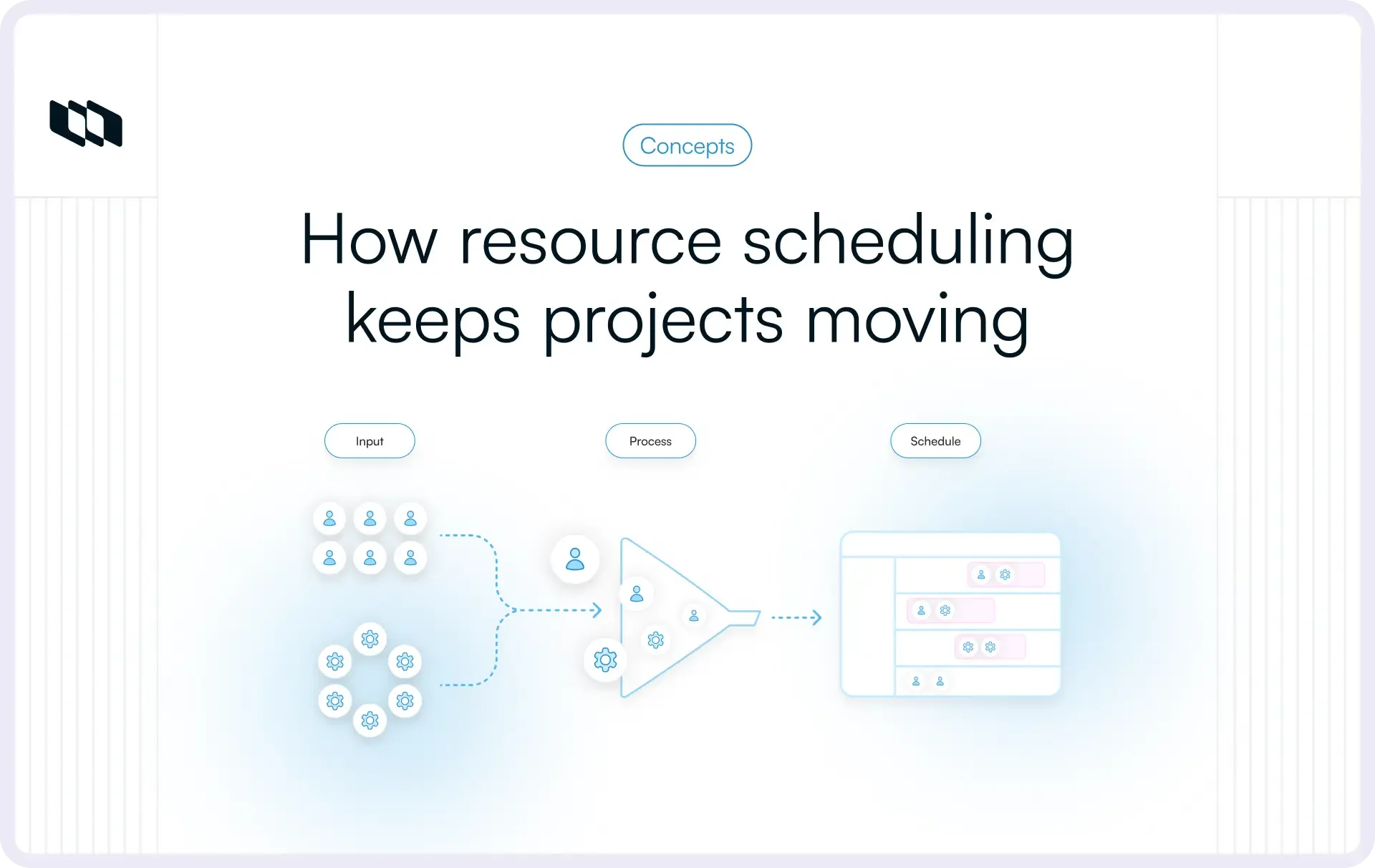
Project timelines often assume people are infinitely available; reality proves otherwise. Resource scheduling in project management brings honesty into the system. By aligning work with actual capacity and availability, project resource scheduling makes trade-offs visible before they turn into delivery risks. It shows who is booked, where conflicts exist, and how work should flow over time. In this article, we’ll explain how resource scheduling works, the approaches teams use, and why it plays a central role in delivering projects predictably at scale.
What is resource scheduling?
Resource scheduling in project management is the practice of deciding who works on what, when, and for how long, based on real capacity and availability. It takes a project plan and turns it into an execution-ready schedule by aligning tasks with the people responsible for delivering them.
A resource schedule goes beyond listing assignments. It shows how work fits across a timeline, where effort overlaps, and how individual workloads change over the course of a project. This makes project resource scheduling a day-to-day execution tool rather than a one-time planning exercise. When teams deliberately schedule resources, they move from hopeful timelines to realistic delivery, with fewer surprises during execution.
Where resource scheduling fits in project management
Resource scheduling often gets treated as a planning step that happens once and then gets ignored. In practice, it sits at the intersection of planning and execution and keeps both aligned as work progresses.
How resource scheduling connects to project planning and timelines
Project planning defines what needs to be delivered and by when. Timelines, milestones, and dependencies set the structure of the work. Resource scheduling adds the missing layer by answering whether the planned work can actually be delivered with the people available.
By mapping tasks to real team members and their capacity, project resource scheduling turns abstract timelines into executable schedules. It highlights where plans rely on unavailable skills, overlapping commitments, or unrealistic assumptions about effort. This connection ensures that schedules reflect real-world constraints instead of ideal conditions.
Why resource scheduling is a day-to-day execution concern
Resource scheduling does not stop once a project starts. As priorities shift, work expands, or availability changes, schedules need to adapt. Teams use resource scheduling to rebalance workloads, adjust sequencing, and respond to conflicts before they impact delivery.
In this way, resource scheduling in project management acts as a living system. It helps teams make informed trade-offs during execution and keeps project schedules aligned with reality, not just initial plans.
Resource scheduling vs resource planning vs resource allocation
These terms are often used interchangeably, but they solve different problems at different stages of a project. Confusing them usually leads to schedules that look fine during planning and break down during execution.
Think of them as three connected layers that build on one another, rather than three ways of saying the same thing.
Resource planning
Resource planning focuses on what the work will require before anyone is assigned to it. Teams estimate upcoming demand, assess available capacity, and evaluate whether timelines are feasible with the current skills and bandwidth. At this stage, the goal is not to decide who does the work. The goal is to determine whether the organization can take on the work and where capacity constraints might arise if priorities change.
Resource allocation
Resource allocation is about ownership. Once teams understand demand and capacity, they assign people or roles to specific tasks or projects. Allocation confirms responsibility, but it does not yet show how work fits across time. Without scheduling, allocated work can overlap silently across multiple initiatives, creating hidden overload that only surfaces during execution.
Resource scheduling
Resource scheduling in project management is where planning and allocation become actionable. It places assigned work onto a timeline, accounting for availability, capacity, and dependencies. Project resource scheduling exposes conflicts early, shows how work flows week by week, and enables teams to adjust before delays and burnout take hold. This step turns intent into a realistic execution plan that teams can actually follow.
What a resource schedule actually looks like
Resource scheduling can sound abstract until you see how it shows up in day-to-day work. A resource schedule is not a separate document that lives outside the project. It is a practical view that makes execution visible and manageable.
1. Tasks mapped to people
A resource schedule connects individual tasks to specific people or roles. Each piece of work has clear ownership, which removes ambiguity about who is responsible for delivery. This mapping also helps teams understand how responsibilities stack up across multiple projects.
2. Start and end dates for each assignment
Resource scheduling in project management places work within defined time boundaries. Tasks are assigned clear start and end dates, making it easier to see how long work is expected to take and how it fits into the broader project timeline. This clarity supports realistic sequencing and reduces last-minute reshuffling.
3. Visibility into availability and capacity
A strong resource schedule shows more than assignments. It reflects availability and capacity over time. Teams can see who is fully booked, who has room to take on more work, and where overload is likely to occur. This visibility allows for early adjustments before issues impact delivery.
4. A shared view of who is working on what
Project resource scheduling works best when it is visible to everyone involved. A shared schedule creates alignment across teams, helps managers make informed decisions, and gives individuals clarity on their commitments. When everyone works from the same view, coordination becomes simpler and execution more predictable.
Why resource scheduling matters in real projects
Resource scheduling matters because it directly shapes how work is experienced and delivered. When scheduling is vague or implicit, teams rely on assumptions. When it is deliberate, teams gain clarity, control, and predictability during execution.
1. Prevents overallocation and burnout
Without resource scheduling, work tends to pile up on the same people. Tasks get assigned without a clear view of existing commitments, leading to stretched schedules and sustained overload. Resource scheduling in project management surfaces these conflicts early by showing how much work is assigned to each person over time. This allows teams to rebalance workloads before pressure builds and productivity drops.
2. Reduces delays caused by hidden dependencies
Many delays do not come from the work itself but from overlooked dependencies between tasks and people. Project resource scheduling makes these dependencies visible by showing when work overlaps or relies on the same individuals. When teams can see where tasks compete for the same capacity, they can adjust sequencing and avoid bottlenecks that quietly slow projects down.
3. Improves predictability and decision-making
Predictability improves when schedules reflect reality. By aligning timelines with actual availability and capacity, resource scheduling helps teams forecast delivery more accurately. This clarity supports better decision-making, whether it involves adjusting scope, shifting priorities, or committing to new work with confidence.
4. Makes workload and ownership visible
A clear resource schedule shows who is responsible for what and how work is distributed across the team. This visibility reduces confusion, strengthens accountability, and creates a shared understanding of commitments. When workload and ownership are transparent, teams collaborate more effectively, and projects move forward with fewer surprises.
The two core approaches to resource scheduling
Most resource scheduling decisions fall into one of two models. The difference is simple: in one model, the deadline is fixed. In the other, the team’s capacity is fixed. Understanding the situation you are in helps you choose a realistic schedule, set expectations early, and make the right trade-offs when constraints arise.
1. Time-constrained scheduling
Time-constrained scheduling starts with a non-negotiable date. The delivery window is fixed, so the schedule is built to hit that timeline. The main question becomes: what resources do we need to meet the date?
This approach is common when a project is tied to an external commitment, such as a product launch, a contractual deadline, a compliance requirement, or a planned event. In time-constrained scheduling, teams often increase capacity by adding people, extending coverage, or shifting work from other priorities. Teams may also reduce scope, simplify deliverables, or parallelize tasks when adding resources does not help.
Resource scheduling in project management becomes especially important here because fixed deadlines tend to expose overload quickly. A schedule that ignores capacity will still “fit” on paper, but it will break during execution.
2. Resource-constrained scheduling
Resource-constrained scheduling starts with a fixed level of capacity. The team, budget, or skills available are limited, so the schedule is built around what the team can realistically handle. The main question becomes: given our available resources, how long will this work take?
This approach is common among engineering teams with stable staffing, internal platform work, maintenance-heavy roadmaps, or multi-project environments in which the same specialists are shared across initiatives. When capacity is the constraint, timelines usually flex. Teams schedule work in a sequence that matches availability, prioritize the most valuable outcomes first, and plan the rest based on realistic throughput.
Project resource scheduling is critical here because it prevents quiet overload. Without a resource schedule, teams tend to accept new work without seeing how it stacks against existing commitments.
When each approach makes sense
A quick way to decide which model applies is to ask what you can move more easily.
- Choose time-constrained scheduling when the deadline is fixed, and the organization is willing to adjust scope or capacity to meet it.
- Choose resource-constrained scheduling when capacity is fixed, and the timeline needs to reflect what that capacity can deliver.
In real projects, teams sometimes blend both approaches. A common pattern is to treat major milestones as time-constrained while scheduling the remaining scope as resource-constrained. That combination keeps commitments clear while still respecting capacity.
What you need before creating a resource schedule
Resource scheduling works best when it starts with clarity. Before tasks are placed on a timeline, teams need a shared understanding of what needs to be done and the conditions under which it will happen. Skipping these inputs usually results in schedules that appear structured but fail at execution.
1. Defined scope and deliverables
Every resource schedule begins with clarity on scope. Teams need to know what is included in the project and what outcomes are expected. Clear deliverables help prevent work from expanding silently and ensure that scheduling decisions are tied to actual project goals rather than vague activities.
2. Task breakdown and effort estimates
High-level deliverables need to be broken down into schedulable tasks. Each task should be small enough to estimate effort realistically. These estimates do not need to be perfect, but they should reflect how work is actually done. Without this breakdown, resource scheduling in project management becomes guesswork.
3. Required skills or roles
Not all tasks are interchangeable. Some require specific skills, experience, or domain knowledge. Identifying the roles or skill sets needed for each task helps teams assign work realistically and avoid bottlenecks caused by scarce expertise.
4. Availability, capacity, and non-working time
A reliable resource schedule accounts for real availability. This includes working hours, planned time off, parallel commitments, and other projects. Capacity should reflect what people can reasonably take on, not their theoretical maximum. Ignoring non-working time is one of the fastest ways schedules lose credibility.
5. Dependencies and constraints
Tasks rarely exist in isolation. Dependencies between tasks, shared resources, external approvals, and fixed milestones all influence how work can be scheduled. Capturing these constraints up front allows project resource scheduling to reflect the actual flow of work rather than an idealized sequence. When these prerequisites are clear, teams can create resource schedules that support execution instead of adding friction.
How resource scheduling works: Step by step
A good resource schedule is built like a working system, not like a one-time plan. The goal is simple: translate scope and timelines into a realistic execution view based on real capacity, real constraints, and real ownership.
Below is a step-by-step resource scheduling process that works across most project types, from product launches to infrastructure migrations.
Step 1: Break project work into schedulable tasks
Start by converting deliverables into tasks that can actually be scheduled. “Build onboarding” is too big. You want tasks with clear outcomes, owners, and a clear finish line, such as “design onboarding flow,” “implement API endpoints,” or “write onboarding emails.”
A useful rule is this: if a task cannot be owned by one person (or one small pair) and finished within a predictable window, it is too large to schedule reliably. Breaking work down properly makes project resource scheduling practical instead of theoretical.
Step 2: Estimate effort and duration
Next, estimate how much work each task requires and how long it will take in calendar time. Effort and duration are related but not the same.
- Effort is the total work involved, such as 10 hours of design work or 3 days of engineering effort.
- Duration is how long it takes on the calendar, accounting for context switching, meetings, reviews, and dependencies.
Resource scheduling in project management becomes more accurate when teams estimate both. A task that requires 12 hours of focused work may still take a full week if the owner has partial availability.
Step 3: Identify the right people or roles
Now match tasks to roles or people based on skills, context, and ownership boundaries. Any capable team member can handle some work. Some work needs a specialist or someone with system knowledge.
At this step, avoid the common trap of assigning based solely on availability. The “free” person is not always the best fit. Resource scheduling works best when tasks go to the right owner first, then the schedule is adjusted to reflect reality.
Step 4: Check availability and capacity
This is where scheduling becomes real. Before placing tasks on a timeline, check each person’s availability and capacity.
Availability is affected by:
- Existing project commitments
- Planned leave and holidays
- Recurring meetings and operational work
- Review cycles and support rotations
Capacity is about what someone can reasonably deliver alongside everything else. In project resource scheduling, capacity should be treated as a planning limit, not a target to maximize.
Step 5: Assign work and place it on a timeline
Once you know who owns what and what capacity looks like, place the work onto a timeline. This means setting start and end dates for tasks while respecting dependencies.
Good resource scheduling makes sequencing visible. It clarifies what must happen first, what can run in parallel, and where handoffs will occur. If your schedule requires everything to happen at once to meet the timeline, it signals that the plan needs adjustment.
Step 6: Resolve conflicts and overlaps
As soon as you schedule tasks, conflicts will show up. That is the point. A resource schedule is valuable because it reveals where work collides.
Common conflicts include:
- One person is assigned to multiple high-effort tasks in the same week
- Dependencies that create hidden waiting time
- Shared specialists are becoming bottlenecks
- Parallel work creates a review overload
Resolving conflicts usually involves trade-offs. You can re-sequence tasks, move dates, shift scope, or reassign work. If deadlines are fixed, you may need to adjust capacity or simplify deliverables. This is where time-constrained and resource-constrained scheduling choices become concrete.
Step 7: Share the schedule with the team
A resource schedule only helps if it is shared and trusted. Once the schedule is drafted, review it with the people doing the work.
This step is where hidden constraints surface fast. Team members will point out missing work, unrealistic timing, or dependencies you missed. That feedback loop makes the schedule stronger and increases buy-in.
From there, treat the schedule as a living execution tool. Review it regularly, adjust as work changes, and use it to keep commitments aligned with real capacity.
Resource leveling vs resource smoothing
Once a resource schedule is in place, conflicts are inevitable. Resource leveling and resource smoothing are two common techniques teams use to adjust schedules when capacity and timelines collide. While they sound similar, they are used in different situations and lead to different trade-offs.
What does resource leveling do?
Resource leveling focuses on resolving overallocation by adjusting the schedule itself. When the same person or role is assigned more work than their capacity allows, leveling spreads that work out over time.
This often means pushing tasks to later dates or changing the sequence in which work is done. Timelines may extend, but workloads become realistic. Resource leveling is commonly used in resource-constrained scheduling, where capacity is fixed, and the schedule must adapt to match it.
In project resource scheduling, leveling helps teams avoid burnout by ensuring that no one is scheduled beyond what they can reasonably deliver.
What does resource smoothing do?
Resource smoothing aims to reduce workload spikes without changing the overall project timeline. Instead of moving end dates, teams adjust how work is distributed within available flexibility.
This technique relies on float, or slack, in the schedule. Tasks are shifted within their allowed windows to balance workloads more evenly. Resource smoothing works best when deadlines are firm, but there is some room to rearrange non-critical work.
In resource scheduling for project management, smoothing helps teams maintain delivery commitments and make execution more manageable.
How these techniques help teams stay realistic
Both techniques serve the same goal: aligning schedules with reality. Resource leveling acknowledges that timelines may need to be adjusted to respect capacity. Resource smoothing preserves timelines while redistributing effort where possible.
Knowing which technique to apply helps teams make informed trade-offs rather than react late. Together, they allow project resource scheduling to remain flexible, credible, and grounded in actual team constraints.
Common challenges teams face with resource scheduling
Even well-designed resource schedules can struggle in real environments. The challenges below show up across teams and industries, often for reasons that go beyond tools or process maturity.
1. Constant plan changes
Priorities shift, new work appears, and assumptions made during planning quickly become outdated. When plans change frequently, resource schedules can feel fragile. The issue rarely changes. The issue is treating schedules as fixed commitments rather than as adjustable execution guides. Teams that review and update schedules regularly handle change with far less disruption.
2. Partial availability and context switching
Most people do not work on one project at a time. Meetings, support work, and parallel initiatives reduce focused time. When schedules assume full availability, tasks stretch longer than expected. Project resource scheduling works better when capacity reflects how people actually work, not how schedules hope they will.
3. Invisible or untracked work
Unplanned work often takes longer than expected. Reviews, coordination, bug fixes, and stakeholder conversations rarely show up in task lists. When this work remains invisible, schedules drift, and deadlines slip. Resource scheduling in project management becomes more reliable when teams acknowledge and account for this hidden effort.
4. Outdated schedules that no one trusts
Schedules lose value when they stop reflecting reality. If updates lag behind execution, teams stop using them. Trust erodes quickly once schedules feel disconnected from day-to-day work. Keeping resource schedules current, visible, and open to adjustment helps them remain a useful decision-making tool rather than a reporting artifact.
Practical best practices for effective resource scheduling
Effective resource scheduling is less about complex rules and more about consistent habits. These practices help teams keep schedules realistic, useful, and aligned with how work actually unfolds.
1. Schedule to capacity, not optimism
Build schedules around real availability, not best-case assumptions. Account for meetings, parallel work, and recovery time. When capacity is treated as a constraint, project resource scheduling becomes more accurate and far easier to sustain.
2. Review and adjust schedules regularly
A resource schedule should be revisited as work progresses. Weekly reviews are often enough to catch conflicts, update estimates, and adjust sequencing. Regular check-ins keep schedules aligned with reality instead of letting drift accumulate.
3. Keep ownership clear
Every scheduled task should have a clear owner. Ambiguous ownership leads to delays and uneven workload distribution. Clear accountability makes it easier to track progress and rebalance work when priorities shift.
4. Avoid locking schedules too far ahead
Detailed scheduling works best in the near term. For work far into the future, keep plans flexible and high-level. This approach allows resource scheduling in project management to adapt as information improves and priorities evolve.
5. Treat schedules as living documents
Resource schedules are tools for execution, not static reports. They should change as conditions change. Teams that treat schedules as living systems are better equipped to respond to uncertainty while maintaining delivery discipline.
Tools and views that support resource scheduling
Resource scheduling does not depend on a specific tool. What matters is having the right views to understand work, capacity, and timing. The tools teams use may vary, but the underlying views remain largely the same.
1. Resource calendars
Resource calendars show availability over time. They reflect working hours, planned leave, holidays, and other non-working periods. In project resource scheduling, calendars help teams place work where capacity actually exists and avoid scheduling tasks during unavailable windows.
2. Workload or capacity views
Workload views display how much work is assigned to each person or role over a given period. These views make over- and under-allocation visible at a glance. Capacity views support better decisions by showing whether new work can be absorbed or needs to be sequenced differently.
3. Gantt charts with dependencies
Gantt charts help teams visualize how tasks unfold over time and how they depend on one another. When combined with resource information, they reveal how scheduling decisions impact timelines. This view is especially useful for identifying critical paths and understanding how changes ripple through a schedule.
4. Time tracking as a feedback loop
Time tracking provides feedback on how estimates compare to reality. Over time, this data helps teams refine effort estimates and improve scheduling accuracy. In project management resource scheduling, time tracking is most valuable when used to learn and adjust, not to micromanage.
Closing thoughts
Resource scheduling in project management is not about building perfect schedules. It is about creating a realistic execution system that respects capacity, skills, and change. When teams deliberately schedule resources, they stop relying on assumptions and start making informed trade-offs early.
Strong project resource scheduling connects planning to daily work. It makes constraints visible, clarifies ownership, and gives teams a shared view of how work unfolds over time. As projects evolve, schedules evolve with them, helping teams stay aligned without losing momentum. When treated as a living practice rather than a one-time exercise, resource scheduling becomes one of the most practical ways to improve delivery predictability and team health.
Frequently asked questions
Q1. What are the five steps of scheduling?
The five steps of scheduling typically include defining the work, breaking it into tasks, estimating effort and duration, sequencing tasks based on dependencies, and assigning resources with clear start and end dates. In resource scheduling, these steps ensure that timelines reflect real capacity and availability rather than assumptions.
Q2. What is a resource schedule used for?
A resource schedule shows who is working on what, when, and for how long. It helps teams balance workloads, avoid overallocation, coordinate dependencies, and make informed decisions when priorities or availability change during execution.
Q3. What are L1, L2, L3, and L4 schedules in planning?
These levels describe increasing detail in project schedules. L1 is a high-level milestone view for leadership. L2 breaks work into major phases or deliverables. L3 adds detailed activities and dependencies for delivery planning. L4 is the most granular level, often used for day-to-day execution and resource scheduling.
Q4. What are the two types of resource scheduling constraints?
The two main constraints are time-constrained scheduling and resource-constrained scheduling. Time-constrained scheduling fixes the deadline and adjusts capacity or scope to meet it. Resource-constrained scheduling fixes available capacity and allows timelines to adjust based on what the team can realistically deliver.
Q5. What are the 5 C’s of project management?
The 5 C’s commonly refer to clarity, communication, coordination, control, and commitment. Together, they emphasize clear goals, transparent information flow, aligned execution, disciplined oversight, and shared ownership across the project team.
Recommended for you




 Download for Mac
 Download for Android