Project intake process: A step-by-step guide to building one that works
Introduction
Every growing team reaches a stage where incoming project requests outpace the ability to evaluate them thoughtfully. Marketing proposes campaigns, product suggests enhancements, leadership introduces strategic initiatives, and each request competes for a limited time and attention. Without a structured approach, decisions are driven by urgency rather than value. A robust project intake process establishes a single path for capturing requests and assessing them against shared criteria. This guide explains how to build that process from the ground up.
What is a project intake process?
A project intake process is a structured workflow that captures, evaluates, and routes new project requests before they enter execution. It's the system your team uses to decide what gets worked on, what gets deferred, and what gets declined, and it ensures that every request, regardless of source, follows the same path to a decision.
Think of it as the front door to your project pipeline. Nothing moves into planning or execution without first passing through intake.
At its core, a project intake process answers three questions:
- What is being requested? — A clear, consistent way to capture the details of any incoming request.
- Should we do it? — An evaluation framework that assesses feasibility, value, and alignment with business goals.
- What happens next? — A defined decision path that routes approved requests into execution and communicates outcomes to stakeholders.
Without this structure, project requests accumulate without context, pile up without priority, and are often picked up or dropped based on factors unrelated to business impact. With it, your team gains a repeatable, defensible way to manage incoming work, one that scales as your organization grows.
The project intake process isn't about slowing things down. It's about making sure the right things move fast.
Project intake vs. project initiation
These two terms are often used interchangeably, but they describe fundamentally different stages of work, and confusing them is one of the most common reasons intake processes fail.
- Project intake is the decision layer. It exists to answer a single question: should this project happen? Intake evaluates requests before committing resources. It's where you assess alignment, feasibility, and priority. At the end of intake, a project is either approved, deferred, or rejected.
- Project initiation begins after that decision is made. Once a project is approved, initiation is the process of formally scoping it, assigning ownership, setting objectives, and preparing it for planning and execution. This is where charters are written, stakeholders are aligned, and timelines start to take shape.
The distinction matters because they require different inputs, different participants, and different outputs.
Intake is cross-functional and evaluative: it pulls in stakeholders, leadership, and resource owners to assess whether the work is worth doing. Initiation is operational and generative — it's where the project team takes over and begins building the plan.
Skipping intake and jumping straight to initiation is a common mistake. Teams end up investing planning effort into projects that were never properly evaluated, only to discover mid-execution that they conflict with another priority, lack sufficient resources, or don't actually align with business goals. Intake prevents that waste. Initiation builds on the decisions intake makes.
Where intake fits in the project lifecycle
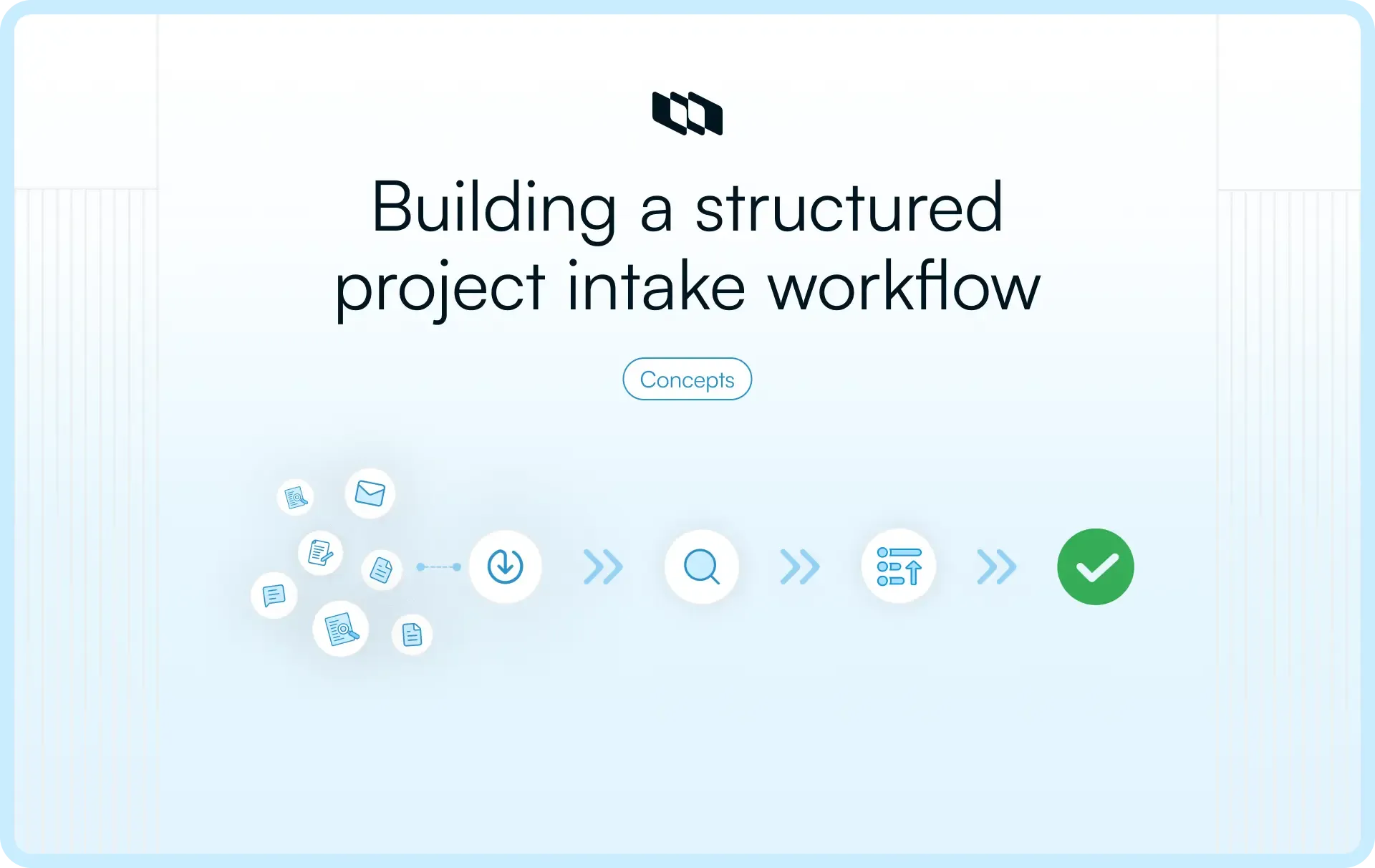
Project intake sits between idea generation and project planning. Requests entered through the project intake form are evaluated and prioritized, and then progress to planning once approved. This decision layer filters incoming work, ensuring only well-defined, high-impact projects enter execution, creating a more predictable and manageable delivery pipeline.
Why a project intake process matters
A well-implemented project intake process creates consistency and clarity across teams. It improves decision quality and strengthens alignment between incoming work and strategic priorities.
1. Consistent decision-making
When every request is evaluated against the same criteria, strategic fit, feasibility, priority, and resource availability, decisions become defensible and repeatable. Teams stop making judgment calls in isolation and start applying a shared framework that everyone understands.
2. Better resource planning
Intake gives you a real-time view of what's being requested versus what your team can take on. That visibility allows resource owners to plan ahead, flag conflicts early, and prevent the kind of overcommitment that leads to missed deadlines and burned-out teams.
3. Clear visibility into incoming work
A structured intake process creates a single source of truth for all project requests, what's been submitted, what's under evaluation, and what's been approved or rejected. That visibility benefits everyone, from team leads managing bandwidth to executives tracking strategic priorities.
4. Reduced rework and confusion
Projects that enter execution without proper intake often get sent back for more information, rescoped mid-flight, or cancelled altogether after resources have already been invested. Intake catches those gaps early, when fixing them is cheap, rather than late, when it's costly.
5. Improved stakeholder trust
When stakeholders know their requests will be received, reviewed, and responded to with a clear outcome, they engage with the process rather than work around it. That trust is foundational; it's what makes intake sustainable over the long term rather than something teams quietly abandon when things get busy.
Core components of an effective intake process
A strong project intake process relies on a few essential components that keep incoming work structured and decisions consistent. Each component below plays a specific role in helping teams evaluate requests, assign resources thoughtfully, and maintain alignment with business goals.
1. A single entry point for requests
Every project request should enter through one standardized channel. This single entry point prevents fragmentation and ensures that no request bypasses evaluation. When teams accept requests through scattered messages, emails, or meetings, important context gets lost, and prioritization becomes inconsistent.
A centralized project intake form or submission system creates a single source of truth for incoming work. It allows teams to capture all requests in one place and review them systematically within the project intake workflow.
2. A standardized project intake form
A good intake form does one thing: it forces requestors to think before they submit. At a minimum, it should capture the problem being solved, the expected outcome, the rough scope, and the urgency. When everyone submits the same information in the same format, evaluation gets faster, and the back-and-forth to fill in missing context drops significantly.
A typical project intake form includes:
- Project name and brief description
- Business objective or problem statement
- Expected outcome or success criteria
- Estimated timeline and resource needs
- Priority or urgency from the requester's perspective
3. Clear roles and decision owners
Intake stalls when no one knows who's supposed to act next. You need three things clearly defined: who receives and triages new requests, who evaluates them for feasibility and fit, and who has the final authority to approve, defer, or reject. In small teams, one person might cover all three. That's fine, what matters is that the roles are explicit, not assumed.
4. Defined evaluation and prioritization criteria
Without clear criteria, prioritization defaults to whoever makes the most noise.
Define what a good project looks like before requests start coming in. Most teams evaluate across a few core dimensions: strategic alignment, expected impact, resource cost, urgency, and feasibility. You don't need a complex scoring model. Even a simple checklist applied consistently is better than ad hoc judgment calls.
5. A visible intake workflow
Stakeholders don't just want their requests reviewed; they want them acted on. They want to know what's happening with them.
Map out the stages a request moves through, submitted, under review, approved, deferred, rejected, and make those stages visible. When requestors can see where their submission sits without having to ask, you reduce follow-up noise and build trust in the process.
6. Documented decisions and next steps
A decision that isn't documented is a decision that'll get relitigated.
Every request should end with a recorded outcome and a reason. Approved? Note who owns it and what happens next. Deferred or rejected? Note why, and whether there are conditions that could change the outcome. This creates a paper trail that protects your team, keeps stakeholders informed, and helps you spot patterns in requests over time.
Stages of a project intake process
A well-designed project intake process follows a clear sequence from submission to execution handoff. Each stage in the project intake workflow serves a specific purpose: capture the request, validate the information, evaluate feasibility, prioritize against other work, and then decide the outcome. When these stages are defined and visible, teams manage incoming project requests with structure rather than reaction.
1. Request submission
Every project intake process begins with a structured request submission. The project intake form captures essential details, including the problem statement, expected impact, timeline, stakeholders, and initial scope. This ensures that each request enters the system with enough context for evaluation.
A consistent submission format reduces ambiguity and allows teams to compare requests objectively. It also creates a centralized record of all incoming work within the project intake workflow.
2. Initial review and clarification
Once submitted, the request goes through an initial review. The goal at this stage is completeness and clarity. Reviewers check whether the information provided in the project intake form is sufficient to assess feasibility and impact.
If details are missing or unclear, the reviewer requests clarification before moving forward. This step prevents poorly defined projects from reaching evaluation and ensures that decisions are based on accurate information.
3. Evaluation and feasibility assessment
At this stage, the team evaluates the project request against defined intake criteria. This typically includes strategic alignment, business impact, estimated effort, resource requirements, risk level, and dependencies.
Feasibility assessment also considers capacity. Teams review current commitments and skill availability to determine whether the project can realistically be delivered within the proposed timeline. This structured evaluation strengthens the project evaluation process and improves decision quality.
4. Prioritization and decision-making
After evaluation, requests are compared against each other and against existing commitments. Prioritization ensures that the most valuable and feasible projects move forward first.
Decision-makers use shared criteria to approve, defer, or reject requests. This stage formalizes the project request process and ensures that approvals align with strategic goals and available capacity.
5. Approval and execution handoff
When a request is approved, it moves from the project intake workflow into planning and delivery. At this point, ownership is assigned, resources are allocated, and detailed planning begins.
A structured handoff ensures that the team entering execution has access to the original context, evaluation notes, and defined objectives captured during intake. This continuity improves execution clarity and reduces misalignment.
6. Deferral or rejection
Not every project request moves forward immediately. Some requests may be deferred due to limited capacity or lower strategic priority. Others may be rejected for feasibility or alignment reasons.
In both cases, the decision and rationale should be documented clearly. Deferred requests can be revisited during future prioritization cycles, and documented reasoning ensures transparency within the project intake process.
How to build a project intake process: step by step
Building a project intake process becomes simple when each layer is designed deliberately. The goal is not to introduce bureaucracy. The goal is to create a predictable way to evaluate incoming work before it consumes delivery capacity.
improves the quality of completed requests and streamlines
Follow these steps in order.
Step 1: Define what qualifies as a project
The first decision determines everything that follows. If every small request enters the intake pipeline, the process becomes overloaded. If large initiatives bypass intake, prioritization loses structure. Teams need a clear threshold.
Define a project using one or more of the following:
- Cross-functional involvement
- Multi-week effort
- Dedicated resource allocation
- Budget ownership
- Strategic impact
For example, a small UI adjustment stays within a team backlog. A new feature release spanning design, engineering, QA, and marketing enters the project intake workflow.
Document this definition clearly. When the boundary is well-defined, the intake pipeline remains focused on productive, meaningful tasks.
Step 2: Assign intake roles and responsibilities
Intake fails when ownership is vague. Three responsibilities must be clearly assigned:
Intake coordinator
- Reviews new submissions
- Ensures required fields are complete
- Routes requests to evaluators
Evaluator(s)
- Assess feasibility, effort, risk, and alignment
- Validate resource availability
- Provide structured feedback
Decision owner
- Approves, defers, or rejects
- Balances competing priorities
- Communicates final decisions
In early-stage teams, one person may cover multiple roles. In scaling organizations, these responsibilities are distributed. What matters is clarity. Every stage in the project intake process must have an accountable owner.
Step 3: Design a simple intake form
A project intake form should capture enough context to evaluate a request properly without overwhelming the requester.
Limit the form to essential fields:
- Project title
- Problem statement
- Proposed scope
- Expected business or user impact
- Target timeline
- Estimated effort or resources required
- Stakeholders involved
For example, a system migration request should clearly explain the current limitation, the target system, expected benefits, and resource implications. This context enables meaningful evaluation instead of follow-up clarification loops.
A concise form improves the quality of completed requests and streamlines the project request process.
Step 4: Establish evaluation criteria
Evaluation criteria transform intake from subjective discussion into structured decision-making. Before the first request arrives, define how projects will be assessed. Most teams evaluate across five core dimensions:
- Strategic alignment
- Business impact
- Effort and cost
- Urgency or deadline constraints
- Feasibility given current capacity
A lightweight scoring model is sufficient. High, medium, and low across each dimension often provides enough clarity to compare competing requests.
For example, a high-impact initiative that requires moderate effort and fits current capacity ranks differently than a low-impact request that consumes significant engineering time. Clear criteria enable faster and more defensible prioritization.
Step 5: Map your intake workflow and statuses
Every request needs a visible path.
A typical project intake workflow includes:
Submitted → Under review → Evaluated → Approved/Deferred/Rejected
Define each status clearly:
- What does it mean?
- Who owns it?
- What triggers movement to the next stage?
When this workflow lives inside your project management system, visibility increases instantly. Stakeholders see where requests stand. Teams see demand volume. Decision-makers see pipeline pressure.
Step 6: Centralize everything in one system
Intake depends on a single source of truth.
When requests live across email threads, spreadsheets, and messaging apps, prioritization becomes fragmented. A centralized system allows teams to evaluate requests side by side and maintain complete visibility into the pipeline.
A dedicated intake board inside your project management tool keeps every request in context. When a project is approved, it transitions directly into planning without losing historical discussion or evaluation notes.
This continuity strengthens the overall project intake workflow.
Step 7: Communicate the process and enforce it
Even a well-designed intake process fails if stakeholders bypass it.
Communicate clearly:
- Where to submit requests
- What information is required
- How long evaluation takes
- How decisions are communicated
During the early months, redirect informal requests back to the intake form. Consistency builds trust. Over time, stakeholders recognize that structured submissions lead to faster, more transparent decisions. An intake process becomes effective when it becomes habitual.
What to include in a project intake form
A well-designed project intake form ensures requests enter the system with clear, complete details for proper evaluation. It saves time by capturing essential information upfront, enabling teams to assess impact, effort, and feasibility efficiently. Each field should provide clarity on objectives, requirements, and alignment with priorities and capacity.
The sections below outline the essential information every project intake form should include.
1. Request overview and objectives
Every project request should begin with a clear overview. This section explains what is being requested and why it matters. Requestors should describe the problem, opportunity, or improvement the project addresses and the objective they want to achieve.
A concise objective helps reviewers quickly understand the intent. For example, a request might aim to improve onboarding conversion, reduce manual reporting effort, or enable a new product capability. Clear objectives make evaluation faster and more consistent.
2. Business impact and expected outcomes
Understanding the expected impact helps teams prioritize effectively. This section should capture the value the project delivers and who benefits from it. Requestors can describe outcomes such as revenue growth, efficiency improvements, customer experience gains, or risk reduction.
When business impact is clearly defined, evaluators can compare requests more objectively. A project that improves retention for a core user segment may rank differently from one that delivers minor internal convenience. Capturing expected outcomes early strengthens the project evaluation process.
3. Stakeholders and ownership
Every project involves people responsible for delivery and people affected by the outcome. The intake form should identify the primary requester, project sponsor, and key stakeholders. It should also clarify who will own execution if the project is approved.
Clear ownership improves coordination and accountability. It ensures that decision-makers know who to consult during evaluation and who will be responsible for moving the project forward within the project intake workflow.
4. Timeline and urgency
Timeline expectations help teams understand when value is expected and whether deadlines are flexible. This section should capture any target launch dates, regulatory deadlines, or dependencies on other initiatives.
Urgency should be explained rather than simply labeled. For instance, a request tied to a customer contract renewal carries more weight than a general improvement idea. Documenting a timeline and urgency helps teams align project prioritization with real constraints.
5. Scope and deliverables
A high-level scope description outlines what the project includes and what it aims to deliver. This does not need to be a detailed specification, but it should clarify boundaries and expectations. Requestors can describe key deliverables, affected systems, or functional areas involved.
Defined scope reduces ambiguity during evaluation. It allows teams to estimate effort more accurately and prevents misunderstandings once the project moves into execution.
6. Resource requirements and effort estimate
Understanding resource needs is essential before approving any project. This section captures the expected effort, required skill sets, and potential budget considerations. Even rough estimates provide valuable context for decision-making.
For example, a request that requires two engineers for six weeks differs significantly from one that needs cross-functional involvement for an entire quarter. Early visibility into resource requirements helps teams balance incoming work with available capacity.
7. Risks, dependencies, and constraints
Projects rarely exist in isolation. This section identifies risks that could affect delivery and dependencies on other teams, tools, or timelines. Constraints such as compliance requirements, vendor limitations, or technical complexity should also be documented.
Capturing these factors early improves feasibility assessment. It helps teams anticipate challenges and determine whether the project fits current priorities and capabilities.
8. Success metrics and approval criteria
Defining success upfront creates alignment across stakeholders. This section should outline how the project’s impact will be measured once completed. Metrics may include adoption rates, performance improvements, cost savings, or user satisfaction.
Approval criteria can also be documented here. For example, a project may require leadership approval, budget confirmation, or resource availability before moving forward. Clear success metrics and approval criteria strengthen the project intake process and support better decision-making across the project lifecycle.
Example of a project intake workflow in practice
Imagine your marketing team wants to launch a customer referral program. It touches product, engineering, and go-to-market, so it goes through intake. Here is what that looks like from start to finish.
- Submission: The marketing manager completes the intake form with the business objective, proposed scope, expected outcome, and a rough Q3 timeline.
- Initial review: The intake coordinator reviews the submission within 48 hours, notices the resource estimate is missing, and sends one follow-up question. The gap gets filled, and the request moves forward.
- Evaluation: The review group assesses the request against the defined criteria. Strategic fit is strong. Engineering estimates four to six weeks of work. Two dependencies are flagged: an authentication update and a Q2 email migration that must be completed first.
- Decision: The decision owner approves the project with a revised timeline. Given the current engineering capacity, the build starts post-migration with an early Q4 target. The scope stays intact; only the timing shifts.
- Handoff: A project is created in the team's project management tool with the agreed scope, key milestones, and the intake notes attached. The execution team picks it up with full context already in place.
The marketing manager gets a clear answer. The engineering team gets a project they are ready to take on. And the decision is documented, so it never needs to be relitigated.
Best practices for improving your intake process
A project intake process should evolve as teams grow and workloads increase. The goal is to maintain structure without creating unnecessary friction. Teams that review and refine their project intake workflow regularly make faster decisions and maintain stronger alignment between incoming work and strategic priorities.
The practices below help keep the intake process effective, scalable, and easy for stakeholders to follow.
1. Keep the process simple and consistent
An effective project intake process focuses on clarity and consistency. When the process becomes overly detailed, stakeholders hesitate to submit requests or provide incomplete information. A simple and predictable flow encourages adoption and improves submission quality.
Maintain a concise project intake form, clear workflow stages, and defined evaluation criteria. Consistency ensures that every request moves through the same path and receives equal consideration. Over time, this consistency strengthens trust in the project request process and improves decision speed.
2. Use transparent criteria for decisions
Transparent evaluation criteria make prioritization easier to understand and accept. When teams document how requests are assessed, stakeholders gain clarity on what drives approval or deferral. This transparency reduces confusion and aligns expectations across departments.
For example, if strategic alignment and business impact carry more weight than urgency, stakeholders can frame their requests accordingly. Clear criteria turn the project intake process into a predictable system rather than a subjective discussion.
3. Review and adjust regularly
A project intake workflow should adapt as priorities, team size, and delivery capacity change. Regular reviews help teams identify bottlenecks and refine evaluation criteria. Monthly or quarterly reviews often provide enough insight to improve the process without creating additional overhead.
During these reviews, teams can assess whether requests move through the pipeline efficiently, whether evaluation criteria remain relevant, and whether approved projects deliver expected outcomes. Continuous adjustment ensures the intake process remains aligned with evolving business needs.
4. Prevent side-channel requests
Side-channel requests weaken even the most well-designed intake system. When stakeholders bypass the project intake form and request work through informal conversations, visibility and prioritization suffer. Teams may commit to work without proper evaluation, which disrupts planning.
Encourage all stakeholders to submit requests through the defined project intake workflow. When informal requests appear, redirect them to the intake system. Over time, consistent use of a single entry point reinforces discipline and ensures that every request receives proper evaluation.
5. Track outcomes and improve decision quality
Tracking outcomes helps teams understand whether their intake decisions deliver the expected value. Reviewing approved projects against success metrics provides insight into decision quality and prioritization accuracy.
For instance, if several approved projects fail to deliver meaningful impact, the evaluation criteria may need to be adjusted. If high-value requests are frequently deferred due to capacity constraints, teams may need better resource planning. Measuring outcomes strengthens the project intake process and helps teams make more informed decisions over time.
Common mistakes to avoid
Even well-designed project intake processes lose effectiveness when a few critical practices are overlooked. Small implementation gaps can slow decision-making, reduce visibility, and weaken stakeholder trust. Recognizing these common mistakes helps teams maintain a structured and reliable project intake workflow.
1. Overcomplicating the intake form
An intake form should capture essential information without creating friction. When forms become overly detailed, requestors either provide incomplete responses or avoid them altogether. This leads to inconsistent submissions and delays in evaluation.
Keep the project intake form focused on clarity. Capture objectives, impact, scope, timeline, and resource expectations. A concise form improves submission quality and makes the project request process easier for everyone involved.
2. Skipping capacity checks
Approving projects without reviewing available capacity creates unrealistic commitments. Teams may commit to high-value initiatives while already operating at full workload. This results in delays, context switching, and reduced delivery quality.
Capacity should be reviewed alongside impact and effort during evaluation. A strong project intake process ensures that approved work aligns with actual resource availability and realistic timelines.
3. Lack of clear decision ownership
When decision ownership is unclear, project requests remain in review stages longer than necessary. Teams wait for approvals, and stakeholders receive little clarity on next steps. Defined ownership keeps the project intake workflow moving and ensures accountability.
Every request should have a clear reviewer and a designated decision owner responsible for approval, deferral, or rejection. Clear responsibility improves decision speed and consistency.
4. Poor communication of outcomes
Stakeholders expect visibility into what happens after submission. When decisions are made without clear communication, confusion increases and trust declines. Requestors may follow up repeatedly or submit duplicate requests.
Each project request should end with a documented decision and rationale. Communicating outcomes clearly helps stakeholders understand prioritization and supports transparency within the project intake process.
5. Allowing requests outside the process
Side-channel requests weaken the structure of any intake system. When work begins through informal conversations or direct messages, it bypasses evaluation and disrupts prioritization. This creates inconsistencies and reduces visibility into incoming work.
Encourage all stakeholders to submit requests through the defined project intake workflow. Consistent use of a single system ensures that every request receives proper evaluation and maintains fairness across teams.
Final thoughts
A structured project intake process creates clarity when work enters the system. Instead of reacting to scattered requests and shifting priorities, teams gain a consistent way to evaluate, prioritize, and approve projects based on impact and capacity. This clarity improves planning accuracy, strengthens alignment with business goals, and helps teams focus on work that delivers measurable value.
As organizations grow, the volume and complexity of project requests increase. A defined project intake workflow ensures that this growth remains manageable. With a clear project intake form, transparent evaluation criteria, and visible decision-making, teams build a reliable foundation for prioritization and execution. When every request follows a consistent path from submission to decision, teams commit with confidence and stakeholders gain trust in how work gets prioritized.
Frequently asked questions
Q1. What are the steps of the intake process?
A typical project intake process follows a structured sequence to evaluate and prioritize incoming work. The key steps include:
- Request submission through a standardized project intake form
- Initial review to ensure clarity and completeness
- Evaluation based on impact, effort, and feasibility
- Prioritization against current goals and capacity
- Decision-making to approve, defer, or reject
- Resource allocation and planning for approved projects
- Handoff to execution and ongoing tracking
These steps ensure that every project request is assessed consistently before entering delivery.
Q2. What are the 7 stages of a project?
Most projects follow seven core stages from idea to completion:
- Project intake and evaluation
- Initiation and approval
- Planning and scoping
- Resource allocation
- Execution and coordination
- Monitoring and progress tracking
- Closure and outcome review
These stages create a structured lifecycle that helps teams manage work from concept to completion.
Q3. What is the process of intake?
The intake process is the structured method used to capture and evaluate new requests before work begins. In project management, it involves collecting request details, assessing value and feasibility, prioritizing against existing commitments, and deciding whether the request should move forward.
A defined intake process helps teams maintain visibility into demand and make consistent prioritization decisions.
Q4. What is an intake procedure?
An intake procedure is the documented set of steps used to receive, review, and decide on incoming requests. It defines how requests are submitted, who evaluates them, what criteria are used, and how decisions are communicated.
In project environments, an intake procedure ensures that all project requests follow the same path and receive fair evaluation before resources are committed.
Q5. What are the 5 stages of the interview process?
While unrelated to project intake, the interview process typically includes five stages:
- Application or initial screening
- Preliminary interview or recruiter conversation
- Technical or role-specific assessment
- Final interview with decision-makers
- Offer and onboarding
Each stage helps organizations evaluate candidates consistently and make informed hiring decisions.
Recommended for you



 Download for Mac
 Download for Android