What is a product feedback loop? definition, types, and best practices
Introduction
A user reports confusion during onboarding, another requests a missing feature, and product analytics shows a sudden drop in activation. Each signal points to something important, yet real progress begins when teams connect these inputs into a structured product feedback loop that guides decisions and releases. A clear product feedback process helps teams understand users' experiences, prioritize improvements, and build with confidence. This guide explains what a product feedback loop is, its definition, the most common types, and how modern teams create a reliable customer feedback loop that continuously improves the product.
What is a product feedback loop?
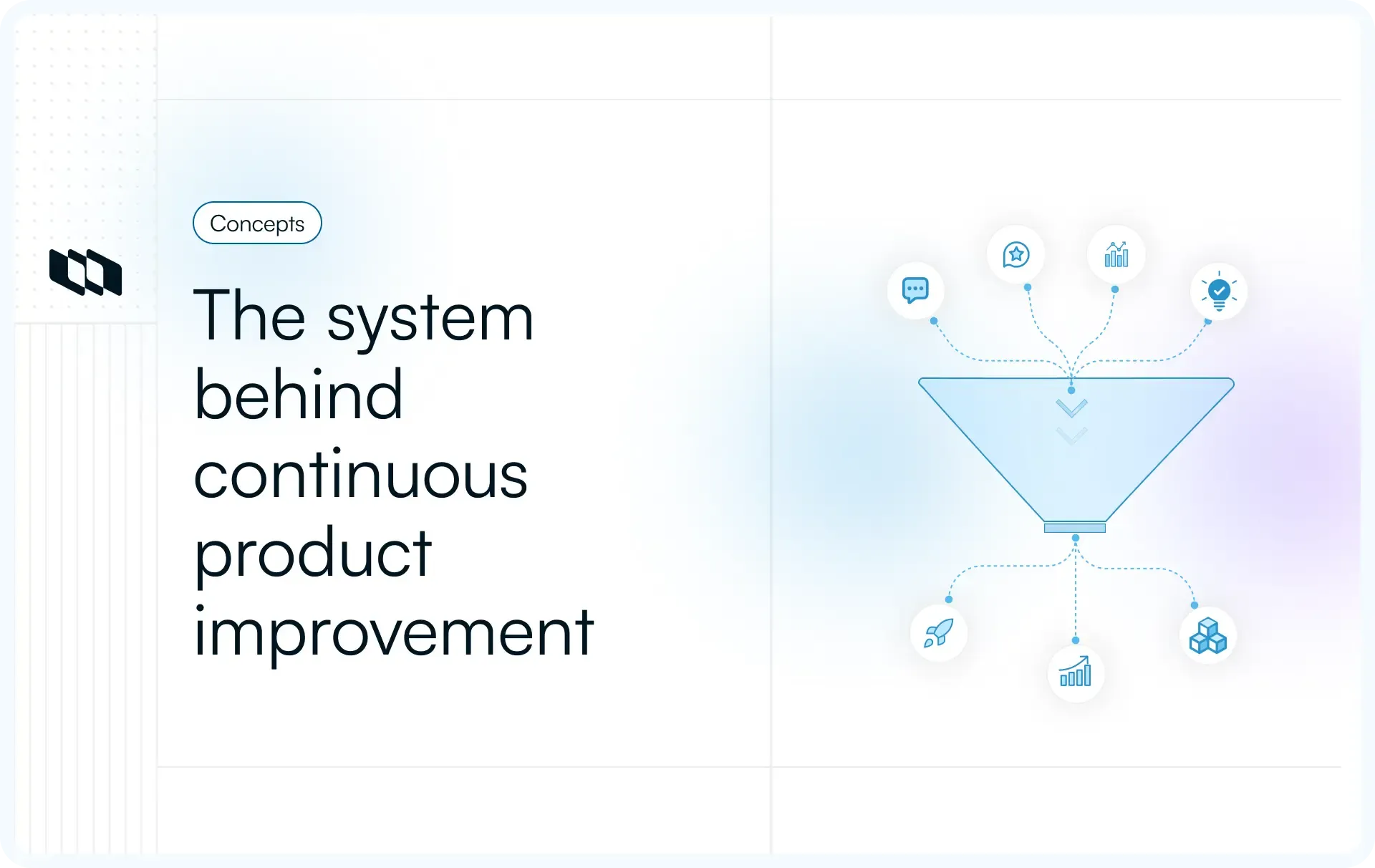
A product feedback loop is a structured, repeatable process that helps product teams collect feedback, turn it into insights, implement improvements, and communicate updates to users in a continuous cycle. This product feedback process ensures that user input consistently informs product decisions and releases rather than sitting unused across scattered channels.
A product feedback loop helps teams:
- Collect feedback from users across multiple channels
- Analyze and interpret patterns within that feedback
- Turn insights into prioritized product improvements
- Communicate updates and outcomes back to users
- Restart the cycle with new learnings and signals
It is called a loop because feedback does not end with collection or implementation. Every improvement shipped to users generates new reactions, new usage behavior, and new feedback. That new input feeds directly into the next cycle of decisions and releases, creating a continuous customer feedback loop that keeps the product aligned with real user needs.
Example
A SaaS team notices repeated feedback about confusion during onboarding. They review support tickets, session recordings, and survey responses to identify the main friction point. The team redesigns the onboarding flow, ships the update, and informs users who reported the issue. After release, activation rates improve, and new feedback highlights smaller usability tweaks. That input enters the next iteration of the product feedback loop, keeping improvement continuous and data-driven.
Why product feedback loops matter for modern teams
A structured product feedback loop helps teams move from assumption-led decisions to evidence-led improvements. In this section, we examine how a structured product feedback loop helps teams prioritize better, reduce guesswork, and build with clearer direction.
1. Helps teams prioritize the right features and fixes
Every product team receives more feedback than it can act on. Without a structured customer feedback loop, decisions often depend on urgency, internal opinions, or the loudest requests. A well-managed product feedback loop helps teams group similar feedback, identify recurring problems, and focus on changes that impact the most users. This approach ensures that product improvements align with real usage patterns rather than isolated suggestions.
2. Reduces guesswork in product decisions
Many roadmap decisions involve uncertainty. Teams often rely on assumptions about what users want or how they behave. A consistent product feedback process replaces assumptions with real signals from users and usage data. When feedback from support, analytics, and interviews is analyzed together, product teams gain clearer direction and confidence in their decisions. This reduces rework and improves release quality.
3. Improves user satisfaction and retention
Users are more likely to stay engaged with a product when they see their feedback acknowledged and acted upon. Closing the customer feedback loop by communicating updates or improvements builds trust and encourages continued engagement. Over time, this strengthens relationships with users and improves retention, since the product evolves based on real needs and expectations.
4. Aligns product development with real user needs
Product teams aim to build solutions that solve meaningful problems. A structured product feedback loop connects development efforts directly with user experience and outcomes. Instead of building solely on assumptions or internal priorities, teams use feedback signals to guide planning and execution. This alignment ensures that development time and effort contribute to measurable product value.
5. Enables continuous improvement instead of one-time fixes
Product improvement works best as an ongoing system rather than a series of isolated updates. A strong product feedback process ensures that feedback collection, analysis, implementation, and follow-up happen continuously. Each release generates new insights, and each insight informs future improvements. This continuous customer feedback loop helps teams refine the product steadily and respond to changing user needs without disruption.
The core stages of a product feedback loop
A strong product feedback loop follows a clear sequence that helps teams move from raw feedback to measurable improvement. Each stage in this product feedback process ensures that user input turns into structured action and continuous learning.
This section breaks down the key stages that make a product feedback loop consistent and effective across teams and releases.
1. Collect feedback
Every product feedback loop begins with collecting signals from users and usage. Feedback comes through multiple channels, including surveys, interviews, support tickets, product analytics, reviews, and community discussions. Each source reveals a different perspective on how users experience the product.
A reliable customer feedback loop captures both direct feedback, such as feature requests and complaints, and indirect signals, such as drop-offs or usage trends. Consistent collection ensures that teams see patterns early and maintain visibility into user needs across the product lifecycle.
2. Organize and analyze feedback
Raw feedback often arrives in large volumes and across multiple channels. Without structure, valuable insights remain hidden within scattered comments and data points. This stage of the product feedback process focuses on organizing feedback into themes and identifying patterns.
Teams group similar feedback, tag recurring issues, and connect qualitative insights with quantitative data. This helps separate meaningful signals from isolated opinions. Organized analysis helps product teams understand the root causes of user behavior and identify opportunities for improvement.
3. Prioritize and implement changes
Once patterns emerge, teams translate insights into actionable product decisions. Prioritization ensures that feedback with the highest impact receives attention first. Teams evaluate feedback based on factors such as frequency, severity, business impact, and alignment with product goals.
Insights then move into the development workflow as roadmap items, bug fixes, usability improvements, or new features. A well-defined product feedback loop connects user feedback directly to execution, ensuring that valuable insights drive measurable changes.
4. Close the loop with users
Closing the loop is a critical stage that strengthens the customer feedback loop. After implementing improvements, teams communicate updates to users who shared feedback or were affected by the issue. This may include release notes, direct responses, or in-product updates.
Clear communication shows users that their feedback influenced decisions. It builds trust, encourages continued engagement, and improves the quality of future feedback. When users see visible outcomes from their input, they remain more invested in the product’s growth.
5. Measure impact and restart
Every change introduced through the product feedback loop should be evaluated for impact. Teams track metrics such as adoption, retention, usage patterns, and reductions in recurring issues to determine whether the change improved outcomes.
These insights inform the next iteration of the product feedback process. New feedback and data reveal additional opportunities for refinement, restarting the cycle. This continuous approach ensures that the product evolves in response to real user experience rather than isolated assumptions.
Types of product feedback loops
Product teams rely on various product feedback loops to understand users, make decisions, and consistently improve the product. Each loop serves a different purpose within the overall product feedback process. This section explores the most important types of product feedback loops and how teams use them in practice.
1. Open-loop vs. closed-loop feedback
Open-loop and closed-loop feedback represent two distinct ways teams respond to user input within a product feedback loop. Both play an important role in maintaining a healthy product feedback process.
Open-loop feedback focuses on aggregated insights rather than individual responses. Teams analyze patterns across multiple feedback sources and implement broader product improvements without having to respond to every user individually.
Example: Several users request better filtering options in dashboards. The team analyzes recurring feedback, prioritizes enhancements, and delivers an improved filtering experience. Release notes and updates communicate changes to the broader user base rather than responding to every request individually.
Closed-loop feedback focuses on direct follow-up with individual users after action is taken. This type of customer feedback loop helps build trust and clarity for users who report issues or request improvements.
Example: A user reports that exporting reports fails for large datasets. The team fixes the issue and informs the same user once the update is released. This direct response completes the closed-loop feedback cycle and strengthens user trust in the product.
Together, open-loop and closed-loop feedback ensure that the product feedback loop supports both individual user relationships and large-scale product improvements.
2. Qualitative vs. quantitative feedback loops
A strong product feedback loop combines qualitative and quantitative signals to build a complete picture of user experience. Relying on only one type creates blind spots in decision-making.
Qualitative feedback loops focus on descriptive and contextual insights that explain why users behave as they do. These insights often come from direct conversations or open-ended feedback.
Qualitative feedback helps teams:
- Understand user expectations and motivations
- Identify usability friction and confusion
- Discover unmet needs and feature gaps
- Add context to behavioral data
Example: Several users mention difficulty understanding dashboard metrics during interviews. Their explanations reveal confusion about terminology rather than functionality. This insight helps the team improve labels and onboarding guidance.
Quantitative feedback loops focus on measurable signals that show how users interact with the product. These signals help teams validate trends and track impact over time.
Quantitative feedback helps teams:
- Measure adoption and engagement
- Identify drop-offs or friction points
- Track feature usage trends
- Evaluate the impact of product changes
Example: Analytics shows that many users abandon the onboarding process at step three. Combining qualitative feedback from support conversations, the team identifies the root cause and simplifies the process.
When qualitative and quantitative feedback loops work together, teams gain both context and evidence. This combination strengthens the product feedback process and improves decision accuracy.
3. Fast vs. slow feedback loops
Product teams operate across different time horizons. Some decisions require rapid iteration, while others depend on long-term trends and research. Fast and slow feedback loops help teams balance speed with strategic thinking.
Fast feedback loops focus on quick signals and rapid iteration. These loops help teams identify issues early and respond quickly through small improvements or releases.
Fast loops are useful when:
- Releasing frequent updates or experiments
- Monitoring usability issues or bugs
- Gathering feedback on new features
- Validating short-term improvements
Example: After launching a new navigation layout, the team monitors in-app feedback and session recordings. Early signals reveal confusion in a specific section. The team refines the layout in the next release, completing a fast feedback loop within days.
Slow feedback loops focus on long-term insights and strategic direction. These loops rely on research, trends, and broader data analysis rather than immediate reactions.
Slow loops are useful when:
- Evaluating major feature investments
- Understanding evolving user needs
- Conducting market or user research
- Planning long-term roadmap direction
Example: Quarterly interviews and usage trends indicate that enterprise users require more detailed reporting capabilities. The team uses these insights to shape a long-term roadmap initiative rather than shipping immediate changes.
Fast and slow loops complement each other. Fast loops help teams iterate quickly and address immediate issues, while slow loops guide strategic decisions and product evolution. Together, they create a balanced product feedback loop that supports both execution and long-term growth.
Common sources of product feedback
A strong product feedback loop depends on consistent and diverse inputs. Feedback arrives from multiple touchpoints across the user journey, and each source reveals a different aspect of the product experience. The following sources form the foundation of an effective customer feedback loop for modern product teams.
1. Customer interviews and usability testing
Direct conversations with users provide detailed insights into how people understand and use the product. Interviews and usability sessions reveal motivations, expectations, and points of confusion that rarely appear in raw analytics.
These interactions help teams:
- Understand user goals and workflows
- Identify friction in navigation or features
- Discover unmet needs or feature gaps
- Validate assumptions about user behavior
Example: During usability testing, several users hesitate while configuring a workflow. Their feedback highlights unclear terminology, prompting improvements to labels and onboarding guidance.
2. Support and success conversations
Support tickets, chat transcripts, and customer success calls offer real-time feedback from users actively trying to complete tasks. These conversations highlight recurring issues, urgent bugs, and feature limitations.
Support-led feedback helps teams:
- Identify high-frequency issues affecting usability
- Understand user expectations during critical workflows
- Detect friction that impacts retention or satisfaction
- Prioritize fixes that improve the day-to-day experience
Example: Multiple support tickets report difficulty exporting reports. This recurring issue signals a high-impact problem that moves quickly into the product feedback loop for resolution.
3. Product analytics and usage behavior
Behavioral data shows how users interact with features and workflows. Analytics reveals patterns such as feature adoption, drop-offs, session duration, and engagement trends.
Usage-driven feedback helps teams:
- Detect friction points across workflows
- Measure feature adoption and engagement
- Identify underused or confusing features
- Validate the impact of product changes
Example:
Analytics reveals that many users abandon a setup step before completion. This pattern prompts deeper investigation through interviews and support data, leading to a streamlined setup flow.
4. Surveys and NPS responses
Structured surveys provide scalable feedback across large user segments. Ratings, open-ended responses, and NPS insights help teams understand satisfaction, expectations, and areas for improvement.
Survey feedback helps teams:
- Measure overall user sentiment
- Identify recurring themes across responses
- Track changes in satisfaction over time
- Prioritize improvements that affect perception and retention
Example: Survey responses highlight confusion around reporting features. Repeated mentions across segments guide improvements in documentation and interface clarity.
5. Reviews, communities, and social media
Public feedback often reflects candid user sentiment and expectations. Reviews, forums, and community discussions reveal how users perceive the product and compare it with alternatives.
Public feedback helps teams:
- Identify reputation-related issues
- Understand competitive positioning
- Spot recurring feature requests
- Track sentiment across broader audiences
Example: Community discussions highlight demand for deeper integrations. This recurring theme informs future roadmap planning and partnership decisions.
6. Sales and churn feedback
Sales conversations and churn analysis reveal why users adopt or leave the product. These insights connect product decisions directly with revenue and retention outcomes.
Revenue-linked feedback helps teams:
- Understand objections during evaluation
- Identify missing capabilities for specific segments
- Learn why customers discontinue usage
- Align product improvements with business outcomes
Example:
Churn interviews reveal that teams require advanced reporting capabilities for long-term adoption. This insight influences roadmap priorities and positioning.
Why relying on only one source creates blind spots
No single feedback channel captures the full product experience. Interviews reveal intent but may lack scale. Analytics shows behavior but may lack context. Support data highlights problems, but may focus only on active users.
A balanced product feedback loop combines qualitative and quantitative signals from multiple sources. This integrated approach helps teams validate patterns, avoid bias, and make well-informed decisions. When feedback from different channels aligns, teams gain stronger confidence in prioritization and product direction.
How to build an effective product feedback loop
A strong product feedback loop does not happen automatically. It requires a clear structure that connects feedback with decisions, execution, and communication. When teams follow a consistent product feedback process, feedback stops feeling scattered and starts guiding real product improvements.
The steps below outline how modern product teams can build a reliable customer feedback loop that continues to deliver value as the product evolves.
1. Define what feedback matters most
Every team receives a constant stream of feedback, yet only a portion of it should influence product decisions. Clarity at this stage ensures that the product feedback loop focuses on signals that actually guide improvements.
Focus on:
- Identifying which product decisions feedback should inform, such as usability improvements, retention drivers, or feature prioritization
- Defining clear feedback categories, such as bugs, workflow friction, missing capabilities, or performance concerns
- Aligning feedback collection with current product goals and roadmap priorities
- Ensuring that teams capture feedback that helps them act rather than simply observe
When teams define what matters early, the product feedback process becomes intentional and easier to manage.
2. Centralize feedback in one place
Feedback often lives across support tools, emails, interviews, internal chats, and analytics dashboards. When these signals remain scattered, teams struggle to identify patterns and maintain visibility.
To strengthen the customer feedback loop:
- Bring all feedback sources into a single, accessible system
- Ensure every team can view and contribute to feedback insights
- Maintain consistent fields or tags for easier tracking and analysis
- Reduce dependency on individual memory or isolated notes
Centralization creates a shared view of user experience and keeps the product feedback loop structured and actionable.
3. Categorize and identify patterns
Raw feedback becomes valuable only when teams organize it into meaningful themes. Pattern recognition helps teams understand what users experience at scale rather than reacting to isolated requests.
To surface insights clearly:
- Tag feedback by feature area, workflow, or user segment
- Group similar requests and issues into common themes
- Distinguish between one-off feedback and recurring patterns
- Review feedback trends regularly to identify emerging needs
Categorization transforms scattered feedback into clear signals that inform roadmap and usability decisions.
4. Prioritize using clear criteria
A consistent prioritization approach ensures that feedback leads to focused improvements rather than reactive changes. Clear criteria help teams evaluate which insights deserve immediate attention and which can be planned for later.
Effective prioritization considers:
- Frequency of feedback across users or segments
- Impact on user experience or business outcomes
- Effort required to implement improvements
- Alignment with strategic product direction
When prioritization remains consistent, the product feedback loop supports confident decision-making and balanced roadmap planning.
5. Turn insights into actionable work
Insights only create value when they translate into execution. Converting feedback themes into structured tasks or roadmap items ensures that the product feedback process drives visible change.
To make feedback actionable:
- Convert themes into clear product improvements or tasks
- Link feedback insights to development or design workflows
- Assign ownership for implementation and follow-up
- Track progress so teams can see feedback and move toward resolution
This connection between insights and execution keeps the product feedback loop outcome-focused and reliable.
6. Close the loop consistently
Closing the loop strengthens trust and keeps the customer feedback loop active. Users remain more engaged when they know their feedback influences real changes.
Teams should focus on:
- Informing users when issues are resolved or improvements are shipped
- Sharing updates through release notes, emails, or in-product messages
- Acknowledging feedback even when immediate changes are not planned
- Reinforcing that user input shapes product direction
Consistent communication builds credibility and encourages users to continue sharing meaningful feedback.
7. Repeat and refine continuously
A product feedback loop functions as an ongoing system rather than a one-time setup. Each iteration of feedback and improvement generates new insights that guide future decisions.
To maintain momentum:
- Review the effectiveness of your product feedback process regularly
- Adjust collection methods as the product and user base evolve
- Improve categorization and prioritization practices over time
- Ensure feedback remains connected to measurable outcomes
Continuous refinement keeps the product feedback loop responsive, scalable, and aligned with changing user needs.
Best practices for maintaining healthy feedback loops
A product feedback loop delivers consistent value when teams treat it as a disciplined system rather than an occasional activity. Healthy feedback loops rely on clear patterns, shared visibility, and consistent follow-through.
The practices below help teams maintain a strong and reliable product feedback process as the product and user base grow.
1. Focus on patterns, not isolated requests
Individual feedback can be useful, yet patterns across multiple users reveal what truly needs attention. Prioritizing recurring themes helps teams focus on improvements that impact a larger segment of users. Reviewing grouped feedback regularly ensures that the product feedback loop remains aligned with meaningful trends rather than one-off opinions.
2. Combine qualitative and quantitative insights
A complete customer feedback loop relies on both context and evidence. Qualitative insights from interviews, support conversations, and open-ended feedback explain user expectations and frustrations. Quantitative signals from analytics and surveys show how widely those issues occur and how they affect behavior. Combining both perspectives strengthens decision-making and improves prioritization accuracy.
3. Involve cross-functional teams
Feedback affects multiple areas of the product experience, which makes cross-functional visibility essential. Product managers, engineers, designers, support, and customer success teams each contribute valuable context. Shared access to feedback ensures that decisions reflect a broader understanding of user needs and technical feasibility. Collaboration across teams keeps the product feedback process balanced and informed.
4. Avoid overreacting to the loudest users
Highly vocal users often share frequent feedback, yet their needs may represent only a small portion of the user base. A structured product feedback loop helps teams evaluate feedback by frequency, impact, and alignment with goals, rather than by volume alone. This balanced approach prevents reactive decisions and supports long-term product health.
5. Make feedback visible across the organization
When feedback remains hidden within individual teams, valuable insights get lost. Making feedback accessible across the organization improves alignment and encourages shared ownership of user experience. Visibility into trends, recurring issues, and user sentiment helps teams stay informed and responsive. A transparent customer feedback loop ensures that everyone understands what users need and why certain decisions are made.
6. Build a habit of closing the loop with users
Closing the loop strengthens trust and keeps feedback flowing. Communicating updates, fixes, and improvements shows users that their input leads to real outcomes. Consistent follow-up encourages more thoughtful feedback and improves overall engagement. A product feedback loop becomes more effective when users see visible results from their contributions.
How to measure the effectiveness of your feedback loop
A product feedback loop delivers value only when it leads to measurable improvements. Tracking the right indicators helps teams understand whether their product feedback process is working and where it needs refinement. Clear metrics also bring visibility into how quickly feedback moves from input to action and impact.
Focus on a small set of practical signals that reflect responsiveness, execution speed, and user outcomes.
1. Track the time taken to respond to feedback
Response time reflects how quickly teams acknowledge and act on incoming feedback. Faster responses indicate that the customer feedback loop is active and consistently monitored.
Measure:
- Time taken to acknowledge user feedback
- Time taken to review and categorize new inputs
- Time taken to communicate status or next steps
Shorter response cycles improve user trust and maintain engagement with the product feedback loop.
2. Measure time from feedback to implementation
Speed from insight to execution reveals how efficiently feedback moves through the product feedback process. When feedback translates into improvements quickly, teams maintain momentum and relevance.
Track:
- The time between identifying a recurring issue and prioritizing it
- Time between prioritization and release
- Overall cycle time from feedback to shipped improvement
This metric highlights whether feedback leads to timely product decisions and releases.
3. Monitor the reduction in repeated issues or complaints
A strong product feedback loop should reduce recurring problems over time. If the same issues continue appearing, it indicates gaps in analysis or implementation.
Monitor:
- Frequency of repeated support tickets
- Recurring usability complaints
- Repeated feature requests for previously addressed issues
A decline in repeated issues shows that feedback-driven improvements are effective.
4. Evaluate feature adoption after improvements
When feedback informs product changes, adoption and usage patterns should reflect the impact of those changes. Measuring adoption helps teams understand whether improvements align with user needs.
Track:
- Usage of newly improved or released features
- Changes in workflow completion rates
- Engagement levels after updates
Strong adoption signals that the product feedback loop supports meaningful product improvements.
5. Observe user satisfaction and retention trends
User sentiment and retention provide long-term indicators of feedback loop effectiveness. When users see consistent improvements from their input, satisfaction and loyalty often follow.
Measure:
- Changes in satisfaction scores or survey ratings
- Retention across key user segments
- Feedback sentiment over time
Positive trends suggest that the product feedback process aligns closely with user expectations.
6. Look for qualitative signals that users feel heard
Not all success indicators are numerical. Qualitative feedback often reveals whether users feel acknowledged and valued.
Watch for:
- Positive responses to updates and fixes
- Increased willingness to share feedback
- Constructive and detailed user input
- References to improvements in conversations or reviews
These signals show that the customer feedback loop builds trust and encourages ongoing engagement.
Final thoughts
Collecting feedback happens naturally across support conversations, reviews, interviews, and product analytics. Real progress begins when teams run a structured product feedback loop that turns those signals into clear decisions and continuous improvements. A consistent product feedback process ensures that insights move beyond observation and lead to meaningful product outcomes.
Teams that maintain a strong customer feedback loop gain clearer direction, prioritize with confidence, and ship improvements that reflect real user needs. Over time, this discipline strengthens decision-making, improves feature relevance, and builds lasting trust with users who see their feedback shaping the product.
Frequently asked questions
Q1. What are product feedback loops?
Product feedback loops are structured and repeatable processes that help teams collect feedback, analyze it, turn insights into product improvements, communicate updates to users, and continue the cycle. A well-defined product feedback loop ensures that user input consistently guides product decisions and releases rather than remaining unused across scattered channels.
Q2. What are the 5 steps of a feedback loop?
The five key steps in a product feedback loop include:
- Collect feedback from users and usage data
- Organize and analyze feedback to identify patterns
- Prioritize insights based on impact and relevance
- Implement improvements or fixes
- Communicate updates and restart the cycle
These steps form a continuous product feedback process that helps teams consistently improve the product.
Q3. What are the 4 components of a feedback loop?
The four core components of a customer feedback loop are:
- Feedback collection from users and behavioral data
- Analysis and interpretation of insights
- Implementation of product improvements
- Communication and follow-up with users
Together, these components create a complete product feedback loop that supports continuous product improvement.
Q4. What is an example of a feedback loop?
A simple product feedback loop example begins when users report confusion during onboarding. The product team reviews support tickets and usage data to identify the main issue, improves the onboarding flow, and releases the update. The team then informs users about the change and tracks adoption and completion rates. New user feedback enters the next iteration, continuing the loop.
Q5. What are the 5 R’s of feedback?
The 5 R’s of feedback help teams manage feedback more effectively within a product feedback process:
- Receive feedback from relevant sources
- Review and analyze insights
- Respond with acknowledgment or updates
- Resolve issues or implement improvements
- Refine the process based on outcomes
These steps help teams maintain a structured customer feedback loop that continuously improves the product and user experience.
Recommended for you




 Download for Mac
 Download for Android