RICE vs ICE vs Kano: Which framework works best in 2025?
Introduction
As backlogs grow and delivery speeds increase, teams need clearer ways to decide what deserves focus. In 2025, product prioritization frameworks are less about scoring ideas and more about making consistent, defensible decisions.
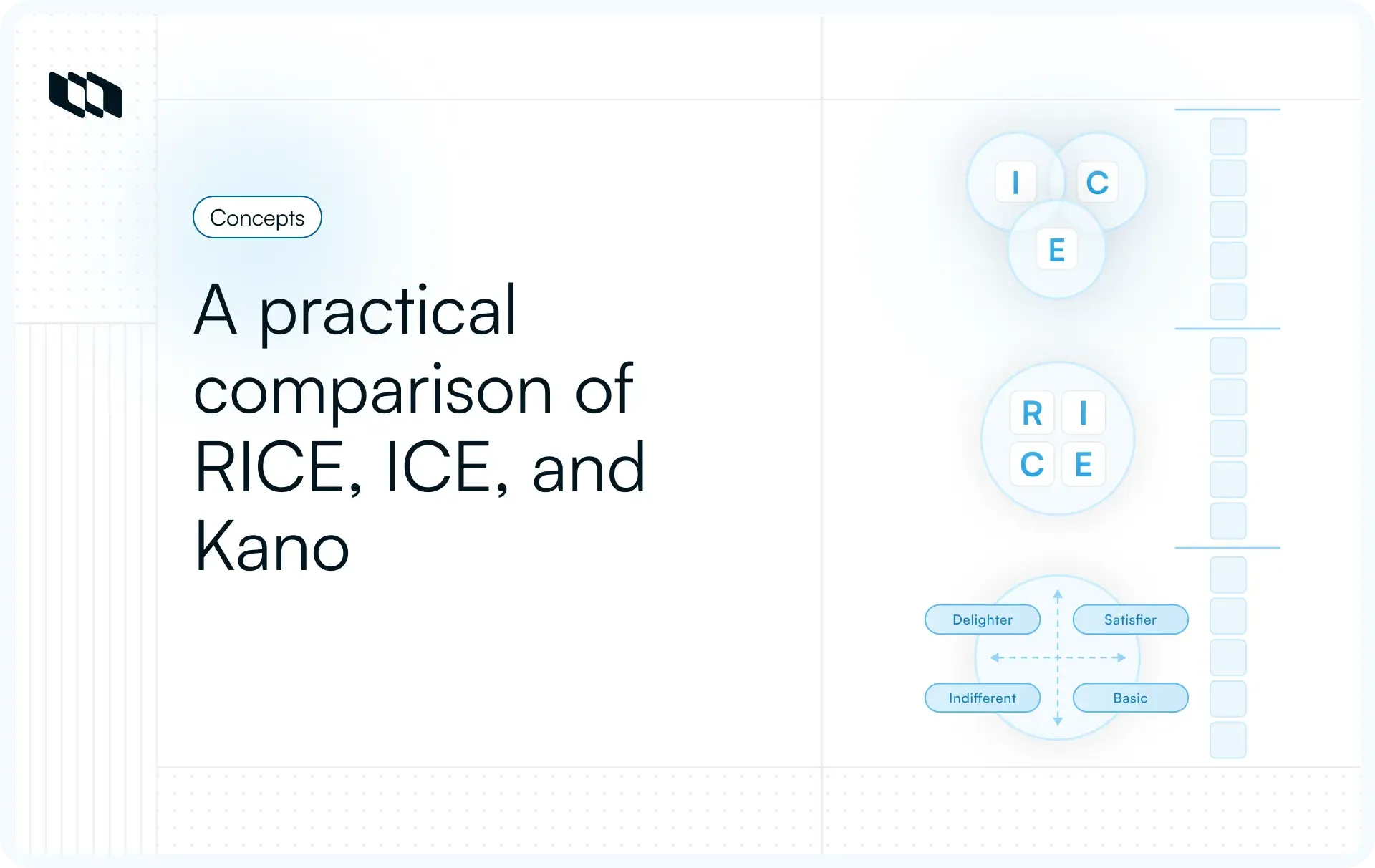
RICE, ICE, and the Kano model are three of the most widely used frameworks, yet they’re often applied interchangeably, even though they solve very different problems. This guide compares RICE, ICE, and Kano to help teams choose the right feature prioritization framework based on their goals, constraints, and product maturity stage.
What is a prioritization framework?
At its core, a prioritization framework is a decision-making tool. It helps teams evaluate multiple ideas and decide which ones deserve attention first, especially when time, people, and capacity are limited. Instead of relying on instinct or urgency, product prioritization frameworks introduce a shared way to compare work using agreed criteria. The goal isn’t mathematical precision. It’s clarity.
A quick overview of RICE, ICE, and Kano
Not all prioritization frameworks solve the same problem. RICE, ICE, and the Kano model are often discussed together, but they are built to optimize for very different decisions.
1. RICE: Scoring ideas for roadmap-level decisions
The RICE framework is a structured scoring model that ranks product ideas based on four factors: reach, impact, confidence, and effort. It works best when teams need to compare many competing initiatives and make defensible roadmap decisions.
RICE introduces discipline into prioritization by forcing teams to estimate value and effort explicitly, even when the data isn’t perfect.
2. ICE: Moving fast with lightweight prioritization
The ICE framework simplifies prioritization to three inputs: impact, confidence, and ease. By removing reach, ICE reduces estimation overhead and enables faster decisions. ICE is commonly used for experiments, growth initiatives, and short-term bets where speed matters more than precision.
3. Kano: Prioritizing based on customer satisfaction
The Kano model takes a different approach. Instead of scoring ideas, it categorizes features by their impact on customer satisfaction, from basic expectations to performance drivers and delighters. Kano is especially useful in discovery and UX-focused work, where understanding how a feature is perceived matters more than ranking it numerically.
The RICE framework
The RICE framework is best understood as a tool for comparing many competing initiatives when teams need to make roadmap-level trade-offs visible and defensible. It’s not about precision. It’s about creating a shared way to reason through uncertainty.
What RICE is optimized for
RICE works well when teams are deciding between multiple features, improvements, or initiatives that all seem “important.” By scoring ideas across reach, impact, confidence, and effort, teams can surface which bets offer the strongest value relative to the cost of building them.
This makes RICE especially useful for:
- Quarterly or multi-sprint roadmap planning
- Teams with several stakeholders competing for priority
- Situations where decisions need to be explained and revisited later
In practice, RICE helps teams move from opinions to explicit trade-offs.
When RICE works best in real teams
RICE is most effective when:
- Teams have directional data, not perfect data
- Effort estimates are relatively stable
- The goal is ranking initiatives, not validating ideas
For scaling product teams, RICE often becomes the default feature prioritization framework for roadmap discussions because it balances structure with flexibility.
When to pair RICE with other frameworks
RICE works best after discovery, not instead of it. Teams often get better results by:
- Using qualitative methods (like Kano or user research) to shape ideas
- Then, applying RICE to prioritize which validated ideas to build first
If you’re looking for a step-by-step breakdown of how RICE scoring works, check out our detailed guide on prioritization frameworks.
The ICE framework
The ICE framework is designed for speed. It exists for moments when teams need to make a reasonable decision quickly, without heavy data, long debates, or complex scoring models. Unlike roadmap-level prioritization frameworks, ICE supports short-cycle decisions where learning fast matters more than ranking perfectly.
What ICE stands for
ICE evaluates ideas using three inputs:
- Impact: How much meaningful change could this idea create if it works? This could be user behavior, adoption, retention, or internal efficiency, depending on the goal of the work.
- Confidence: How strongly the team believes the idea will deliver the intended impact. Confidence is usually informed by past experiments, qualitative feedback, or pattern recognition, not certainty.
- Ease: How easy the idea is to implement relative to other options. Ease considers engineering effort, dependencies, risk, and time to ship.
Together, these inputs help teams answer a simple question: What’s worth trying next, given what we know right now?
How ICE scoring works
ICE scoring is intentionally lightweight. Teams typically score each idea on a simple scale (e.g., 1–10) for impact, confidence, and ease, then multiply or average the scores.
What makes ICE different from other feature prioritization frameworks is what it leaves out.
Why ICE removes reach
ICE does not include reach because it’s often the least reliable input in early or fast-moving contexts. When teams are running experiments or shipping small bets, estimating how many users will be affected introduces unnecessary guesswork.
By removing reach, ICE reduces false precision and keeps the focus on:
- Is this idea meaningful if it works?
- How confident are we?
- How quickly can we test it?
How ICE enables faster decision-making
Because ICE uses fewer inputs, it lowers the cognitive and operational cost of prioritization. Teams can score ideas in minutes, not hours. This makes ICE well-suited for,
- Weekly experiment planning
- Growth backlog grooming
- Rapid iteration cycles
Instead of perfect decisions, ICE optimizes for learning velocity.
When ICE works best
ICE is most effective in environments where speed and adaptability matter more than long-term optimization.
- Early-stage products: Early-stage teams rarely have reliable data for reach or impact estimates. ICE allows these teams to move forward using informed judgment while continuously validating assumptions.
- Growth experiments: Growth teams often juggle many small ideas with uncertain outcomes. ICE helps prioritize experiments that balance potential upside with ease of execution.
- Quick iteration cycles: When teams ship, measure, and adjust frequently, ICE keeps prioritization lightweight enough to evolve alongside learning, without becoming a bottleneck.
Limitations of the ICE framework
ICE is powerful, but only when used in the right context.
- High subjectivity: ICE relies heavily on team judgment. Without shared scoring guidelines, scores can drift or reflect personal bias.
- Risk of bias: Ideas that feel easy or familiar can rise to the top, even if they don’t meaningfully move outcomes.
- Limited use for long-term planning: ICE is not designed for roadmap prioritization. It lacks the structure needed to compare large initiatives or justify decisions across quarters.
For these reasons, ICE works best as a complement to more structured product prioritization frameworks, not a replacement.
The Kano model
The Kano model doesn’t rank work. It explains how customers experience it. Unlike scoring-based product prioritization frameworks, Kano helps teams understand which features are simply expected, which drive incremental value, and which create outsized satisfaction. Its strength lies in shaping what teams consider valuable, not in deciding when to build it.
What the Kano model measures
Kano groups are categorized into four broad categories based on customer perception:
- Must-have features: Baseline expectations. Users may not notice them when they work, but feel immediate dissatisfaction when they’re missing.
- Performance features: Capabilities where “more” or “better” directly improve satisfaction. These often compete head-to-head with alternatives.
- Delighters: Unexpected features that create disproportionate positive reactions, without being explicitly requested.
- Indifferent features: Functionality that has little to no impact on customer satisfaction, regardless of implementation quality.
This categorization helps teams avoid over-investing in work that won’t meaningfully change how users feel.
How the Kano model works in practice
In real teams, Kano is typically informed by:
- Customer interviews and qualitative feedback
- Structured surveys that assess expectation vs satisfaction
- Pattern analysis across support, usage, and feedback data
Features are then mapped into Kano categories to guide discussion. The goal isn’t accuracy at the individual feature level; it’s identifying patterns in customer expectations.
When Kano works best
Kano is most useful before prioritization decisions are finalized.
It works particularly well for:
- UX-heavy products where experience drives retention
- Initiatives focused on customer satisfaction and churn reduction
- Discovery and validation phases, before effort is committed
Because Kano doesn’t account for delivery costs or sequencing, it’s most effective when paired with scoring frameworks such as RICE or ICE.
For a deeper explanation of how the Kano model works, including examples, please read our complete guide on the prioritization frameworks.
RICE vs ICE vs Kano: A comparison
If you’re comparing RICE vs ICE vs Kano, don’t start by asking “which is best?” Start by asking: What kind of decision are we making right now? These three product prioritization frameworks optimize for different outcomes. That’s why teams get stuck when they try to use one framework for every situation.
What you’re comparing | RICE framework | ICE framework | Kano model |
Primary goal | Rank initiatives using a structured value vs effort lens | Move fast on short-cycle bets with lightweight scoring | Understand satisfaction impact: baseline vs performance vs delighters |
Speed of decision-making | Medium (needs more inputs, more discussion) | Fast (minimal inputs, quick scoring) | Medium (needs customer signal to be meaningful) |
Data required | Moderate: directional reach, impact, and effort estimates | Low: informed judgment is often enough | Moderate: feedback patterns or surveys improve accuracy |
Ease of adoption | Medium: needs scoring rules to stay consistent | High: easiest to start and run weekly | Medium: simple concept, but needs customer input to avoid guesswork |
Best use cases | Roadmap planning, cross-team alignment, ranking many initiatives | Experiments, growth backlog, rapid iteration cycles | Discovery, UX improvements, retention work, expectation-setting |
This is the simplest way to remember it:
- RICE helps you pick the best bets across a crowded roadmap.
- ICE helps you pick the next bet when speed matters.
- Kano helps you understand which bets will actually change how customers feel.
How to choose based on real team dynamics
Most prioritization failures don’t stem from teams lacking frameworks. It fails because teams use the wrong tool for the job. Here’s a practical way to decide,
- Use RICE when your problem is alignment.
If multiple stakeholders want different things, and you need a defensible ranking, RICE works well because it forces trade-offs into the open. - Use ICE when your problem is momentum.
If you’re stuck debating small bets, experiments, or quick improvements, ICE reduces overhead and helps you move. - Use Kano when your problem is perception.
If you’re building UX-heavy work, retention improvements, or quality-of-life upgrades, Kano helps teams avoid “shipping a lot” without actually improving satisfaction.
Which framework works best in 2025?
In 2025, the question isn’t which prioritization framework is best. It’s which one fits the decision you’re making, the maturity of your team, and the constraints you’re operating under.
Most modern teams intentionally use more than one framework.
1. For early-stage or fast-moving teams
Early-stage teams move in conditions of low certainty and high pressure. Data is incomplete, scope changes often, and speed matters more than perfect ranking.
This is where the ICE framework works best. It keeps prioritization lightweight and enables teams to make progress without overthinking inputs they can’t reliably estimate yet. By focusing on impact, confidence, and ease, ICE supports fast iteration and learning, which is exactly what early teams need.
For teams trying to build momentum, ICE reduces decision friction and keeps work moving.
2. For scaling teams and roadmap planning
As teams scale, the prioritization problem changes. There are more stakeholders, more initiatives, and higher expectations around explaining why something is prioritized.
This is where the RICE framework becomes more effective. It adds structure without locking teams into rigid processes, making it easier to compare initiatives across teams and plan beyond the next sprint.
RICE works well when alignment matters, decisions need to be documented, and prioritization has long-term consequences.
3. For customer-experience-led decisions
Some decisions aren’t about speed or scope; they’re about perception. When teams are working on UX improvements, quality-of-life features, or retention-focused initiatives, the Kano model helps clarify what actually moves customer satisfaction. It prevents teams from over-investing in features that feel useful internally but don’t change how users experience the product.
In these cases, Kano provides insight that scoring frameworks alone can’t surface.
4. Using frameworks together: The hybrid approach most teams need
In practice, the most effective teams don’t rely on a single product prioritization framework.
A common and effective hybrid approach looks like this:
- Kano for discovery, to understand which problems and features matter most to customers
- RICE for prioritization, to rank validated ideas and plan the roadmap
- ICE for experiments and quick wins, to keep learning cycles fast
This layered approach reflects how product work actually happens in 2025, discovery, prioritization, and execution each require different decision tools.
Conclusion
There’s no single prioritization framework that works for every team, product, or moment, and that’s the point. RICE, ICE, and the Kano model exist to support different kinds of decisions. RICE helps teams make roadmap trade-offs visible and defensible. ICE keeps momentum high when speed and learning matter. Kano grounds prioritization in how customers actually experience the product.
In 2025, effective prioritization isn’t about choosing one framework and applying it everywhere. It’s about matching the tool to the decision, being honest about uncertainty, and revisiting priorities as context changes. The teams that prioritize well aren’t the ones with the most sophisticated frameworks. They’re the ones that use simple tools consistently and treat prioritization as an ongoing practice, not a one-time exercise.
Frequently asked questions
Q1. What is the difference between the Kano model and the RICE model?
The Kano model explains how customers perceive features. It categorizes features by their impact on satisfaction (basic expectations vs. delighters). It’s best suited for discovery and UX decisions.
The RICE model helps teams rank what to build next. It scores initiatives based on reach, impact, confidence, and effort to support roadmap and prioritization decisions.
Q2. What are the 5 levels of priority?
A commonly used five-level prioritization scale includes:
- Critical: Must be done immediately to avoid failure or severe impact
- High: Important work that directly affects key outcomes
- Medium: Valuable but not urgent
- Low: Nice to have, limited impact
- Backlog/Deferred: Intentionally postponed
These levels are often used alongside prioritization frameworks to communicate urgency clearly.
Q3. What is the 4 prioritization matrix?
The 4 prioritization matrix usually refers to the impact vs. effort matrix. It divides work into four quadrants:
- High impact, low effort (quick wins)
- High impact, high effort (major projects)
- Low impact, low effort (fill-ins)
- Low impact, high effort (avoid or deprioritize)
It’s a simple visual tool for quick decision-making, especially in early planning discussions.
Q4. What is the RICE method in Agile?
In Agile teams, the RICE method is used to prioritize features, epics, or initiatives before they enter the backlog. Teams score work based on:
- Reach: how many users are affected
- Impact: how much value it creates
- Confidence: how reliable the estimates are
- Effort: how much work is required
The goal isn’t precision, but transparent trade-offs that support sprint and roadmap planning.
Q5. What are the 5 categories of the Kano model?
The Kano model typically includes five categories:
- Must-have (basic): Expected features that prevent dissatisfaction
- Performance: Better execution leads to higher satisfaction
- Delighters (excitement): Unexpected features that create delight
- Indifferent: Features that don’t significantly affect satisfaction
- Reverse: Features that actually reduce satisfaction for some users
These categories help teams understand which features truly influence customer experience.
Recommended for you



 Download for Mac
 Download for Android