Project escalation procedures: When and how to escalate issues
Introduction
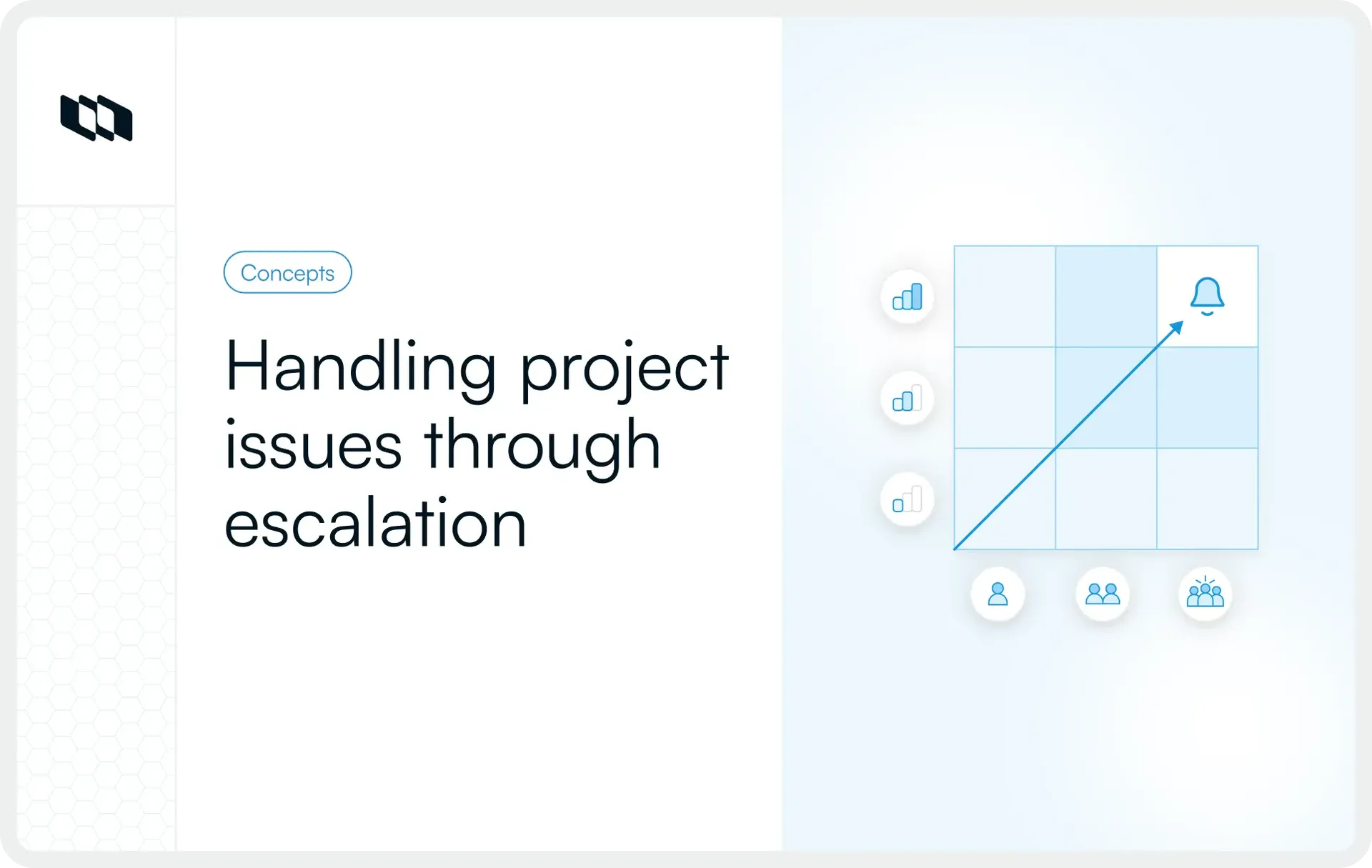
Project escalation plays a critical role in keeping work moving when teams hit decision limits. Without clear procedures, issues linger, ownership blurs, and delivery risks grow. Project escalation procedures provide a structured way to raise issues, involve the right leaders, and unblock progress. This guide breaks down project escalation in project management, explains when to escalate issues, and walks through a practical process for doing so. You will also learn how escalation levels, escalation matrices, and real-world examples apply in active projects.
What is project escalation?
Project escalation is the process of raising an issue to a higher level when the current owner cannot resolve it within their authority, time, or available resources. In project management, escalation exists to protect delivery outcomes, not to assign blame or bypass teams.
A project issue becomes an escalation when progress depends on a decision that the team cannot make on its own. Project escalation procedures define how issues are routed to the appropriate decision-maker in a clear and predictable way.
What does escalation mean in day-to-day project work
In practice, project escalation in project management means recognizing when an issue has crossed a threshold that affects delivery. This threshold could involve timelines, budget, scope, quality, or cross-team dependencies.
For example, a project manager may identify a dependency delay that impacts the release date. If the team lacks the authority to reprioritize work across teams, the issue must be escalated. The goal is to secure a decision that unblocks progress.
Why project escalation exists
Projects operate within defined limits. Teams can solve most problems at their level, yet some issues require broader authority or trade-off decisions.
Project escalation procedures exist to:
- Ensure decisions reach the right level quickly
- Reduce delays caused by unclear ownership
- Protect project timelines and outcomes
A clear project escalation process helps teams act early, communicate impact clearly, and avoid prolonged uncertainty.
What makes an issue escalation-worthy
An issue qualifies for project issue escalation when resolution depends on factors beyond the team’s control. Common signals include:
- decisions that require leadership approval
- resource or budget constraints
- cross-functional alignment issues
- risks that threaten delivery commitments
When these conditions appear, escalation becomes a structured response rather than an emotional reaction.
Project escalation as a delivery safeguard
Effective project escalation in project management supports transparency and accountability. It creates a shared understanding of when and how issues move up, preventing confusion and last-minute surprises. A well-defined project escalation process helps teams focus on execution while leaders focus on decisions that shape outcomes.
Project escalation vs. issue management vs. risk management
Project escalation, issue management, and risk management often appear together in project discussions, yet each plays a distinct role in project control. The table below summarizes their differences, followed by brief explanations of how they work together in practice.
Aspect | Issue management | Risk management | Project escalation |
Primary focus | Problems that are already affecting work | Events that may affect the project in the future | Decisions required to unblock progress |
Timing | During execution | During planning and throughout the project | When authority, time, or resources limit action |
Ownership | Team members or the project manager | Project manager with stakeholders | Project manager escalating to decision-makers |
Typical outcome | Issue resolution at the team level | Mitigation or contingency planning | Approval, prioritization, or trade-off decisions |
Role in control | Keeps day-to-day work moving | Reduces uncertainty and surprises | Protects delivery when action is blocked |
How issue management works in projects
Issue management focuses on handling problems that already exist. These issues affect active tasks and require timely resolution to avoid delays. Teams usually resolve issues within their scope by assigning owners, setting deadlines, and tracking progress. Issue management remains effective as long as teams have the authority and resources to act.
How risk management supports planning
Risk management addresses uncertainty before it turns into impact. Teams identify possible risks, assess their likelihood and severity, and prepare response plans. Risks remain potential events until they occur. This approach helps teams prepare rather than react, improving predictability during execution.
Where project escalation fits in
Project escalation becomes necessary when an issue or risk reaches a point where the team cannot proceed without a decision from a higher level. In project escalation in project management, the focus shifts from execution to decision authority. A structured project escalation process ensures the right stakeholders step in to approve changes, allocate resources, or adjust priorities.
How these practices work together
Issue management handles current problems. Risk management prepares for future ones. Project escalation connects both to leadership decisions when progress depends on authority beyond the team. Together, they create a balanced system for maintaining control and momentum throughout the project.
Why do issues escalate in projects
Issues escalate in projects when teams reach limits that affect delivery. These limits usually involve authority, capacity, or dependencies rather than effort. Understanding why escalation occurs helps teams respond early and with clarity.
1. Unclear ownership or decision rights
Projects slow down when teams lack clarity on who owns a decision. Work continues, discussions repeat, and issues linger without resolution. When no single owner can approve a change or set direction, the issue must be escalated to establish accountability and move work forward.
2. Resource or capacity constraints
Resource limits often trigger project issue escalation. A key team member may be overloaded, reassigned, or unavailable at a critical moment. When teams cannot adjust capacity or priorities on their own, escalation becomes necessary to reallocate resources or reset commitments.
3. Missed dependencies or handoffs
Many projects rely on work across multiple teams. When a dependency slips or a handoff breaks down, progress stalls. If the affected team lacks the authority to reprioritize external work, the issue escalates so leaders can resolve cross-team alignment.
4. Budget or timeline pressure
Projects operate within fixed constraints. As costs rise or schedules tighten, teams may face trade-offs they cannot decide independently. Project escalation procedures help bring these decisions to stakeholders who can approve changes or adjust expectations.
5. Quality or technical blockers
Technical complexity often surfaces late in execution. A defect, architectural limitation, or performance issue may threaten delivery quality. When resolving the problem requires additional time, scope changes, or expert input, escalation ensures the right decisions support long-term outcomes.
6. External vendor or stakeholder delays
External parties often influence project timelines. Vendor delays, contract constraints, or stakeholder availability can block progress. Since teams lack direct control in these situations, project escalation in project management enables leadership to intervene and unblock delivery.
When to escalate an issue
Knowing when to escalate is a core project management skill. Escalation works when it activates timely decisions and protects delivery outcomes. It loses value when it replaces ownership or problem-solving. Clear criteria help teams escalate with purpose and confidence.
Clear escalation triggers
An issue is ready for project escalation when it creates a risk that the team cannot address through execution alone. The triggers below help distinguish normal project friction from escalation-worthy situations.
- Impact exceeds agreed delivery thresholds: Projects operate within defined constraints for time, scope, cost, and quality. When an issue pushes the project beyond these agreed limits, the team needs approval to reset expectations or make trade-offs. Project escalation procedures ensure these decisions reach stakeholders who own delivery outcomes.
- Decision authority sits outside the team: Many project issues involve choices around priority, budget, or scope. When the team lacks authority to make these calls, progress depends on leadership input. In project management, project escalation moves decisions to the level where they can be acted upon without delay.
- Resolution attempts reach a limit: Teams often try multiple paths to resolve issues within their control. When these attempts stop producing progress, the issue shifts from execution to decision-making. Project issue escalation helps realign direction and prevent repeated cycles of discussion.
- Dependencies require intervention across teams: Cross-team work introduces shared ownership and competing priorities. When a dependency delay affects delivery and cannot be resolved through coordination alone, escalation aligns leadership. This helps remove blockers that teams cannot solve on their own.
When escalation reduces clarity
Escalation loses effectiveness when it replaces foundational project hygiene. Certain situations benefit more from refinement and local action than from upward movement.
- The issue lacks clarity and context: Escalating an unclear problem slows decision-making. Leaders need a concise summary of what happened, why it matters, and what outcome is at risk. Teams add value by defining the issue before escalating it.
- Local ownership has not been exercised: Many issues are resolved through direct discussion, scope clarification, or priority alignment within the team. When these steps remain untested, escalation introduces overhead without improving outcomes.
- Urgency outweighs delivery impact: Emotional urgency often feels immediate, yet project escalation should respond to measurable impact. Escalating based on delivery risk rather than frustration keeps the process objective and effective.
What strong teams do before escalating
Effective teams treat escalation as the final step in a clear process. Before escalating, they document the issue, assess impact, confirm ownership, and outline possible options. These inputs strengthen the project escalation process and help decision-makers act quickly and with confidence.
Types of project escalation
Project escalation takes different forms depending on where authority, expertise, or coordination is required. Understanding these escalation paths helps teams choose the right approach and avoid unnecessary delays.
1. Hierarchical escalation
Hierarchical escalation moves an issue up the reporting chain to someone with broader decision authority. Teams use this path when a decision affects priorities, scope, budget, or delivery commitments. It works best when the issue requires approval or trade-offs that shape overall outcomes.
For example, a project manager may escalate to a department head when a deadline requires reallocating resources across multiple teams. Since the decision impacts competing priorities, it sits at a leadership level rather than within the delivery team.
2. Functional escalation
Functional escalation routes an issue to another team or subject-matter expert who holds the required knowledge or capability. Authority may remain unchanged, yet resolution depends on specialized input. It supports collaboration across domains and helps teams resolve technical or operational blockers efficiently.
For example, a product team may escalate a performance issue to an infrastructure team that owns the underlying systems. The escalation focuses on expertise rather than hierarchy.
3. Formal escalation
Formal escalation follows a defined process with documentation, ownership, and timelines. Teams often use this approach for high-impact issues that affect delivery commitments or external stakeholders. It strengthens clarity when consequences affect multiple parties.
For example, a critical vendor delay may trigger a formal escalation with a written issue summary, impact assessment, and decision deadline. This structure ensures visibility and accountability across stakeholders.
4. Informal escalation
Informal escalation relies on direct communication rather than documented workflows. Teams use this approach for time-sensitive issues that require quick alignment. It supports speed and trust when the impact remains limited.
For example, a project manager may request a brief discussion with a functional lead to resolve a dependency delay before it affects the schedule. The issue remains controlled without entering a formal escalation path.
Choosing the right escalation path
Effective project escalation in project management depends on matching the issue to the appropriate path. Hierarchical escalation addresses authority gaps. Functional escalation addresses knowledge gaps. Formal and informal escalation define the level of structure required. Choosing the right escalation path keeps decisions timely and prevents unnecessary friction.
The project escalation procedure
A project escalation process works when it turns a messy issue into a clear decision. The steps below help you escalate with context, speed, and accountability, while keeping the team focused on delivery.
Step 1: Clearly define the issue
Start with one sentence that describes the problem in plain words. This sentence should answer three questions: what is happening, why it matters, and what is at risk.
A useful format can be: “Because X happened, Y outcome is at risk by Z date.”
This keeps project issue escalation grounded in impact rather than frustration.
Example: “The API contract changed during integration, so the release date is at risk by two weeks.”
Step 2: Assess impact and urgency
Decision-makers act faster when the impact is specific. Assess the issue across the main project constraints and state urgency based on delivery risk.
Cover these areas in simple terms:
- Time: what milestone or date moves, and by how much
- Cost: added spend, extended vendor time, or additional hours required
- Scope: features dropped, reduced, or added to recover delivery
- Quality: defect risk, performance impact, security concerns, or reliability issues
- Stakeholders: customer commitments, internal launches, or compliance implications
Then set urgency using a clear deadline, such as “decision needed by the end of the day Wednesday to protect the release plan.”
Step 3: Document what has already been tried
Escalation gains credibility when it shows due diligence. List what the team attempted, what outcomes occurred, and what remains blocked.
Keep this short and factual:
- Actions taken
- People involved
- Results observed
- Reason progress stopped
This reduces repeat discussions and helps leaders focus on decisions rather than re-triage.
Step 4: Identify the correct escalation level
Project escalation procedures depend on routing issues to the level that can act. The right escalation level is tied to the decision required, not seniority.
Use this simple matching logic:
- When the team needs expert input, escalate functionally to the right specialist or team
- When the team needs approval or trade-offs, escalate hierarchically to the decision owner
- When the issue affects multiple teams or commitments, escalate to the leader who can align priorities
A project escalation process stays efficient when every escalation includes a clear “decision owner.”
Step 5: Escalate with options, not just problems
Decision-makers need paths forward, not open-ended problems. Present two or three options with trade-offs. Each option should include the changes and the cost.
Useful option patterns include:
- Adjust scope to protect timeline
- Add capacity to protect the scope
- Move the date to protect quality
- Accept risk with mitigation steps
This step is where project escalation in project management becomes practical. You bring clarity, you reduce decision effort, and you speed up resolution.
Step 6: Agree on a decision and next steps
Escalation only helps when it produces a decision that changes execution. Capture the decision clearly and convert it into immediate next steps.
Include:
- The decision taken
- The owner for follow-up work
- The deadline for the next checkpoint
- Stakeholder update responsibilities
A project issue escalation becomes effective when it results in an owner, a timeline, and a measurable outcome.
Step 7: Capture learnings to prevent future escalations
After resolution, take five minutes to capture what caused the escalation and what should change next time. This is how teams improve the project escalation process over time.
Examples of useful learnings:
- Add clearer ownership for decision areas
- Define escalation thresholds earlier in planning
- Improve dependency tracking and handoffs
- Set communication protocols for high-risk work
This step turns escalation into a delivery safeguard rather than a recurring fire drill.
Escalation levels and roles in a project
Project escalation works when each role understands its responsibility in the escalation chain. Clear ownership prevents delays, repeated discussions, and missed decisions.
1. Team members
Team members are closest to the work and usually spot issues first. Their role in the project escalation process is to raise concerns early with clear context.
Typical responsibilities include:
- Identifying issues that affect task delivery or dependencies
- Sharing impact on timelines, quality, or handoffs
- Escalating to the project manager when the resolution exceeds their authority
Team members support project issue escalation by providing facts, not solutions that require approval.
2. Project manager
The project manager acts as the central point of escalation. This role assesses issues, determines impact, and decides whether escalation is required.
Key responsibilities include:
- Evaluating whether an issue meets escalation thresholds
- Documenting impact across time, cost, scope, and quality
- Selecting the correct escalation level
- Presenting options and recommendations to decision-makers
In project management, the project manager ensures project escalations remain structured, timely, and focused on outcomes.
3. Functional or program leads
Functional or program leads handle escalations that affect cross-team coordination, shared resources, or multiple projects. They bring broader visibility and authority to align priorities.
Their responsibilities include:
- Resolving conflicts between teams or functions
- Approving resource shifts or sequencing changes
- Balancing trade-offs across initiatives
Escalation at this level helps restore flow when issues extend beyond a single project boundary.
4. Project sponsor or steering committee
The project sponsor or steering committee owns escalations with strategic impact. These escalations involve major changes to scope, budget, timeline, or risk exposure.
Responsibilities at this level include:
- Approving significant trade-offs or delivery changes
- Aligning project decisions with business goals
- Removing organizational or external blockers
At this stage, project escalation procedures ensure leadership decisions protect long-term outcomes rather than short-term fixes.
How escalation flows across levels
Each escalation level builds on the previous one. Team members surface issues. Project managers assess and structure them. Functional or program leads align execution across teams. Sponsors and steering committees make decisions that shape delivery direction. This clear flow keeps the project escalation process efficient and predictable.
Final thoughts
Project escalation works when it supports timely decisions and protects delivery outcomes. Clear project escalation procedures help teams raise issues with context, involve the right decision-makers, and move work forward without confusion. When escalation follows a structured process, it strengthens accountability and reduces last-minute surprises. Teams that treat escalation as a delivery safeguard rather than a reaction build trust, maintain momentum, and handle complexity with confidence. A well-defined project escalation process ensures that problems surface early, decisions arrive on time, and projects stay aligned with their goals
Frequently asked questions
Q1. What is a project escalation?
Project escalation is the process of raising an issue to a higher level when the team cannot resolve it within its authority, time, or available resources. In project management, escalation helps move decisions to the right stakeholder so delivery risks receive timely action.
Q2. What are the three types of escalation?
The three common types of project escalation are hierarchical, functional, and by formality. Hierarchical escalation moves issues up the reporting chain for decisions or approvals. Functional escalation routes issues to another team or expert for resolution. Formal and informal escalation describe how structured the escalation process is based on impact and urgency.
Q3. What is the escalation process?
The project escalation process is a structured sequence for resolving blocked issues. It typically includes defining the issue, assessing impact, documenting attempted solutions, escalating to the correct decision-maker, presenting options, agreeing on a decision, and tracking follow-up actions. This process ensures escalation leads to resolution rather than repeated discussion.
Q4. What are the 7 stages of escalation?
The seven stages of escalation in project management include identifying the issue, defining its impact, attempting a local resolution, selecting the appropriate escalation level, presenting options, securing a decision, and capturing lessons learned. These stages help teams escalate issues with clarity and accountability.
Q5. What are the 4 stages of escalation?
The four stages of escalation represent a simplified view of escalation flow. They include issue identification, escalation to the appropriate authority, decision-making, and execution of the agreed action. These stages highlight the transition from problem recognition to delivery recovery.
Recommended for you




 Download for Mac
 Download for Android