Managing uncertainty in long-term projects
Introduction
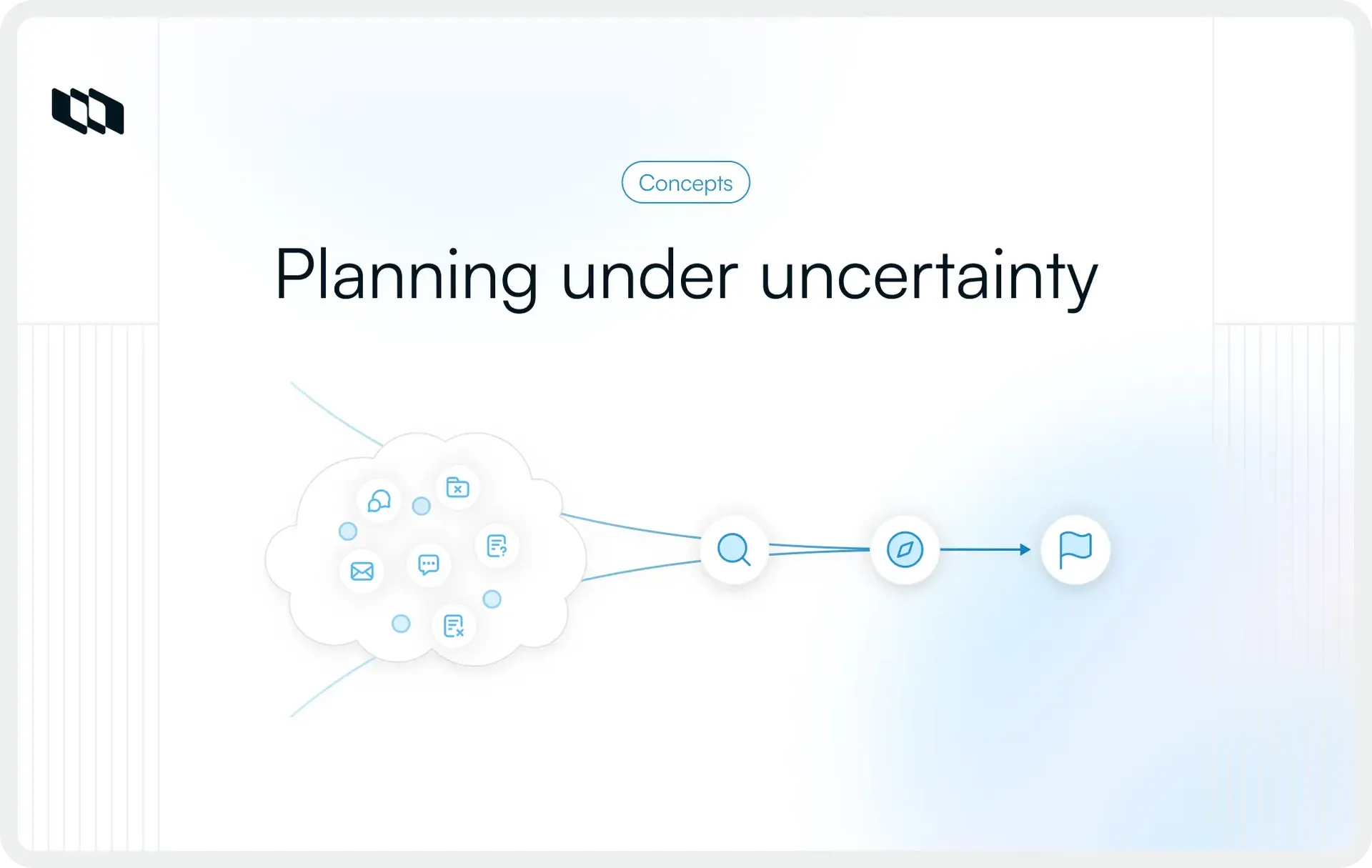
Long-term project planning often assumes that clarity improves automatically with time. In reality, uncertainty grows unless teams actively reduce it. Dependencies shift, priorities change, and early estimates lose relevance faster than expected.
Managing uncertainty in long-term projects requires a different approach to planning and execution. This guide focuses on practical techniques that help teams surface unknowns early, make stronger decisions with limited information, and sustain momentum across complex, multi-month initiatives.
What does uncertainty mean in project management
Uncertainty in project management refers to the lack of complete or stable information needed to plan and execute work with confidence. In long-term projects, this uncertainty grows over time as assumptions age and new variables emerge. Requirements evolve, constraints shift, and decisions made early must often be revisited as reality becomes clearer. Understanding what uncertainty actually represents is the first step toward managing it effectively.
Uncertainty vs risk
Risk and uncertainty are closely related, which is why they are often used interchangeably in project conversations. However, they describe different planning challenges.
- Risk involves situations where possible outcomes are known and can be estimated using probabilities. Teams can anticipate these scenarios and prepare mitigation or contingency plans in advance.
- Uncertainty exists when outcomes cannot be clearly defined upfront. The information needed to predict impact or likelihood is incomplete and changes as the project progresses. In long-term project planning, uncertainty requires continuous learning and adjustment rather than one-time analysis.
Why long-term projects amplify uncertainty
Long-term projects magnify uncertainty because critical decisions are made far ahead of execution. Early assumptions quickly harden into plans, even though the underlying context continues to change.
As timelines extend, teams evolve, priorities shift, and external conditions such as budgets, markets, or regulations introduce new constraints. Feedback loops are also slower in the early phases, delaying validation of assumptions. Over time, these factors compound, increasing project uncertainty and placing sustained pressure on planning, coordination, and decision-making.
The main types of uncertainty in long-term projects
Uncertainty in long-term projects does not show up in a single form. It appears in patterns that affect planning, execution, and decision-making in different ways. Treating all uncertainty the same often leads teams to apply the wrong response. A simple way to manage uncertainty in projects is to first identify the type you are dealing with.
1. Variation
Variation refers to small, expected deviations that occur in day-to-day project execution. These include slight estimate overruns, temporary resource unavailability, or minor rework. Individually, these shifts seem manageable. Over long timelines, they accumulate and quietly erode delivery predictability. Variation is common in long-term project planning and requires ongoing monitoring rather than major changes to the plan.
2. Foreseen uncertainty
Foreseen uncertainty includes areas where teams know there is risk, but lack precise outcomes. Examples include integrating with unfamiliar systems, adopting new technology, or coordinating across multiple teams. The uncertainty is visible early, even if its impact is not fully understood. Managing this type of project uncertainty depends on early exploration, expert input, and incremental validation.
3. Unforeseen uncertainty
Unforeseen uncertainty emerges during execution and cannot be predicted during planning. These are the “unknown unknowns” that surface through real-world use, shifting dependencies, or unexpected constraints. In long-term projects, this type of uncertainty often drives rework and delays in decision-making. Responding effectively requires fast learning, open communication, and the ability to adapt plans without losing direction.
4. Chaos
Chaos represents situations where upfront planning provides limited value. Requirements are unclear, constraints shift rapidly, and outcomes cannot be predicted with confidence. In these moments, progress comes from learning rather than forecasting. Managing uncertainty in such environments means shortening planning cycles, testing assumptions quickly, and allowing direction to emerge through execution rather than prediction.
Common sources of uncertainty in long-term projects
Uncertainty in long-term projects often comes from structural conditions rather than poor execution. As timelines extend, more variables influence outcomes, many of which sit outside a single team’s control. Recognizing these sources early helps teams anticipate where uncertainty is likely to grow and plan accordingly.
1. Evolving requirements and scope changes
Requirements rarely remain static over long timelines. As user needs become clearer and business priorities shift, the scope evolves. Without deliberate mechanisms to absorb change, these shifts introduce uncertainty into schedules, dependencies, and delivery expectations.
2. Cross-team and external dependencies
Long-term projects depend on coordination across teams, vendors, or systems. Each dependency adds variables related to timing, quality, and availability. As the number of dependencies grows, so does project uncertainty, especially when ownership or communication is unclear.
3. Estimation uncertainty in early phases
Early estimates rely heavily on assumptions. Limited information, unvalidated approaches, and unknown constraints make precision difficult at the start of long-term project planning. As work progresses, these early estimates often require revision, increasing uncertainty if they are treated as fixed commitments.
4. Decision delays and unclear ownership
When decision rights are unclear, progress slows. Unresolved questions linger, work stalls, and teams hesitate to move forward. Over time, decision delays compound uncertainty by pushing risk and rework later into execution.
5. Team changes and knowledge gaps
Staff changes are common in long-running projects. When knowledge is not documented or shared effectively, context is lost. New team members need time to rebuild understanding, which introduces uncertainty into timelines and execution quality.
6. Market, regulatory, or budget shifts
External forces such as market conditions, compliance requirements, or budget adjustments can reshape project constraints with little notice. These changes often sit outside the project team’s influence but have a direct impact on planning and delivery.
How uncertainty shows up during project execution
Uncertainty in project management rarely appears as a single disruptive event. It surfaces gradually through patterns that signal growing gaps between plans and reality. Recognizing these signals early allows teams to respond before uncertainty turns into delivery risk.
1. Plans lose clarity over time
In the early phases of long-term projects, plans feel detailed and confident. As execution progresses, assumptions weaken, and dependencies shift. Timelines become less specific, milestones feel harder to define, and the plan starts to describe intent rather than concrete outcomes.
2. Rework increases and work stalls
As unknowns surface, teams revisit earlier decisions or redo completed work. Tasks pause while waiting for clarification, inputs, or approvals. Over time, this rework compounds, slowing progress and increasing project uncertainty.
3. Schedules become negotiation tools
When uncertainty grows, delivery dates stop serving as forecasts and become negotiation points. Discussions focus on defending or revising timelines rather than assessing what has changed and why. This shift signals that planning confidence is eroding.
4. Stakeholder confidence declines
As uncertainty remains unresolved, stakeholders struggle to form clear expectations. Updates feel less definitive, and trust in the plan weakens. This often leads to more oversight, more questions, and slower decision-making.
5. Teams hesitate to commit or escalate
In uncertain environments, teams become cautious. Commitments feel risky, and raising issues feels costly. When escalation slows, uncertainty stays hidden longer and becomes harder to address later in execution.
How to reduce uncertainty without pretending to eliminate it
Uncertainty in long-term projects cannot be removed upfront. It can only be reduced over time through deliberate choices in how work is planned, sequenced, and reviewed. Teams that manage uncertainty well focus less on locking in perfect plans and more on creating systems that convert unknowns into knowledge as early as possible.
1. Break work into learning milestones
Traditional milestones focus on outputs such as features delivered or phases completed. Learning milestones concentrate on validating the assumptions with the most uncertainty. These may include technical feasibility, integration complexity, user behavior, or operational constraints.
By structuring long-term project planning around learning milestones, teams gain clarity earlier. Each milestone answers a specific question, reducing uncertainty and informing subsequent decisions. This approach prevents teams from progressing deep into execution before discovering that key assumptions were incorrect.
2. Involve experts and stakeholders early
Uncertainty grows when decisions are made in isolation. Experts and stakeholders often hold critical context about constraints, dependencies, and trade-offs that surface much later if they are not involved early.
Early engagement reduces assumption debt. Instead of discovering misalignment during execution, teams validate direction while changes are still inexpensive. In long-term projects, this practice improves decision quality and reduces rework caused by late feedback or delayed approvals.
3. Run pilots, prototypes, or thin slices
Pilots and prototypes turn uncertainty into observable data. Rather than debating what might happen, teams test a small, controlled version of the work to see what actually happens.
Thin slices are especially effective in uncertain project environments. They allow teams to exercise real workflows, integrations, or user paths without committing to full-scale delivery. This approach surfaces technical and operational unknowns while change remains manageable and learning is rapid.
4. Use buffers intentionally
Buffers are a response to uncertainty, not a sign of poor planning. Time buffers absorb variation in execution. Capacity buffers protect teams from overload when unexpected work appears. Decision buffers account for delays in approvals or cross-team coordination.
The key is visibility. Buffers that are hidden become eroded without awareness. Buffers that are explicit can be monitored, adjusted, and discussed openly. In long-term projects, actively managed buffers provide flexibility without creating false confidence or unrealistic commitments.
Planning long-term projects when estimates are unreliable
In long-term projects, estimates are least reliable when they matter most. Early timelines are built on assumptions that have not yet been validated, yet they often become the foundation for commitments. Effective long-term project planning accepts this reality and adapts how plans are created, communicated, and refined over time.
1. Plan in horizons
Planning in horizons aligns effort with certainty. Near-term work benefits from detailed planning because information is freshest and feedback is fastest. Teams can define tasks, owners, and acceptance criteria with confidence.
Mid-term planning should remain directional. At this stage, the focus shifts to sequencing, dependencies, and decision points rather than precise task breakdowns. Long-term planning works best as placeholders that signal intent and scope without overcommitting to specifics that are likely to change. This horizon-based approach allows plans to evolve as uncertainty reduces, without requiring constant rework.
2. Use ranges instead of single-date commitments
Single-date commitments create a false sense of precision in uncertain environments. Ranges communicate both intent and risk more accurately. Best-case, likely, and worst-case scenarios acknowledge variability while still providing useful guidance for decision-making.
As uncertainty decreases, these ranges should narrow. Updating ranges is a sign of learning, not instability. In long-term project planning, this practice improves trust by aligning expectations with current knowledge rather than outdated assumptions.
3. Tackle riskiest work first
The highest-risk work holds the most uncertainty. Deferring it increases the chance that critical issues surface late, when change is expensive and disruptive.
By addressing riskiest elements early, teams convert uncertainty into insight while there is still flexibility to adjust direction. This approach shortens feedback loops, strengthens estimates, and reduces the likelihood of late-stage surprises that threaten delivery.
Communicating uncertainty without losing stakeholder trust
Uncertainty creates discomfort for stakeholders when it is hidden, inconsistent, or poorly framed. Trust erodes when plans appear confident on the surface but shift without explanation. Clear communication does not remove uncertainty, but it gives stakeholders confidence that it is being managed deliberately.
1. Talk about uncertainty clearly
Clear communication starts with precision. Probabilities communicate reality better than certainty. Sharing best-case, likely, and worst-case scenarios helps stakeholders understand both direction and risk without inflating expectations.
Equally important is framing trade-offs explicitly. Long-term projects often require choices between scope, time, and capacity. Stating these trade-offs upfront creates alignment and prevents future conflict when priorities shift. Transparency strengthens credibility even when outcomes remain uncertain.
2. Create predictable decision and review cadences
Uncertainty feels chaotic when decisions appear ad hoc. Predictable cadences create stability. Stakeholders should know when key decisions are made, who owns them, and what inputs are required.
Equally important is setting clear moments to revisit assumptions. As projects progress and new information emerges, previously sound decisions may require adjustment. Scheduled reviews normalize change and reinforce that updates reflect learning rather than indecision.
3. Keep a single source of truth
Fragmented information increases uncertainty. When plans, assumptions, risks, and decisions live across documents and tools, alignment suffers.
A single source of truth provides shared visibility into what is known, what is assumed, and what has been decided. It reduces misinterpretation, speeds up decision-making, and ensures that all stakeholders operate from the same understanding of the project’s current state.
Lightweight artifacts that help manage uncertainty over time
Managing uncertainty in long-term projects requires more than good intentions. Teams need simple artifacts that make uncertainty visible, track learning, and support better decisions as conditions change. The goal is clarity and continuity, not documentation for its own sake.
1. Assumptions log
An assumptions log captures what the team currently believes to be true. These assumptions often sit beneath plans without being explicitly stated. Writing them down makes uncertainty visible and creates a clear trigger for review when conditions change. Over time, this log shows which assumptions were validated, revised, or replaced.
2. Risk register
A risk register helps teams track known risks that could affect delivery. In long-term projects, risks evolve as work progresses. Regularly reviewing and updating this register ensures that foreseen uncertainty stays current and does not quietly turn into late-stage surprises.
3. Decision log
Long-running projects involve hundreds of decisions, many of which are revisited months later. A decision log records what was decided, why it was decided, and what information was available at the time. This context reduces rework, prevents circular discussions, and supports faster alignment when circumstances shift.
4. Dependency tracker
Dependencies are a major source of project uncertainty. A dependency tracker makes cross-team and external dependencies explicit by capturing ownership, timing, and status. This visibility helps teams anticipate delays, coordinate proactively, and reduce surprises caused by misalignment.
5. Milestone plan with explicit buffers
A milestone plan that includes visible buffers acknowledges uncertainty directly. Time, capacity, and decision buffers provide flexibility without hiding risk. When buffers are tracked openly, teams can adjust plans early rather than react late, preserving momentum over long timelines.
Common mistakes that increase uncertainty over time
Uncertainty in long-term projects often grows due to avoidable decisions rather than unavoidable complexity. These patterns appear repeatedly across teams and industries and quietly undermine even well-intentioned plans.
1. Locking dates too early
Early timelines are often treated as commitments rather than forecasts. When dates harden before assumptions are validated, teams inherit pressure that limits learning and flexibility. As reality diverges from early plans, uncertainty increases rather than decreases.
2. Hiding buffers instead of managing them
Buffers are sometimes concealed to make plans appear confident. When buffers are hidden, they get consumed without visibility or discussion. This erodes trust and removes the ability to respond deliberately when conditions change.
3. Treating uncertainty only as a risk register problem
Risk registers capture known risks, but they do not address knowledge gaps. When teams rely solely on risk tracking, unforeseen uncertainty remains unmanaged. Long-term project planning requires continuous learning, not just periodic risk reviews.
4. Delaying validation of key assumptions
Critical assumptions often sit untested while teams focus on delivery. When these assumptions are validated late, the cost of change is significantly higher. Early validation reduces uncertainty and prevents large-scale rework.
5. Unclear decision ownership
When it is unclear who owns which decisions, progress slows. Questions linger, escalation is delayed, and uncertainty accumulates. Clear decision ownership accelerates learning and reduces friction throughout execution.
Final thoughts
Long-term projects succeed by reducing uncertainty gradually, not by predicting everything upfront. As work progresses, teams learn more about constraints, dependencies, and outcomes that were unclear at the start. Progress comes from converting unknowns into informed decisions, step by step.
Effective project uncertainty management prioritizes learning, visibility, and decision quality over rigid plans. Adaptive planning allows teams to respond as reality evolves, while clear communication keeps stakeholders aligned and confident throughout the journey.
You do not need perfect foresight to deliver complex, long-term work. You need systems that help teams learn faster, plan deliberately, and move forward with clarity even when the future remains uncertain.
Frequently asked questions
Q1. How to manage uncertainty in a project?
Managing uncertainty in a project starts with identifying what is unknown and why it is unknown. Break work into learning milestones, validate assumptions early, and plan in horizons rather than fixed timelines. Use ranges instead of single-date commitments, surface dependencies clearly, and create regular decision and review cadences. Over time, this approach reduces uncertainty by turning unknowns into informed decisions.
Q2. What are the 5 C’s of project management?
The 5 C’s of project management commonly refer to clarity, communication, coordination, commitment, and control. Together, they help teams align goals, manage dependencies, maintain stakeholder trust, and guide execution. In long-term projects, these elements support better decision-making as uncertainty evolves.
Q3. What is the 15-15 rule in project management?
The 15-15 rule suggests reviewing a project every 15 days for 15 minutes to assess progress, risks, and blockers. This lightweight cadence helps teams surface issues early, maintain alignment, and adapt plans before small problems become major disruptions, especially in long-running projects.
Q4. How to manage a long-term project?
Managing a long-term project requires adaptive planning rather than fixed forecasts. Plan in horizons, address high-risk work early, involve stakeholders continuously, and maintain clear visibility into assumptions, risks, and decisions. Regular reviews and clear ownership help teams stay aligned as conditions change over time.
Q5. What are the four types of project uncertainty?
The four common types of project uncertainty are variation, foreseen uncertainty, unforeseen uncertainty, and chaos. Variation involves small expected deviations. Foreseen uncertainty includes known areas of doubt. Unforeseen uncertainty covers unknown unknowns that emerge during execution. Chaos describes situations where learning becomes more important than upfront planning.
Recommended for you



 Download for Mac
 Download for Android