Issue tracking workflow: Definition, stages, and examples
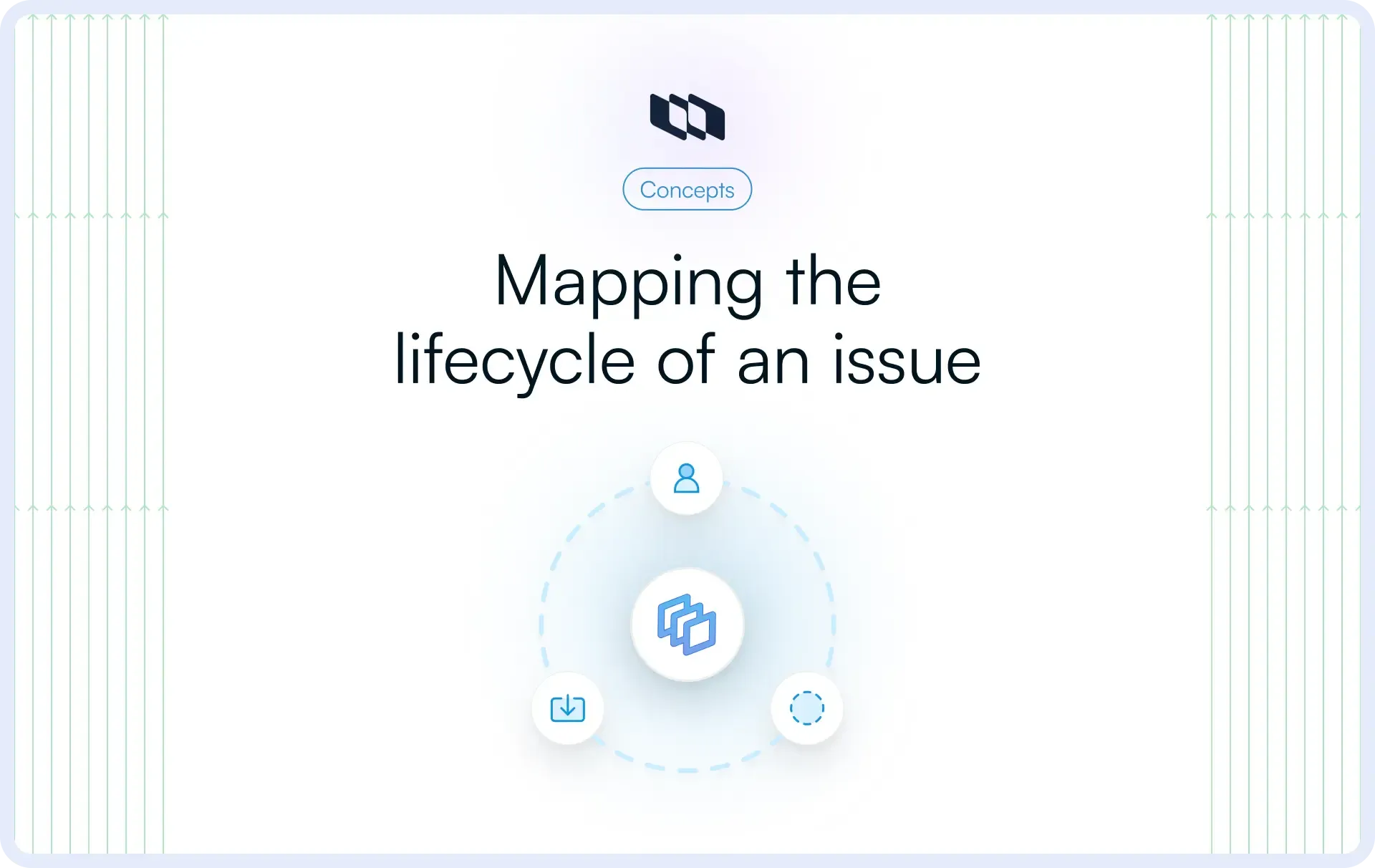
Introduction
Every growing product eventually reaches a point where issues multiply faster than clarity. Bugs stack up, tickets circulate, and priorities shift daily. What separates high-performing teams from reactive ones is a disciplined issue tracking workflow. A well-defined issue management workflow maps each issue through structured lifecycle stages, assigns clear ownership, and creates measurable resolution outcomes. In this guide, we define the issue-tracking process in depth, outline the key stages, and share workflow examples to help teams build a scalable issue-tracking system.
What is an issue tracking workflow?
An issue tracking workflow is a structured process that moves an issue from identification to closure through defined lifecycle stages, ownership rules, and status updates. It ensures that each issue is documented, prioritized, assigned, resolved, and reviewed within a consistent system. A well-designed issue management workflow provides teams with clarity on who owns the issue, its current stage, and what needs to happen next. This structure turns scattered problem reports into trackable work that teams can manage and resolve with confidence.
What qualifies as an issue in modern teams
In modern product and project environments, an issue includes any item that affects delivery, quality, or user experience. Teams track multiple issue types within a single issue tracking system to maintain visibility and coordination.
Common issue types include:
- Bugs and defects that affect functionality or usability
- Performance or reliability issues that impact system stability
- Customer-reported problems from support or feedback channels
- Operational blockers that slow delivery or coordination
- Feature or improvement requests that require evaluation and action
A structured issue-tracking workflow ensures that all issue types follow a consistent path from reporting to resolution, regardless of their source.
Issue tracking vs. bug tracking vs. ticketing
These terms often appear together but serve different purposes within the broader issue management workflow.
- Bug tracking focuses on identifying, reproducing, and resolving software defects. It represents one category within the broader issue tracking process.
- Ticketing refers to the system used to capture and manage requests or problems. Support teams and IT teams often rely on ticket-based workflows to manage incoming issues.
- An issue-tracking workflow covers the entire end-to-end process. It connects reporting, triage, prioritization, assignment, resolution, and closure into a unified lifecycle.
While bug tracking and ticketing operate within this system, the issue-tracking workflow defines how every issue moves through the organization, with clarity and accountability.
Why issue tracking workflows matter for modern teams
As products scale and teams grow, the volume of issues across engineering, support, and operations increases. A structured issue-tracking workflow ensures these issues move through a clear process rather than getting buried across tools, messages, and meetings. Strong workflows improve speed, clarity, and reliability across the entire issue lifecycle.
1. Faster resolution and less firefighting
A defined issue tracking process reduces the time spent figuring out what needs attention and who should handle it. Clear reporting standards, prioritization rules, and ownership assignments allow teams to move directly from identification to resolution. This structure reduces repetitive investigation and enables faster turnaround across bug fixes, operational issues, and customer-reported problems.
2. Clear ownership and accountability
An effective issue management workflow assigns a single accountable owner to every issue. Teams gain clarity on who investigates, who resolves, and who verifies completion. This ownership model prevents issues from circulating across conversations and ensures steady progress through each stage of the issue lifecycle. Clear accountability also improves follow-through and the quality of resolution.
3. Better prioritization when everything feels urgent
Modern teams manage multiple streams of work simultaneously. Without a structured issue tracking workflow, urgent and important issues compete for attention without clear evaluation criteria. A defined prioritization approach enables teams to consistently assess severity, impact, and urgency. This helps teams focus on the issues that affect users, delivery timelines, and system stability the most.
4. Improved product quality and customer experience
Consistent issue tracking strengthens quality control across the product lifecycle. Teams capture defects, performance concerns, and customer-reported problems in a single system and move them through defined resolution stages. This structured approach improves reliability, reduces recurring issues, and creates a better experience for users who expect timely fixes and clear communication.
5. Better visibility across teams and stakeholders
A well-designed issue-tracking system provides real-time visibility into open issues, progress toward resolutions, and workload distribution. Product managers, engineering leaders, and stakeholders can review status updates without having to chase information across tools. This transparency supports better planning, stronger coordination, and more informed decision-making across projects and releases.
Core components of an effective issue tracking workflow
A reliable issue tracking workflow depends on a few foundational components. These components create consistency across teams and ensure that every issue moves through the issue lifecycle with clarity. When these elements remain undefined, issues circulate without structure, and resolution slows down across product and engineering teams.
1. Standardized issue reporting
Every issue should be entered into the issue tracking system with complete, structured information. Standardized reporting allows teams to quickly understand the problem and move it through the issue-tracking process without repeated clarification.
Each issue should include:
- A clear title
- A concise description
- Expected and actual impact
- Steps to reproduce when relevant, environment details, priority level,
- And an assigned owner
This structure ensures that anyone reviewing the issue can understand the context, urgency, and next steps without additional back-and-forth. Consistent reporting also improves searchability, trend analysis, and resolution speed across the issue management workflow.
2. Issue categories and types
Categorization plays a central role in an effective issue tracking workflow. When teams classify issues into defined types, routing and prioritization become faster and more accurate. Categories such as bugs, performance issues, operational blockers, and feature requests help teams direct work to the right owners and maintain organized backlogs.
Clear categorization also improves reporting and analysis. Teams can review which issue types occur most frequently, which product areas generate recurring problems, and where resolution time increases. This visibility supports better planning and continuous improvement throughout the issue-tracking process.
3. Statuses and workflow states
Statuses represent the progress of an issue as it moves through the workflow. Defined workflow states create shared understanding across teams and eliminate confusion around what “in progress” or “resolved” actually means.
A simple structure, such as open, triaged, in progress, resolved, and closed, works well for most teams. Each status should have a clear definition and exit criteria. Open indicates a newly reported issue. Triaged confirms validation and prioritization. In progress shows active work. Resolved indicates a completed fix or decision. Closed confirms verification and completion. Well-defined statuses make the issue lifecycle transparent and ensure consistent movement toward resolution.
4. Roles and responsibilities in issue tracking
A structured issue-tracking workflow functions smoothly when roles are clearly defined. Each issue moves faster when every participant understands their responsibility within the issue lifecycle.
- Reporter: Captures the issue with complete and structured information. The reporter provides context, details on impact, reproduction steps when applicable, and supporting evidence such as logs or screenshots. Strong reporting improves clarity at the outset of the issue-tracking process.
- Triage owner: Reviews new issues, validates completeness, removes duplicates, categorizes correctly, and sets initial priority. The triage owner protects the workflow from noise and ensures that only actionable issues move forward.
- Assignee: Takes accountability for investigating and resolving the issue. The assignee analyzes root cause, proposes a solution, implements changes, and updates status as the issue progresses through the workflow stages.
- Reviewer or QA: Verifies the resolution. This role confirms that the issue is fully addressed, checks for regressions, and validates that acceptance criteria are met before closure.
- Closer: Confirms final completion within the issue tracking system. The closer ensures documentation is updated, resolution notes are clear, and the issue lifecycle reaches a clean endpoint.
Clear role definitions reduce ambiguity and maintain steady movement across the issue management workflow.
5. Prioritization and severity frameworks
An effective issue tracking workflow depends on disciplined prioritization. Teams often confuse urgency with impact, which leads to reactive decision-making.
- Impact measures the consequence of the issue on users, revenue, delivery timelines, or system stability. High-impact issues affect critical workflows or a large portion of users.
- Urgency measures how quickly the issue requires action. An urgent issue may demand immediate attention due to release schedules, contractual obligations, or operational risk.
A structured issue tracking process evaluates both dimensions together. Teams often use severity levels such as critical, high, medium, and low, combined with business impact assessments. For example, a high-impact, high-urgency issue moves to the top of the queue, while a low-impact, low-urgency issue enters the backlog for planned resolution.
Clear prioritization criteria ensure that teams focus on meaningful outcomes rather than reacting to the loudest request.
Key stages of an issue tracking workflow
A robust issue-tracking workflow ensures issues move clearly and accountably from discovery to resolution. Defined stages provide proper attention, context, and ownership, improving resolution speed and enabling quick identification of recurring problems.
Stage 1: Issue identification and reporting
Every issue tracking workflow begins with clear identification. Issues can originate from customer feedback, QA testing, system monitoring, internal reviews, or stakeholder requests. Teams should provide a single intake path so issues enter the issue tracking system in a structured format.
Capture the source of the issue, affected components, and initial impact. A consistent intake process ensures that issues reach the system quickly and remain visible from the start.
Stage 2: Issue documentation
Once reported, the issue must be fully documented. Clear documentation reduces the need for repeated clarification and speeds up investigations.
Include a concise description, expected and actual behavior, steps to reproduce when relevant, screenshots or logs, affected environment, and initial priority. Well-documented issues enable teams to move forward without delays and to improve collaboration across product, engineering, and support.
Stage 3: Triage and validation
Triage ensures that each issue entering the workflow is valid, actionable, and correctly categorized. During this stage, teams review duplicates, confirm accuracy, and request missing information.
Categorize the issue by type and affected area. Validate impact and assign an initial severity level. Effective triage prevents backlog clutter and ensures that only meaningful issues move forward in the issue tracking process.
Stage 4: Prioritization
Prioritization determines the order in which issues receive attention. Teams evaluate impact on users, delivery timelines, revenue, and system stability.
Use defined severity levels and business-impact criteria to consistently rank issues. A structured prioritization approach ensures that high-impact issues move ahead of lower-impact tasks and keeps the workflow aligned with product and operational goals.
Stage 5: Assignment and ownership
Once prioritized, the issue is assigned. Assign each issue to a clear owner who takes responsibility for investigating and resolving it.
Ownership should align with expertise and workload. One accountable assignee maintains progress, while collaborators can support investigation or implementation. Clear ownership prevents delays and keeps the issue lifecycle moving forward.
Stage 6: Investigation and root cause analysis
The assigned owner analyzes the issue to identify the root cause. Reproduce the problem, review logs, analyze recent changes, and gather relevant context.
Document findings directly in the issue-tracking system. Clear investigation notes improve collaboration and help future reviews when similar issues appear. Root cause clarity ensures that the resolution addresses the underlying problem rather than the symptoms.
Stage 7: Resolution and implementation
Resolution involves implementing a fix, workaround, or decision. The approach depends on issue type and severity. Engineering teams may release code fixes. Operations teams may adjust configurations. Product teams may decide to change scope or prioritization. Record the resolution approach and link related commits, tasks, or documentation within the issue tracking workflow for traceability.
Stage 8: Testing and verification
After implementation, teams verify that the issue is fully resolved. Testing confirms that the fix works as intended and maintains system stability.
Quality assurance reviews functionality, checks for regressions, and validates acceptance criteria. Verification ensures confidence before moving the issue toward closure and protects overall product quality.
Stage 9: Closure and documentation
Closure represents formal completion of the issue lifecycle. Before closing, confirm that the resolution meets expectations and that stakeholders have visibility into the outcome.
Add resolution notes, root-cause details, and relevant references, such as commits, release notes, or documentation updates. Proper closure creates a reliable record and improves future analysis throughout the issue-tracking process.
Stage 10: Review and continuous improvement
A mature issue tracking workflow includes regular review. Teams analyze patterns across resolved issues to identify recurring defects, operational gaps, or process inefficiencies.
Track metrics such as resolution time, reopen rate, and issue volume by category. Use these insights to refine prioritization rules, improve documentation standards, and strengthen workflow design. Continuous improvement ensures that the issue tracking system evolves alongside product and team complexity.
Best practices for building a strong issue tracking workflow
A structured issue-tracking workflow delivers value only when teams maintain consistency and discipline throughout the process. The following best practices help teams maintain an effective and sustainable issue management workflow.
1. Standardize how issues are logged
Consistent issue reporting is the foundation of an effective issue-tracking process. Every issue should follow the same logging format with defined fields and required context. Structured templates for bugs, operational issues, and feature requests improve clarity and reduce time spent gathering missing information. Standardized logging also improves searchability, reporting accuracy, and trend analysis across the issue tracking system.
2. Define clear ownership and response expectations
Each issue should have one accountable owner responsible for progress and resolution. Teams should also define response expectations for triage, investigation, and resolution timelines based on severity. Clear ownership and response standards prevent delays and ensure steady movement across the issue lifecycle. This structure supports accountability and builds trust across product, engineering, and support teams.
3. Set measurable goals and KPIs
A mature issue tracking workflow includes measurable performance indicators. Teams should track metrics such as time to first response, resolution time, reopen rate, and backlog volume by priority. These KPIs help leaders evaluate workflow efficiency and identify bottlenecks. Clear metrics also support continuous improvement and ensure that the issue tracking process aligns with delivery and quality goals.
4. Keep communication visible and centralized
All updates related to an issue should remain within the issue tracking system. Centralized communication ensures that context, decisions, and progress remain accessible to all stakeholders. Teams benefit from reduced context switching and improved transparency when discussions, status updates, and resolution notes stay linked to the issue itself. Visible communication supports faster decision-making and stronger coordination.
5. Review and clean up backlog regularly
A growing backlog without regular review undermines the effectiveness of any issue-tracking workflow. Teams should schedule recurring backlog reviews to reassess priority, close outdated issues, and update context where needed. Regular cleanup ensures that active issues remain visible and that the issue tracking process reflects current product and operational realities.
6. Improve workflows incrementally over time
An effective issue management workflow evolves with team needs and product complexity. Small, consistent improvements to reporting standards, prioritization rules, or workflow stages deliver better results than large disruptive changes. Regular reviews of workflow performance and team feedback help maintain an efficient, scalable system.
7. Track outcomes, not just activity
A strong issue-tracking system focuses on outcomes such as resolution quality, stability improvements, and reduced issue recurrence. Activity metrics alone provide limited insight. Teams should analyze whether resolved issues lead to lasting improvements and whether recurring patterns decrease over time. Outcome-focused tracking ensures that the issue-tracking workflow directly contributes to product reliability and operational efficiency.
Metrics to track issue workflow effectiveness
A structured issue-tracking workflow delivers consistent results when teams measure performance throughout the issue lifecycle. Clear metrics reveal where issues slow down, where ownership gaps appear, and how efficiently teams move from identification to closure. Tracking the right indicators helps teams refine their issue-tracking process and maintain consistent resolution standards.
1. Time to first response
Time to first response measures how quickly a newly reported issue receives initial acknowledgment and triage. A fast initial response builds confidence across teams and ensures that high-impact issues receive early attention. Monitoring this metric helps teams maintain discipline around intake and triage within the issue tracking workflow.
2. Resolution time
Resolution time tracks the duration from issue reporting to closure. This metric reflects overall efficiency across the investigation, implementation, and verification stages. Teams can analyze resolution time by issue type or severity to identify bottlenecks and improve workflow design. Consistent resolution timelines support predictable delivery and stronger operational reliability.
3. Reopen rate
Reopen rate measures how often closed issues are reopened. A high reopen rate signals incomplete investigation, insufficient testing, or unclear resolution criteria. Tracking this metric helps teams strengthen verification steps and improve resolution quality across the issue management workflow.
4. Issue backlog aging
Backlog aging tracks how long issues remain open without progress. Aging analysis highlights stalled issues and reveals gaps in prioritization. Reviewing aging trends ensures that important issues remain visible and receive timely attention. This metric also supports healthier backlog management in the issue-tracking system.
5. Escalation rate
Escalation rate reflects how frequently issues require intervention from leadership or senior stakeholders. A rising escalation rate may indicate unclear prioritization, resource constraints, or workflow inefficiencies. Monitoring escalation patterns helps teams refine severity frameworks and strengthen response planning for critical issues.
6. Throughput and closure rate
Throughput measures the number of issues that move to closure within a defined time period. The closure rate reflects the consistency of resolution across the issue-tracking process. Together, these metrics provide insight into team capacity, workload distribution, and workflow efficiency. Strong throughput and stable quality signal a healthy, well-managed issue-tracking workflow.
What to look for in an issue tracking system
An effective issue-tracking workflow relies on a system that provides visibility, structure, and flexibility. The ideal system supports execution over superficial features, aligning with product development, support, and project management needs while maintaining clarity and control.
1. Core workflow capabilities
An issue-tracking system should support structured workflow management. Teams should be able to define statuses, assign clear ownership, set priorities, and track progress at each stage of the issue-tracking process. Dashboards and workload views should provide real-time visibility into open issues, progress toward resolutions, and team capacity. These core capabilities ensure that issues move consistently from reporting to closure without manual tracking.
2. Integrations and collaboration features
Issue tracking rarely happens in isolation. Teams rely on development tools, communication platforms, and support systems throughout the issue lifecycle. Strong integrations allow issues to connect with code repositories, CI pipelines, documentation systems, and support channels. Integrated notifications and shared activity updates keep teams aligned and reduce context switching. Centralized collaboration improves response time and ensures that decisions remain visible within the issue-tracking workflow.
3. Reporting and analytics
A mature issue-tracking system provides reporting beyond basic counts. Teams should be able to analyze resolution time, reopen rates, backlog trends, and workload distribution. Historical insights help identify recurring problem areas and workflow bottlenecks. Clear analytics enable leaders to evaluate performance and improve the issue-tracking process using real data rather than assumptions.
4. Scalability and flexibility
As teams grow and products evolve, issue volume and complexity increase. An effective system should scale without requiring frequent structural changes. Flexible workflows, customizable fields, and adaptable reporting ensure the issue-tracking workflow continues to support evolving needs. Scalability also includes the ability to manage multiple projects, teams, and issue types within a unified system.
5. Security and deployment considerations
Data control and deployment flexibility are important factors in selecting an issue-tracking system. Teams handling sensitive information often require strong permission controls, audit trails, and compliance support. Deployment options such as cloud or self-hosted environments influence data governance and operational control. Organizations should evaluate which model aligns with their security standards, regulatory requirements, and infrastructure strategy before finalizing their issue tracking system.
How to set up an issue tracking workflow for your team
Designing an effective issue tracking workflow requires clarity, consistency, and continuous refinement. Teams benefit from a structured setup that defines how issues move through the system and how ownership and prioritization work at each stage.
The following steps provide a practical approach to building a reliable issue tracking process for product, engineering, and operations teams.
1. Define workflow stages and statuses
Start by defining the lifecycle stages that every issue should follow. Common stages include open, triaged, in progress, resolved, and closed. Each status should have a clear definition and exit criteria so teams share a common understanding of progress.
Keep the workflow simple and aligned with actual work patterns. A streamlined structure improves adoption and ensures the issue-tracking workflow remains easy to maintain as teams grow.
2. Create issue templates and standards
Standardized templates improve clarity and reduce back-and-forth during investigations. Define required fields for different issue types such as bugs, operational issues, and feature requests. Include title, description, impact, reproduction steps, environment details, priority, and owner.
Templates ensure that every issue enters the issue tracking system with consistent context. This improves triage efficiency and helps teams move quickly from reporting to resolution.
3. Assign clear ownership rules
Every issue should have one accountable owner responsible for driving progress. Define how ownership is assigned and how collaboration happens across teams. Support and product teams may report issues, while engineering or operations teams handle resolution.
Clear ownership rules reduce delays and prevent issues from circulating without progress. This structure strengthens accountability across the issue lifecycle.
4. Set review and triage cadences
Regular review cadences keep the issue tracking workflow healthy. Schedule recurring triage sessions to validate new issues, update priorities, and assign owners. Conduct backlog reviews to reassess aging issues and remove outdated items.
Defined cadences ensure the issue-tracking process remains up to date and aligned with team priorities. They also help teams maintain visibility into workload and resolution progress.
5. Continuously improve using workflow data
An effective issue tracking workflow evolves through data-driven improvement. Review metrics such as resolution time, reopen rate, and backlog aging to identify bottlenecks. Gather feedback from team members on where the process slows down or creates friction.
Use these insights to refine statuses, templates, and prioritization frameworks. Continuous improvement ensures the issue-tracking system remains efficient, scalable, and aligned with product and operational goals.
Final thoughts
An issue tracking workflow creates structure around uncertainty. It transforms scattered reports, urgent messages, and recurring defects into a defined issue tracking process with clear ownership and measurable progress. When teams align on lifecycle stages, prioritization standards, and accountability rules, resolution becomes predictable rather than reactive.
A strong issue management workflow supports clarity across product, engineering, and operations. It surfaces patterns, improves decision-making, and strengthens product quality over time. Teams that treat issue tracking as a structured system rather than a passive log build reliability into their delivery process and create a foundation for continuous improvement.
Frequently asked questions
Q1. What is the issue tracking process?
The issue tracking process is the structured method teams use to identify, log, prioritize, assign, resolve, and close issues. It ensures that every bug, task, or operational problem moves through defined lifecycle stages with clear ownership, status updates, and resolution tracking. A robust issue-tracking workflow improves visibility, accountability, and resolution speed across product and engineering teams.
Q2. What are the four types of workflows?
The four common types of workflows used in project and issue tracking systems are:
- Sequential workflow: Work moves through fixed stages in a defined order.
- State-based workflow: Progress depends on status changes such as open, in progress, and closed.
- Parallel workflow: Multiple tasks or investigations run at the same time.
- Rule-driven workflow: Automation routes issues based on priority, type, or conditions.
Most modern issue-tracking workflows combine state-based and rule-driven approaches.
Q3. How do you prepare an issue tracker?
To prepare an issue tracker, define workflow stages and statuses first. Create standardized issue templates that capture title, description, priority, impact, and owner. Set clear triage and prioritization rules to evaluate new issues. Assign ownership guidelines and resolution expectations. Track metrics such as resolution time and backlog size to continuously improve the issue tracking process.
Q4. What are the five stages of issue management?
The five main stages of issue management are:
- Identification: Capture and log the issue.
- Assessment: Evaluate impact and set priority
- Assignment: Assign a clear owner.
- Resolution: Investigate and implement a fix or decision.
- Closure: Verify resolution and close the issue with documentation.
These stages form the core of a structured issue management workflow used by product and project teams.
Q5. What is the difference between issue tracking and bug tracking?
Issue tracking covers all types of work that require resolution, including bugs, feature requests, operational problems, and support tickets. Bug tracking focuses specifically on identifying and resolving software defects. Bug tracking is part of a broader issue-tracking workflow that manages the full lifecycle of all issue types.
Recommended for you



 Download for Mac
 Download for Android