Building cross-functional Agile teams
Introduction
Agile teams move fastest when they are not required to wait on others. When work is handed off between separate design, engineering, backend, QA, and analytics teams, velocity decreases significantly. Cross-functional teams address this challenge by aligning individuals with diverse skill sets around a shared outcome, enabling them to deliver value without depending on external approvals or resources.
This guide explores why cross-functional teams consistently outperform siloed ones and outlines practical steps to build a team capable of delivering more efficiently, cleanly, and with fewer obstacles.
What is a cross-functional Agile team?
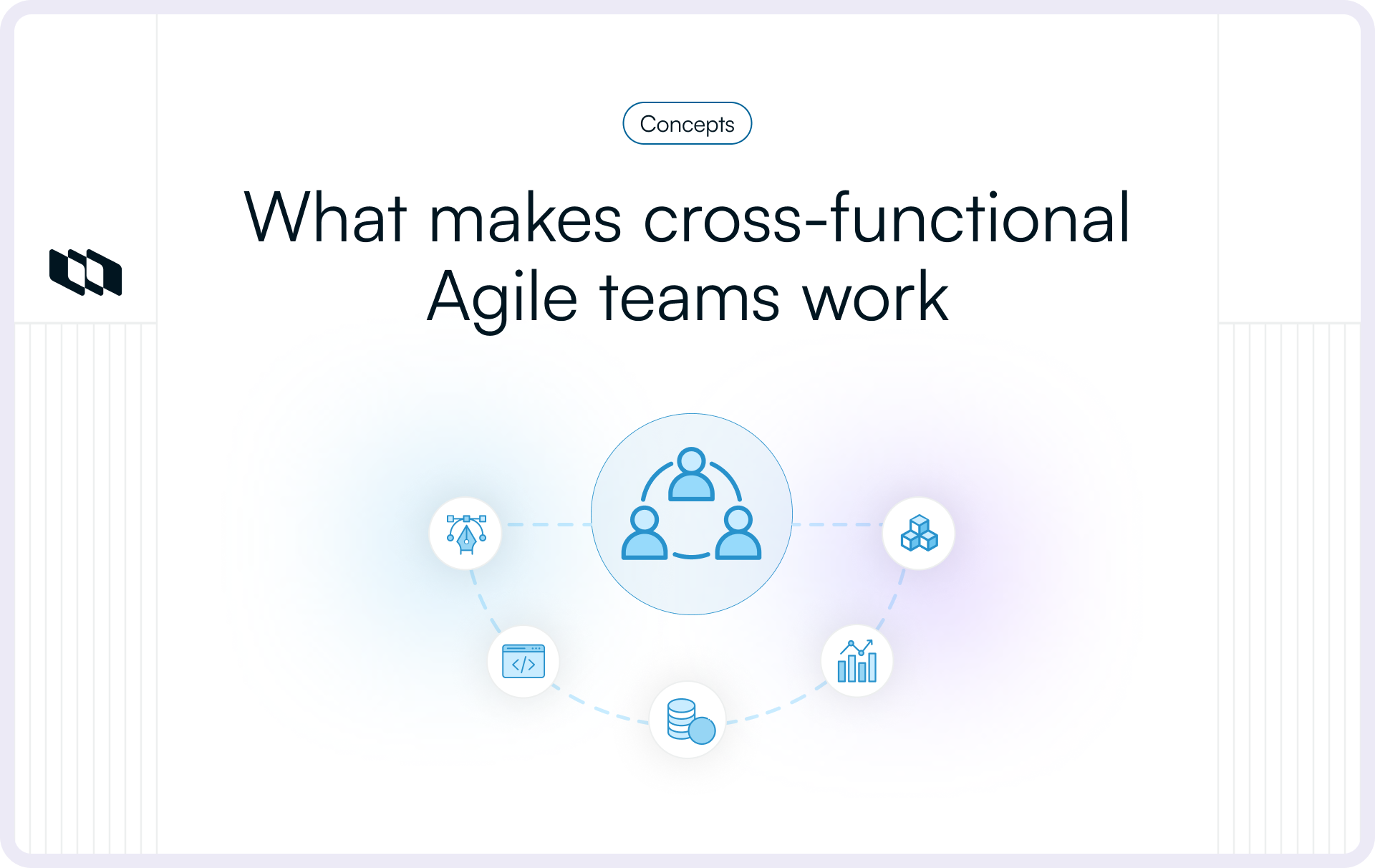
A cross-functional Agile team is a small, stable unit that includes all the skills required to deliver customer value from initiation to completion. Rather than relying on separate design, backend, frontend, QA, data, or operations teams, a cross-functional team owns the entire workflow—discovery, design, development, testing, and validation.
This approach differs significantly from functional or component-based team structures, in which work is passed between multiple departments through extended chains of handoffs. In such models, progress depends on the queues, priorities, or availability of others, which slows delivery and undermines ownership.
Cross-functional Agile teams succeed by eliminating these dependencies. They align diverse skills around a common goal, make decisions close to the work itself, and maintain contextual knowledge within the team. The results are faster iteration, fewer blockers, and greater transparency in accountability.
Key characteristics of a cross-functional team
- Diverse skills within a single team: Product, design, engineering, QA, and data professionals work as a unified group.
- Shared goals: Success is measured by outcomes, not by the completion of individual tasks.
- End-to-end ownership: The team is responsible for taking a problem from definition through to production.
- Fewer handoffs: External dependencies, delays, and context-switching are minimized.
Cross-functional teams are the organizational unit that Agile frameworks presuppose: small, empowered groups capable of delivering value independently.
Why cross-functional teams actually work
Cross-functional Agile teams work because they remove the structural causes of slow delivery — not just the symptoms. When the people who define, design, build, and validate work operate as one unit, everything moves faster and with far fewer surprises.
Below are the core benefits, explained with simple examples.
1. Faster delivery with fewer delays
Most delays happen when teams wait for each other — design waiting for backend, QA waiting for builds, and engineering waiting for clarifications. In a cross-functional team, these skills sit together, so answers and decisions happen immediately. Work flows continuously instead of pausing at every boundary.
Example: Instead of logging a ticket and waiting 2 days for another team to review it, the developer and designer resolve it in minutes during a quick pairing session.
2. Better decisions because context stays inside the team
When work is passed between multiple teams, context can get diluted. Each group only sees a slice of the problem. Cross-functional teams avoid this by keeping product, design, engineering, and QA in the same conversations, with the same understanding of the customer problem.
Example: A backend engineer doesn’t just receive a spec — they were part of the discovery call. So they catch edge cases early, not during sprint 3.
3. Stronger collaboration and shared accountability
Functional teams optimize for their own output — design hands off designs, engineering hands off code, QA hands off reports.
Cross-functional teams optimize for outcomes, not deliverables. Everyone owns the success of the feature, not only their part of it.
Example: If usability issues arise during testing, design, and engineering, resolve them together rather than passing the responsibility back and forth.
4. Higher-quality outcomes through tighter feedback loops
Quality improves when feedback arrives early and continuously.
In cross-functional teams, design reviews, technical discussions, and testing happen inside the same sprint, often on the same day.
Example: QA tests a feature while it’s being developed, not after a week-long handoff. Issues get fixed before they compound.
5. More learning, broader skill growth, and better morale
When people work in silos, they only see their slice of the process.
Cross-functional teams create exposure — designers learn how engineers think, engineers know how analytics shapes decisions, and the team becomes more versatile. This leads to higher autonomy, stronger problem-solving skills, and better team morale.
Example: A frontend engineer gains API knowledge by collaborating regularly with the backend, making future work smoother and faster.
When cross-functional teams make the biggest impact
Cross-functional Agile teams aren’t just a structural preference — they create outsized impact in specific situations where speed, clarity, and collaboration matter the most. If your team works in any of the scenarios below, cross-functionality becomes a force multiplier.
Ideal scenarios for cross-functional teams
1. Product teams shipping customer-facing features
When teams own a product area end-to-end — onboarding, dashboards, billing, mobile — they need fast decisions, tight feedback loops, and the ability to ship independently. A cross-functional team can move from problem to production without external queues slowing them down.
2. Customer journey work (activation, retention, expansion)
Customer journeys cut across multiple skills: design, engineering, analytics, research, and PM. Keeping these functions inside one team helps teams understand the full flow, not isolated touchpoints.
3. New product development or 0–1 work
Early-stage builds require rapid learning, constant iteration, and fewer approval cycles. A small, cross-functional team accelerates discovery and reduces the cost of wrong assumptions.
4. Platform or core services teams
Even on internal platforms, cross-functionality helps engineers, analysts, and QA members align on reliability, performance, and the internal user experience without waiting on other teams for clarity or fixes.
Signals your team needs restructuring
If your current structure shows any of these symptoms, a cross-functional model will likely help:
- Too many dependencies on external teams: If every feature requires coordination across design, backend, frontend, QA, and data teams, you’re operating in a dependency maze. Each dependency becomes a potential slowdown.
- Slow reviews or long waits between stages of work: Design reviews stuck in queues, backend PRs waiting for days, QA pipelines getting overloaded — these are signs the process is built around silos, not collaboration.
- Repeated blockers in sprints: If sprint retros keep surfacing the same issues — unclear requirements, missing designs, backend delays, unavailable reviewers — it’s a structural issue, not a process issue.
- Unclear ownership of outcomes: If no single team is accountable for a feature or product area's success, work floats between groups, and quality suffers. Cross-functional teams restore clear product ownership.
Foundations to get right before forming cross-functional teams
Cross-functional Agile teams only work when a few core foundations are already in place. Without these, even the best structure will slip back into silos, unclear ownership, or stalled decision-making. These are the essentials to align before you form or reorganize a team.
1. Shared product goals and aligned priorities
A cross-functional team can only operate effectively if everyone is driving toward the same outcomes. This means clear product goals, aligned quarterly priorities, and a shared definition of success. When the team understands why something matters, it becomes far easier to collaborate across skills and make trade-offs quickly.
2. Baseline psychological safety
Cross-functional work requires open discussions, early feedback, and the willingness to raise risks before they become blockers. Teams need a baseline of psychological safety — the ability to ask questions, push back, and surface concerns without fear of friction or hierarchy.
3. Clear roles and decision-making boundaries
Cross-functional doesn’t mean “everyone does everything.” It means each function understands how its work fits together and who has decision rights at each stage.
Examples:
- PM owns priority and problem framing
- Design owns user experience decisions
- Engineering owns technical choices and feasibility
- QA owns quality gates
Clear boundaries prevent conflicts and reinforce accountability.
4. Leadership sponsorship
Cross-functional teams only thrive when leaders agree on the mission, provide air cover for focus, and remove competing priorities. Without leadership alignment, teams get pulled into external work and lose the independence they need to deliver end-to-end.
5. Tooling and workflow readiness
A team can only move fast if the underlying tools and workflows support collaboration. This includes shared backlogs, consistent documentation, integrated project tools, design systems, testing environments, and easy access to data. Without this foundation, teams fall back into handoffs and async dependencies that slow everything down.
How to design a cross-functional Agile team
Designing a cross-functional Agile team is less about org charts and more about making sure one team can deliver value end to end. You’re building a unit that can understand a problem, design a solution, ship it, and learn from real usage — without constantly depending on other teams.
Here’s a practical way to design that team.
1. Identify the required capabilities
Start by asking a simple question: “What skills do we need to take this product area from idea to production and then iterate?”
For most product teams, the capabilities usually include,
- Product management (priorities, problem definition, alignment)
- Design (UX, UI, research)
- Engineering (frontend, backend, sometimes mobile)
- QA or testing (manual and/or automated)
- Data or analytics (events, reporting, experimentation)
- Domain knowledge (e.g., compliance, payments, infrastructure)
Instead of thinking in job titles, think in capabilities. A single person might cover multiple capabilities in smaller teams.
A simple way to do this is to create a skills matrix,
- List the capabilities on one axis
- List your people on the other side
- Mark, who can cover which capability at what depth (primary, secondary, backup)
This gives you a realistic view of whether your cross-functional team can truly deliver independently or still has critical gaps.
2. Choose the right team size and mix
Your goal is to keep the team small but complete. Most effective cross-functional Agile teams sit in the range of 5–9 people, with a mix such as:
- 1 product manager
- 1–2 designers (shared across teams in some orgs, dedicated in others)
- 3–6 engineers (balanced across frontend, backend, mobile as needed)
- 1 QA or SDET
- Part-time data analyst or shared data support
If you’re working on a complex surface (for example, a billing platform, workflow automation, or multi-tenant features), you may also include:
- A domain expert (e.g., compliance lead, SRE, or payments specialist)
When you design the mix, sense-check it against your roadmap:
- Can this team build and maintain the product area without constant external help?
- Do they have enough engineering capacity to ship, not just maintain?
- Is design and data support enough for meaningful decisions, not just decoration and dashboards?
3. Define ownership boundaries
A cross-functional team still needs clear scope. They should know exactly what they own and where their responsibility stops.
Good ownership boundaries are usually defined along:
- Product areas – e.g., “checkout experience,” “workspace settings,” “onboarding flows”
- Capabilities – e.g., “notifications platform,” “permissions system,” “task management core”
For each team, make it explicit:
- What they fully own (roadmap, implementation, quality, and outcomes)
- What they influence but don’t own (e.g., shared design system, shared infra)
- When they must collaborate with the platform, security, or compliance teams
This prevents two common failure modes,
- Teams stepping on each other’s roadmap because ownership isn’t clear
- Teams feel blocked because they think they “can’t change” parts of the system they’re actually responsible for
Document these boundaries somewhere everyone can see — ideally in your workspace or project management tool, not in a static slide.
4. Establish working agreements
Even the best cross-functional team structure will stall without clear working agreements. These are simple, explicit rules about how the team works together. Useful areas to define:
Cadences
- How often do you plan (sprint planning or flow-based planning)
- How you track progress (standups, async check-ins, Kanban boards)
- How you reflect and adjust (retrospectives, monthly health checks)
Communication norms
- What is shared in real time vs async
- Which channels are used for what (e.g., Slack for quick questions, docs for decisions, issues for work items)
- Expectations for response times during working hours
Decision-making patterns
- Who decides what (product, design, technical, quality, release timing)
- How trade-offs are handled (e.g., time vs scope vs quality)
- How disagreements are resolved (escalation paths, tie-breakers)
Working agreements don’t need to be complex. One shared page with a few clear, agreed-upon rules is enough. The key is that the whole team has bought into it and reviews it regularly as the team evolves.
Step-by-step process for building a cross-functional Agile team
Building a cross-functional Agile team isn’t a one-day reorg. It’s a structured shift from siloed execution to an integrated, outcome-focused way of working. Below is a clear, practical sequence you can apply in any product organization.
1. Run a skills and dependency analysis
Start by mapping the team’s current reality:
- What skills are missing inside the team?
- Where do dependencies cause delays?
- Which steps in the delivery process require external approvals, reviews, or input?
This gives you a factual baseline. Instead of guessing why delivery slows, you can point to specific capability gaps, bottlenecks, and workflow constraints.
Example: If every feature waits on data modeling or QA capacity, those are the first capabilities to bring inside the team.
2. Close critical capability gaps
Once the gaps are clear, close them deliberately. Not everything requires hiring — often, structured learning is enough.
Options include:
- Training sessions
- Pairing with senior engineers
- Shadowing domain experts
- Cross-skilling between frontend/backend
- Design–engineering co-creation sessions
The goal is simple: make the team increasingly self-sufficient so it relies less on external queues.
3. Choose your transition strategy
There’s no one right way to move into a cross-functional model. Choose based on team size, maturity, and product complexity.
- Gradual shift: Move one capability at a time (e.g., add a dedicated designer first, bring QA next). Works for stable teams without major delivery pain.
- All-in reorg: Restructure teams around product areas in a single change. Useful when dependencies are extremely high or delivery is consistently blocked.
- Pilot teams (inspect–adapt–scale): Start with one cross-functional team, measure impact, refine the model, and then scale. This is the most common and safest path for growing teams.
4. Enable collaboration and knowledge transfer
Cross-functional teams only work when collaboration becomes a habit, not a ceremony.
Practical ways to build shared understanding:
- Pairing sessions (design–engineering, frontend–backend, QA–engineering)
- Mob programming or mob design reviews
- Weekly design walkthroughs
- Shared code reviews and architecture discussions
- Joint grooming and estimation sessions
This reduces context gaps and builds empathy between roles.
5. Hire or augment where needed
If major capabilities are missing — e.g., data engineering, product design, QA automation, or domain expertise — you may need to hire or allocate people part-time. The goal isn’t to staff every specialty. It’s to add just enough capability so the team can deliver and learn independently without waiting in long queues.
6. Set up team agreements and rituals
Once the team is in place, align on how you’ll work together.
Useful agreements include:
- Daily standups or async check-ins
- Shared backlog management
- Sprint reviews focused on outcomes, not demos
- Retrospectives with real follow-through
- Decision logs for transparency
- Communication rules for Slack, docs, and issues
These rituals give the team rhythm, reduce friction, and keep everyone aligned on priorities and progress.
Everyday practices that keep cross-functional teams healthy
A cross-functional Agile team is not a “set it and forget it” structure. Even with the right people and capabilities, the team only stays effective if its daily habits support clarity, autonomy, and continuous learning. These practices keep the team healthy over the long term.
1. Shared goals and shared metrics
Cross-functional teams work best when everyone is driving toward the same outcomes — not isolated departmental targets.
Useful shared metrics include:
- Team OKRs tied to customer outcomes
- Adoption, activation, or retention metrics
- Cycle time and delivery predictability
- Quality metrics like escaped defects or incident counts
Shared metrics remove the “my part is done” mindset. The whole team succeeds or fails together.
2. Strong async practices to reduce meeting load
Healthy teams don’t rely on constant synchronous discussions. They build strong async habits so everyone stays unblocked without jumping into meetings.
Practical async tools:
- Short daily updates in Slack instead of full standups
- Clear documentation of decisions in issues or docs
- Tagged reviews and comments instead of calls
- Async previews for design or architecture changes
This creates more focus time and keeps work moving, even across time zones.
3. Transparent work visualization
Visibility prevents ambiguity — and ambiguity creates dependencies. Simple ways to keep work visible:
- A shared Kanban board with clear stages
- Work-in-progress (WIP) limits to prevent overload
- Explicit swimlanes for bugs, features, and experiments
- Clear owners for each work item
When everyone can see the state of work at a glance, coordination becomes lightweight and sprints become more predictable.
4. Regular feedback loops with customers and stakeholders
Cross-functional teams thrive when they stay close to user problems.
Build tight feedback loops:
- Quick usability tests
- Customer interviews tied to discovery
- Beta releases and early access programs
- Lightweight stakeholder reviews to validate direction
- Analytics reviews during sprint planning
Frequent feedback keeps the team aligned on real needs, not assumptions.
5. Maintain psychological safety, equal contribution, and trust
The team model collapses when people don’t feel safe speaking up, challenging assumptions, or surfacing risks early.
Healthy habits include:
- Retros where everyone participates, not just leads
- Rotating facilitation so all voices are heard
- Inviting dissent during design or technical discussions
- Celebrating learning and small wins, not just delivery
- Making escalation safe — not political
Teams that feel safe collaborate better, solve problems faster, and produce higher-quality work.
How to measure if your cross-functional team is working
A cross-functional team isn’t “working” just because people from different functions sit together. You know the model is effective when delivery becomes smoother, quality improves, and outcomes lift. These metric categories help you assess that without guesswork.
1. Delivery flow
Cross-functional teams should reduce waiting time and unblock work faster. If the team structure is healthy, delivery flow becomes more predictable.
Key indicators:
- Cycle time: how long it takes to move work from start to finish
- Throughput: how many valuable items the team ships per week or sprint
- Blocker time: how often work gets stuck, and for how long
If cycle time drops and blocker time shrinks, your team is benefiting from fewer handoffs and faster decisions.
2. Quality
Quality metrics tell you whether the team is catching issues early and collaborating effectively across design, engineering, and QA.
Useful signals:
- Defects found during development vs after release
- Escaped bugs: issues users find in production
- Stability: incidents, crashes, or performance regressions
A strong cross-functional team sees fewer defects late in the cycle because problems are discussed early, not discovered during final QA.
3. Team health
Healthy teams communicate openly, participate evenly, and maintain steady engagement — all markers of a functioning cross-functional unit.
What to watch:
- Participation in rituals like planning, reviews, and retros
- Engagement: how consistently team members contribute ideas or feedback
- Psychological safety signals: whether risks and concerns are raised early
If only a few voices dominate discussions, or if retros produce the same blockers every sprint, the team model needs reinforcement.
4. Outcomes
Ultimately, cross-functional teams exist to deliver value — not just ship tasks. Look for improvements in outcomes tied to the product’s goals.
Outcome metrics may include:
- Customer value delivered: adoption, activation, completion rates
- Business impact: revenue, retention, trial-to-paid conversions
- Goal progress: OKR movement across quarters
If outcomes improve while delivery feels smoother and quality stays high, you know your cross-functional structure is doing its job.
Conclusion
Cross-functional Agile teams work because they solve the structural problems that slow most organizations down. By bringing product, design, engineering, QA, and data into one unit, you remove unnecessary handoffs, reduce dependency chains, and give teams the clarity and ownership they need to ship meaningful outcomes.
The shift isn’t about adding more roles — it’s about creating a team that can understand a problem, make decisions quickly, and deliver value without waiting on other departments. With the right foundations, clear ownership boundaries, strong async habits, and shared goals, cross-functional teams become faster, more predictable, and far more aligned with customer needs.
If you invest in the structure and support these teams with healthy daily practices, they grow into one of the most reliable levers for scaling product delivery.
Frequently Asked Questions
Q1. What are cross-functional teams in Agile?
Cross-functional teams in Agile are small groups that include all the skills needed to deliver value end-to-end. Instead of relying on separate design, engineering, QA, and data teams, the cross-functional team owns the entire workflow from discovery to release.
Q2. What are the 4 cross-functional teams?
There isn’t a universal “four types” model, but cross-functional teams commonly fall into these categories:
- Product teams (shipping customer-facing features)
- Platform teams (building shared systems and services)
- Journey teams (owning activation, onboarding, or retention flows)
- Innovation or 0–1 teams (exploring new product areas or experiments)
Q3. What is a cross-functional team?
A cross-functional team is a group of people with different skill sets — such as product, design, engineering, QA, and data — who work together toward a shared outcome. They collaborate as one unit and can deliver work without depending heavily on other teams.
Q4. What is the best example of a cross-functional team?
A strong example is a product squad responsible for a feature area, like onboarding or billing. The team includes a PM, designers, engineers, QA, and data support, allowing them to define the problem, build the solution, test it, and ship independently.
Q5. How to manage cross-functional teams in Scrum?
Manage cross-functional teams in Scrum by providing a shared backlog, clear ownership boundaries, and consistent rituals such as sprint planning, reviews, and retrospectives. Use async updates, transparent boards, and tight feedback loops to keep work unblocked and aligned.
Recommended for you



 Download for Mac
 Download for Android