The science of estimation: Story points vs time tracking
Introduction
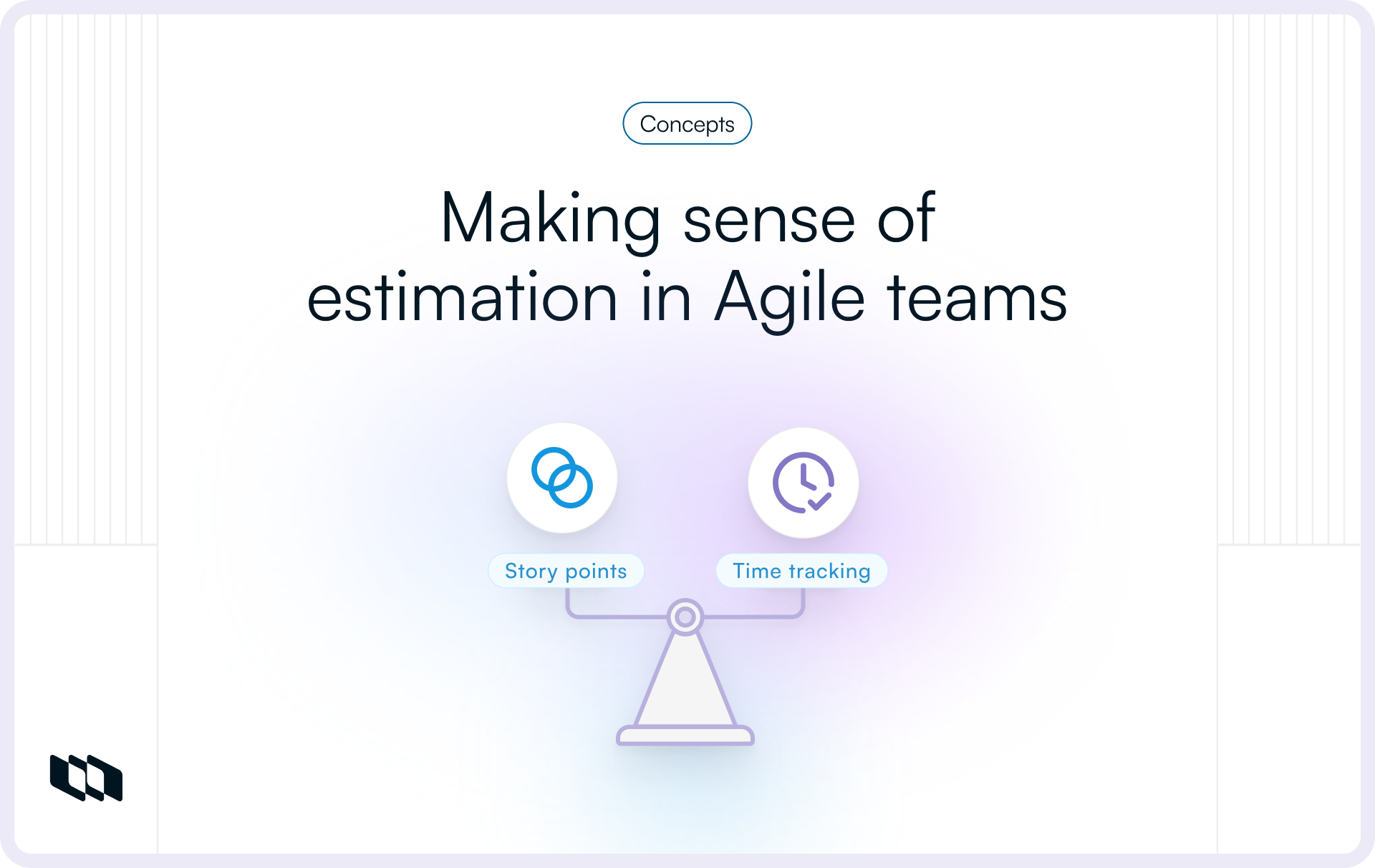
Ask any software team where their frustration originates, and estimation is likely to appear near the top of the list. This is not due to carelessness—it stems from the inherent difficulty of predicting work within a complex system. Story points measure relative effort, while time estimates attempt to map work to hours or days. Both approaches support decision-making, but they address different questions.
This guide explores how these two estimation methods function within real-world teams, when each is most effective, and why relying exclusively on one can create challenges. The objective is straightforward: enable clearer planning, reduce surprises, and support a process that teams can trust.
Why teams estimate at all
Many teams assume estimation is primarily about predicting deadlines. It is not. Effective estimation reduces surprises, promotes clarity, and makes planning more objective and data-driven. Regardless of whether you use story points, time tracking, or throughput, the underlying purpose remains the same.
1. Shared understanding
Estimation encourages the team to slow down and discuss the work in detail. This process uncovers scope gaps, hidden tasks, dependencies, and risks that might otherwise emerge mid-sprint. These conversations often improve sprint outcomes more than the estimates themselves.
2. Alignment on scope
A shared estimate reflects a shared definition of "done." Particularly in story point estimation, the team aligns on effort, complexity, and uncertainty, rather than relying on a single individual to set expectations. This alignment ensures a common understanding before work begins.
3. Forecasting and planning
Individual tasks may be unpredictable, but patterns such as velocity, throughput, and cycle time tend to stabilize over time. Estimation provides the data necessary for realistic forecasting of releases, roadmaps, and team capacity.
4. Risk identification
If team estimates diverge significantly, something is unclear—perhaps a missing requirement, an unknown integration, or an external dependency. Such divergence is not a failure but an early warning signal that the work should be clarified, split, or explored through a short spike before commitment. What story points actually measure
What story points actually measure
Story points exist because time-based estimates become unreliable as uncertainty increases. Points offer teams a shared, objective way to discuss effort without assuming they can predict specific durations. Rather than asking “How long will this take?”, story points encourage the question, “How large is this compared to work we already understand?”
They shift the conversation away from individual speed and toward team-level complexity, which is more stable and more useful for planning.
What are story points?
Story points are an abstract, relative unit of effort. They measure how “big” a piece of work feels compared to other work your team has already done. They don’t map to hours. They’re not tied to personal pace. And they intentionally avoid the precision illusion that time-based estimation creates.
Points exist to help teams reason about:
- How tricky is this to implement?
- How many unknowns are lurking?
- How much actual scope is involved?
Because once a team aligns on “size,” you can forecast using velocity or throughput, which is far more reliable than guessing task durations.
The three factors behind every estimate
When teams estimate with story points, they’re really comparing three dimensions of effort. Each one matters,
When teams size work, they’re really weighing three things:
• Complexity: How technically difficult or mentally demanding is this?
• Uncertainty: Are there unknowns? New tech? External dependencies? Missing details?
• Volume/scope size: How much work is actually involved? How many screens, rules, edge cases, or integration points?
Points combine these three dimensions into a single number so teams can discuss effort without arguing over minutes and hours.
Why teams use Fibonacci-style scales
Real work isn’t linear. The bigger something is, the harder it is to judge whether it’s “slightly bigger” or “a lot bigger.” That’s why most teams use scales like: 1, 2, 3, 5, 8, 13 …
The gaps get wider because precision drops fast as work grows. Fibonacci helps teams avoid:
- Endless arguments (“Is this a six or a seven?”)
- False precision (“We think this is exactly 11 hours”)
- Wasted time debating tiny differences
Instead, teams group sizes into broad buckets: small, medium, large, and very large.
This makes estimation faster and more consistent.
Planning Poker (fast consensus without anchoring)
Planning Poker is a quick way to size work without one person influencing everyone else.
The team discusses the story, privately picks a number, and reveals it simultaneously.
If estimates differ:
- High/low estimators explain what they’re seeing
- The team aligns on complexity, uncertainty, or scope
- Then votes again
It surfaces misunderstandings early and gets the team to a shared, reasonable number in minutes.
Good practices that make points actually work
• Keep a small baseline story: Always have a reference “2-pointer” or “5-pointer” that everyone can compare new work against.
• Split or spike unclear stories: If estimates are far apart, that’s a signal — clarify, split, or do a short spike before sizing again.
• Never convert points to hours: The moment points become hours, they stop being useful. It anchors teams, creates pressure, and breaks the purpose of relative sizing.
What time-based estimation is actually for
Time-based estimation feels intuitive because everyone understands hours and days. But hours aren’t great at capturing complexity or uncertainty. They’re best used when you need calendar alignment, not when you’re trying to understand the shape of work. Time tracking works when teams need precision around deadlines, budgets, or contracts — not as the primary tool for predicting delivery in uncertain environments.
What is time-based estimation?
Time-based estimation is when a team tries to answer: “How long will this take in ideal hours or days?”
“Ideal” is the keyword — no interruptions, no meetings, no external delays. In reality, that ideal rarely exists, which is why hour-based estimates often slip.
Hours are helpful for commitments, billing, and short-term planning, but they aren’t reliable enough for long-range forecasting.
Typical workflow
Most teams follow a straightforward process when estimating in hours:
- Break the story into smaller sub-tasks
- Estimate the ideal hours each task would take
- Track how many hours actually get spent
- Use this information to adjust future estimates
This works reasonably well when tasks are small, predictable, and well understood — but it collapses when uncertainty or complexity is high.
Where hour-based estimates break down
Hour-based estimation feels precise, but that precision is often misleading. Here’s why,
1. The planning fallacy: Humans consistently underestimate how long work takes, even when they know they are underestimating. We forget interruptions, context switching, and coordination overhead.
2. Hidden work: In real engineering environments, a lot of work never makes it into the estimate:
- Debugging
- Waiting for approvals
- Environment issues
- Back-and-forth clarifications
- Meetings and async coordination
This “invisible work” makes hour-based plans look accurate on paper but wrong in practice.
3. The precision illusion: Saying something will take “6.5 hours” feels scientific — but rarely reflects reality. Hours give a sense of accuracy that disappears when requirements shift or unknowns arise.
4. Sensitivity to team changes: Hours tie estimates to individual capacity. If a senior engineer leaves or a new joiner picks up a task, estimates have to be rewritten. Story points avoid this because effort is relative, not personal.
Where hours work well
Time tracking does have real value — just not for everything. Use hours when you need absolute time for formal or external commitments:
1. Billing or time-and-materials work: Agencies, consultancies, external vendors — clients expect hours.
2. Fixed-fee contracts: Procurement, legal, and finance often require hour-based breakdowns.
3. Known, low-uncertainty tasks: Small bug fixes, repeatable work, or tasks with little complexity do well with hour estimates.
4. Regulatory or compliance reporting: Audits, certifications, or mandated logs often require teams to track hours explicitly.
Outside these scenarios, story points or throughput usually give more accurate forecasting and fewer surprises.
Story points vs hours: a simple comparison
Story points and hours aren’t competing systems. They measure different things and solve different problems. The key is knowing what each one represents and when each one works best. Here’s a clear, practical comparison,
Dimension | Story points | Hours |
What it measures | Relative effort — complexity, uncertainty, and scope compared to known work | Actual duration — ideal hours/days needed to complete the task |
Best use cases | Backlog sizing, sprint planning, long-range forecasting, high-uncertainty work | Billing, fixed-fee contracts, short-term scheduling, predictable low-variance work |
Forecasting method | Velocity or throughput trends + Monte Carlo ranges | Capacity math: available hours vs estimated hours |
Sensitivity to uncertainty | Low uncertainty is accounted for in the estimate itself | High — unknowns cause delays, slips, and re-estimates |
Incentive risks | Points inflation when used as a productivity metric | Padding, overestimation, or Parkinson’s Law (“work expands to fill the time”) |
Nature of measurement | Team-level and collaborative | Individual-level and tied to personal capacity |
Stability across team changes | High — relative sizing remains valid; velocity adjusts over time | Low — hours vary based on who performs the work |
When to choose story points
Story points work best when teams need a stable, team-level way to reason about effort without getting trapped in hour-by-hour precision. They shine in environments where uncertainty is high, and work varies in complexity.
Here’s when story points make the most sense:
1. High-uncertainty work
When you’re dealing with new features, unclear requirements, technical unknowns, or integrations that may change, hour estimates fall apart fast. Story points handle this uncertainty better because they compare effort relative to familiar work instead of trying to predict the exact time.
2. Agile teams need long-range forecasting
Velocity and throughput trends stabilize over multiple sprints, even when individual tasks fluctuate. This makes story points ideal for,
- Release planning
- Quarterly roadmaps
- Epic-level forecasting
- Communicating delivery confidence to stakeholders
Throughput (count of items completed per sprint) is even simpler and can be used instead of points for forecasting.
3. Team-level planning
Story points encourage teams to think together:
- What makes this work big or small?
- What’s risky?
- What do we not understand yet?
Because points aren’t tied to individual speed, they naturally promote shared ownership and group alignment.
4. Fast-moving product teams
Teams shipping product increments every sprint need a lightweight way to size work and plan the next iteration. Story points are quick to assign, easy to maintain, and effective when work is varied and evolving.
When to choose hours
Hours aren’t useless — they’re just meant for a different kind of work. When you need clear, time-based accountability or when tasks are highly predictable, hour estimation becomes the practical choice. It gives stakeholders the specificity they expect and works well when uncertainty is low.
Here’s when estimating in hours actually makes sense:
1. Client billing
Agencies, consultancies, and vendors often bill by the hour or need detailed timesheets for invoicing. In these cases, hours aren’t optional — they’re part of the financial model.
2. Compliance and regulatory reporting
Some industries require formal time logs for specific activities. Audits, certifications, grants, and regulated environments depend on hour-by-hour documentation.
3. Small, predictable changes
If the work is well understood, low risk, and repeatable (like a simple configuration change or a known bug fix), estimating in hours is straightforward and usually accurate.
4. Teams that are new to relative estimation
New Agile teams sometimes struggle with story-point estimation because they haven’t established shared calibration yet. Using hours temporarily can help them gain confidence while they learn how to size work based on complexity and uncertainty rather than time.
Once the team is more experienced, shifting to story points or throughput allows for more accurate forecasting and less time spent debating hour-level precision.
Conclusion
Story points and hours aren’t competing tools — they’re built for different kinds of decisions. Story points help teams understand effort, uncertainty, and scope, making them ideal for sprint planning, backlog sizing, and long-range forecasting through velocity or throughput. Hours help when you need time-bound clarity for billing, compliance, or predictable, low-variance work.
The real win comes from using both intentionally. Size work in points (or throughput) to plan reliably at the team level. Use hours only when a specific contract, deadline, or coordination task requires it. And support every plan with real delivery data — not guesses — through flow metrics and Monte Carlo forecasting.
When teams stop trying to convert points into hours and start using each method for what it does best, planning becomes calmer, forecasts become more credible, and delivery becomes far more predictable.
FAQs
Q1. Why does estimation use story points instead of time?
Story points work better than hours because they focus on complexity, uncertainty, and scope rather than personal speed. Time estimates collapse when unknowns arise, but story-point estimates remain stable enough for agile forecasting, velocity trends, and team-level planning.
Q2. How many hours is 3 story points equal to?
No fixed number. Story points never convert to hours. Points measure relative effort, not duration. A “3-point” story is simply bigger than a “2” and smaller than a “5.” Converting points to hours destroys the purpose of relative sizing and leads to inaccurate planning.
Q3. What is the 3-5-3 rule in Agile?
The 3-5-3 rule refers to the Scrum framework:
- 3 roles (Product Owner, Scrum Master, Developers)
- 5 events (Sprint, Sprint Planning, Daily Scrum, Sprint Review, Sprint Retrospective)
- 3 artifacts (Product Backlog, Sprint Backlog, Increment)
It has nothing to do with story points or time tracking.
Q4. Should story points be based on time or complexity?
Story points should be based on complexity, uncertainty, and volume/scope — not time.
Trying to map them to hours reintroduces the same precision problems that story points were created to avoid.
Q5. Is 1 story point equal to 1 day?
No. There is no universal conversion between points and days. One team’s “1-point” item may take a few hours; another team’s may take a full day. Story points only work when they stay relative inside one team — never tied to exact time.
Recommended for you



 Download for Mac
 Download for Android