Rolling wave planning in project management: When and how to use it
Introduction
Planning often begins before clarity exists. Timelines are requested, dependencies appear late, and assumptions quietly shape decisions. Traditional project plans struggle in these moments because they treat uncertainty as a temporary inconvenience rather than a constant reality.
Rolling wave planning in project management offers a more grounded approach. Instead of forcing detail too early, teams plan near-term work with confidence while keeping future work intentionally high-level. In this guide, we explore when to use rolling wave planning and how to apply it without losing control or direction.
What is rolling wave planning in project management?
Rolling wave planning is a project planning approach designed for situations where clarity improves over time. Instead of creating a fully detailed plan upfront, teams focus on planning immediate work in depth and keep future work at a higher level. This approach allows teams to move forward with confidence while staying responsive to change, learning, and evolving constraints.
Rolling wave planning explained in simple terms
Rolling wave planning follows a straightforward idea: "Plan what you know. Outline what you do not."
Near-term work is planned in detail. Tasks are clearly defined, owners are assigned, timelines are estimated, and dependencies are mapped. This level of detail helps teams execute without ambiguity.
Future work, however, is handled differently. Instead of committing to detailed tasks too early, teams keep upcoming phases intentionally lightweight. These phases are usually expressed as milestones, assumptions, or rough estimates rather than fixed schedules.
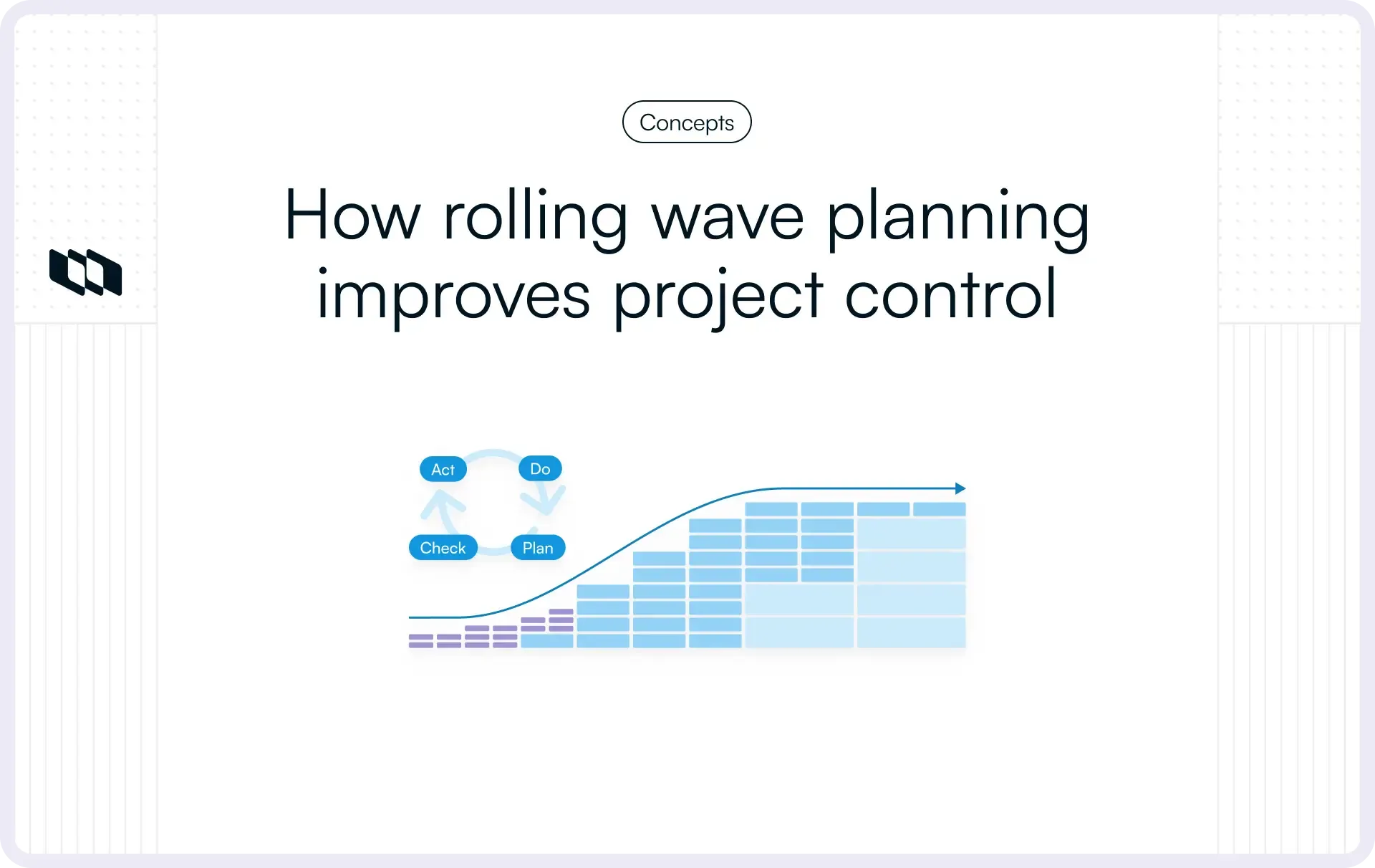
As the project advances, planning happens in waves:
- Near-term plans stay detailed and actionable
- Future plans remain flexible and high-level
- Each new wave replaces assumptions with real data
This rhythm keeps planning grounded in reality while avoiding premature decisions that often lead to rework.
How far ahead should you plan?
The concept of a planning horizon sits at the core of rolling wave planning. The planning horizon defines how far into the future a team can plan with reasonable confidence. Work closer to execution tends to be clearer. Requirements are better understood, dependencies are visible, and estimates are more reliable. As planning extends further out, uncertainty increases. Priorities evolve, risks surface, and technical complexity becomes harder to predict.
Rolling wave planning responds to this reality by adjusting planning depth:
- Work inside the planning horizon is planned in detail
- Work beyond the horizon is kept at an intentionally high level
This balance helps teams reduce rework and prevents long-term plans from becoming outdated before execution even begins.
The length of the planning horizon varies by project. Some teams plan a few weeks ahead in detail, while larger initiatives may outline months of work at a high level and refine plans phase by phase.
Rolling wave planning vs progressive elaboration
Rolling wave planning is often associated with progressive elaboration, which explains why the two terms are frequently confused.
- Progressive elaboration is a broad principle of project management. It describes how plans, requirements, and estimates naturally become more detailed as understanding improves over time.
- Rolling wave planning turns that principle into an operating model. It defines when refinement happens and how teams move from high-level outlines to detailed plans. Each wave becomes a deliberate planning checkpoint rather than an ad hoc adjustment.
In simple terms, progressive elaboration explains how planning evolves. Rolling wave planning defines how teams apply that evolution in real projects.
How rolling wave planning works
Rolling wave planning follows a simple, repeatable flow. Teams begin with a broad view of the project, focus on detailed planning on what is immediately ahead, and continuously refine future work as they learn more. The structure stays stable, even though the details evolve.
1. Start with a high-level project roadmap
Every rolling wave plan begins with a high-level roadmap. This roadmap sets direction without forcing precision too early.
At this stage, teams typically define:
- Major phases of the project
- Key milestones or outcomes
- Known assumptions and constraints
Just as important, teams clarify what stays fixed and what stays flexible. Deadlines, budgets, or regulatory requirements may remain constant, while scope details, sequencing, or implementation choices stay open to refinement.
This roadmap acts as a shared reference point. It aligns stakeholders on direction while leaving room for learning.
2. Plan the first wave in detail
Once the roadmap is in place, teams focus on the first wave of work. This is where detailed planning happens. Near-term tasks are broken down clearly. Ownership is assigned. Dependencies are identified. Timelines are estimated based on the best available information.
Only the work that is about to begin receives this level of detail. Planning further ahead in the same way would rely on assumptions that are likely to change. Rolling wave planning avoids that trap by keeping future work intentionally lighter. The result is a plan that is actionable today without being brittle tomorrow.
3. Execute, learn, and plan the next wave
As execution begins, teams actively observe what they are learning.
At the end of each wave, teams typically review:
- What was completed and what changed
- New risks, constraints, or dependencies
- Assumptions that proved accurate or inaccurate
These insights inform the next planning wave. Future phases are refined based on real progress rather than guesses made early on. Importantly, this does not mean resetting the entire plan. The overall roadmap remains intact, while details are adjusted where clarity has improved.
This cycle repeats throughout the project, allowing plans to evolve steadily without losing structure or direction.
When to use rolling wave planning?
Rolling wave planning works best in projects where uncertainty is real and unavoidable. Instead of forcing early precision, it gives teams a way to plan responsibly while information is still emerging. Below are the situations where this approach delivers the most value.
1. When project goals are unclear or evolving
Many projects begin with direction but not full clarity. Goals exist, but the path to reach them is still forming. This is common in early-stage initiatives where teams are exploring feasibility, scope, or stakeholder expectations.
Plans often start with assumptions rather than confirmed inputs. Rolling wave planning allows teams to move forward without waiting for perfect answers. Near-term work is planned with confidence, while future goals are refined as understanding improves.
2. When planning, data is missing early on
Detailed planning depends on reliable inputs. When those inputs are missing, upfront plans quickly lose relevance. Rolling wave planning is well-suited for projects affected by:
- Unclear or incomplete requirements
- Estimates that rely on early guesses
- Dependencies on vendors, partners, or other teams
By limiting detailed planning to what is known today, teams reduce rework and avoid revisiting plans built on fragile assumptions. As data becomes available, plans naturally become more precise.
3. Research, discovery, and R&D-heavy work
In research and discovery-driven projects, learning is part of the work itself. Teams often uncover constraints, technical limitations, or new opportunities only after execution begins. Rolling wave planning supports this reality by allowing plans to mature alongside learning. Each wave incorporates new insights, which improve planning accuracy over time without disrupting progress.
This makes the approach especially effective for exploratory initiatives where outcomes become clearer through experimentation.
4. Innovation and high-change projects
Innovation introduces change by design. New products, new integrations, and new markets rarely follow a predictable path.
Rolling wave planning helps teams stay aligned without locking decisions too early. High-level direction provides structure, while flexible planning waves allow teams to adapt to changing priorities, customer feedback, or technical discoveries. The approach supports momentum while preserving decision-making space.
5. Projects with dependencies and fixed deadlines
Some projects face a mix of uncertainty and immovable deadlines. In these cases, rolling wave planning often works better than pure sprint planning. Sprint-based approaches focus on short delivery cycles, but they may struggle when work must follow a strict sequence or align with external milestones.
Rolling wave planning maintains a clear end-to-end roadmap while allowing teams to refine execution details as dependencies resolve. This balance makes it effective for complex projects where timing matters as much as adaptability.
When rolling wave planning may not be the right fit
Rolling wave planning is effective in many uncertain environments, but it is not a universal solution. In some situations, a more traditional planning approach can be clearer, faster, and easier to manage. Understanding these boundaries helps teams choose the right method with confidence.
1. Stable projects with well-defined scope
Some projects begin with a high level of certainty. Requirements are clear, dependencies are well understood, and the delivery path is unlikely to change. In these cases, full upfront planning is both feasible and efficient. Investing time in detailed schedules, estimates, and resource plans early on reduces coordination effort later. Rolling wave planning adds little value here because the information needed to plan accurately already exists.
For predictable, repeatable work, a traditional planning approach often provides better clarity and control.
2. Environments that require fixed baselines early
Certain projects operate under strict constraints that limit flexibility. This is common in compliance-driven or contract-heavy environments where scope, cost, and timelines must be formally approved at the start.
Rolling wave planning relies on the ability to refine plans as new information emerges. When baselines must remain fixed for reporting, legal, or regulatory reasons, this flexibility becomes difficult to apply in practice.
In such settings, teams may still use rolling wave concepts internally, but external commitments often require a more rigid planning structure.
3. Teams without a regular replanning cadence
Rolling wave planning depends on discipline. Without a clear cadence for review and refinement, plans either drift or become outdated. Teams may delay replanning until issues escalate, or they may constantly rework plans without clear decision points.
Both patterns reduce trust in the plan. Rolling wave planning works best when teams treat each wave as a deliberate planning moment, supported by consistent review and communication. Without this rhythm, the approach quickly loses effectiveness.
4. A simple rule of thumb for choosing the approach
A helpful way to decide is to look at uncertainty and impact together. When uncertainty is low and outcomes are predictable, upfront planning works well. When uncertainty is high and decisions carry significant impact, rolling wave planning provides more control over time.
The goal is not flexibility for its own sake, but planning that reflects how much is truly known at each stage of the project.
Rolling wave planning vs. other planning approaches
Teams often compare rolling wave planning with agile sprint planning and waterfall planning because all three influence how and when commitments are made. The real difference lies in planning depth, how uncertainty is handled, and the level of flexibility built into the plan.
The comparisons below help clarify where the rolling wave planning approach fits and how it complements other planning methods.
Rolling wave planning vs. Agile sprint planning
Rolling wave planning and agile sprint planning both support adaptive project planning, but they solve different problems. One focuses on how plans evolve over time, while the other focuses on how work is delivered in short cycles.
Aspect | Rolling wave planning | Agile sprint planning |
Primary focus | Deciding how much detail to plan and when | Delivering work in short, time-boxed cycles |
Planning horizon | Detailed near-term planning with high-level future plans | Planning one sprint at a time |
Handling uncertainty | Reduces uncertainty gradually through planning waves | Adapts quickly through frequent reprioritization |
Dependencies | Handles strong sequencing and milestone-driven work well | Works best when tasks can be reordered easily |
Best fit | Complex, dependency-heavy projects | Product development and delivery teams |
When teams use both together
Many teams combine the two approaches. Rolling wave planning provides roadmap-level structure and defines upcoming phases. Agile sprint planning then handles execution within each phase. This combination works well when teams need flexibility at the delivery level without losing visibility across the entire project.
Rolling wave planning vs. waterfall planning
Rolling wave planning and waterfall planning differ mainly in the level of certainty they assume at the start of a project.
Aspect | Rolling wave planning | Waterfall planning |
Core assumption | Clarity improves as the project progresses | Clarity exists at the start |
Upfront planning | High-level planning early, details added over time | Full details defined upfront |
Response to change | Plans evolve in controlled waves | Changes are formally managed |
Predictability | Increases gradually as uncertainty reduces | Fixed early in the project |
Best fit | Projects shaped by learning and change | Stable, well-defined initiatives |
How to choose between them
If future work depends on information that will emerge during execution, rolling wave planning provides a more reliable planning model. If requirements, scope, and delivery paths are already well understood, waterfall planning can offer faster alignment and simpler governance.
How to use rolling wave planning: Step-by-step
Rolling wave planning works best when it follows a clear, repeatable process. The steps below show how teams apply the rolling wave planning approach in real projects without overcomplicating planning or losing control.
Step 1: Define outcomes, constraints, and non-negotiables
Start by aligning on what success looks like and what must stay fixed throughout the project.
This typically includes:
- the outcomes or goals the project must achieve
- budget limits and delivery deadlines
- scope boundaries or regulatory requirements
These elements create guardrails for planning. They give teams clarity on where flexibility exists and where it does not. Rolling wave planning works within these constraints rather than constantly renegotiating them.
Step 2: Identify risks and unknowns early
Next, identify what makes long-term planning unreliable. This could include unclear requirements, unproven technology, external dependencies, or assumptions that still need validation. The goal is not to solve every unknown upfront, but to recognize where uncertainty exists.
By surfacing risks early, teams avoid pretending certainty and can decide which parts of the plan should remain high-level until more information becomes available.
Step 3: Break the project into phases and milestones
With constraints and risks in mind, outline the project at a high level. Define major phases, key milestones, or decision points without breaking everything into tasks. This structure provides direction while keeping future work flexible. It also helps stakeholders understand how progress will unfold over time.
At this stage, clarity matters more than precision. The focus is on sequencing and intent, not detailed schedules.
Step 4: Plan the first wave in detail
Once the roadmap is set, shift focus to the first wave of execution. This is where detailed planning happens. Teams define tasks, assign owners, identify dependencies, and agree on acceptance criteria. Estimates are based on the best available information and adjusted as needed.
Only near-term work receives this level of detail. Future phases remain intentionally lightweight until they move closer to execution.
Step 5: Set a baseline for the current wave
Before execution begins, establish a baseline for the active wave. Decide what you will track, such as progress against milestones, key dependencies, risks, or scope changes. Also, define what triggers replanning, whether that is a missed dependency, a new constraint, or a shift in priorities.
This baseline creates accountability without locking the entire project into assumptions that may change later.
Step 6: Review and roll the next wave forward
At the end of each wave, pause to review what changed and what was learned.
Teams typically refine:
- estimates and timelines for upcoming work
- assumptions that proved inaccurate
- dependencies or risks that have surfaced
At the same time, parts of the plan that remain uncertain stay at a high-level. Only work moving closer to execution is detailed further.
This cycle repeats throughout the project, allowing plans to evolve steadily while the overall structure remains intact.
Artifacts that support rolling wave planning
Rolling wave planning stays effective when teams rely on a small set of practical artifacts. These artifacts provide structure without creating unnecessary documentation. Each one supports decision-making as plans evolve from high-level to detailed over time.
Essential artifacts
Rolling wave planning does not require an extensive planning toolkit. A few well-maintained artifacts are usually enough.
- High-level roadmap: The roadmap outlines the overall direction of the project. It captures major phases, key milestones, and essential constraints. This artifact remains relatively stable and helps stakeholders understand where the project is headed, even as details evolve.
- Near-term work breakdown: This is the detailed plan for the current wave. It includes tasks, owners, timelines, and acceptance criteria for work that is about to be executed. Unlike the roadmap, this artifact changes more frequently as waves progress.
- Dependency view: Dependencies often determine how work can realistically be sequenced. A clear dependency view highlights handoffs, external inputs, and sequencing constraints. Keeping this visible helps teams anticipate delays and adjust plans before issues escalate.
- Risk and assumption log: Rolling wave planning depends on knowing what is still uncertain. A shared log of risks and assumptions makes uncertainty explicit. As waves progress, assumptions are validated, risks are updated, and unknowns gradually turn into known constraints.
What to update at the end of each wave
At the end of every planning wave, teams review and refresh a few key elements rather than reworking the entire plan.
Typically, this includes:
- Updating estimates based on actual progress and learning
- Revisiting assumptions that influenced earlier decisions
- Adjusting dependencies as sequencing becomes clearer
- Refining milestones for upcoming phases
This focused update keeps plans relevant and trustworthy. It ensures that each new wave builds on real execution data while preserving the overall structure of the project.
Example: Rolling wave planning in a real project
To see how rolling wave planning works in practice, consider a product team building a new third-party integration with a fixed launch deadline.
The goal is clear. The integration must be live before a partner launch date. The uncertainty lies in technical constraints, data mapping complexity, and external API behavior, all of which become clearer only once development begins.
Project context: Uncertainty with a fixed deadline
At kickoff, the team knows:
- The integration must support a defined set of user actions
- The launch date is non-negotiable
- The external API documentation is incomplete
What the team does not know yet is how stable the API is, how data validation will behave at scale, or where performance bottlenecks might appear. Planning everything upfront would rely heavily on assumptions.
This is where rolling wave planning becomes useful.
What wave 1 looked like
The first planning wave focuses on discovery and foundation work.
The team plans wave 1 in detail, including:
- Technical spike to explore the API
- Initial data mapping and validation logic
- Basic authentication and error handling
Tasks are clearly defined, owners are assigned, and timelines are estimated based on current knowledge. At the same time, later phases such as advanced sync logic and edge-case handling are outlined only as high-level milestones. This allows the team to start execution without overcommitting to details that may change.
How wave 2 and wave 3 evolved
By the end of wave 1, several assumptions are validated. The team understands API limits, data inconsistencies, and performance constraints.
- In wave 2, planning becomes more precise. Tasks related to core integration flows are detailed. Dependencies between backend and frontend work are clarified. Estimates become more reliable because they are grounded in real findings.
- Wave 3 focuses on optimization, testing, and readiness for launch. At this point, uncertainty is significantly lower—planning shifts from exploration to execution confidence, with tighter timelines and more explicit acceptance criteria.
What changed as uncertainty reduced
Across the waves, the overall roadmap stays intact. The launch milestone does not move. What changes is the level of detail and confidence in the plan. Early assumptions are replaced with verified information. Risk areas receive more attention. Low-risk work becomes easier to schedule accurately.
This is the core value of rolling wave planning. It allows teams to commit responsibly, adapt based on learning, and still deliver against fixed goals without relying on fragile upfront plans.
Final thoughts
Rolling wave planning offers a practical way to plan when certainty develops over time. Instead of forcing detailed commitments too early, it aligns planning effort with what teams actually know at each stage of the project.
By combining a stable high-level roadmap with flexible planning waves, teams gain structure without rigidity. Near-term work stays actionable, future work remains adaptable, and decisions are based on real progress rather than assumptions.
For projects shaped by uncertainty, dependencies, or discovery, rolling wave planning improves both planning accuracy and delivery confidence. When applied with discipline and clear review cycles, it helps teams stay aligned, respond thoughtfully to change, and move complex projects forward with clarity and control.
Frequently asked questions
Q1. What is an example of rolling wave planning in project management?
A common example is a product team building a third-party integration with a fixed launch date. The team plans discovery and technical validation work in detail first, while outlining later development and testing phases at a high level. As API constraints and data behavior become clearer, future phases are planned in more detail without changing the overall roadmap.
Q2. How do you do rolling wave planning?
Rolling wave planning starts with defining outcomes, constraints, and non-negotiables. Teams then create a high-level roadmap, plan near-term work in detail, and keep future work intentionally lightweight. At the end of each wave, plans are reviewed and refined based on what was learned, and the next wave is planned with greater precision.
Q3. What is an example of a rolling plan?
A rolling plan might show detailed tasks for the next four weeks, milestone-level planning for the next two months, and phase-level goals for the rest of the project. As the project progresses, the detailed window moves forward, and future phases become more defined.
Q4. What is the rolling wave technique?
The rolling wave technique is a planning method where detailed planning is limited to work that is about to begin. Future work is planned progressively as uncertainty reduces. This technique helps teams avoid overplanning early and reduces rework caused by changing assumptions.
Q5. What is another name for rolling wave planning?
Rolling wave planning is often associated with progressive elaboration. While the terms are sometimes used interchangeably, progressive elaboration describes the principle, and rolling wave planning refers to the structured way teams apply that principle in real projects.
Recommended for you



 Download for Mac
 Download for Android