What is engineering operations? A complete guide
Introduction
A strong engineering team still needs a strong operating system behind it. Roadmaps need coordination, dependencies need ownership, capacity needs visibility, and engineering processes need to evolve as the organization grows.
That is where engineering operations comes in. EngOps focuses on improving how engineering work is planned, executed, measured, and supported. In this guide, we cover its core responsibilities, roles, benefits, metrics, tools, and best practices, along with the signals that indicate when an organization needs a dedicated engineering operations function.
What is engineering operations?
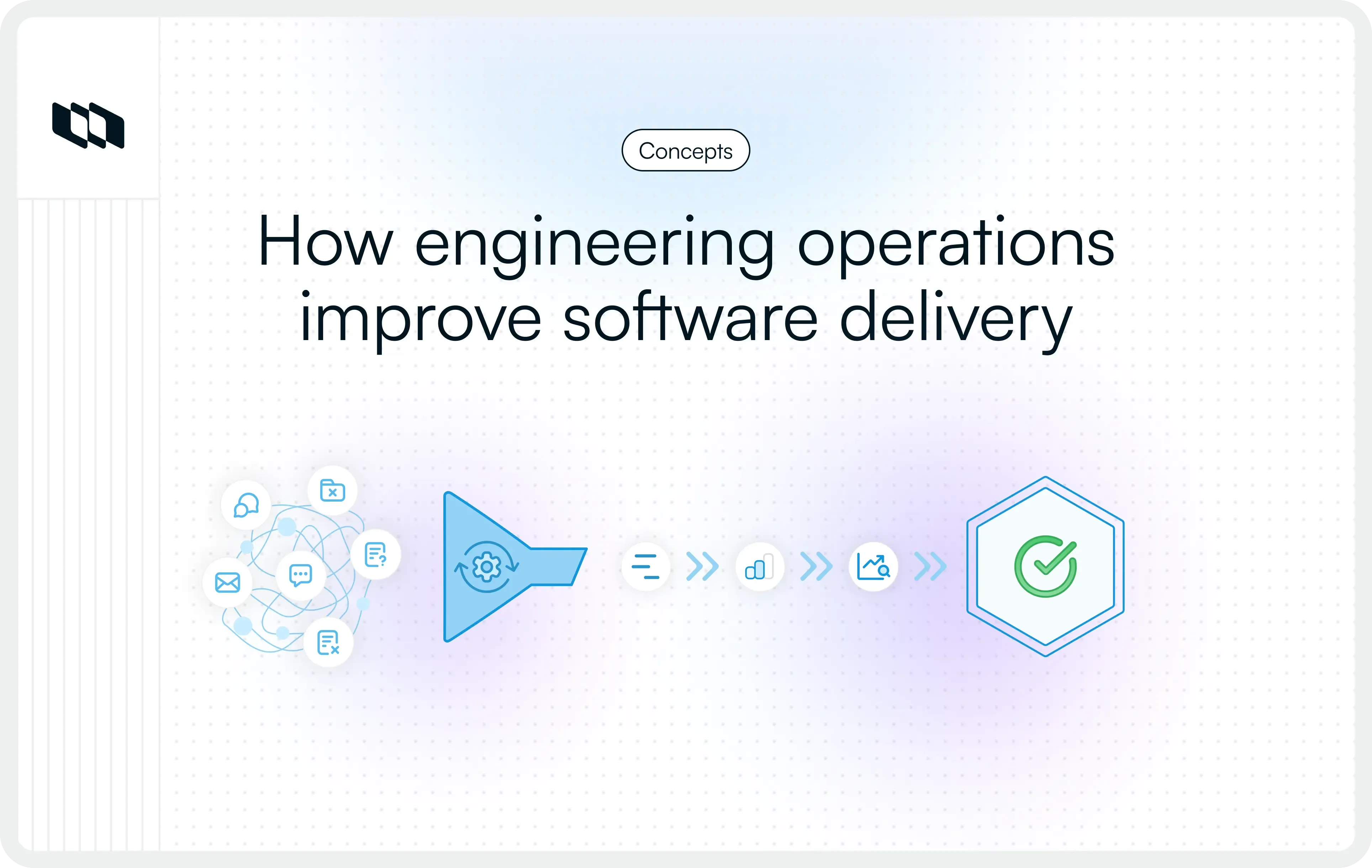
Engineering operations, or EngOps, is the discipline focused on improving how a software engineering organization plans, coordinates, measures, and supports its work. It brings together the processes, tools, data, and operating practices that help engineering teams deliver consistently as the organization grows.
In practice, EngOps can cover engineering planning, cross-team coordination, capacity management, workflow improvement, delivery reporting, tooling, documentation, and developer enablement. The exact scope depends on the organization. Smaller teams may distribute these responsibilities across engineering managers and technical program managers, while larger organizations may establish a dedicated engineering operations team.
The function essentially looks at how engineering gets work done as a system. It gives engineering leaders greater visibility into where work is going, where delivery friction occurs, and which processes or operating practices need improvement.
Engineering operations vs. operations engineering
The two terms sound similar but describe different scopes of work.
Factor | Engineering operations | Operations engineering |
Primary focus | How the engineering organization operates | How technical systems operate |
Typical scope | Planning, processes, coordination, capacity, tooling, and reporting | Infrastructure, deployments, monitoring, incidents, and system reliability |
Primary outcome | More effective and predictable engineering execution | Reliable and performant production systems |
Common roles | EngOps managers, technical program managers, engineering operations analysts | Operations engineers, infrastructure engineers, SREs |
Engineering operations works on the operating environment around software delivery, while operations engineering works directly on the technical environment in which software runs.
Why is engineering operations important?
As engineering organizations grow, coordination gets harder. More teams, tools, dependencies, and delivery commitments create operational complexity that needs clearer ownership and structure.
1. Cross-team dependencies
Engineering work increasingly depends on other teams, shared systems, and sequencing decisions. EngOps helps make those dependencies visible and easier to coordinate.
2. Fragmented processes and tools
Teams often develop different workflows, planning methods, and reporting habits. Engineering operations creates more consistency across the organization while preserving team-level flexibility.
3. Unclear ownership
Planning, tooling, reporting, and coordination responsibilities can become distributed across several roles. EngOps helps define who owns what and where operational decisions should sit.
4. Inconsistent delivery
Different planning and execution practices can make delivery harder to predict. EngOps helps teams identify recurring friction and improve the systems around software delivery.
5. Limited visibility into progress and capacity
Engineering leaders need a clear view of priorities, progress, workload, and risk. Engineering operations brings that information together so planning and resource decisions can be made with better context.
What does an engineering operations team do?
An engineering operations team improves the systems around software delivery. Its responsibilities usually span planning, coordination, process design, capacity, tooling, reporting, and developer enablement, with the exact scope shaped by the size and maturity of the engineering organization.
1. Engineering planning and program coordination
EngOps helps connect roadmaps, initiatives, timelines, and dependencies across teams. This includes coordinating cross-functional programs, surfacing sequencing risks, and keeping execution aligned with engineering priorities.
2. Process improvement
Engineering operations looks for friction in how work moves through the organization. Teams may refine planning cycles, handoffs, review processes, escalation paths, and delivery workflows to make execution more consistent and easier to manage.
3. Resource and capacity planning
EngOps helps engineering leaders understand where team capacity is allocated and how much work can realistically fit into a planning period. This supports better prioritization, staffing decisions, and roadmap planning.
4. Tooling and systems management
Engineering teams often rely on multiple systems for planning, development, documentation, reporting, and communication. EngOps helps evaluate, configure, connect, and maintain these tools so information flows more consistently across the engineering workflow.
5. Engineering data and reporting
EngOps creates clearer visibility into how engineering work is progressing. This can include delivery dashboards, operational reviews, planning reports, dependency tracking, and metrics that help leaders identify risks and make better decisions.
6. Developer enablement
Engineering operations also supports the working environment around developers. Common areas include onboarding, documentation, knowledge sharing, access to internal resources, and reducing recurring operational friction that slows teams down.
Engineering operations roles and responsibilities
Engineering operations can take different forms depending on the size and complexity of the organization. In a smaller company, one person may own planning processes, delivery reporting, tooling, and cross-team coordination alongside other responsibilities. As the engineering organization grows, these responsibilities often become specialized across a dedicated EngOps team.
The titles vary between companies, but four roles commonly appear within the function:
Role | Primary focus | Typical responsibilities |
Head of Engineering Operations | EngOps strategy and organizational effectiveness | Defines the operating model, sets priorities for the function, partners with engineering leadership, and drives improvements across planning, processes, tooling, and reporting |
Engineering Operations manager | Day-to-day execution of EngOps programs | Runs planning cadences, coordinates cross-team work, improves workflows, manages operational processes, and keeps engineering programs moving |
Technical program manager | Complex programs and cross-team delivery | Coordinates timelines, dependencies, risks, milestones, and stakeholders across technical initiatives that span multiple teams |
Engineering Operations analyst | Engineering data and operational insights | Maintains dashboards, analyzes delivery and capacity data, supports reporting, identifies trends, and helps leaders make decisions from reliable engineering data |
Head of Engineering Operations
The Head of Engineering Operations typically owns the direction of the function. They work closely with engineering leadership to identify where the organization needs stronger processes, clearer operating rhythms, better tooling, or improved visibility.
Their scope often includes defining planning frameworks, setting EngOps priorities, improving coordination across teams, and ensuring that operational practices evolve with the engineering organization.
Engineering Operations manager
An Engineering Operations manager turns that strategy into repeatable day-to-day practices. They may run quarterly planning processes, coordinate engineering reviews, improve workflows, manage tooling changes, and help teams resolve recurring operational friction.
This role usually sits close to engineering managers and technical leads because many EngOps improvements depend on how teams actually plan and execute work.
Technical program manager
Technical program managers focus on complex initiatives that require coordination across several engineering teams. Their work often involves managing dependencies, tracking milestones, surfacing risks, aligning stakeholders, and maintaining visibility across the full program.
Within EngOps, they provide the coordination layer required for work that extends beyond the boundaries of a single team or project.
Engineering Operations Analyst
Engineering Operations analysts focus on the data behind engineering execution. They may build and maintain dashboards, analyze delivery trends, track capacity allocation, prepare operational reviews, and improve the quality of engineering reporting.
Their role helps turn raw activity data into useful context for planning, prioritization, and continuous improvement.
Smaller organizations may combine several of these responsibilities into a single role. Larger engineering organizations usually separate them as planning, program management, tooling, and data needs become more specialized.
Engineering operations vs. related functions
Engineering operations works across many of the same systems and workflows as engineering management, DevOps, platform engineering, site reliability engineering, and Product Operations. The difference lies in what each function is primarily responsible for improving.
EngOps focuses on the operating system around engineering work: how teams plan, coordinate, measure, and improve execution across the organization.
Function | Primary focus | Typical responsibilities | Primary outcome |
Engineering operations | Engineering execution and organizational effectiveness | Planning processes, cross-team coordination, capacity visibility, tooling, reporting, workflow improvement | More consistent and visible engineering delivery |
Engineering management | People, teams, and technical delivery | Team leadership, hiring, coaching, performance management, technical direction, delivery ownership | Stronger teams and successful execution |
DevOps | Software delivery flow and automation | CI/CD, infrastructure automation, deployment practices, environment management, developer workflows | Faster and more reliable software delivery |
Platform engineering | Internal developer platforms and shared infrastructure | Building self-service platforms, standardizing developer workflows, managing internal tooling and infrastructure capabilities | Better developer experience and scalable engineering infrastructure |
Site reliability engineering | Production reliability and service health | Reliability targets, observability, incident response, automation, capacity planning, performance management | Reliable and resilient production systems |
Product Operations | Product planning and execution systems | Product processes, roadmap coordination, tooling, customer insight workflows, product data, cross-functional alignment | More effective and consistent product execution |
These functions often work closely together. Engineering managers may own delivery at the team level, while EngOps improves the processes and systems used across teams. DevOps, platform engineering, and SRE focus more directly on technical delivery and production systems, while Product Operations supports the operating model around product decisions and product teams.
The boundaries can vary by company, but the core distinction remains useful: Engineering Operations is primarily concerned with improving how the engineering organization operates as a whole.
How to build an engineering operations function
Building an engineering operations function usually works best when it starts with a small number of recurring problems rather than a broad mandate to “fix engineering.” The goal is to create better operating practices around the work teams already do, then expand the function as those practices prove useful.
1. Identify the biggest operational bottlenecks
Start by looking for recurring friction across planning, coordination, delivery, and reporting. The most useful starting points are problems that affect multiple teams or repeatedly consume engineering management time.
Examples include:
- Cross-team dependencies that surface too late
- Planning cycles that consistently exceed available capacity
- Status reporting that requires manual follow-up
- Different teams using incompatible workflows
- Important delivery context spread across several tools
- Repeated handoff or ownership gaps
- Leadership struggling to understand progress across major initiatives
The goal at this stage is to identify patterns rather than individual project failures. If the same issue appears across several teams or planning cycles, it is a strong candidate for EngOps ownership.
2. Define the scope and ownership of EngOps
Once the main problems are clear, define what Engineering Operations will actually own.
A useful scope might include planning cadences, cross-team coordination, delivery reporting, workflow standards, engineering tooling, capacity visibility, or operational reviews. The exact mix should reflect the problems the organization is trying to solve.
Ownership should also be explicit. Engineering managers, technical program managers, platform teams, Product Operations, and EngOps may all touch similar areas, so teams need clarity on who sets the process, who maintains it, and who participates in it.
For example, EngOps might own the quarterly planning framework while engineering managers own the actual commitments for their teams. That distinction keeps the function supportive without blurring decision rights.
3. Prioritize a few high-impact processes
Trying to standardize every engineering process at once creates unnecessary overhead. Start with two or three areas where better structure would remove meaningful friction.
Good candidates often include:
- Quarterly or monthly planning
- Dependency tracking
- Engineering intake
- Status reporting
- Capacity planning
- Incident follow-up
- Onboarding
- Cross-team program reviews
Choose processes that are frequent, visible, and connected to real delivery outcomes. A planning process that affects every team will usually create more value than optimizing a workflow used once a year.
For each process, define what “better” should look like. That could mean fewer late dependencies, faster planning cycles, clearer ownership, or less manual reporting.
4. Create shared workflows and documentation
Once a process is selected, make the operating model visible.
Document how work enters the process, who owns each step, what information teams need to provide, where decisions are recorded, and how progress is tracked. Keep the workflow simple enough that teams can use it without constant explanation.
Shared workflows work best when they provide consistency around the essentials while leaving room for team-level variation. For example, every team might use the same dependency fields and review cadence while keeping its own sprint or cycle structure.
Documentation should live close to the work whenever possible. Teams should be able to move from a project, initiative, or process directly to the relevant context instead of searching across disconnected tools.
5. Establish metrics and review cadences
EngOps needs a way to understand whether the processes it introduces are improving the engineering system.
Choose a small set of metrics tied directly to the problem being addressed. If the goal is better planning, track delivery predictability, capacity variance, or dependency delays. If the goal is better coordination, track blocked work, handoff time, or program-level risks.
Review those metrics at a regular cadence, such as weekly operational reviews, monthly delivery reviews, or quarterly planning retrospectives.
The review itself matters as much as the metric. EngOps should use these sessions to identify patterns, understand root causes, and decide which part of the operating model needs adjustment.
6. Improve the function as the organization grows
Engineering Operations should evolve with the organization. A process that works for five teams may need more structure when the company reaches fifteen, while another process may become unnecessary once teams develop stronger operating habits.
Review the function periodically and ask:
- Which processes are creating measurable value?
- Which ones have become too heavy?
- Where are new coordination problems appearing?
- Which responsibilities now need dedicated ownership?
- Which workflows can be automated?
- Which practices should remain standardized across teams?
As the organization grows, EngOps may expand from a single owner into a broader team covering program management, systems, analytics, and process improvement. The function should grow in response to operational complexity, with each new layer solving a clear problem rather than adding process for its own sake.
When does a company need engineering operations?
There is rarely a specific headcount at which a company suddenly needs an engineering operations function. The need usually becomes visible through recurring coordination, planning, and visibility problems that start consuming more engineering leadership time.
Some of the clearest signals include:
1. Engineering managers spend too much time coordinating work
When managers spend a growing share of their time chasing updates, resolving ownership questions, preparing status reports, and coordinating across teams, the organization may need a dedicated function to absorb that operational load.
2. Cross-team dependencies frequently delay projects
As teams become more interconnected, delivery can depend on shared systems, sequencing decisions, and work owned elsewhere. Repeated dependency delays are a strong sign that cross-team coordination needs clearer structure and ownership.
3. Teams use inconsistent workflows
Different teams may plan work, track progress, document decisions, and report status in completely different ways. Some variation is healthy, but excessive inconsistency makes collaboration and organization-wide visibility much harder.
4. Roadmaps become unreliable
When priorities shift frequently, estimates lose context, or teams commit beyond available capacity, roadmaps stop serving as useful planning tools. EngOps can help strengthen the planning process behind them and make assumptions, dependencies, and capacity more visible.
5. Engineering knowledge is spread across multiple tools
Important context often ends up fragmented across project trackers, documents, chat threads, dashboards, and spreadsheets. As that fragmentation grows, teams spend more time finding information and less time using it to make decisions.
6. Leaders lack a clear view of progress and capacity
Engineering leaders need to understand which initiatives are moving, where teams are overloaded, and where delivery risk is building. If answering those questions requires manual reporting across multiple systems, the organization has a visibility problem that EngOps can help solve.
7. The same delivery problems keep recurring
Repeated missed handoffs, planning gaps, ownership confusion, or capacity issues usually point to a systemic problem rather than a one-off project issue. Engineering operations helps teams identify those patterns and improve the underlying processes that create them.
The strongest signal is usually repetition. When coordination and delivery problems appear across multiple teams and planning cycles, EngOps becomes a way to improve the engineering system rather than solve each issue individually.
Benefits of engineering operations
Engineering operations creates value by making the engineering organization easier to coordinate, understand, and improve. The benefits usually become more visible as teams scale and work becomes more interconnected.
1. More predictable delivery
EngOps helps teams plan against real capacity, surface dependencies earlier, and maintain clearer ownership across initiatives. That gives engineering leaders a more reliable view of what can be delivered, where risks are building, and which commitments may need to change.
Over time, this improves delivery predictability because teams are working from better planning inputs rather than relying on fragmented assumptions.
2. Better cross-team coordination
Large engineering initiatives often span multiple teams, systems, and timelines. EngOps creates clearer coordination around those dependencies so teams understand what they are waiting on, what they own, and how their work connects to broader programs.
This reduces the amount of manual follow-up required from engineering managers and makes complex initiatives easier to manage across team boundaries.
3. Improved process consistency
As organizations grow, teams often develop different approaches to planning, reporting, documentation, and execution. Some variation is useful, but too much makes collaboration and leadership visibility harder.
Engineering operations helps establish shared practices where consistency adds value, such as planning cadences, status reporting, intake processes, or dependency tracking. This makes the organization easier to navigate without removing team-level flexibility.
4. Clearer capacity and resource visibility
Engineering leaders need to understand where time and effort are being spent across maintenance, roadmap work, technical debt, incidents, and strategic initiatives.
EngOps improves that visibility by bringing capacity and workload information into the planning process. Leaders can make more informed trade-offs, identify overloaded teams, and assess whether current priorities fit the available engineering bandwidth.
5. Faster onboarding
New engineers need more than technical documentation. They also need to understand how work is planned, where decisions are documented, which tools teams use, and how delivery processes operate.
EngOps helps standardize and organize that operational knowledge. A clearer onboarding path reduces the time new team members spend figuring out internal processes and helps them contribute effectively sooner.
6. Earlier identification of blockers
Blockers often become expensive when they surface late. Engineering operations improves visibility into dependencies, stalled work, ownership gaps, and capacity constraints before they affect larger delivery commitments.
This gives teams more time to resolve issues, re-sequence work, or adjust plans while there is still room to respond.
7. Better alignment between engineering and business priorities
Engineering teams frequently balance customer work, platform improvements, reliability needs, technical debt, and strategic initiatives. EngOps helps make those trade-offs more visible by connecting engineering work with broader company priorities.
This gives leaders a clearer view of where engineering effort is going and whether resource allocation reflects the outcomes the business is trying to achieve.
Engineering operations metrics to track
Engineering operations metrics should help teams understand how effectively the engineering system is working and where processes need improvement. They are most useful when applied at the team or organizational level rather than used to evaluate individual developer performance.
Useful metrics include:
- Delivery predictability: How consistently teams complete planned work within the expected timeframe. This helps reveal gaps between planning assumptions and actual delivery.
- Cycle time: How long work takes to move from active development to completion. Changes in cycle time can highlight friction within the delivery process.
- Throughput: The amount of work completed during a given period. Tracking trends can help teams understand how delivery capacity changes over time.
- Work in progress: The amount of active work teams are handling at once. High WIP can signal overloaded teams, competing priorities, or slow-moving work.
- Dependency delays: The time work spends waiting on another team, system, decision, or prerequisite. This helps identify recurring cross-team bottlenecks.
- Capacity allocation: How engineering effort is distributed across roadmap initiatives, maintenance, technical debt, reliability work, and other priorities.
- Quality and incident trends: Patterns in defects, production incidents, and recurring reliability issues can show where delivery practices or systems need attention.
- Developer onboarding time: How long new engineers take to become productive within the team's workflows, systems, and processes.
- Progress against engineering initiatives: How major initiatives are advancing against their milestones, dependencies, and expected outcomes.
The most useful EngOps metrics provide context for improvement. A small, consistent set of measures usually gives teams more actionable insight than a large dashboard of disconnected activity data.
Tools used in engineering operations
Engineering operations usually work across a connected toolset. The goal is to keep planning, delivery, technical execution, documentation, and operational data aligned across the systems engineering teams already use.
Common tool categories include:
- Project and work management: Used to plan initiatives, organize engineering work, track dependencies, manage capacity, and monitor delivery progress across teams.
- Documentation and knowledge management: Used to capture technical decisions, processes, onboarding material, project context, and operational knowledge so teams can find the information they need quickly.
- Engineering analytics: Used to understand delivery trends, developer workflows, bottlenecks, capacity, and other signals that help engineering leaders improve the system.
- Source control and CI/CD: Used to manage code, reviews, builds, testing, and deployments. EngOps typically connects delivery planning with these systems rather than managing technical execution directly.
- Incident management and observability: Used to monitor production systems, coordinate incident response, track reliability, and identify recurring operational issues that may need process or ownership changes.
- Communication and collaboration: Used for day-to-day coordination, status updates, decision-making, and cross-team communication around engineering work.
The strongest Engineering Operations setups create clear connections between these tools so teams can move from planning to execution to operational insight without losing context along the way.
Engineering operations best practices
Effective engineering operations should make engineering work easier to coordinate, understand, and improve. The best practices below help EngOps add structure without creating unnecessary overhead.
1. Start with real operational problems
Build EngOps around recurring friction that teams already experience. Dependency delays, unreliable planning, fragmented reporting, unclear ownership, and repeated handoff issues are stronger starting points than introducing process for its own sake.
2. Design processes with engineering teams
The people using a workflow should help shape it. Engineering managers, tech leads, and developers can surface practical constraints that a centralized function may miss, which makes the final process easier to adopt and maintain.
3. Standardize where consistency adds value
Shared practices are most useful in areas such as planning, dependency tracking, status reporting, and documentation. Teams can still retain flexibility in the parts of their workflow that depend on local context.
4. Maintain a shared source of truth
Plans, ownership, dependencies, decisions, and progress should be easy to find. A reliable system of record reduces duplicate reporting and gives teams a common view of what is happening across engineering.
5. Automate repetitive coordination work
Recurring status updates, reminders, handoffs, reporting, and workflow transitions are good candidates for automation. This reduces manual coordination and gives engineering managers more time for technical and people leadership.
6. Measure outcomes rather than individual activity
EngOps metrics should reveal how the engineering system is performing. Delivery predictability, cycle time, blocked work, capacity allocation, and reliability trends provide more useful context than individual activity counts.
7. Review and improve processes regularly
Engineering organizations change as teams, products, and dependencies evolve. Review operating practices at a regular cadence, keep what continues to work, and refine processes as new sources of friction appear.
Final thoughts
Engineering operations becomes more valuable as engineering work becomes more interconnected. The function gives teams a clearer way to coordinate plans, improve processes, manage capacity, connect tools, and understand how work is moving across the organization.
Strong EngOps practices focus on the system around software delivery. When ownership, workflows, data, and operating rhythms are clear, engineering teams can spend less time navigating operational friction and more time delivering meaningful work with greater consistency.
Frequently asked questions
Q1. What is engineering operations?
Engineering operations, or EngOps, is the discipline focused on improving how software engineering teams plan, coordinate, measure, and support their work. It typically covers planning processes, cross-team coordination, capacity, tooling, reporting, documentation, and continuous improvement.
Q2. What do engineering operations do?
Engineering operations teams help improve the systems around software delivery. Their work can include program coordination, process improvement, capacity planning, engineering tooling, delivery reporting, documentation, onboarding, and improving visibility across engineering initiatives.
Q3. What are the 7 types of engineering?
Common engineering disciplines include civil, mechanical, electrical, chemical, software, aerospace, and industrial engineering. The exact classification varies by source and educational system. In this article, engineering operations specifically refers to the operational discipline within software engineering organizations.
Q4. What is an IT operations engineer?
An IT operations engineer focuses on maintaining and supporting an organization’s IT systems and infrastructure. Responsibilities can include system administration, monitoring, troubleshooting, infrastructure management, incident response, and maintaining the availability and performance of internal technology systems.
Q5. What are the different types of engineering operations?
Within software organizations, engineering operations can span several areas, including engineering planning, program management, process improvement, capacity planning, tooling and systems management, engineering analytics, developer enablement, and operational coordination. The exact mix depends on the organization’s size, structure, and engineering needs.
Recommended for you


 Download for Mac
 Download for Android