What is semantic search? How it works
Learn what semantic search is, how it works with vector embeddings, and where it helps teams find relevant information across knowledge and projects.
Learn what semantic search is, how it works with vector embeddings, and where it helps teams find relevant information across knowledge and projects.
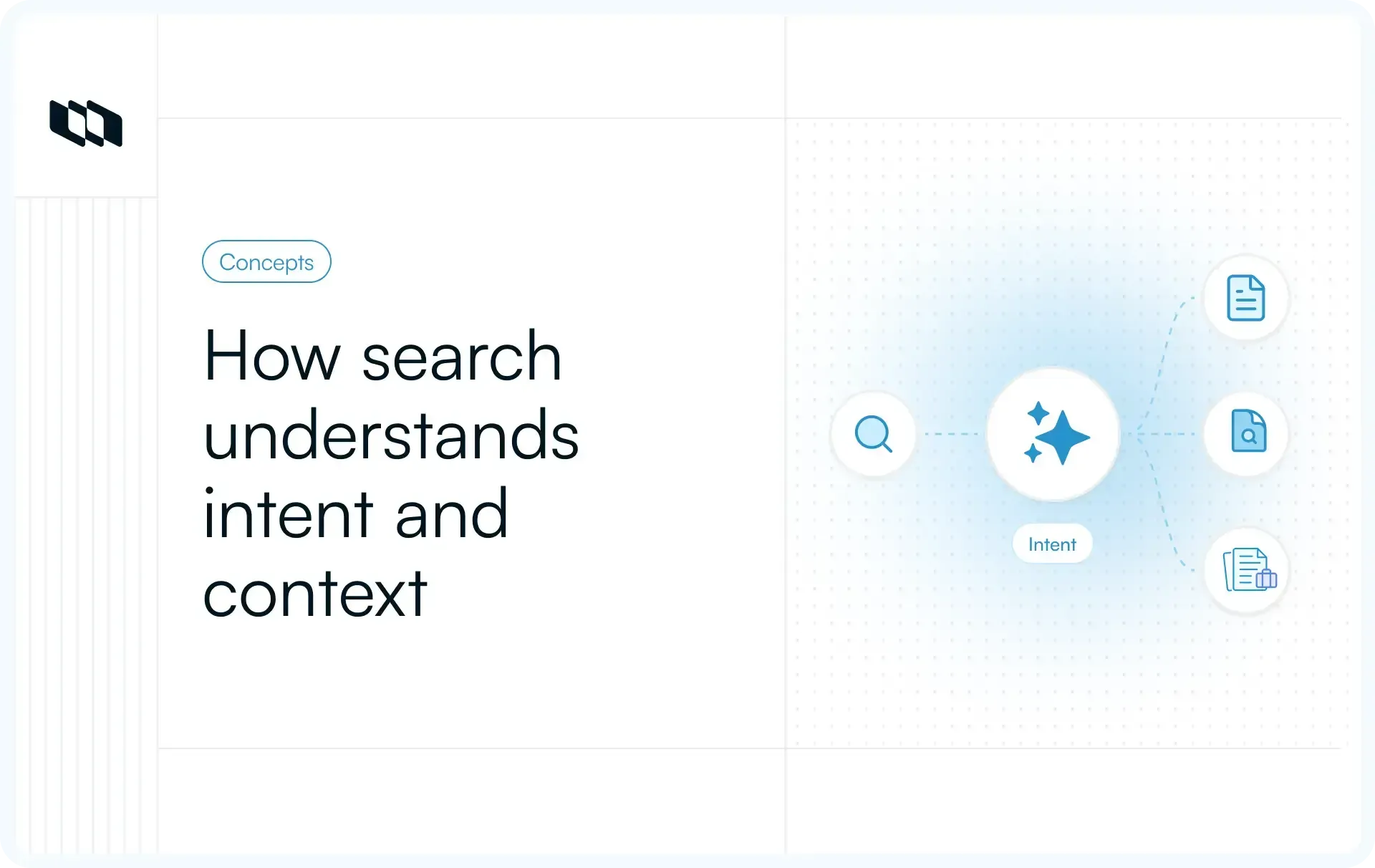
An engineer searches the company's knowledge base for "Why did the latest payment service deployment fail?" The relevant incident report is titled "Production rollout: missing configuration key" and explains the failure without using the same words as the query. A keyword-based search may struggle to connect the two.
Semantic search helps retrieve information through meaning and context, even when queries and documents use different terminology. This guide explains how semantic search works, the technologies behind it, and its applications across engineering, project management, and organizational knowledge.
What is semantic search?
Semantic search is an information retrieval technique that identifies relevant information based on the meaning and context of a search query. It uses learned relationships between words, phrases, and concepts to retrieve content that may be relevant even when it does not contain the exact search terms.
Traditional keyword search relies primarily on lexical matching, using factors such as term frequency, exact phrases, and document relevance signals. Semantic search introduces another way to identify relevant information by representing the meaning of queries and documents.
For example, consider someone searching for "how to prevent unauthorized access to customer information." A semantic search system may retrieve documentation about permission management, access control policies, or data security practices because those topics are conceptually related to the query.
Modern semantic search commonly uses artificial intelligence, natural language processing (NLP), machine learning, and vector embeddings to identify these relationships. It becomes particularly useful when people search using descriptions, questions, or terminology that differs from the language used in the underlying documents.
How does semantic search work?
Semantic search works by processing searchable content, converting text into numerical representations, retrieving semantically similar information, and ranking the results according to relevance.
To understand how semantic search works step by step, consider an engineer investigating why the latest payment service deployment failed. The organization's knowledge base contains incident reports, deployment records, troubleshooting guides, and engineering documentation.
The following five steps explain how a modern embedding-based semantic search system retrieves the relevant information.
Step 1. Prepare and index the content
The process begins by collecting information from the sources that need to be searchable. These may include incident reports, technical documentation, project records, knowledge-base articles, and other organizational information.
Before indexing, the system prepares the content for retrieval. This typically involves extracting readable text, identifying relevant metadata, and dividing longer documents into smaller, meaningful sections called chunks.
Chunking helps retrieval systems identify the specific part of a document that addresses a query. For instance, a lengthy incident report may contain separate sections covering symptoms, root cause, affected services, corrective actions, and preventive measures.
Rather than returning the entire report based on its overall similarity, the system can retrieve the section describing the failure.
Metadata such as the document title, source, project identifier, modification date, and access permissions may also be preserved to support subsequent filtering and ranking.
Step 2. Convert content into vector embeddings
Once the content is prepared, an embedding model converts each indexed text section into a numerical representation called a vector embedding.
These embeddings capture patterns of semantic similarity learned during model training. Text describing related concepts can receive similar vector representations even when different terms are used.
For example, consider these two statements:
- "Payment service deployment failed because an environment variable was missing."
- "Production rollout encountered a configuration error during service initialization."
Both statements describe related technical problems. A suitable embedding model may represent them as semantically similar despite their different wording.
The resulting vectors are stored in a searchable index alongside references to the original content.
Step 3. Interpret the search query
When the engineer searches for "Why did the latest payment service deployment fail?", the system processes the query using an embedding model compatible with the one used to index the documents.
The model produces a query vector representing learned relationships between concepts such as payment services, production deployments, failures, and incident causes.
This representation helps the system retrieve content about related technical problems.
However, the word "latest" introduces an additional requirement. Semantic similarity alone cannot reliably determine which deployment occurred most recently. The system needs supporting information, such as deployment timestamps, project identifiers, or structured query filters, to resolve that requirement accurately.
This distinction matters because identifying topically relevant information and identifying the correct record are separate retrieval tasks.
Step 4. Retrieve semantically similar results
The search system compares the query vector with indexed document vectors to find content with similar representations.
This process is called vector similarity search. Mathematical measures such as cosine similarity or dot product help estimate how closely the representations align.
For large document collections, approximate nearest-neighbor algorithms can identify promising matches efficiently without exhaustively comparing every indexed vector.
The initial results may include incident reports describing missing configuration values, failed service initialization, and deployment errors. Some will be more relevant than others, and several may concern different releases of the same service.
Step 5. Rank and return relevant results
After retrieving candidate documents, the system may apply additional signals to determine their final ranking.
These can include document recency, exact service identifiers, lexical relevance, metadata filters, and results from a reranking model.
For the engineer's query, the search system needs to distinguish between incidents that describe similar failures and the incident associated with the most recent payment service deployment.
When suitable metadata is available, a search application can combine semantic relevance with release timestamps and service-specific filters to identify the appropriate record.
Permission checks must also be enforced throughout retrieval and result presentation. Where documents are indexed as smaller chunks, those chunks must retain or reliably reference the authorization rules governing their source documents.
The final results can then direct the engineer to the relevant incident report and its associated technical documentation.
Example: How semantic search finds a relevant incident report
Consider three records in an engineering knowledge base.
Document | Content | Relevance to the query |
INC-4712: Payment API rollout, November 16 | Production deployment failed because a configuration key was missing | Explains the latest recorded failure |
INC-4628: Payment API rollout, November 4 | Deployment interrupted by a database migration timeout | Semantically relevant but concerns an earlier deployment |
RUN-19: Deployment checklist | Instructions for validating environment variables before release | Useful supporting information, but not the incident report |
Illustrative records created for this example.
Semantic retrieval may identify all three documents because they discuss related deployment concepts.
The first document becomes the strongest answer when the system combines its relevance to the failure question with verified service and deployment metadata. The third document may still be useful as supporting troubleshooting guidance.
This example illustrates an important property of semantic search: vector similarity helps identify relevant candidates, while additional retrieval and ranking logic can establish which candidate best satisfies the complete question.
What technologies power semantic search?
Modern semantic search systems combine language models, numerical representations, and information retrieval infrastructure. Each technology contributes to a different part of the retrieval process.
Natural language processing (NLP)
Natural language processing provides techniques for analyzing and representing human language. It helps search systems work with the relationships and ambiguities found in everyday communication.
For example, the word "sprint" has different meanings in athletic training and Agile software development. A model processing an engineering document can use surrounding language to identify which meaning is more likely.
NLP also supports techniques for handling linguistic variations, terminology differences, and relationships between expressions.
Modern embedding models frequently learn these relationships directly from training data, reducing the need to maintain large collections of manually configured synonyms.
Machine learning and language models
Machine learning enables models to learn patterns from data and apply those patterns to unfamiliar inputs.
Transformer-based language models are widely used in modern semantic retrieval because they can produce representations informed by the surrounding text.
For example, "release" in a software delivery document carries a different meaning from the same word in a legal agreement. Contextual representations help distinguish these uses.
However, an embedding model's effectiveness depends on its training data and the terminology it has encountered.
An organization searching specialized engineering documentation may find that a general-purpose model performs inconsistently on internal abbreviations, proprietary service names, or highly specific technical concepts.
Model selection therefore has a direct influence on retrieval quality.
Vector embeddings and vector databases
Understanding how vector embeddings work in semantic search requires separating the representation of information from the technology used to search it.
A vector embedding represents text as an array of numerical values. Similarity measures compare these representations to identify related content.
A vector index organizes embeddings for efficient retrieval. Vector databases provide infrastructure for storing, indexing, and querying vectors, often with additional capabilities such as metadata filtering.
Some traditional databases and search engines also support vector indexes, so organizations can implement semantic search without introducing a dedicated vector database.
The infrastructure decision depends on factors such as content volume, search latency, filtering requirements, operational complexity, and integration with existing systems.
Relevance ranking and reranking models
Initial retrieval systems are often designed to identify promising matches quickly. A reranking model can provide a more detailed assessment of the relationship between a query and each retrieved candidate.
For example, two documents may discuss payment service failures, but only one addresses the specific deployment and error condition mentioned in the query.
A reranker can help distinguish their relevance, while structured metadata resolves requirements such as dates, projects, and service identifiers.
Some retrieval architectures also incorporate explicit relationships between records. Knowledge graphs can provide this information when a question depends on how projects, services, incidents, or other entities are connected.
Semantic search vs. keyword search: What is the difference?
The difference between semantic search and keyword search lies in how each approach identifies relevant information.
Keyword search evaluates lexical relationships between a query and indexed content. Semantic search evaluates learned relationships between their meanings.
The two approaches serve different retrieval needs, particularly in environments where users search using both precise identifiers and descriptive language.
Parameter | Keyword search | Semantic search |
Matching approach | Uses matching terms, phrases, and lexical relevance signals | Uses meaning-based representations and semantic similarity |
Query interpretation | Primarily evaluates words and their occurrence | Captures learned relationships between concepts and expressions |
Synonyms | May require synonym expansion or related techniques | Can recognize conceptually related terminology |
Exact identifiers | Effective for issue IDs, error codes, and precise strings | Can struggle with uncommon identifiers |
Context | Uses lexical and available document signals | Can represent broader semantic relationships |
Computational requirements | Often requires fewer resources | May require embedding generation, vector indexing, and additional ranking |
Example | Searching for | Searching for "why are requests timing out?" |
Consider the query "database connections are running out during peak traffic."
A keyword-based system may prioritize documents containing those terms. Semantic search may also retrieve material discussing connection pool exhaustion, resource limits, or database connection saturation.
However, when someone searches for a specific identifier such as DB-2041, lexical matching is generally more dependable for retrieving that exact record.
Semantic search vs. vector search
- Semantic search describes a retrieval objective: finding information according to meaning and conceptual relevance.
- Vector search describes a retrieval technique: identifying similar numerical representations using distance or similarity measures.
Modern semantic search systems commonly use vector search because text embeddings provide a numerical representation of semantic relationships.
However, vector similarity can also support applications involving images, audio, recommendations, and other data types.
Semantic retrieval can also incorporate additional techniques beyond vector search, including lexical matching and structured relationships.
What is hybrid search?
Hybrid search combines lexical retrieval with semantic retrieval to handle queries that require different forms of matching.
Consider an engineering manager investigating an authentication problem.
A search for AUTH-2041 requires precise identifier matching. A search for "users lose their sessions after switching authentication providers" requires broader conceptual retrieval.
A hybrid search system can retrieve candidates using both techniques and combine their results through methods such as rank fusion or weighted scoring.
This approach is useful for technical documentation, incident records, and project knowledge because users frequently switch between searching for exact records and describing unfamiliar problems.
What are the benefits of semantic search?
The benefits of semantic search for businesses primarily come from improving information retrieval when users and source documents express the same concepts using different terminology.
1. More relevant search results
Semantic search can identify conceptually related information that might be overlooked by exact-term matching.
This is especially useful when the answer exists in the knowledge base but uses language that differs from the user's question.
The quality of those results still depends on the model, indexed content, and ranking configuration.
2. Better interpretation of user intent
Semantic models can identify relationships between a question and the concepts likely to be relevant to it.
For example, "reduce repeated production incidents" may be associated with root cause analysis, corrective actions, and reliability engineering practices.
This helps search systems identify useful starting points for investigation, although they may need additional context to establish the user's precise requirements.
3. Easier information discovery
Employees often encounter unfamiliar terminology when working across teams or joining an organization.
Semantic retrieval reduces dependence on knowing the exact language used by the original author. This can make existing knowledge more accessible to people who understand the problem but are unfamiliar with internal naming conventions.
4. More natural search experiences
People can describe what they need using questions and complete sentences.
A query such as "what should we check before deploying a database migration?" can be a useful way to retrieve relevant guidance without requiring the user to construct a specific keyword combination.
This makes search interfaces more accessible to people with different levels of familiarity with the underlying information.
5. Better reuse of organizational knowledge
Historical decisions, documented solutions, and operational guidance become more useful when teams can retrieve them during related work.
Semantic search can support this reuse by making relevant material discoverable across a searchable collection, reducing the need to recreate explanations or investigate previously resolved questions.
What are the real-world applications of semantic search?
Semantic search use cases extend across business applications, technical systems, and AI-assisted information retrieval. Its value depends on the type of information being searched and how accurately the system can connect user questions with useful sources.
Enterprise knowledge management
Organizations use semantic search to retrieve information from internal documentation, policies, and knowledge repositories.
For example, an employee searching for "how do I request access to the analytics environment?" might find an IT procedure covering data-platform permissions and access approvals.
This helps employees discover relevant guidance even when they are unfamiliar with the terminology used in internal processes.
For more information about retrieval across connected organizational systems, see our guide to enterprise search.
Project and product management
Project teams accumulate requirements, specifications, work items, and decision records throughout delivery.
Semantic search can help product managers investigate whether a new requirement resembles an earlier request or whether a similar problem has already been addressed.
For example, a product manager researching customer authentication issues may retrieve historical requirements describing session expiration, token refresh failures, or login interruptions.
These connections are useful during discovery, prioritization, and technical discussions when teams need to understand previous decisions before creating new work.
Software development and technical documentation
Engineers frequently describe problems through observable symptoms before identifying their causes.
A developer searching for "API requests slowing down after deployment" might retrieve documentation discussing connection pool limits, gateway timeouts, or service resource exhaustion.
Semantic retrieval helps identify potentially relevant technical references, giving engineers a starting point for troubleshooting.
The retrieved information still requires verification against the actual application, infrastructure, and error conditions.
Customer support and help centers
Customer support systems use semantic retrieval to connect user questions with troubleshooting instructions, product documentation, and previously documented solutions.
For example, a customer searching for "I can't change who can see my workspace" might retrieve an article covering workspace roles or visibility settings.
Support teams can also use retrieval systems to locate relevant reference material while investigating unfamiliar requests.
Accurate, maintained documentation remains essential because semantic matching cannot compensate for missing or incorrect instructions.
E-commerce and product discovery
Online stores use semantic search to interpret descriptive requests involving product characteristics and intended use.
A customer searching for "comfortable shoes for long walks in wet weather" might receive results for waterproof walking or hiking footwear.
This allows product discovery to accommodate natural descriptions of customer needs.
Structured filters are still necessary for precise requirements such as size, availability, and price.
AI-powered knowledge retrieval and RAG
Semantic search plays an important role in retrieval-augmented generation (RAG), an approach that combines information retrieval with generative AI.
A RAG application retrieves information relevant to a user's question and supplies it to a language model as context for generating an answer.
For example, an engineering assistant answering a question about a deployment procedure may retrieve relevant runbooks, release instructions, and technical documentation before constructing a response.
The quality of the answer depends on the retrieved evidence and how effectively the model uses it.
Semantic search can be one part of a RAG retrieval system, alongside keyword search, structured queries, and other methods.
This is closely related to context engineering, which addresses how information is selected, organized, and supplied to AI systems.
What are the challenges and limitations of semantic search?
Despite its ability to retrieve conceptually related information, semantic search introduces challenges that affect retrieval precision, reliability, and operational performance.
1. Difficulty with exact-match queries
Embedding models can struggle with identifiers that have limited semantic meaning.
For example, PROJ-1042 and PROJ-1043 may refer to entirely different work items despite their similar structure.
A system relying exclusively on embedding similarity may retrieve the wrong record when users search for precise identifiers.
Lexical retrieval, structured lookups, and appropriate filtering are often needed for these queries.
2. Ambiguous queries and inaccurate matches
Semantically similar content may describe different underlying problems.
A search for an application outage might retrieve reports about network failures, database errors, and infrastructure incidents because they share related terminology.
These results can be useful for exploration, but their similarity does not establish that they address the same cause.
Search applications need appropriate ranking strategies and sufficient contextual information to distinguish related topics from relevant answers.
3. Data quality and indexing challenges
Incomplete, outdated, or poorly organized source material can reduce retrieval quality.
Chunking also requires careful attention. Very small chunks may separate an instruction from the condition that explains when it applies, while oversized chunks may contain several unrelated topics.
Duplicate documents, inconsistent naming conventions, and missing metadata can make it harder to identify authoritative or current information.
For organizations maintaining an internal knowledge base, documentation ownership and regular updates are important foundations for reliable retrieval.
4. Computational costs and performance
Semantic retrieval often requires additional resources for embedding generation, vector indexing, storage, and query processing.
Retrieval latency can also increase when applications use multiple candidate-generation techniques or computationally intensive reranking models.
Organizations need to balance retrieval quality with processing costs, indexing frequency, and expected query volume.
5. Privacy, security, and access control
Semantic search introduces security requirements when it operates over confidential or permission-controlled information.
Search systems must enforce authorization before exposing document content, including retrieved chunks, snippets, cached results, and information supplied to downstream AI applications.
Permissions also need to remain accurate when users change roles, documents become private, or access is revoked.
Organizations should evaluate where embeddings are generated and stored, how sensitive information is handled, and whether retrieval infrastructure follows applicable data-governance policies.
How can organizations improve semantic search accuracy?
Improving semantic search accuracy requires evaluating the complete retrieval process against the information users actually need. Model quality matters, but content preparation, ranking strategies, and ongoing testing also influence the results.
Use appropriate embedding models
Select models based on the content domain, supported languages, and retrieval requirements.
General-purpose models may perform well on common terminology but struggle with specialized technical language, internal abbreviations, or proprietary product concepts.
Evaluate potential models using representative queries and known relevant documents from the intended search environment.
Improve document structure and chunking
Organize documents with descriptive headings, meaningful sections, and consistent terminology.
Choose chunk boundaries that preserve the context needed to interpret each passage. For example, a troubleshooting instruction should remain associated with the error condition or system configuration it addresses.
Preserving document titles, source references, and relevant metadata can also improve downstream retrieval and ranking.
Combine semantic and keyword retrieval
Use hybrid retrieval when queries include both natural-language descriptions and exact technical terms.
Engineering and project-management information often contains issue identifiers, component names, version numbers, and error codes alongside descriptive documentation.
Combining retrieval techniques can help cover these different search patterns, provided the combined ranking strategy is tested against representative queries.
Apply reranking and metadata filters
Metadata filters can restrict retrieval to relevant projects, services, document categories, or time periods.
Reranking models can then assess which candidates most closely address the query.
For instance, filtering deployment incidents by service identifier and release period before final ranking may improve results for a question about a specific production failure.
Authorization constraints should remain mandatory throughout this process.
Evaluate search quality regularly
Search quality should be measured using representative queries and documents with established relevance judgments.
Common evaluation metrics include:
- Precision@K: Measures the proportion of relevant results among the first K retrieved items.
- Recall@K: Measures the proportion of known relevant documents retrieved within the first K results.
- Normalized Discounted Cumulative Gain (nDCG): Measures ranking quality by considering document relevance and position.
For example, a team evaluating search across engineering incident reports might prepare a set of common troubleshooting queries and identify which reports should be considered relevant.
The team can then compare retrieval configurations using those queries, measure improvements, and investigate recurring failures.
Ongoing evaluation becomes particularly important as new documentation is added, embedding models change, and users begin searching for different types of information.
Frequently asked questions
1. Is semantic search a form of artificial intelligence?
Modern semantic search commonly uses artificial intelligence, particularly machine learning and natural language processing, to represent and retrieve information based on meaning. Embedding models are widely used to capture semantic relationships between queries and documents. Semantic retrieval can also incorporate structured or rule-based techniques.
2. Does semantic search require a vector database?
No. Semantic search can use vector indexing capabilities available in traditional databases and search engines. A dedicated vector database may be appropriate for applications with specific scalability, retrieval, or infrastructure requirements, but it is not mandatory for implementing semantic retrieval.
3. Can semantic search understand different languages?
Yes. Multilingual embedding models can represent content from different languages in a shared semantic space, enabling cross-language retrieval. Performance depends on the languages supported by the model, its training data, and the terminology used in the indexed documents.
4. Can semantic search work with unstructured data?
Yes. Semantic search is commonly used with unstructured information such as documents, technical reports, knowledge-base articles, and support conversations. The content is usually extracted and prepared before indexing. Multimodal models can also support retrieval involving images and other data types.
5. What is the relationship between semantic search and large language models?
Semantic search retrieves relevant information, often using embeddings generated by trained language models. Generative large language models can use the retrieved content to answer questions or complete tasks. These capabilities can operate together, although information retrieval and answer generation remain separate functions.
Recommended for you




 Download for Mac
 Download for Android
