What is context engineering?
Introduction
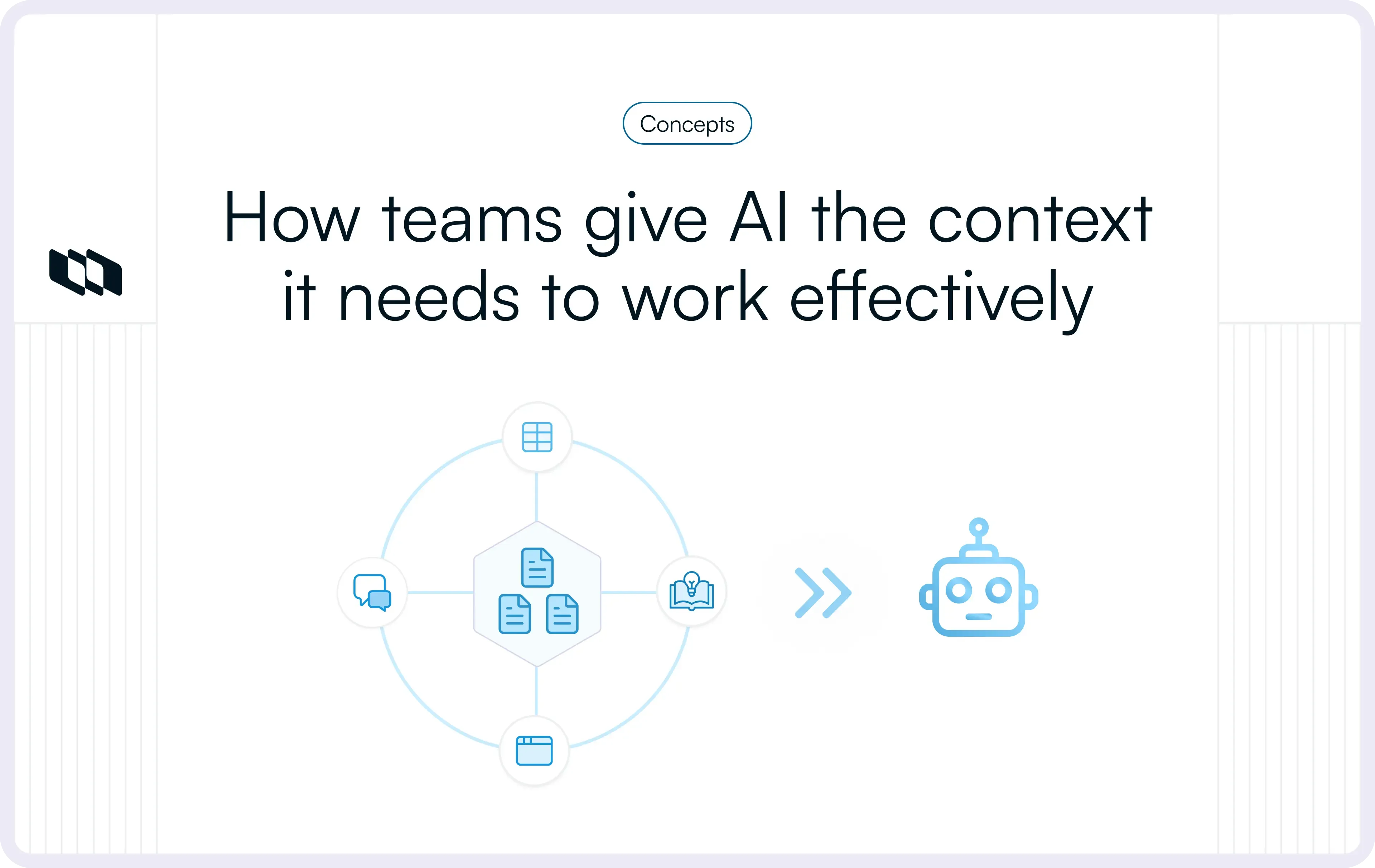
Every AI response depends on what the model can see at that moment. Instructions, conversation history, retrieved documents, tool outputs, memory, and runtime state can all shape the result. Context engineering brings structure to that growing information layer. It helps teams decide what belongs in an LLM context, what should stay out, and what needs to change as a task progresses. This guide breaks down context engineering in AI, the techniques behind it, and how teams use it to build more reliable AI agents.
What is context engineering?
Context engineering is the practice of selecting, structuring, and managing the information an AI model needs to complete a task effectively.
That information can include instructions, conversation history, retrieved documents, memory, tool outputs, and task state. The goal is to give the model the most useful context for the current step, while keeping irrelevant information out.
Context can also change as a task progresses. A tool call may return new data, an earlier detail may become less useful, or an agent may need different information for its next action.
The context window is the space where this information is available to the model while it generates a response or decides what to do next. You can think of it as the model’s working memory.
What does "context" mean for an LLM?
Context can come from several sources:
- System instructions: The model’s role, rules, constraints, and expected behavior.
- User input: The current question, request, or task.
- Conversation history: Relevant information and decisions from earlier interactions.
- Retrieved knowledge: Documents, databases, knowledge bases, or search results brought in when needed.
- Memory: Information retained from previous interactions or tasks. Agent memory is especially useful in longer or recurring workflows.
- Tools and tool outputs: APIs, functions, MCP tools, and the information returned when the model uses them.
- State and metadata: Details such as permissions, IDs, task status, variables, and workflow state.
- Examples and output schemas: Reference examples or structures that guide the format of the response.
The mix depends on the task. A simple question may need only the user request and a few instructions. Context engineering for AI agents is more dynamic because agents may also need live data, memory, tools, permissions, and the results of previous actions as they work.
Why is context engineering important?
The quality of an AI system depends heavily on the information available when it makes a decision. Good context helps the model stay focused, use reliable information, and carry useful details from one step to the next.
Here is where AI context engineering makes the biggest difference:
- Keeps responses relevant: Supplies information tied to the current request, reducing distractions from unrelated data.
- Improves factual grounding: Gives the model access to trusted documents, databases, or other external sources when a task requires current or specific information.
- Supports multi-step tasks: Preserves goals, decisions, task state, and important details as the model works through several steps.
- Makes tool use more reliable: Provides enough information for the model to choose the right tool, pass the right inputs, and interpret the result correctly.
- Uses the context window efficiently: Prioritizes useful information and removes material that no longer helps with the current step, reducing wasted tokens.
- Supports more capable AI agents: Agents continuously retrieve data, call tools, update state, and make decisions. Context engineering for AI agents helps keep that changing information useful throughout the workflow.
As AI systems take on longer and more complex work, context window management for AI agents becomes increasingly important for maintaining reliable performance.
Context engineering vs. prompt engineering
Prompt engineering focuses on how instructions are written so a model can understand and respond to a request effectively. Context engineering covers a broader system around that prompt, including the knowledge, memory, tools, conversation history, and state available to the model while it works.
In practice, prompt engineering is one part of the wider context engineering vs. prompt engineering picture. A well-written prompt still depends on the quality of the information surrounding it.
Factor | Prompt engineering | Context engineering |
Focus | How instructions are written | What information the model receives |
Scope | Primarily the prompt | Prompts, knowledge, memory, tools, history, and state |
Typical use | Individual or contained tasks | Dynamic, multi-step AI systems |
Information | Usually supplied directly | Often retrieved and assembled dynamically |
Lifecycle | Commonly prepared before inference | Updated as the task progresses |
Goal | Help the model interpret the instruction clearly | Give the model useful information for each step of the task |
When do you need context engineering?
Prompt engineering may be enough for a simple, self-contained request. Context engineering in AI becomes more important when the task depends on information that changes or accumulates over time.
This commonly happens when:
- Information changes during the task, such as project status, customer data, or live system state.
- Several data sources are involved, including documents, databases, APIs, or search systems.
- Previous interactions matter, so the model needs relevant history or memory.
- External tools are required, and the model needs context to choose and use them correctly.
- AI agents work through multiple steps, with new information generated after each action.
- Context must be retrieved dynamically, based on what the model needs at a particular point in the workflow.
For these systems, the quality of the prompt is only one part of performance. The surrounding context has to stay relevant as the task evolves.
How does context engineering work?
Context engineering works as a continuous process of deciding what information an AI system needs, where that information should come from, and how much of it should be placed in the model’s context window.
The exact setup varies by application, but the underlying lifecycle is usually similar.
1. Identify what the task needs
The process starts by defining the information required to complete the task.
That can include:
- Instructions and constraints
- Relevant knowledge
- Available tools
- Conversation history
- Memory
- Current task state
- Permissions or user-specific information
For example, an AI agent asked to summarize the status of a delayed project may need the project goal, current work items, owners, dependencies, recent updates, and access to the project system.
This first step sets the boundaries for the rest of the context. If the system cannot identify what is relevant to the task, retrieval and context selection become much less effective.
2. Retrieve relevant context
Once the system knows what it needs, it has to find the information.
Relevant context may come from:
- Previous messages
- Documents and files
- Databases
- Knowledge bases
- APIs
- Search systems
- Project or product data
- Long-term memory
Retrieval can happen before the model responds or during the task as new questions arise.
An agent reviewing a software release, for instance, may first retrieve the release plan and open work items. If it later finds a blocked task, it may retrieve the dependency, recent comments, and owner information before deciding what to do next.
This is where techniques such as RAG often fit into context engineering in AI. Retrieval brings external information into the model’s working context when that information becomes useful.
3. Select the useful information
Retrieval can return far more information than the model needs. The next step is deciding what deserves space in the context window.
The system may rank results by relevance, remove duplicates, discard stale information, or filter records based on the current task.
Consider an agent looking for the cause of a release delay. A project may contain hundreds of work items, comments, documents, and activity logs. The model may only need the blocked tasks, their dependencies, recent updates, and the release deadline.
Good LLM context is selective. The aim is to preserve the information that can influence the next decision while keeping unrelated material out of the model’s attention.
4. Structure the context
Useful information still needs to be presented in a form the model can interpret clearly.
Context may be organized into sections such as:
- Task instructions
- Relevant facts
- Current state
- Retrieved records
- Tool definitions
- Constraints
- Examples
- Expected output format
Structured context becomes especially important when several sources contribute information at the same time.
An AI agent might receive project data from one tool, customer feedback from another, and instructions from the user. Clear labels and consistent formats help the model understand which information serves which purpose.
This is also where prompt engineering contributes to the broader context-engineering process. Instructions still matter, but they sit alongside the data, tools, memory, and state required to complete the task.
5. Fit the information within the context budget
Every model has a finite context window, so the system has to decide how that space should be used.
As conversations and agent workflows become longer, context can accumulate quickly. Tool outputs, retrieved documents, earlier messages, and intermediate results can consume a large portion of the available tokens.
Teams typically manage this through techniques such as:
- Prioritizing high-value information
- Summarizing older interactions
- Compressing long documents or tool outputs
- Removing stale context
- Storing large artifacts externally
- Retrieving details again when they become relevant
This is the core of context window management for AI agents. The system has to preserve important goals, decisions, and state while making room for new information generated during the task.
A larger context window gives the system more capacity, but good context management still determines which information receives that capacity.
6. Assemble the context for the model
After retrieval, selection, structuring, and compression, the system assembles the information the model will use for its next inference.
A single context window might contain:
- The system instructions
- The user’s current request
- A short summary of earlier decisions
- Relevant project records
- Available tools
- The latest tool output
- Current workflow state
- The required response format
The model then uses this combined context to produce a response, choose a tool, or decide what action should happen next.
This assembly can look different at every step. An agent does not need the exact same information throughout an entire workflow.
7. Update the context as the task progresses
Context engineering becomes especially important once the model starts taking actions.
Every action can produce new information. A tool returns a result, a user adds a requirement, a work item changes state, or the agent discovers a new dependency. The system then has to decide what should enter the context next and what can be removed.
For example, an agent investigating a blocked project might:
Retrieve the project → find the blocked work item → inspect its dependency → read the latest update → identify the owner → prepare a status summary.
The useful context changes at each stage.
This continuous updating is what makes context engineering for AI agents different from preparing a single prompt. The system repeatedly retrieves, filters, organizes, and refreshes information as the agent moves through the task.
In practice, how context engineering works comes down to one recurring decision: what does the model need to know for the next step, and what can safely stay outside its active context?
What are the core techniques in context engineering?
Context engineering relies on a small set of techniques for deciding what information enters the model’s context, how it is organized, and when it should be refreshed.
1. Context selection
Choose the information that is most relevant to the current task. This helps keep the model focused and reduces noise from unrelated history, data, or tool outputs.
2. Context retrieval
Bring in external information only when the task requires it. Common approaches include semantic search, keyword search, hybrid retrieval, RAG, and structured database queries.
3. Context structuring
Organize information using clear sections, labels, schemas, or consistent formats so the model can distinguish instructions, facts, state, and outputs more easily.
4. Context sequencing
Control the order in which information appears. Important instructions, constraints, and task-critical details should be positioned where they are easy for the model to use.
5. Context compression
Condense long conversations, documents, or previous actions while preserving the facts and decisions that still matter. This becomes especially useful in long-running AI agent workflows.
6. Context offloading
Keep large files, logs, or artifacts outside the active context window and retrieve them when needed. This frees space for information that is more relevant to the current step.
7. Context isolation
Separate context between tasks, tools, or agents so unrelated information does not influence every interaction. Isolation is particularly useful in multi-agent systems and complex workflows.
8. Memory management
Decide what should stay in short-term context and what should persist as agent memory across sessions. Good memory management helps preserve useful information without carrying unnecessary history forward.
Together, these techniques help teams manage LLM context more deliberately. The aim is to keep the model’s working information relevant, structured, and manageable as the task changes.
How does RAG fit into context engineering?
Retrieval-augmented generation, or RAG, is one way to bring external knowledge into a model’s context. It retrieves relevant information from sources such as documents, databases, or knowledge bases and makes that information available when the model generates a response.
RAG mainly answers one question: what external information should be retrieved for this task?
Context engineering covers a wider set of decisions. Along with retrieval, it manages:
- Instructions
- Conversation history
- Memory
- Tool definitions and outputs
- Runtime state
- Information ordering
- Context compression
- Token allocation
This makes RAG an important technique within context engineering in AI, especially when models need access to information that is too large, too dynamic, or too specific to keep permanently in the context window.
In practice, RAG helps fetch the right knowledge, while context engineering determines how that knowledge fits alongside the rest of the information the model needs to act effectively.
Why isn't a larger context window enough?
A larger context window gives a model more room to work with, but more capacity does not automatically improve the quality of the context.
Every document, message, tool output, and piece of history added to the window competes for attention. If too much low-value information accumulates, important details can become harder for the model to use consistently.
This becomes especially challenging for long-running AI agents, which may generate new context after every action. Tool results, intermediate decisions, memory, and conversation history can quickly expand beyond what remains useful.
Effective context window management for AI agents focuses on keeping high-value information accessible. That may involve:
- Removing stale or redundant context
- Summarizing older interactions
- Compressing large tool outputs
- Offloading bulky information outside the active window
- Retrieving details again when they become relevant
The goal is to maximize useful signal inside the window, rather than simply filling the available space.
What are the common context engineering failures?
Poor context can affect an AI system in several ways. Some problems come from incorrect information, while others appear when too much context accumulates or different pieces of information start competing with each other.
1. Context poisoning
Context poisoning happens when incorrect, outdated, or misleading information enters the model’s context and begins shaping later responses. The risk becomes greater when that information is stored in memory or carried across several steps, because one bad input can influence decisions further down the workflow.
Teams can reduce this by validating important inputs, relying on trusted sources, and being careful about what information is allowed to persist in memory.
2. Context distraction
A model can struggle when its context contains too much information, even if most of that information is technically relevant. Long conversation histories, large documents, and detailed tool outputs can bury the few details that matter most for the current step.
Pruning older information, summarizing previous interactions, and retrieving details only when needed can help keep the context focused.
3. Context confusion
Context confusion occurs when the model receives information or options that are loosely related to the task but do not actually help it complete the work. This often shows up when an agent has access to too many tools, overlapping instructions, or several sources with similar information. The model then has to spend more effort deciding what to use.
A better approach is to expose only the tools, data, and instructions that are useful for the current task.
4. Context clash
Context clash happens when different parts of the context disagree.
For example, an older project update may say a task is blocked while a newer record shows it as complete. Conflicting instructions can create the same problem.
Clear source priorities, current state information, and regular removal of stale context help reduce these conflicts.
5. Context overflow and goal drift
Long-running AI agents introduce another challenge. Every action can add messages, tool results, intermediate decisions, and new state to the context. As that history grows, the agent may lose sight of the original objective or important constraints established earlier in the task.
Good context window management for AI agents keeps those high-value details visible while older or lower-value information is compressed, summarized, or moved outside the active context.
How is context engineering used in AI agents?
AI agents rely on context continuously because their work unfolds across multiple steps. The information they need at the beginning of a task is rarely the same information they need later.
A typical agent loop looks like this:
Receives a goal → reads current state → retrieves information → selects a tool → receives the tool output → updates its state → decides the next step
At every stage, the agent’s context changes. New information enters, previous results become less important, and the system has to decide what should remain available.
That is why context engineering for AI agents is central to how reliable agent workflows are built. The agent needs enough context to understand the task, act correctly, and carry useful information forward without allowing its context window to become overloaded.
The core context usually includes:
- Goal and instructions: What the agent is expected to accomplish, along with the rules and boundaries it should follow.
- Current task state: Where the agent is in the workflow, what has already been completed, and what still needs attention.
- Relevant knowledge: Documents, records, project data, or other information required for the current decision.
- Available tools: The APIs, functions, search systems, databases, or other tools the agent can use to gather information or take action.
- Previous actions and results: What the agent has already tried and what those actions returned. This prevents unnecessary repetition and helps inform the next step.
- Short-term memory: Information that matters within the current task or session, such as recent decisions, intermediate findings, or temporary state.
- Persistent memory: Information that remains useful across sessions or recurring workflows, such as preferences, established facts, or previous outcomes.
- Permissions and constraints: What the agent is allowed to access, change, or execute within the system.
Consider an agent reviewing a delayed software release. It may begin with the release goal and current project state, retrieve blocked work items, inspect dependencies, check recent updates, and then identify which issue requires attention first.
Each step produces new context. Effective AI context engineering keeps the information needed for the next decision available while removing or compressing details that have already served their purpose.
This is also where agent memory, tool access, and context window management for AI agents come together. The agent has to remember enough to stay consistent, retrieve enough to stay informed, and keep its active context focused enough to make sound decisions as the task progresses.
What does context engineering look like in practice?
Consider an AI agent connected to a project management system. A user asks:
“Find the login bug reported by customers, check whether engineering is already working on it, and summarize the current status.”
The agent cannot answer reliably from the request alone. It has to build the right context as it works through the task.
1. Understand the instruction
The agent first identifies the goal: find the relevant bug, confirm whether engineering is working on it, and return a concise status summary.
2. Capture the user request
The phrase “login bug reported by customers” becomes the starting point for retrieval. The agent now knows what issue it is looking for and what information the final answer should contain.
3. Retrieve work data
The agent searches relevant projects or work items for issues related to login failures, authentication, or customer-reported bugs.
4. Pull in related context
Once it finds a likely match, it retrieves the information needed to understand the issue, such as:
- Current status
- Assignee
- Priority
- Recent comments
- Linked customer reports
- Dependencies or blockers
5. Maintain task state
The agent keeps track of the relevant project, work item ID, and what it has already checked. This helps it continue the investigation without repeating earlier steps.
6. Use additional tools when needed
If the work item references another system, document, or customer report, the agent can use the appropriate tool to retrieve that information and add it to the working context.
7. Select the useful details
The project may contain hundreds of work items and comments. The agent keeps only the facts that help answer the user's question, such as whether the bug is confirmed, who owns it, what state it is in, and whether anything is blocking progress.
8. Produce a grounded response
With the relevant context assembled, the agent can summarize the current situation using information from the actual work system.
This example shows how context engineering works in a real workflow. The agent continually retrieves, filters, and updates information as the task develops. Structured work data, such as statuses, assignees, dependencies, comments, and relationships between work items, gives the agent usable context for deciding what to do next.
Final thoughts
Context engineering is becoming a core discipline for building reliable AI systems because models increasingly work across tools, memory, live data, and multi-step workflows. The practical goal is simple: give the model the most relevant information for the decision in front of it. That means selecting useful context, retrieving what is missing, structuring it clearly, and managing the context window as the task evolves.
For teams building AI agents, this becomes even more important. Strong context engineering for AI agents helps preserve goals, state, permissions, and useful memory while keeping irrelevant information out of the active context.
As AI systems take on more complex work, the quality of their decisions will depend increasingly on the quality of the context they receive.
Frequently asked questions
Q1. What is context engineering?
Context engineering is the practice of selecting, structuring, retrieving, and managing the information an AI model receives while completing a task. That context can include instructions, conversation history, external knowledge, memory, tool outputs, and runtime state. The goal is to give the model the most relevant information for each step while using its context window effectively.
Q2. What are the five layers of context engineering?
There is no single standardized five-layer model for context engineering, but its core functions can be grouped into five practical layers:
- Instructions: The model's role, goals, rules, and constraints.
- Knowledge: Retrieved documents, records, search results, and other external information.
- Memory: Information retained from earlier interactions or tasks.
- Tools: APIs, functions, tool definitions, and outputs available to the model.
- State: Current task progress, permissions, variables, and other runtime information.
These layers work together to determine what an AI system knows and can use at a given point in a task.
Q3. What are the five layers of software?
Software architectures vary, but a common five-layer model includes the user interface, API or service layer, business logic, data layer, and infrastructure layer. The user interface handles interactions, APIs connect components, business logic applies application rules, the data layer stores and retrieves information, and infrastructure provides the compute, networking, and hosting needed to run the system.
Q4. What is LLM engineering?
LLM engineering is the discipline of building reliable applications and systems around large language models. It covers areas such as prompt and context design, retrieval, RAG, tools, AI agents, evaluation, observability, guardrails, data pipelines, and model deployment. Context engineering is therefore one part of the broader LLM engineering practice.
Q5. What is agentic context engineering?
Agentic context engineering is the practice of managing and updating the context an AI agent uses as it works through a task. The agent may retrieve new information, call tools, preserve useful memory, update its state, and remove outdated context between steps.
The term is also associated with Agentic Context Engineering, or ACE, a research framework that treats context as an evolving playbook. In ACE, agents use execution feedback to generate, reflect on, and curate useful strategies over
Recommended for you



 Download for Mac
 Download for Android