What is dependency mapping in project management?
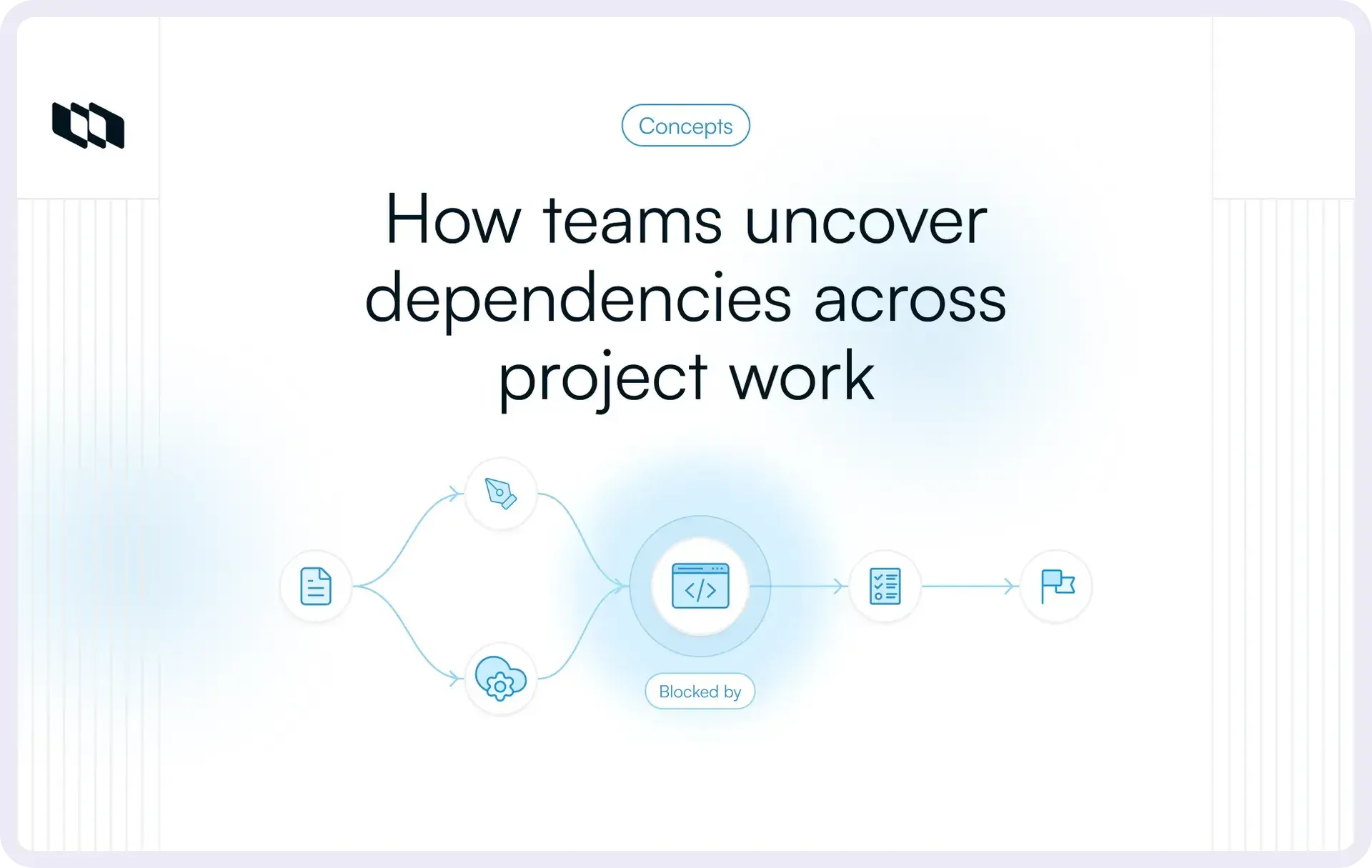
A backend API runs two days late, pushing integration testing into the following week and putting a planned product release at risk. The delay began with one task, but its impact reached several teams.
Dependency mapping in project management helps teams visualize these connections before they disrupt delivery. By showing which activities depend on others, who owns each handoff, and where delays could spread, teams can build more realistic schedules.
This guide explains dependency mapping, its components and types, how to create a dependency map, and the tools and practices that make it useful throughout a project.
What is dependency mapping in project management?
Dependency mapping is the process of identifying, documenting, and visually representing relationships between project tasks, activities, deliverables, and milestones. It shows how the progress or completion of one activity affects another, helping teams establish a logical sequence of work and understand potential scheduling impacts.
A project dependency describes a relationship between activities. A dependency map brings those relationships together in a visual structure, usually using connected nodes and directional arrows.
Consider a software team building a new authentication feature. The frontend engineer needs an approved interface design before implementing the login screen. That relationship can be represented as:
UI design approval → Frontend implementation
The arrow indicates that frontend implementation depends on design approval. If the design takes longer than expected, the team can examine the downstream work and determine whether the delay affects the planned release.
Project dependency mapping becomes particularly useful when several teams contribute to the same deliverable, activities overlap, or important milestones depend on multiple handoffs.
What are the key components of a dependency map?
A dependency map combines task information with the relationships that determine how work progresses. The level of detail depends on project complexity, but seven components help make the map useful for planning and coordination.
- Tasks and activities: These are the individual units of work represented as nodes in a dependency diagram. Each should describe a distinct activity or deliverable, such as developing an API endpoint or completing integration testing.
- Dependency connections: Directional arrows show how activities relate to one another. For a finish-to-start dependency, an arrow typically runs from the predecessor to the task waiting on its completion. Other relationship types may connect task start or finish points.
- Predecessors and successors: A predecessor is an activity whose start or finish governs another activity. The dependent activity is its successor. For example, API development is a predecessor of integration testing when testing requires the completed API.
- Dependency classifications: Relationship labels indicate whether activities have finish-to-start, start-to-start, finish-to-finish, or start-to-finish dependencies. These distinctions matter when teams plan overlapping work.
- Owners and responsibilities: Each activity should have an accountable owner, such as a backend engineer, product designer, or QA lead. Ownership makes it easier to coordinate handoffs and resolve blockers.
- Timelines and milestones: Start dates, estimated durations, due dates, and delivery checkpoints provide scheduling context. A dependency becomes more actionable when the team knows when the required output is expected.
- Risks and constraints: External approvals, limited specialist availability, and uncertain delivery dates can affect dependent activities. These should be documented alongside the map, with significant risks highlighted for review.
A simple dependency map may contain only tasks and connections. Larger projects benefit from additional ownership, scheduling, and risk information so teams can use the map during execution.
What are the different types of dependencies in project management?
Task dependencies can be classified according to how activities are sequenced and what creates the relationship. Understanding these classifications helps teams represent the actual conditions governing work rather than assuming every activity must be completed before the next begins.
Types based on task sequencing
The four standard scheduling relationships describe how the start or finish of a predecessor affects its successor.
Dependency type | Meaning | Example |
Finish-to-start (FS) | A successor cannot begin until its predecessor finishes. | Integration testing begins after the required API implementation is complete. |
Start-to-start (SS) | A successor cannot begin until its predecessor has started. | Test-case preparation begins after requirements review has started. |
Finish-to-finish (FF) | A successor cannot finish until its predecessor finishes. | A test summary cannot be finalized until the associated test execution is complete. |
Start-to-finish (SF) | A successor cannot finish until its predecessor starts. | An outgoing support shift cannot end until its replacement shift begins. |
Finish-to-start is commonly used for sequential work. Start-to-start and finish-to-finish relationships are useful when activities can overlap, while start-to-finish is comparatively uncommon.
These four relationships are defined in the Project Management Institute's Practice Standard for Scheduling.
Types based on the nature of dependencies
Dependencies can also be categorized according to where they originate and whether the relationship is required or chosen.
- Internal dependencies: Relationships between activities managed within the project or organization. For example, frontend implementation may depend on the internal design team's approved screens.
- External dependencies: Relationships involving work or decisions outside the project team's direct control, such as receiving access to a third-party payment gateway.
- Mandatory dependencies: Relationships required by technical, physical, contractual, or regulatory conditions. A production deployment that requires an approved security review is one example.
- Discretionary dependencies: Relationships established through team preferences or working practices. A team might choose to finish a full design review before implementation, even when some independent development could begin earlier.
These categories describe different dimensions of a relationship. An internal dependency may be mandatory or discretionary, depending on the circumstances.
For a broader explanation, see our guide to dependencies in project management.
Why is dependency mapping important in project management?
Project plans often contain several activities that appear independent when viewed as individual tasks. Mapping their relationships reveals the coordination required to complete those activities in the intended order.
Here are six ways dependency mapping supports project planning and execution.
1. Improves task sequencing and scheduling
A dependency map shows which activities need to happen sequentially and where work can safely overlap.
For example, frontend and backend development may proceed simultaneously once interface requirements are agreed upon. Integration testing, however, may require completed outputs from both teams.
Recognizing these relationships helps project managers arrange activities around actual requirements instead of imposing unnecessary sequential work.
2. Identifies potential bottlenecks early
Some activities have several downstream tasks waiting on their completion. When these relationships are visible, teams can assess where delays may have broader consequences.
A shared authentication service, for instance, might support multiple features scheduled for the same release. Mapping the dependent work helps the engineering manager recognize its importance and coordinate delivery expectations.
3. Supports realistic project timelines
Task estimates alone provide an incomplete basis for scheduling. Teams must also account for approvals, handoffs, waiting periods, and the availability of prerequisite work.
Dependency mapping reveals these conditions before dates are finalized. It can also help distinguish scheduling flexibility from activities that have little room for delay.
4. Improves resource allocation
A dependency map helps managers recognize when connected activities require the same specialists or equipment.
Suppose two integration tasks depend on a single database engineer. Even if the tasks have no direct technical dependency, their competing resource requirements may prevent simultaneous execution.
The team can then adjust assignments or scheduling assumptions rather than discovering the conflict during implementation.
5. Strengthens cross-team coordination
Product delivery frequently involves design, engineering, QA, infrastructure, and other functions. Each team may manage its own backlog while contributing to a shared milestone.
A dependency map identifies the outputs each team requires from another, making handoff responsibilities and timing easier to discuss.
6. Supports risk management and decision-making
When a task changes, the map provides a starting point for impact analysis. Project managers can trace affected successors, examine available scheduling flexibility, and identify teams that need updated information.
This is particularly useful when handling scope changes, supplier delays, or unexpected technical work that affects several deliverables.
How do you create a dependency map? A step-by-step process
Creating a useful dependency map starts with understanding the work and the conditions connecting it. The process can be completed using a whiteboard, spreadsheet, or project management application, depending on the number of activities and how frequently plans change.
The following six steps explain how to map dependencies in project management, from the initial task inventory to a validated visual plan.
Step 1: Identify all project tasks and deliverables
Start by defining the project scope and listing the activities required to complete it. Review the project plan, deliverables, milestones, and existing task breakdown to establish the boundaries of the map.
A work breakdown structure (WBS) can provide a useful starting point because it organizes project scope into manageable deliverables and work packages.
For a software release, the initial inventory might include:
- Finalize product requirements and acceptance criteria.
- Complete UX design and obtain approval.
- Develop backend API endpoints.
- Implement frontend interfaces.
- Execute integration tests.
- Complete release approval.
- Deploy the feature to production.
Use a consistent level of detail. A map that mixes broad project phases with individual engineering subtasks becomes difficult to interpret. Focus on activities whose relationships materially affect planning, handoffs, or delivery.
Step 2: Identify relationships between tasks
Next, examine each activity to determine the work it depends on and the activities that depend on its output.
To identify dependencies between project tasks, ask:
- What must be completed before this activity can begin?
- Does another activity need to start before this one?
- Which teams or external parties must provide an input?
- What downstream work requires this activity's output?
- Are any relationships based on working preferences rather than technical requirements?
Record predecessor and successor relationships as you identify them.
For example, integration testing may depend on both frontend implementation and backend API development. Both relationships should appear in the map because either unfinished prerequisite may prevent the planned test activity from proceeding.
Be careful with resource constraints. Two tasks assigned to the same engineer may need separate scheduling, even when neither task technically depends on the other's output. Record that resource conflict explicitly rather than introducing an inaccurate technical dependency.
Step 3: Classify and prioritize dependencies
After identifying the relationships, classify them according to their scheduling logic and underlying conditions.
For each relationship:
- Identify whether it is finish-to-start, start-to-start, finish-to-finish, or start-to-finish.
- Determine whether it is internal or external.
- Establish whether it is mandatory or discretionary.
- Flag relationships involving uncertain delivery dates, limited resources, or important milestones.
Prioritization should consider the consequences of delay and the flexibility available in the schedule.
For example, a third-party security assessment required before production release may need closer monitoring than an internal review that can be rescheduled.
An activity with many dependent tasks deserves attention, but the number of connections alone does not establish whether it is on the project's critical path. That requires analysis of task durations, scheduling logic, and available float.
Step 4: Assign owners and document timelines
Each dependency needs enough context for the relevant teams to coordinate delivery.
Record the following information:
Field | What to capture |
Predecessor | Activity providing the required input |
Successor | Activity dependent on that input |
Relationship type | FS, SS, FF, or SF |
Responsible owner | Person or team accountable for the prerequisite activity |
Required date | When the successor needs the input |
Expected completion | Current forecast for the predecessor |
Status or risk | Whether the handoff is on track, uncertain, or blocked |
For dependencies involving several teams, identify who will confirm that the prerequisite is ready.
For instance, completing API development may require the backend engineer to publish an agreed interface contract and confirm that the necessary endpoints are available for integration.
A clear handoff definition helps teams establish when the dependent activity can proceed.
Step 5: Visualize dependencies using a suitable format
With task information and relationships documented, create the visual map.
Represent each activity as a node and connect related activities using directional arrows. Arrange the nodes so the sequence of work can be followed clearly.
Choose a format according to the planning problem:
- Use a network diagram to examine task relationships and parallel paths.
- Use a Gantt chart to connect dependency information with dates and durations.
- Use a dependency matrix when you need to examine relationships across many activities.
Group related activities where appropriate, label the dependency types, and make important milestones easy to identify.
If the project schedule includes reliable durations and logical relationships, you can also perform critical path analysis to determine which sequence governs the minimum project duration.
Step 6: Validate and review the dependency map
Before using the map as a planning reference, review it with the people responsible for the work.
Ask stakeholders to confirm whether the identified relationships reflect how their activities will actually proceed.
Pay particular attention to:
- Missing prerequisites and external handoffs.
- Activities with multiple predecessors.
- Incorrect or unnecessary dependency relationships.
- Unrealistic start dates or completion assumptions.
- Circular dependencies that create an impossible sequence.
- Important risks or resource constraints missing from the plan.
Consider a case where testing is scheduled to begin on Monday, but one of its required APIs is expected on Wednesday. The map should prompt a scheduling discussion before the team commits to the Monday start.
Once validated, keep the dependency information connected to project reviews and change management. The map should continue to reflect the current delivery plan.
What does a dependency map look like? A practical example
Consider a product team preparing to release a new account settings feature. The release requires coordinated work across product management, design, frontend engineering, backend engineering, quality assurance, and release management.
This project dependency mapping example demonstrates how separate workstreams connect to a shared launch milestone.
Step 1: List the activities and owners
Activity | Responsible team | Immediate prerequisite |
Product requirements | Product manager | None within this example |
UX design | Product designer | Approved requirements |
Backend API development | Backend engineers | Approved requirements and interface contract |
Frontend implementation | Frontend engineers | Approved UX design |
Integration testing | QA engineers | Completed frontend and backend work |
Release approval | Release owner | Successful integration testing |
Product launch | Release manager | Release approval |
For this example, assume the team has agreed on the API contract during requirements planning. This allows frontend implementation to proceed using that contract while backend development continues.
Step 2: Visualize the dependency relationships
The simplified map below uses finish-to-start relationships. Each arrow points toward an activity that requires the preceding output.
Product requirements
         |
         |
         +----> UX design
         |           |
         |           v
         |     Frontend implementation ------+
         |                                   |
         +----> Backend API development -----+
                                             |
                                             v
                                      Integration testing
                                             |
                                             v
                                       Release approval
                                             |
                                             v
                                       Product launch
Example: A software release dependency map showing parallel development activities converging at integration testing.
Step 3: Identify parallel work and critical handoffs
The map highlights three important characteristics of the delivery plan.
- Parallel development: Backend API development and the UX-to-frontend workstream can progress concurrently once their respective prerequisites are ready.
- Converging dependencies: Integration testing requires outputs from both development workstreams. Completion of one alone is insufficient to begin the planned integrated test.
- Sequential release activities: Release approval follows successful testing, and the product launch follows approval.
This view helps the project manager understand which activities can overlap and where coordination is required before the next stage begins.
Step 4: Assess the impact of a delayed activity
Suppose backend API development is delayed by three working days.
Frontend development can continue if its own prerequisites remain available. Integration testing, however, may need to move if the backend work is still incomplete when testing is scheduled to begin.
The team can use the dependency map to:
- Identify integration testing as the immediate affected successor.
- Review whether the original schedule contains enough flexibility to absorb the delay.
- Check the implications for release approval and the planned launch.
- Consider whether independent frontend testing or other unaffected work can continue.
- Communicate any necessary schedule changes to the relevant owners.
The actual impact depends on the planned dates, remaining durations, and available scheduling flexibility. A three-day delay in one activity does not automatically create a three-day delay in the final milestone.
For projects that need to determine which activities directly control the finish date, teams can extend this analysis using the critical path method.
What tools and techniques are used for dependency mapping?
Different dependency mapping tools provide different views of the same project. Some emphasize task relationships, while others make it easier to evaluate timelines, responsibilities, or coordination risks.
The appropriate technique depends on whether the immediate goal is to design the workflow, evaluate the schedule, or monitor dependencies during execution.
Gantt charts
A Gantt chart places project activities against a timeline, using horizontal bars to represent their scheduled durations. When dependency connections are included, teams can see how activity dates relate to one another.
Gantt charts are useful when coordinating overlapping work, evaluating handoff dates, or examining how schedule changes affect downstream tasks.
Network diagrams and PERT charts
A project network diagram represents activities and their logical connections, making it easier to examine task sequences and alternative paths through the project.
Network diagrams support critical path analysis when activity durations and scheduling assumptions are available.
The Program Evaluation and Review Technique (PERT) builds on network-based planning by incorporating uncertainty into duration estimates, typically using optimistic, most likely, and pessimistic estimates.
PERT is particularly relevant when activity durations are difficult to predict reliably.
Dependency matrices
A dependency matrix organizes project activities into rows and columns, with intersections indicating relationships between them.
This format is useful when examining connections across multiple teams, workstreams, or system components.
For example, a platform team might use a matrix to identify which services depend on a planned infrastructure change.
Dependency logs
A dependency log maintains a structured record of dependencies, responsible owners, required dates, statuses, and escalation information.
It is especially useful for monitoring external handoffs and dependencies that require coordination across organizational boundaries.
The log can complement a visual map by holding the operational detail that would otherwise clutter the diagram.
Project management software
Project management software connects dependency relationships with the work items teams use for day-to-day execution.
Depending on the platform, teams may be able to link blocked tasks, view relationships on timelines, update scheduling information, and identify conflicts as plans evolve.
This approach is useful when dependencies change frequently or involve several contributors working in the same project environment.
Comparison of dependency mapping tools and techniques
Tool or technique | Primary purpose | Best suited for |
Gantt chart | Show dependencies alongside scheduled dates | Timeline planning and schedule adjustments |
Network diagram | Visualize logical activity sequences | Complex task relationships and path analysis |
PERT | Analyze scheduling with uncertain activity durations | Projects with substantial estimation uncertainty |
Dependency matrix | Compare relationships in a structured grid | Cross-team and system-level dependencies |
Dependency log | Track ownership, dates, and dependency status | Handoff monitoring and escalation |
Project management software | Connect dependencies with ongoing execution | Collaborative projects with changing schedules |
Teams can combine these techniques. For instance, a project manager might use a network diagram to establish the initial dependency structure, a Gantt chart to plan dates, and a dependency log to monitor external commitments.
What are the best practices for effective dependency mapping?
A dependency map remains valuable when its relationships are accurate, understandable, and regularly reviewed. The following practices help teams maintain that quality as projects move from planning into execution.
1. Map dependencies early in project planning
Identify important dependencies before committing to detailed schedules or delivery milestones.
This gives teams time to evaluate technical prerequisites, approval requirements, and external commitments while there is still flexibility to adjust the plan.
For evolving projects, begin with the relationships that are already understood and expand the map as additional work becomes clearer.
2. Keep dependency maps clear and readable
A map becomes harder to use when every minor relationship receives equal visual attention.
Use consistent activity names, directional arrows, and dependency labels. Group related work where appropriate and maintain enough separation between connections to make the sequence readable.
For large projects, consider separate views for individual workstreams and a higher-level map showing dependencies between teams.
3. Involve the people responsible for dependent work
Dependency assumptions are more reliable when validated by the individuals who understand the underlying activities.
Engineering leads can clarify technical prerequisites, designers can identify approval requirements, and release managers can confirm operational dependencies.
These discussions may reveal opportunities to overlap activities or remove unnecessary sequencing restrictions.
4. Pay closer attention to critical and external dependencies
Prioritize relationships according to their potential scheduling impact and the team's ability to influence their completion.
Dependencies involving external providers, limited specialist capacity, or activities with little scheduling flexibility often warrant more frequent review.
For important external dependencies, establish clear delivery expectations and identify an escalation contact before the required handoff date.
5. Review dependencies as project conditions change
Revisit dependency information during project planning reviews, milestone checks, and significant scope or schedule changes.
The review should consider whether:
- New dependencies have emerged.
- Existing relationships remain valid.
- Prerequisite activities are progressing as expected.
- Completion forecasts or ownership have changed.
The appropriate review frequency depends on the project's pace and complexity. A short-cycle engineering team may review active blockers during each planning or coordination cycle, while a longer infrastructure project may align reviews with major milestones.
6. Track dependency risks and plan responses
When an important dependency becomes uncertain, document the potential impact and agree on a response.
Possible actions include adjusting the sequence of work, allocating additional capacity, preparing alternative activities, or revising the affected milestone.
For example, if a third-party integration is delayed, the team may continue implementation using an agreed interface contract and test doubles while arranging a later integration checkpoint.
Any workaround should have clear assumptions and validation requirements. The aim is to keep useful work progressing while maintaining visibility into the unresolved dependency.
How can Plane help teams visualize and manage project dependencies?
Plane helps teams manage task dependencies using Blocking and Blocked by relationships. With Timeline dependencies, teams can visualize task sequences, identify scheduling conflicts, and coordinate dependent work across projects.
By keeping dependencies connected to work items and project timelines, teams can track blockers and adjust plans as priorities change.
Talk to sales to explore how Plane can support dependency planning and coordination across your projects.
Final thoughts
Dependency mapping gives project teams a clearer understanding of how work connects, where coordination is required, and which activities may be affected when plans change. A useful map combines accurate task relationships with ownership, scheduling context, and regular review.
As projects become more complex, keeping dependency information connected to day-to-day execution makes it easier to identify blockers and coordinate delivery. Plane provides a way to manage these relationships alongside project work and timelines.
Frequently asked questions
Q1. What is the purpose of dependency mapping in project management?
The purpose of dependency mapping is to identify and visualize relationships between project activities so teams can plan task sequences, coordinate handoffs, and assess scheduling impacts. It helps project managers understand which activities rely on others and where delays could affect downstream work.
Q2. What is an example of dependency mapping?
In a software release, integration testing may depend on both frontend and backend development being completed. A dependency map shows these two workstreams connecting to integration testing, followed by release approval and deployment. This helps the team identify prerequisite work and coordinate the release schedule.
Q3. What is the difference between a dependency map and a Gantt chart?
A dependency map primarily illustrates logical relationships between tasks, while a Gantt chart displays activities against a timeline. Gantt charts can also show dependency connections, allowing teams to examine task sequencing alongside planned start dates, durations, and completion dates.
Q4. How do you identify dependencies between project tasks?
Review the project activities and determine which tasks require inputs, approvals, resources, or outputs from other activities. Identify predecessor and successor relationships, classify their dependency types, and validate the connections with responsible team members. Include external handoffs and constraints that could affect scheduling.
Q5. What are the four types of task dependencies?
The four standard task dependency types are finish-to-start (FS), start-to-start (SS), finish-to-finish (FF), and start-to-finish (SF). They describe how the start or completion of one activity governs the start or completion of another.
Recommended for you



 Download for Mac
 Download for Android
