What is a project phase gate review?
Introduction
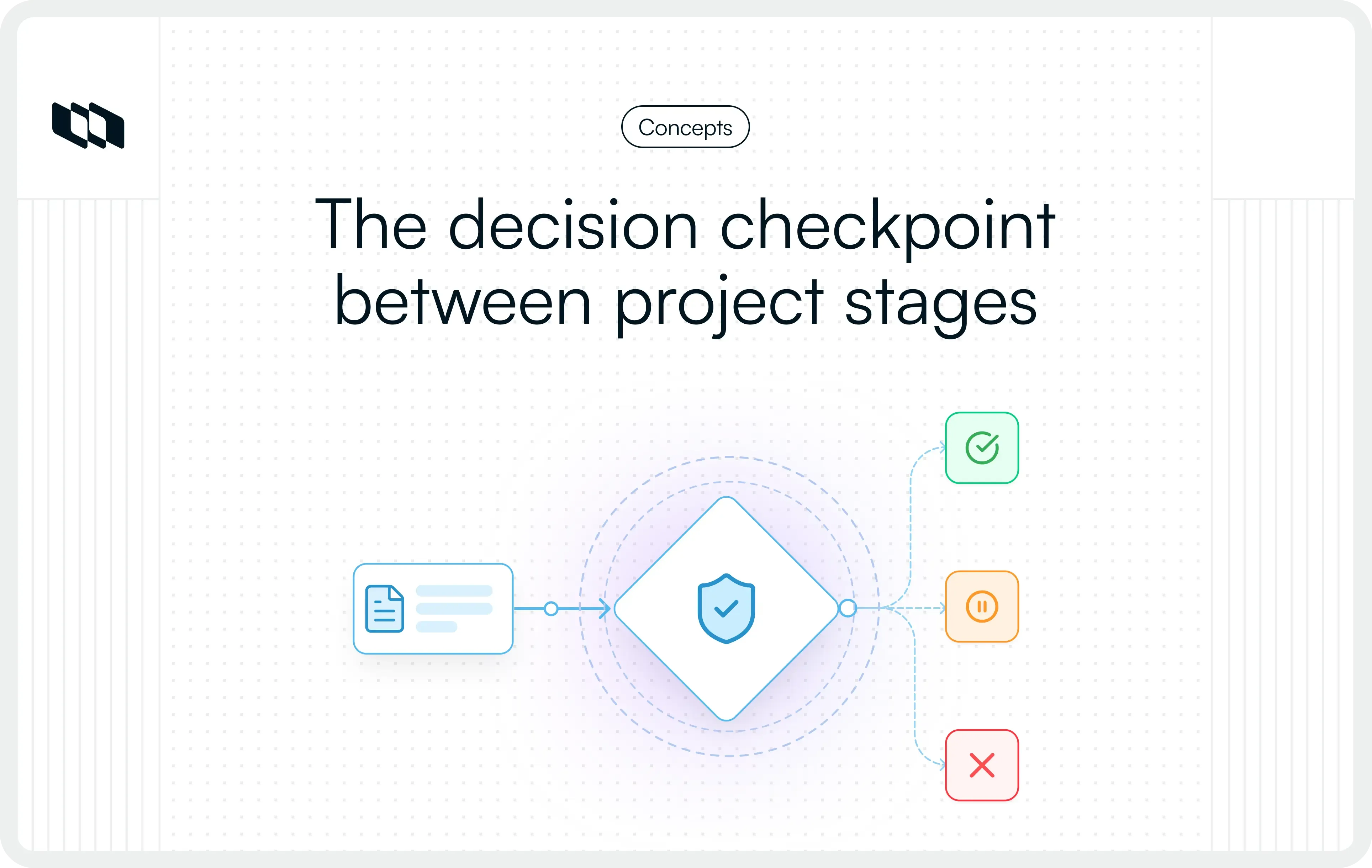
A project phase gate review is a formal checkpoint used to determine whether a project is ready to enter its next phase. During the review, stakeholders assess progress, risks, deliverables, resource needs, and alignment with business goals before approving further work. A well-run phase gate review gives teams a clear basis for making go, hold, revise, or stop decisions. This guide explains how the phase gate review process works, what happens at each gate, who should participate, and how teams can make these reviews more effective.
What is a project phase gate review?
A project phase gate review is a formal checkpoint used to evaluate whether a project is ready to move from one phase to the next. It gives decision-makers a structured way to assess progress, risks, deliverables, and resource readiness before approving further work.
Definition of a phase gate review
A phase gate review takes place at the end of a defined project phase. During the review, stakeholders compare the completed work against agreed-upon criteria and determine whether the project can proceed.
These criteria may include completed deliverables, approved budgets, technical feasibility, unresolved risks, compliance requirements, and resource availability. The exact criteria depend on the project, industry, and level of governance required.
Why organizations use gate reviews
Organizations use gate reviews to avoid carrying unresolved issues into the next phase of a project. They create a deliberate pause for stakeholders to assess whether the project still makes sense and whether the team is prepared to continue. This helps prevent teams from committing additional time, budget, and resources when key assumptions have changed, or important work remains incomplete.
The role of gate reviews in project governance
Gate reviews serve as formal control points within project governance. They give sponsors, project managers, and functional leaders visibility into how the project is progressing and whether it remains aligned with business priorities. They also create a documented record of major decisions, approval conditions, assigned actions, and accountability. This becomes especially important in complex, regulated, or cross-functional projects where several teams contribute to the outcome.
How gate reviews support decision-making
A gate review gives decision-makers a consistent set of evidence to evaluate. Instead of relying on informal updates or individual judgment, reviewers can assess the project against predefined standards. The review may result in approval to proceed, a request for revisions, a temporary hold, or a decision to stop the project. Each outcome helps the organization direct resources toward work that remains viable and strategically relevant.
Example of a project phase gate review
Consider a team developing a new customer portal. Before moving from planning to development, the gate review may verify that requirements are approved, security risks have been assessed, technical dependencies are understood, and engineering capacity is available.
The project moves forward only after reviewers confirm that the team has completed the necessary planning work and is ready to begin development.
Project phase gate review vs. stage gate vs. project review
Terms such as phase gate, stage gate, project review, and milestone review are often used in similar contexts. The differences become clearer when we compare what each review evaluates, when it occurs, and what decision it is expected to produce.
Project phase gate review vs. stage gate
- A project phase gate review evaluates whether a project has met the requirements of its current phase and is ready to proceed. The term can apply across many types of projects, including software implementation, infrastructure, engineering, research, and organizational change.
- A stage gate review follows the same checkpoint-based principle but is commonly associated with product development and innovation. The Stage-Gate process typically moves an idea through defined stages, including discovery, business case development, product development, testing, and launch.
In practice, many teams use phase gate and stage gate interchangeably. The main distinction comes from context rather than from a major difference in how the review works.
Comparison area | Project phase gate review | Stage gate review |
Primary use | General project governance | Product development and innovation |
Review point | End of a project phase | Between defined development stages |
Main focus | Readiness, risk, deliverables, and resources | Product viability, business value, and market readiness |
Common users | Project teams, PMOs, engineering teams, operations teams | Product, research, development, and innovation teams |
Typical decision | Proceed, revise, hold, or stop | Go, kill, hold, or recycle |
Project phase gate review vs. project status review
- A project status review examines how work is progressing against the current plan. Teams may conduct status reviews weekly, biweekly, or monthly to discuss schedules, blockers, budgets, risks, and upcoming work.
- A project phase gate review occurs at a defined transition point and carries greater decision-making authority. Its purpose is to determine whether the project has met the conditions required to enter the next phase. A status review may identify a delay, while a gate review decides whether that delay affects the project’s readiness to continue.
Comparison area | Project phase gate review | Project status review |
Timing | At the end of a project phase | At recurring intervals |
Purpose | Decide whether the project can advance | Understand current project performance |
Scope | Phase deliverables and overall readiness | Active tasks, progress, issues, and near-term plans |
Participants | Sponsors, decision-makers, project leaders, and subject matter experts | Project manager, team members, and relevant stakeholders |
Expected outcome | Formal decision and documented conditions | Updated actions, priorities, and status information |
Project phase gate review vs. milestone review
- A milestone marks a significant event or achievement within a project, such as completing a prototype, receiving regulatory approval, or finishing a major implementation step. A milestone review confirms whether that specific achievement has been completed successfully.
- A phase gate review considers the wider condition of the project. Reviewers assess multiple deliverables, risks, dependencies, resources, and business considerations before deciding whether the entire project can progress.
A milestone can support a gate decision, but reaching a milestone does not automatically mean that all requirements for the next phase have been met.
Comparison area | Project phase gate review | Milestone review |
Focus | Overall readiness to enter the next phase | Completion of a specific event or deliverable |
Evaluation criteria | Multiple business, technical, operational, and governance factors | Criteria linked to the individual milestone |
Decision authority | Usually includes sponsors or governance leaders | Often handled by the project manager or delivery stakeholders |
Result | Approval, revision, hold, or termination | Milestone accepted, rejected, or returned for correction |
Relationship to project plan | Controls progression between phases | Tracks an important point within or between phases |
Understanding go/no-go decision points
A go/no-go decision point is the moment when authorized stakeholders determine whether a project should continue. It usually appears during a phase-gate process after reviewers have evaluated the required deliverables and supporting evidence.
- A go decision confirms that the project meets the agreed conditions for the next phase.
- A no-go decision stops further progression because the project lacks sufficient value, readiness, feasibility, or support. Reviewers may also approve the project with conditions, place it on hold, or request additional work before reconsidering it.
The strength of a go/no-go decision depends on criteria established before the review. When expectations are clear, stakeholders can evaluate the project consistently and explain why a particular decision was made.
How project phase gate reviews work
A phase-gate process divides a project into defined phases, with a formal review at the end of each phase. The gate serves as a decision checkpoint where stakeholders assess whether the project has completed the required work and is ready to proceed.
1. Complete work for the current phase
The team first completes the activities and deliverables assigned to the current phase. These may include research findings, approved requirements, technical designs, risk assessments, test results, or implementation plans.
The expected outputs should be defined before the phase begins. This gives the team a clear standard for completion and reduces uncertainty during the gate review.
2. Prepare gate review deliverables
Before the meeting, the project manager or phase owner gathers the evidence reviewers need to evaluate the project. This usually includes completed deliverables, progress reports, budget information, risk registers, dependency updates, resource plans, and any unresolved issues.
The review material should highlight the decisions required from stakeholders. A concise, well-organized review package helps participants focus on project readiness rather than spending the meeting searching for information.
3. Conduct the gate review meeting
During the meeting, the project team presents the work completed in the current phase and explains any changes to the original plan. Reviewers can question assumptions, examine outstanding risks, and clarify whether dependencies or constraints could affect the next phase.
The meeting should center on evidence and decision-making. Detailed working discussions can be assigned as follow-up actions when they do not affect the immediate gate decision.
4. Evaluate predefined criteria
Reviewers compare the project against the criteria established for that gate. Depending on the project, these criteria may cover deliverable quality, technical feasibility, strategic alignment, budget performance, regulatory requirements, resource availability, and risk exposure.
Using predefined criteria makes the gate review in project management more consistent. It also helps teams understand why a project received approval, required further work, or was stopped.
5. Make a gate decision
Once the evaluation is complete, the authorized stakeholders decide what should happen next. The project may proceed with specific conditions, return for revisions, remain on hold, or stop entirely.
The decision should reflect the project’s current evidence and expected value. Political pressure, sunk costs, or attachment to earlier plans should not outweigh significant risks or a weak business case.
6. Document outcomes and next steps
The final step is to record the decision, the reasoning behind it, and any conditions attached to approval. The record should also identify required actions, owners, deadlines, and the criteria that must be met before the next review.
Documenting the outcome creates accountability and gives the team a reliable reference as the project progresses. It also preserves a clear decision history for sponsors, PMOs, auditors, and future project teams.
Common project phases where gate reviews occur
The number and naming of project phases differ across industries, teams, and delivery models. Even so, most phase gate processes follow a similar progression, beginning with an idea and ending with delivery, evaluation, and closure. Each gate checks whether the project has met the conditions required to continue.
1. Concept and idea evaluation
The first gate examines whether the initial idea is worth developing further. Reviewers consider the problem the project intends to solve, its strategic relevance, potential users or beneficiaries, and whether the opportunity aligns with organizational priorities.
At this stage, the available information may still be limited. The decision usually determines whether the team should invest time in deeper research and feasibility analysis.
2. Feasibility and business case review
Once the idea has passed initial screening, the team evaluates whether it can be delivered successfully and whether the expected value justifies the investment.
The gate review may examine technical feasibility, estimated costs, expected benefits, market or user demand, compliance requirements, operational impact, and major risks. A strong business case provides decision-makers with sufficient evidence to approve further planning.
3. Planning and resource approval
This gate checks whether the project has a credible delivery plan and the resources required to execute it. Reviewers assess scope, timelines, budgets, team capacity, dependencies, procurement needs, and ownership across functions.
Approval confirms that the project can move into active design, development, or implementation. Any uncertainty around funding, staffing, or critical dependencies should be addressed before substantial delivery work begins.
4. Design or development review
During this phase, the team converts approved requirements into a working design, solution, product, or implementation. The review evaluates whether the work meets the agreed functional, technical, security, and quality requirements.
For engineering projects, reviewers may examine architecture, prototypes, integration plans, technical debt, and unresolved design decisions. For operational or organizational projects, the focus may include process design, rollout plans, and readiness across affected teams.
5. Testing and validation review
The testing and validation gate determines whether the completed work performs as expected and is ready for release or implementation.
Reviewers may assess test results, defects, user acceptance, security findings, performance data, evidence of compliance, and operational readiness. Critical issues must be resolved or formally accepted before the project progresses.
6. Deployment or launch review
Before launch, the gate review confirms that the organization is prepared to introduce the project outcome into a live environment. This includes reviewing deployment plans, support coverage, training, communications, rollback procedures, data migration, and stakeholder readiness.
The decision may authorize a full launch, approve a limited rollout, or delay deployment until specific risks have been addressed.
7. Project closure review
The final gate evaluates whether the project has completed its commitments and can be formally closed. Reviewers confirm that deliverables have been accepted, ownership has transferred to the relevant operational teams, outstanding actions are documented, and project records are complete.
This review also gives the team an opportunity to assess results against the original objectives, capture lessons learned, and identify follow-up work that should continue outside the project.
What happens during a project phase gate review?
A project phase gate review brings together the people responsible for evaluating whether the project is ready to move forward. The meeting usually follows a structured agenda, with reviewers examining the evidence produced during the current phase and identifying any issues that could affect the next one.
1. Reviewing project deliverables
The review begins with the deliverables required for the current phase. These may include requirements, designs, prototypes, test results, implementation plans, risk assessments, or approval documents.
Reviewers check whether each deliverable is complete, accurate, and aligned with the standards agreed at the start of the phase. Missing or incomplete outputs may lead to additional work before approval is granted.
2. Assessing risks and dependencies
The team presents the most significant risks, their potential impact, and the actions in place to manage them. Reviewers also examine dependencies on other teams, vendors, systems, approvals, or external events.
The purpose is to understand whether unresolved risks or dependencies could disrupt the next phase. Some may be accepted with clear ownership, while others may need to be resolved before the project continues.
3. Evaluating schedule and budget performance
Reviewers compare actual progress and spending against the approved plan. They look at delays, forecast changes, cost variances, resource constraints, and any assumptions that have shifted since the previous gate. A schedule or budget variance does not automatically prevent the project from progressing. The review should determine whether the revised plan remains realistic and whether additional funding, time, or capacity requires approval.
4. Validating business objectives
A project may remain on schedule while its original business case becomes less relevant. For that reason, the review should revisit the outcomes the project was created to achieve. Stakeholders assess whether the expected value still justifies continued investment, whether user or market needs have changed, and whether the project remains aligned with current organizational priorities.
5. Reviewing quality requirements
The review also examines whether the work meets the project's quality, security, compliance, and performance standards. The evidence may include test results, audit findings, acceptance criteria, defect reports, security assessments, or regulatory documentation. Any gaps should be understood before the project enters a phase where they become more difficult or expensive to correct.
6. Confirming stakeholder alignment
Gate reviews give sponsors, delivery teams, functional leaders, and subject matter experts an opportunity to confirm they share a common understanding of progress and next steps.
This includes agreeing on scope, responsibilities, trade-offs, timelines, and any conditions attached to approval. Misalignment at this point can lead to delays and conflicting expectations in the next phase.
7. Determining readiness for the next phase
The final discussion brings the findings together and assesses whether the project is prepared to proceed. Reviewers consider the completeness of deliverables, remaining risks, available resources, business value, and the team’s ability to execute the next stage. The meeting ends with a formal gate decision, along with documented actions, owners, deadlines, and approval conditions.
Key criteria used in project phase gate reviews
Gate criteria help reviewers evaluate projects against the same standards rather than relying on individual judgment. These criteria should be defined before the review, so teams know what evidence is required and how readiness will be assessed.
1. Strategic alignment
Reviewers first assess whether the project still supports the organization’s current priorities. A project may have made sense when it began, but shifts in strategy, customer needs, or operating conditions can change its relevance. The gate review should confirm that the project continues to contribute to a meaningful business objective and remains worth prioritizing.
2. Business value and expected outcomes
The review examines whether the benefits outlined in the business case are still realistic. This may include expected revenue, cost reduction, operational improvement, customer impact, or risk reduction. If the expected value has changed, reviewers should decide whether the project still justifies the remaining investment.
3. Budget and resource readiness
A project should enter the next phase only when the required funding, people, skills, and tools are available. Reviewers assess current spending, future budget needs, team capacity, specialist support, and any resource conflicts that could delay delivery. Approval may be conditional if additional resources still need to be secured.
4. Risk exposure
Gate reviews consider whether major risks have been identified, assessed, and assigned to clear owners. Reviewers should understand the likelihood and impact of each risk, along with the actions planned to reduce it. Unresolved risks do not always stop a project, but they should be visible and manageable before further work begins.
5. Quality and compliance requirements
The project must meet the quality, security, legal, and regulatory requirements relevant to its current phase. Reviewers may examine test results, audit records, security assessments, approval documents, or acceptance criteria. Any gaps should be addressed before they create larger problems later in the project.
6. Technical feasibility
Technical feasibility assesses whether the proposed solution can be delivered with the available architecture, systems, integrations, and expertise. The review may also consider performance limits, scalability, technical dependencies, implementation complexity, and unresolved design decisions that could affect delivery.
7. Stakeholder approval
The final criterion is whether the relevant stakeholders support the proposed direction. This includes project sponsors, functional leaders, subject matter experts, and teams responsible for delivery or adoption. Their approval should confirm agreement on scope, priorities, responsibilities, risks, and the conditions required for the next phase.
Possible outcomes of a project phase gate review
A project phase gate review can lead to several outcomes depending on the evidence presented, the level of risk involved, and the project’s readiness for the next phase. The decision should be recorded clearly so the team understands what has been approved and what still requires attention.
1. Go
A go decision means the project has met the required criteria and can move into the next phase. The team has completed the expected deliverables, addressed critical risks, and secured the resources or approvals needed to continue.
The decision record should confirm the approved scope, budget, timeline, and any actions that carry forward into the next phase.
2. Conditional go
A conditional go allows the project to proceed while specific issues remain open. These conditions may involve completing a minor deliverable, obtaining an approval, resolving a dependency, or closing a manageable risk within an agreed timeframe.
Each condition should have a clear owner and deadline. Reviewers should also specify whether any part of the next phase must wait until the condition is fulfilled.
3. Hold
A hold decision pauses the project until more information, funding, capacity, or external clarity becomes available. The project may still be viable, but the organization is currently unable to support further progress.
The review should document why the project is being paused, what must change before it can resume, and when the decision will be revisited.
4. Rework or recycle
A rework or recycle decision sends the project back for additional work before another gate review. Reviewers may request changes to the business case, technical design, risk plan, scope, budget, or supporting evidence.
The team should receive specific feedback on what needs to be corrected. A follow-up review can then assess whether those concerns have been addressed.
5. Kill or no-go
A kill-or-no-go decision halts the project because it no longer meets the required criteria. This may happen when the business case has weakened, risks have become unacceptable, the solution is no longer feasible, or organizational priorities have changed.
The project should still be closed in a controlled way. Teams need to document the decision, capture lessons learned, communicate the outcome to stakeholders, and determine how to handle completed work or allocated resources.
Who should participate in a project phase gate review?
The people involved in a gate review should reflect the decisions being made. A smaller project may need only a few core stakeholders, while a complex or high-risk initiative may require broader input from technical, financial, operational, and executive stakeholders.
1. Project manager
The project manager prepares the review materials, presents progress updates, and explains any changes to the scope, schedule, budget, risks, or dependencies. They also record the final decision and coordinate follow-up actions.
2. Project sponsor
The project sponsor represents the business case and confirms whether the project still supports the intended objectives. Sponsors often hold approval authority or provide a recommendation to the final decision-makers.
3. PMO leaders
PMO leaders help ensure that the review follows the organization’s governance standards. They may assess documentation quality, process compliance, portfolio impact, and consistency across projects.
4. Functional managers
Functional managers evaluate whether their teams have the capacity, skills, and operational readiness required for the next phase. They also identify resource conflicts or dependencies within their areas.
5. Subject matter experts
Subject matter experts provide focused input on technical feasibility, security, compliance, finance, procurement, legal requirements, or other specialist areas. Their role is especially important when the gate decision depends on evidence outside the project team’s expertise.
6. Executive stakeholders
Executive stakeholders typically participate in high-value, high-risk, or strategically important projects. They assess broader business impact, funding priorities, and whether continued investment remains justified.
Benefits of project phase gate reviews
Formal gate reviews require time and preparation, but they give organizations a more reliable way to decide which projects should move forward and under what conditions. The strongest benefits come from improving decision quality, controlling risk, and creating clearer accountability around continued investment.
1. Improves project decision-making
A phase gate review brings the right evidence and decision-makers together at a defined point in the project. Reviewers can assess progress, feasibility, business value, and readiness before approving further work. This reduces reliance on informal updates or assumptions and gives teams a clear reason to proceed, revise, pause, or stop the project.
2. Identifies risks before they become harder to manage
Each gate gives teams an opportunity to examine unresolved risks, dependencies, and technical or operational concerns before entering the next phase. Catching these issues early allows the organization to address them while changes are still manageable. It also prevents teams from carrying avoidable problems into development, testing, deployment, or launch.
3. Improves resource allocation
Gate reviews help organizations decide whether a project still deserves additional budget, capacity, and specialist support. Projects with weak business cases, unresolved blockers, or limited strategic value can be paused or stopped before consuming more resources. This allows leaders to redirect people and funding toward initiatives with stronger evidence, clearer readiness, and greater expected value.
4. Strengthens governance and accountability
A gate review creates a documented record of what was evaluated, who approved the decision, and which actions or conditions must be completed next. This improves visibility for sponsors, PMOs, and delivery teams while clarifying ownership. It also gives organizations a consistent governance process for complex, regulated, or cross-functional projects.
Project phase gate reviews in Agile and hybrid environments
Agile and hybrid teams still need moments where sponsors and delivery leaders can assess risk, funding, readiness, and strategic alignment. The difference lies in how these checkpoints are designed and how often they occur.
1. Why Agile teams still need governance checkpoints
Agile delivery improves how teams plan and adapt work, but larger initiatives often require decisions that sit beyond the sprint level. Funding approvals, security reviews, compliance checks, architecture decisions, and launch readiness may still need formal oversight.
A phase gate review gives stakeholders a structured point to make those decisions without interfering with day-to-day delivery.
2. Using lightweight gate reviews
Agile teams can keep gate reviews focused by limiting them to the evidence required for the decision. This may include a short review of outcomes, risks, dependencies, budget, and readiness for the next stage.
Smaller initiatives may use a brief checklist and approval record, while higher-risk projects may require a more detailed review package.
3. Aligning gate reviews with sprint cycles
Gate reviews can be scheduled around major increments, release boundaries, or completion of a defined set of sprints. This allows teams to use working software, test results, and delivery data as evidence during the review.
The gate should evaluate whether the initiative is ready for a broader commitment, such as scaling development, entering production, or expanding rollout.
4. Phase gate reviews in hybrid project environments
Hybrid teams often combine iterative delivery with fixed governance stages. For example, development may happen through sprints while funding, compliance, procurement, and deployment approvals follow formal gates. This approach gives teams flexibility during execution while preserving the control required for complex, regulated, or cross-functional projects.
Final thoughts
A project phase gate review provides teams with a disciplined way to determine whether a project is ready to move forward. By evaluating deliverables, risks, resources, business value, and stakeholder support at defined checkpoints, organizations can make clearer decisions before committing to the next phase.
The process works best when gate criteria are agreed early, review materials are concise, and decisions are documented with clear owners and follow-up actions. Whether a team follows a traditional, Agile, or hybrid delivery model, phase gate reviews can provide the structure needed to manage complex projects with greater visibility and control.
Frequently asked questions
Q1. What is a phase gate review in project management?
A phase gate review is a formal checkpoint held at the end of a project phase. Stakeholders assess whether the required deliverables, risks, resources, and approval criteria have been addressed before deciding whether the project should proceed, pause, return for rework, or stop.
Q2. What is a phase review in project management?
A phase review evaluates the work completed during a specific stage of a project. It helps teams confirm whether the objectives of that phase have been met and whether any unresolved issues could affect the next stage. In many organizations, the phase review also serves as the project’s gate decision.
Q3. What is a gate review in project management?
A gate review is a structured decision point used to evaluate project readiness. Reviewers compare the project against predefined criteria, examine supporting evidence, and issue a formal decision. Gate reviews support project governance by creating clear approval points between major stages of work.
Q4. What is the first phase gate for a project?
The first phase gate usually follows the concept or initiation stage. It evaluates whether the proposed project addresses a valid need, supports organizational priorities, and deserves further investment in feasibility analysis or detailed planning. The exact name and criteria vary by organization.
Q5. What are the five phases of project management?
The five project management process groups are initiating, planning, executing, monitoring and controlling, and closing. These process groups describe how project work is managed. A phase gate process may use different lifecycle stages, such as concept, planning, development, validation, and launch, depending on the project and industry.
Recommended for you


 Download for Mac
 Download for Android