What is a minimum viable product? An ultimate guide
Introduction
Every great product starts with a question: What's the smallest version of this idea that delivers real value? That question is the foundation of the minimum viable product — a concept that has shaped how modern software teams build, validate, and ship. Whether you're a founder stress-testing a new idea or a product manager scoping your next release, understanding what an MVP is and how to build one correctly changes how you approach product development entirely.
What is a minimum viable product (MVP)?
A minimum viable product is the smallest usable version of a product that helps teams test whether a solution delivers real value to users. In product management, an MVP focuses on learning which assumptions about users, workflows, and outcomes hold true in real conditions.
The core purpose of an MVP is validated learning. Teams release a focused version of the product to observe how people interact with it, which problems they try to solve, and whether the experience supports meaningful outcomes. This early evidence shapes future scope decisions and reduces uncertainty before deeper engineering investment.
Early-user testing plays a central role in this process. Instead of relying on internal opinions, teams gather signals from real-world usage, such as adoption patterns, feedback quality, and task-completion behavior. These signals guide iteration priorities and clarify whether the product direction deserves expansion.
Understanding the meaning of the minimum viable product also requires distinguishing between speed and learning. Shipping quickly increases delivery velocity. Learning quickly improves decision quality. An MVP accelerates learning by focusing effort on the smallest experience that yields reliable insight.
Why teams build a minimum viable product
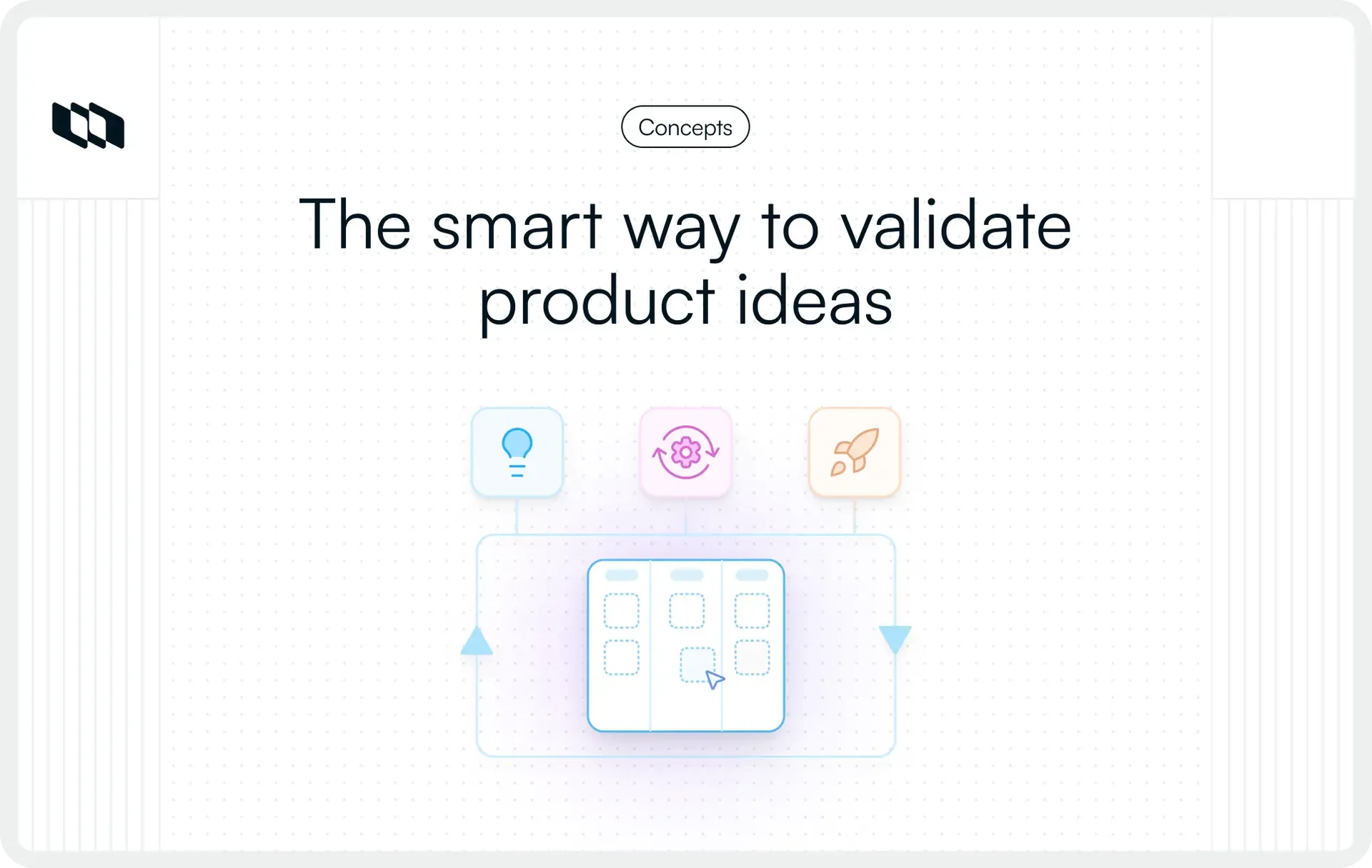
Before a single line of code is written at scale, there are dozens of assumptions baked into a product idea. An MVP is a way for teams to pressure-test those assumptions before committing significant time, budget, and engineering effort to something the market may respond to differently than expected.
Here is why building an MVP is a deliberate strategic choice, not just a shortcut:
- Validating product ideas before full investment: An MVP lets teams make a small, informed bet before going all in. Instead of spending months building a complete product, you release a focused version to a real audience and let their behavior tell you whether the core idea has legs. Validation at this stage is far less costly than course-correcting after a full build.
- Reducing development risk: Product development risk compounds quickly. The longer a team builds without external feedback, the more decisions are made on assumptions rather than evidence. An MVP significantly shortens that feedback loop, giving teams real data to work with before risk accumulates.
- Learning from real users early: User interviews and surveys give you intent. An MVP gives you behavior. There is a meaningful difference between what users say they will do and what they actually do inside a product. Early-user testing through an MVP surfaces that gap at a stage where it is still actionable.
- Improving prioritization decisions: One of the more underrated benefits of an MVP is its impact on your backlog. When you have real usage data from early users, prioritization stops being a debate between opinions and becomes a conversation grounded in evidence. Features that seemed critical during planning may turn out to be low priority once actual user behavior becomes visible.
- Supporting iterative product development: An MVP is not a one-time release. It is the first cycle in a continuous loop of build, measure, and learn. Teams that treat their MVP as the starting point of an iterative process tend to compound learning over time, each release more informed than the last.
What makes a product both minimum and viable?
The term minimum viable product combines two constraints that guide early product decisions. Teams define the smallest scope that still delivers real value to users and produces reliable learning signals. Understanding both parts helps product managers choose features intentionally rather than expanding the scope too early.
What “minimum” means
In MVP development, "minimum" refers to the smallest feature set needed to test the core value proposition with real users. The focus stays on a single workflow or outcome that represents the product’s primary promise.
Teams identify the shortest path that allows users to experience that value. Supporting features, integrations, and refinements remain outside the initial scope until evidence confirms their importance. This approach keeps engineering effort aligned with learning goals and accelerates insight into user behavior.
What “viable” means
Viable means the product is useful enough for people to complete a meaningful task and evaluate its impact. Users interact with the experience under realistic conditions and provide feedback that reflects their genuine needs and expectations.
A viable MVP creates signals teams can trust. Adoption patterns, repeat usage, and qualitative feedback help product teams understand whether the solution deserves expansion, adjustment, or repositioning.
Why an MVP is different from an incomplete release
An MVP in product management represents a deliberately scoped learning instrument rather than a reduced-quality version of a finished product. Teams design the experience around a clear hypothesis and measure users' responses to the core workflow.
Incomplete releases create confusion because users encounter unclear value or inconsistent behavior. A well-defined minimum viable product, meaning it centers on clarity, usefulness, and purposeful scope. Each element supports a specific learning objective that guides the next stage of development.
When should teams build an MVP?
MVP thinking is not universally applicable to every product decision. It is most valuable in situations where uncertainty is high and the cost of being wrong is high. Here are the scenarios where building an MVP is the right call.
1. Testing a new product idea
When a product concept is unproven, an MVP is the most responsible way to move forward. Rather than architecting a full solution around an unvalidated idea, teams build the smallest version that can generate a real signal. This applies equally to early-stage startups building their first product and to established companies exploring a new product line.
2. Validating assumptions about user needs
Every product is built on a set of assumptions about who the user is, what problem they have, and how they want it solved. When those assumptions are largely untested, an MVP creates a structured way to validate them before they get baked into a full development roadmap. The earlier those assumptions get tested, the less expensive it is to adjust them.
3. Launching a new feature with uncertainty
Even within an existing product, uncertainty exists. A feature that seems valuable in a planning meeting may land differently with real users. Scoping that feature as an MVP, releasing it to a subset of users, and measuring engagement before a full rollout is a lower-risk approach than building the complete version up front and discovering problems after a wide release.
4. Entering a new market segment
Expanding into a new market introduces a different set of unknowns. Buyer behavior, willingness to pay, and core use cases may differ significantly from those of your existing user base. An MVP scoped for the new segment lets you learn what that market actually needs before investing in full product adaptation or a dedicated go-to-market motion.
5. Evaluating demand before scaling development
Sometimes the core question is simply: Is there enough demand here to justify the investment? An MVP answers that question with behavioral data. Signups, activation rates, retention, and willingness to pay are all measurable with an MVP release, and each is a more reliable indicator of demand than survey responses or stakeholder intuition.
How to define your minimum viable product
An MVP is defined before design or engineering begins. Teams identify key learnings, target audience, and outcomes to validate the idea's potential. This planning narrows the scope to enable measurable insights and answers the question: What must be true for this idea to progress?
The following steps help teams translate assumptions into a testable product scope.
1. Identify the target users
Every MVP in product management exists for a specific user group. Teams begin by identifying who experiences the problem most frequently and who benefits most from solving it. A clear user definition improves decision quality throughout the entire MVP lifecycle. It shapes feature selection, onboarding flow, feedback collection, and success measurement. When teams design an MVP for a broad audience, learning signals become harder to interpret, and prioritization becomes less precise.
Early-stage MVPs often focus on a narrow segment, such as first-time adopters, technical users, or teams already experiencing the workflow friction the product aims to improve.
2. Define the core problem to address
An MVP tests one meaningful problem at a time. Teams identify the primary workflow challenge they want to improve and design the product experience around that outcome.
This step requires separating central problems from supporting opportunities. A strong MVP scope centers on the smallest workflow that delivers visible value to users. Supporting enhancements remain outside the initial release until evidence confirms their importance.
Clarity at this stage strengthens the minimum viable product, meaning by connecting every feature decision to a specific learning objective.
3. Align the MVP with product or business goals
A minimum viable product serves a strategic purpose beyond experimentation alone. Teams define how the MVP supports broader product direction, adoption goals, or market positioning.
For example, an MVP may help validate a new workflow category, confirm demand within a target segment, or evaluate whether a capability strengthens retention. Alignment with strategy ensures that learning from the MVP informs roadmap decisions rather than remaining isolated from long-term planning. This connection between experimentation and direction makes MVP development valuable across both early-stage and mature product environments.
4. Identify success assumptions to test
Every MVP tests a set of assumptions about users, behavior, and outcomes. Teams make these assumptions explicit before development begins.
Examples include expectations about improvements in task completion, workflow adoption, or repeated usage patterns. Clear assumptions allow teams to evaluate whether the MVP produced meaningful signals after release.
Hypothesis-driven planning accelerates learning by having teams measure outcomes against predefined expectations. This approach ensures the minimum viable product functions as a structured decision tool rather than a limited feature release.
How to choose the right features for an MVP
A well-scoped product MVP answers one question clearly, rather than attempting to represent the full product vision. The following approach helps teams avoid overbuilding and maintain focus during early development.
1. Start with the core user journey
An MVP begins with a single user journey that represents the product’s primary promise. Teams identify the sequence of steps users take to achieve one meaningful outcome and design the experience around that path.
This journey often includes only the actions required to move from problem recognition to task completion. Supporting workflows remain outside the initial scope until usage signals confirm their importance. Defining the core journey early helps teams align engineering effort with measurable learning goals.
2. Separate essential features from nice-to-have features
Feature prioritization becomes clearer when teams evaluate whether each capability directly supports the core workflow. Essential features enable users to complete the intended task. Supporting features improve convenience, flexibility, or scale after the workflow proves valuable.
Product managers often map features against expected learning impact. Capabilities that strengthen adoption signals remain in scope, while enhancements that refine experience quality move to later iterations. This approach strengthens clarity around MVP features and keeps development aligned with purpose.
3. Focus on solving one primary problem
Each minimum viable product in product management should address one clearly defined problem. Expanding scope across multiple workflows introduces uncertainty about which part of the experience influences user behavior. When teams concentrate on a single outcome, feedback becomes easier to interpret, and decisions about iteration become more precise. This focus also supports faster release cycles and clearer roadmap adjustments after early usage signals emerge.
4. Keep the first version intentionally narrow
A narrow scope increases learning speed because teams observe how users respond to a focused experience. Early releases that attempt to represent a broader product direction produce weaker signals and slower iteration cycles.
Intentional scope discipline allows teams to test assumptions quickly, refine priorities with evidence, and expand functionality in response to observed behavior. This principle strengthens MVP development by ensuring each release contributes directly to validated learning.
How to build a minimum viable product step by step
Once teams define the scope, the next step is execution. Effective MVP development follows a structured workflow that connects product decisions, delivery effort, and learning goals. The objective is to release the smallest usable experience that can test a clear assumption under real usage conditions.
1. Define the problem and audience
Start by defining the problem the product is meant to solve and the user group most clearly experiencing it. This step lays the foundation for the entire minimum viable product, as it determines what value the MVP should deliver and which behavior the team wants to understand.
A clear problem statement helps teams avoid vague scope and scattered feature choices. A clear audience definition improves feedback quality because the product reaches users whose workflows match the intended use case.
2. Formulate the product hypothesis
An MVP works best when it is built around an explicit hypothesis. The team should state what it expects users to do, what value they should experience, and which signal will indicate that the idea deserves further investment.
For example, the hypothesis may focus on adoption, repeated usage, workflow completion, or willingness to continue using the product. This step turns the MVP in product management from a simple early release into a learning framework with measurable intent.
3. Select the simplest MVP format
Teams then choose the lightest format that can effectively test the hypothesis. In some cases, that may be a functional software release. In other cases, a prototype, a manual service flow, a landing page, or a limited workflow test may provide enough insight.
The right format depends on the question the team wants to answer. If the goal is to test usability, a lighter format may work well. If the goal is to observe real behavior inside a workflow, a more functional experience may be necessary. Choosing the simplest possible format keeps effort aligned with learning value.
4. Build the core experience
Once the format is clear, the team builds only the essential functionality required to deliver the core workflow. Every element in the experience should support the main user outcome and the learning objective defined earlier.
This stage requires strong scope discipline. Features that improve polish, flexibility, or edge-case handling can be considered later unless they directly affect the test's validity. The purpose here is to deliver a usable and focused product MVP, not a broad first version of the full product vision.
5. Release to early users
A strong MVP reaches a carefully chosen group of early users rather than a broad market immediately. These users are often close to the problem, more willing to explore a focused solution, and more likely to provide useful feedback.
Controlled rollout strategies help teams manage learning with clarity. They may release the MVP to a pilot group, a subset of customers, or a specific user segment with shared workflow needs. This approach improves signal quality and makes it easier to connect user behavior to the assumptions being tested.
6. Collect feedback and usage signals
After release, the team gathers both qualitative and quantitative evidence. Qualitative inputs may include interviews, support conversations, session observations, and open feedback. Quantitative signals may include activation, repeat usage, task completion, retention, or conversion behavior.
This stage is central to understanding how to effectively build a minimum viable product. The goal is to collect signals that explain both what users did and why they behaved as they did. Strong product decisions come from combining behavioral data with direct user context.
7. Iterate based on results
The final step is to interpret the evidence and decide what should happen next. Teams may expand the workflow, refine the experience, further narrow the audience, or revisit the original assumption based on what they learned.
Iteration gives the minimum viable product meaning within the broader product strategy. The MVP is valuable because it improves future decisions. Each cycle of feedback and refinement helps teams invest in the right capabilities with greater confidence and better timing.
Different types of MVP teams can build
A minimum viable product does not always require a fully engineered release. Teams choose different MVP formats depending on the assumption they want to test and the level of effort required to generate reliable learning. Selecting the right format improves speed of insight and keeps engineering investment aligned with product uncertainty.
The following MVP types help teams test ideas at different stages of product development.
1. Single-feature MVP
A single-feature MVP focuses on one capability that represents the product’s core value. Instead of releasing a broad feature set, teams deliver the smallest workflow that allows users to experience the primary outcome.
This approach works well when the goal is to validate whether a specific capability improves adoption, engagement, or task completion. Product teams often use single-feature MVPs inside existing platforms to evaluate whether a new workflow deserves expansion.
2. Concierge MVP
A concierge MVP delivers the intended solution manually before building automation in place. Teams provide the service directly to users while observing how they interact with the workflow and where friction appears.
This format helps teams validate whether users benefit from the outcome before investing in engineering infrastructure. It also creates opportunities to collect detailed qualitative feedback that informs later implementation decisions.
3. Wizard-of-oz MVP
A wizard-of-oz MVP presents an experience that appears automated to the user while the underlying process runs manually behind the scenes. This structure allows teams to simulate functionality without building the full system.
Product teams use this approach when they want to test behavioral response to a capability before committing to technical complexity. The method produces strong learning signals about expectations, workflow fit, and perceived value.
4. Landing-page MVP
A landing-page MVP measures interest in a proposed solution before development begins. Teams describe the product concept, communicate the expected value, and observe whether users sign up, request access, or express intent to try the solution.
This format helps evaluate demand early in the discovery process. It provides evidence about whether the idea attracts attention from the intended audience and whether the positioning resonates with their needs.
5. Prototype MVP
A prototype MVP helps teams test usability and interaction flow before building production-ready functionality. Designers create a simplified version of the experience to help users explore how the workflow operates. This approach supports early validation of navigation structure, feature placement, and task clarity. Feedback from prototype testing helps teams refine the experience before moving into deeper stages of MVP development.
How to evaluate whether your minimum viable product is effective
A strong minimum viable product delivers reliable learning while remaining narrowly scoped. Teams evaluate MVP quality by examining whether the release supports real usage, produces measurable signals, and fits within a focused engineering investment. These criteria help product managers decide whether the MVP should expand, iterate, or shift direction.
The following characteristics define an effective product MVP.
1. Delivers real user value
An MVP succeeds when users can complete a meaningful task that reflects the product’s core promise. The workflow should solve a specific problem clearly enough that users experience immediate usefulness. Signals of value often appear through task completion, repeated interaction, or willingness to continue using the capability. These outcomes confirm that the solution addresses a relevant need rather than a hypothetical scenario.
2. Is usable and understandable
Users should be able to move through the experience without confusion about what the workflow enables or how it supports their goals. A clear interaction structure improves feedback quality because users respond to the intended solution rather than to interface friction. Usability at the MVP stage focuses on the clarity of actions and outcomes rather than on interface polish. This level of usability allows teams to interpret behavior with confidence.
3. Is it feasible to build quickly
An effective minimum viable product in product management maintains a narrow engineering scope, enabling teams to release early and observe real behavior. Limited scope keeps delivery aligned with learning objectives and prevents unnecessary expansion before evidence supports further investment. Speed at this stage improves iteration cycles and strengthens roadmap decisions through earlier insight.
4. Enables actionable feedback
A valuable MVP produces signals that guide the next product decision. These signals may include adoption patterns, workflow completion rates, repeat usage, or structured qualitative input from early users. Actionable feedback allows teams to refine priorities with evidence. This capability gives the minimum viable product meaning as a decision-making tool rather than a small first release.
How teams can manage MVP development effectively
A minimum viable product creates value when teams treat it as a structured learning process rather than a lightweight release milestone. Managing MVP development effectively requires clear assumptions, aligned scope decisions, and disciplined tracking of user feedback. Product managers and engineering teams use these practices to ensure that each MVP contributes directly to roadmap clarity.
The following practices help teams turn MVP work into actionable product insight.
1. Capture ideas and assumptions clearly
Every MVP begins with a set of assumptions about user needs, workflow improvements, and expected outcomes. Teams document these assumptions before development starts so they can evaluate whether the release produced meaningful evidence.
Clear documentation improves alignment across product, design, and engineering. It also ensures that feedback collected after launch connects directly to the questions the team intended to answer through the minimum viable product.
2. Prioritize MVP scope collaboratively
Scope decisions benefit from shared understanding across teams responsible for delivery. Product managers define learning objectives, designers shape the interaction flow, and engineers evaluate implementation feasibility.
Collaborative prioritization helps teams identify the smallest workflow that still produces reliable signals. This approach strengthens focus during MVP development and prevents expansion beyond the intended learning objective.
3. Track feedback from early users
Early-user feedback provides the strongest signals about whether the MVP supports real workflows. Teams collect insights through usage analytics, structured interviews, support conversations, and direct observation of task completion behavior.
Centralizing this feedback allows stakeholders to interpret patterns together and identify which signals reflect meaningful adoption. A shared view of user responses improves iteration speed and reduces ambiguity in decision-making.
4. Use MVP learnings to guide the roadmap
Evidence from early releases helps teams decide whether to expand functionality, refine workflows, or adjust product direction. These decisions shape how the product evolves after the initial launch.
A structured approach to interpreting results ensures that the minimum viable product in product management informs future priorities rather than remaining isolated from long-term planning. Teams that connect MVP insights to roadmap updates maintain stronger alignment between delivery effort and user value.
Final thoughts
A minimum viable product helps teams replace assumptions with evidence at the earliest stage of product development. Instead of expanding scope based on expectations, teams use an MVP to observe how real users respond to a focused solution and whether the workflow supports meaningful outcomes. Understanding what a minimum viable product is changes how product managers define scope, how engineering teams sequence delivery, and how organizations make roadmap decisions. A well-designed MVP creates clarity about which ideas deserve investment and which directions require adjustment.
Teams that treat MVP development as a structured learning process move faster toward product–market alignment. Each release strengthens confidence in priorities and ensures that future features reflect real user value rather than internal assumptions.
Frequently asked questions
Q1. What is a minimum viable product?
A minimum viable product is the simplest version of a product that delivers enough value for early users to complete a meaningful task while generating feedback for product teams. In product management, teams use an MVP to test assumptions about user needs, workflows, and adoption before expanding feature scope or engineering investment.
Q2. What is an MVP example?
A common minimum viable product example in software development is releasing a single workflow that solves a clear user problem, rather than launching a full platform. For instance, a project management tool may begin with only task tracking, allowing teams to create, assign, and complete work items before introducing reporting, automation, or integrations. This focused release helps teams evaluate whether the core workflow supports real usage.
Q3. What is the purpose of the MVP?
The purpose of a product MVP is to generate validated learning about whether a solution delivers real user value. Teams use MVP development to test ideas early, reduce delivery risk, improve prioritization decisions, and guide roadmap direction based on observed behavior rather than assumptions.
Q4. What is the difference between MVP and PoC?
A proof of concept evaluates technical feasibility, while a minimum viable product evaluates user value and adoption potential. Engineering teams build a PoC to confirm whether a solution can work from a technical perspective. Product teams release an MVP to understand whether users engage with the solution and incorporate it into their workflows.
Q5. What is MVP, MMP, and MMF?
MVP, MMP, and MMF represent different stages of product scope and maturity.
- MVP in product management tests whether a core idea delivers value through a minimal workflow.
- A minimum marketable product (MMP) is a version of the product ready for broader adoption, with sufficient completeness to support a consistent user experience.
- A minimum marketable feature (MMF) focuses on delivering a single capability that provides standalone value within an existing product. Each stage supports different decisions across validation, release readiness, and incremental expansion.
Recommended for you



 Download for Mac
 Download for Android