Progressive elaboration in project management: How modern teams refine plans effectively
Introduction
Project plans rarely survive first contact with reality. Requirements shift, stakeholder priorities evolve, and what seemed certain at kickoff becomes fuzzy by week three. Progressive elaboration in project management is the structured response to this reality. Instead of demanding complete upfront clarity, it lets teams refine project details iteratively as new information surfaces. Whether you work in agile, waterfall, or a hybrid setup, progressive elaboration turns uncertainty into a manageable, strategic advantage rather than a source of chaos.
What is progressive elaboration in project management?
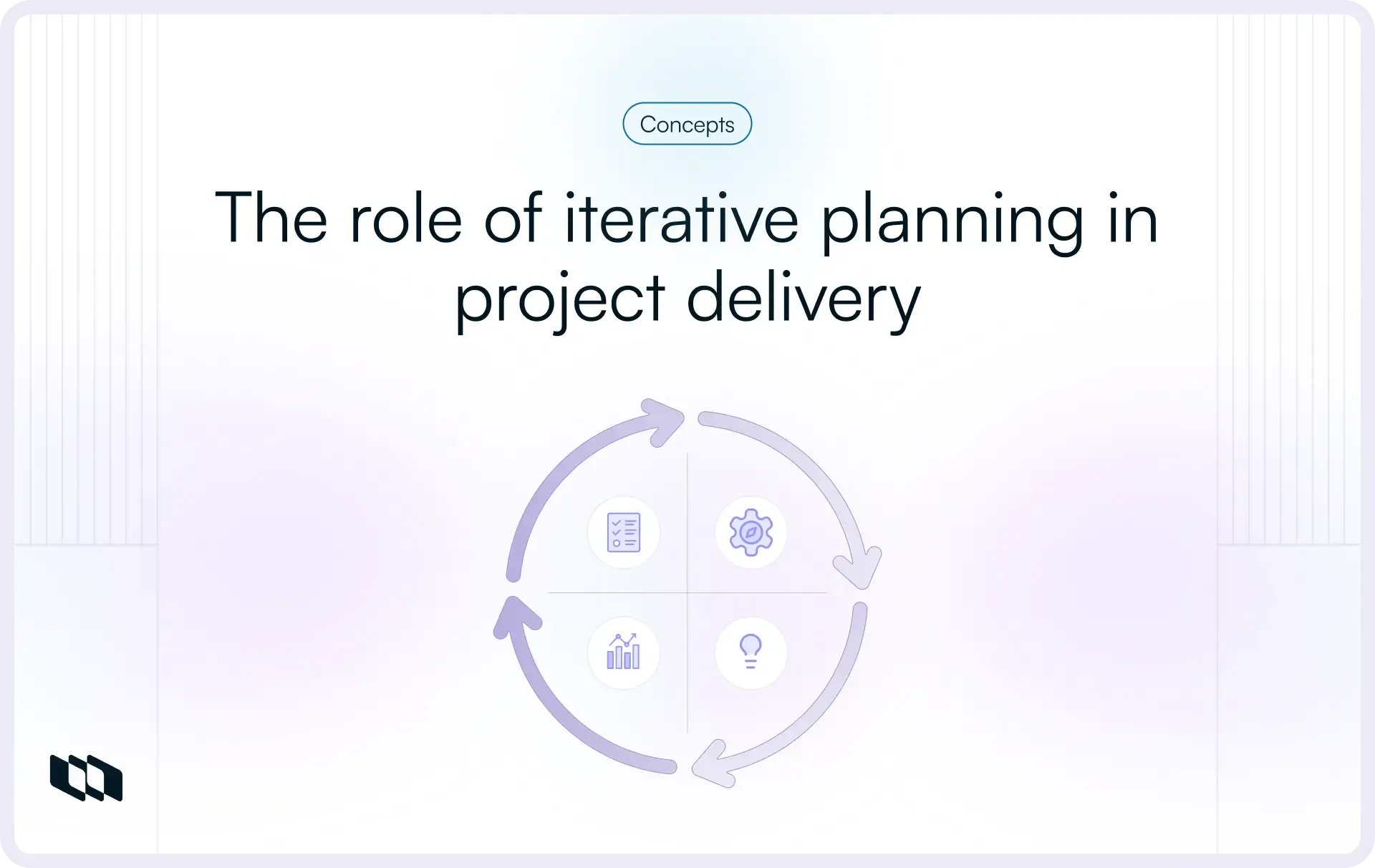
Progressive elaboration is the process of continuously improving and refining project plans by adding detail as more accurate information becomes available. It applies across every dimension of a project: scope, timelines, cost estimates, risk assessments, and deliverables. Teams start with a high-level understanding and build precision incrementally, with each planning cycle producing a sharper, more grounded project plan.
Why projects cannot be fully planned up front
Early project stages are built on assumptions. Requirements are incomplete, stakeholder input evolves, and external dependencies shift in ways that are difficult to anticipate. Demanding full clarity before work begins creates planning paralysis and produces detailed plans built on guesswork. Progressive elaboration allows teams to move forward confidently with what is known today, while structuring the work to absorb new information as the project matures. The plan becomes more detailed and reliable over time, reflecting ground-level reality rather than upfront speculation.
Progressive elaboration is the disciplined practice of starting with what you know, moving forward with intention, and refining project details continuously as clarity improves.
Progressive elaboration in PMBOK and project management methodology
The Project Management Body of Knowledge (PMBOK) defines progressive elaboration as the iterative process of increasing the level of detail in a project management plan as more information and more accurate estimates become available. It is treated as a core planning principle, not a situational workaround.
What makes this significant is its scope. PMBOK positions progressive elaboration as methodology-agnostic, meaning it is equally relevant across predictive (waterfall), agile, and hybrid project environments. The principle acknowledges a universal truth: project clarity improves with time, and planning processes should be designed to reflect that.
- In predictive environments, progressive elaboration manifests as phased planning. Teams define high-level scope early, then elaborate detailed work packages as each project phase approaches. The overall plan evolves in fidelity as execution progresses.
- In agile environments, progressive elaboration is built into the framework's rhythm. Backlog refinement, sprint planning, and iterative delivery are all expressions of the same principle: plan in detail only what you are ready to act on.
- In hybrid environments, teams apply progressive elaboration selectively, using predictive planning for stable, well-understood workstreams and iterative refinement for areas carrying higher uncertainty.
Across all three, the underlying logic stays consistent. Progressive elaboration is a foundational planning discipline that treats detail as something earned through progress, not manufactured through assumption.
Why progressive elaboration matters in project management
Most project failures trace back to decisions made too early with too little information. Progressive elaboration in project management directly addresses this by building adaptability into the planning process itself. Here is why it is one of the most practically valuable principles a project team can adopt.
1. Supports planning under uncertainty
Teams begin projects with partial visibility into scope details, stakeholder expectations, and technical constraints. Progressive elaboration allows planning to mature alongside discovery, which helps teams maintain direction while strengthening clarity across execution stages.
2. Improves estimate accuracy over time
Early schedules, effort projections, and resource allocations reflect initial assumptions. As teams validate requirements and uncover dependencies, estimates become more reliable and better aligned with delivery realities through structured refinement.
3. Reduces the cost of incorrect early assumptions
Initial assumptions influence timelines, budgets, and sequencing decisions. Progressive refinement helps teams adjust plans as clarity improves, supporting better allocation decisions and reducing downstream disruption during execution.
4. Improves stakeholder alignment
Stakeholders gain clearer visibility into evolving priorities, scope boundaries, and delivery expectations through regular planning updates. This shared understanding strengthens coordination across sponsors, product leaders, and delivery teams.
5. Strengthens risk visibility
Risks, constraints, and dependencies become easier to identify as planning detail increases. Progressive refinement enables earlier recognition of delivery challenges and supports more robust mitigation planning throughout the project lifecycle.
How progressive elaboration works in practice
Understanding progressive elaboration as a concept is one thing. Knowing how it actually plays out across a live project is what makes it usable. Here is a step-by-step breakdown of how teams apply it from kickoff through delivery.
1. Start with a high-level project structure
Every project begins with knowns and unknowns. At the outset, teams define the foundational elements:
- What the project is trying to achieve and why it matters
- What the key deliverables look like at a broad, conceptual level
- What the major milestones are and roughly when they land
- What constraints exist around time, budget, or available resources
This high-level structure acts as the project's skeleton. It is intentionally broad because the goal at this stage is direction, not precision. A product team launching a new feature, for example, might define the objective, the target user outcome, and a rough delivery window without specifying every task or dependency yet. That detail comes later, and deliberately so.
2. Add detail as requirements become clearer
As the project moves forward and stakeholder conversations deepen, the high-level structure begins to take shape. Teams progressively elaborate by:
- Breaking broad deliverables into specific workstreams and tasks
- Identifying dependencies between different pieces of work
- Clarifying scope boundaries as requirements become better understood
- Sequencing work based on priority, risk, and readiness
A requirement described as "user authentication" at project start might elaborate into login flows, session management, third-party integrations, and security protocols by the time the team is ready to build it. The detail arrives when the team has enough information to make those decisions accurately.
3. Improve estimates as information increases
Early estimates are usually based on limited information. Progressive elaboration is specifically designed to improve those estimates over time. As teams move through discovery and early execution, they:
- Replace assumption-based estimates with evidence-based ones
- Refine timelines as technical complexity becomes clearer
- Adjust resource plans as scope solidifies
- Update budget forecasts based on validated inputs rather than projections
A timeline estimated at 12 weeks during initiation might be refined to 10 weeks after a technical spike clarifies the build complexity. Each planning iteration produces more accurate numbers because it draws from more reliable, real-world inputs.
4. Review and adjust plans throughout execution
Progressive elaboration is not a one-time planning activity. It continues throughout execution. Teams revisit plans during discovery work, stakeholder reviews, sprint planning, backlog refinement, milestone check-ins, and delivery reviews. These touchpoints are where new learning gets translated into updated plans. During each review, teams ask:
- Which assumptions have been validated or invalidated since the last cycle?
- What has changed in scope, dependencies, or external constraints?
- What does the next planning horizon look like, given current knowledge?
- Are existing estimates and timelines still realistic?
Whether these reviews occur as sprint retrospectives, phase-gate reviews, or steering committee check-ins depends on the methodology. What matters is that new information consistently feeds back into the plan.
5. Keep plans aligned with project learning
The most important discipline when applying progressive elaboration is to treat the project plan as a living document. Every discovery, stakeholder conversation, and completed milestone generates new information. Teams that do this well:
- Maintain planning artifacts that visibly evolve as understanding deepens
- Update backlogs, work breakdown structures, or schedules based on real signals
- Flag assumptions that have changed and document why the plan shifted
- Ensure the current plan reflects the project as it actually is, not as it was initially imagined
The plan at week eight should look meaningfully different from the plan at week one. That is a sign of a healthy, learning-oriented project, not poor initial planning.
Detail vs. precision in progressive elaboration
One of the most misunderstood aspects of progressive elaboration in project management is the assumption that adding detail automatically improves accuracy. It does not work that way. Detail and precision are related but distinct, and understanding the difference is what separates effective iterative planning from structured guesswork.
1. Detail does not always mean accuracy
A project plan can be highly detailed and still be significantly wrong. Teams that front-load detail without sufficient information end up with plans that look comprehensive but are built on unvalidated assumptions.
Consider the difference:
- Detail is the granularity of the plan: tasks, subtasks, owners, timelines, and dependencies.
- Precision is how closely those details reflect reality: accurate estimates, validated requirements, and confirmed constraints.
Early in a project, teams can and should create structure, define phases, outline deliverables, and assign areas of ownership. What they should hold loosely are the exact measurements attached to that structure: specific hour estimates, hard deadlines, and fixed resource commitments. Those numbers gain reliability only as the project generates real information to anchor them.
2. Teams gain clarity progressively
Clarity in a project is earned, not assumed. It arrives through three primary channels:
- Discovery work: Spikes, research, prototypes, and feasibility assessments that test assumptions before full commitment
- Validation cycles: Stakeholder reviews, user feedback, and cross-functional input that sharpen requirements and surface gaps
- Execution signals: Actual delivery data from completed work that recalibrates estimates and exposes hidden complexity
Each of these channels feeds new, reliable information back into the plan. Progressive elaboration structures the planning process to systematically absorb that information, ensuring that as clarity improves, the plan improves with it. Teams that skip this and commit to precision too early find themselves defending outdated plans rather than acting on current reality.
3. Avoiding analysis paralysis
Waiting for complete information before starting is one of the most common and costly planning mistakes. In complex projects, complete information never fully arrives. Conditions change, requirements evolve, and new variables emerge throughout delivery.
Progressive elaboration solves this by separating the decision to begin from the requirement for certainty. Teams move forward with:
- A clear enough understanding of goals and constraints to start meaningfully
- A planning structure designed to absorb new information without breaking
- Defined review points where precision is added as it becomes available
This approach keeps projects in motion while preserving the discipline to refine as learning accumulates. The result is a team that executes with confidence at every stage, not because they have all the answers upfront, but because their planning process is built to handle the ones that arrive later.
Other techniques that support progressive elaboration
Progressive elaboration in project management is effective when teams apply structured techniques that enable plans to mature alongside their understanding of the project. These techniques help teams refine scope, estimates, and sequencing in a controlled way while maintaining alignment across stakeholders and execution workflows.
1. Controlled change requests
As projects evolve, teams gain better visibility into requirements, constraints, and dependencies. Some refinements affect approved scope, timelines, or resource allocations and require formal updates through change requests. Controlled change requests ensure that adjustments reflect improved understanding while preserving accountability and transparency across stakeholders.
This process supports progressive elaboration by strengthening planning accuracy without introducing confusion into execution decisions. Instead of treating updates as disruptions, teams incorporate new information into structured planning revisions that improve delivery readiness.
2. Iterative re-planning during execution
Project plans improve when teams revisit assumptions and sequencing at regular intervals. Discovery milestones, sprint reviews, phase transitions, and stakeholder checkpoints create opportunities to refine timelines, clarify dependencies, and strengthen ownership structures.
Iterative re-planning keeps planning artifacts aligned with real execution signals. As teams learn more about implementation complexity and coordination needs, plans become more actionable and easier to maintain across the lifecycle. This continuous refinement reflects the practical application of progressive elaboration in active delivery environments.
3. Prototyping and early validation
Prototyping helps teams test concepts before committing to detailed implementation decisions. Early validation through wireframes, proof-of-concept builds, architecture experiments, or pilot releases improves requirement clarity and reduces uncertainty in downstream planning.
These validation steps strengthen scope definition and improve estimate reliability by revealing technical constraints and user expectations earlier in the lifecycle. As a result, teams can refine plans with stronger confidence and better alignment across contributors.
4. Backlog refinement in Agile environments
In Agile delivery environments, backlog refinement provides a structured way to apply progressive elaboration continuously. Teams review upcoming work, clarify acceptance criteria, adjust priorities, and improve task sequencing as new information becomes available.
This refinement process ensures that near-term work remains execution-ready while longer-term items stay flexible until additional clarity emerges. Over time, backlog refinement strengthens planning precision and supports coordinated delivery across evolving product priorities.
Progressive elaboration across project management approaches
One of the most practical strengths of progressive elaboration is its methodology-agnostic nature. It does not belong exclusively to agile, nor is it a waterfall-only concept. It surfaces naturally across predictive, agile, and hybrid environments, each expressing the same underlying principle through different planning rhythms and structures.
1. In predictive projects
In predictive or waterfall project management, progressive elaboration plays out across sequential project phases. Teams begin with a high-level project charter and scope statement, then add layers of detail as the project progresses through initiation, planning, execution, and closeout.
In practice, this looks like:
- Initiation phase: Broad goals, high-level deliverables, and rough order-of-magnitude estimates
- Planning phase: Detailed work breakdown structures, resource plans, and schedule baselines built on validated requirements
- Execution phase: Task-level detail added as each workstream approaches, with estimates refined based on progress data
- Monitoring and control: Continuous comparison of planned versus actual performance, with plan updates reflecting current project reality
The plan does not arrive fully formed at kickoff. It earns its detail phase by phase, with each stage producing a more precise and reliable version of the project roadmap.
2. In Agile projects
Agile environments are where progressive elaboration is most visibly embedded in the team's working rhythm. The entire agile framework is structured around the idea that requirements, priorities, and delivery details become clearer through iteration, and planning should reflect that.
Key expressions of progressive elaboration in agile include:
- Epic to story breakdown: Large features start as broad epics and are progressively elaborated into user stories, tasks, and acceptance criteria as they approach the sprint
- Backlog refinement sessions: Regular grooming cycles add detail, estimate effort, and reprioritize based on current stakeholder input and delivery learnings
- Sprint planning: Near-term work is elaborated to task level only when the team is ready to execute it within the upcoming sprint
- Retrospectives feeding forward: Insights from completed sprints directly inform how upcoming work is planned and elaborated
In agile, the product backlog is a living artifact of progressive elaboration. It is never fully detailed at once because the team deliberately reserves detail for the planning horizon, where it is most actionable.
3. In hybrid environments
Hybrid project environments combine elements of predictive and agile planning, and progressive elaboration is the connective tissue that enables them to work together coherently. Teams apply it selectively based on the nature of each workstream.
A typical hybrid application looks like:
- Structured milestones define the broader project timeline and governance checkpoints predictively, giving sponsors and stakeholders a stable planning horizon
- Iterative refinement cycles operate within those milestones for workstreams carrying higher uncertainty, allowing teams to elaborate on details as requirements become clearer
- Phase gate reviews serve as formal progressive elaboration moments, where accumulated project learning is translated into updated plans before the next phase is approved
- Fixed scope with flexible sequencing allows certain deliverables to be committed upfront while the approach and task-level detail evolve through agile cycles
Hybrid teams benefit from progressive elaboration precisely because it gives them a principled way to manage the tension between the predictability sponsors expect and the adaptability complex delivery requires.
Benefits of progressive elaboration
Progressive elaboration in project management improves planning quality by allowing teams to strengthen scope clarity, estimates, sequencing, and coordination as project knowledge increases. Instead of relying on early assumptions throughout execution, teams continuously align plans with real signals from stakeholders, delivery progress, and technical discovery.
1. More realistic planning outcomes
Early project plans often reflect initial expectations rather than implementation realities. As requirements become clearer and dependencies surface, planning artifacts evolve to more accurately represent the actual structure of the work. This gradual refinement produces timelines, deliverables, and ownership models that more closely match execution needs across the lifecycle.
2. Improved decision-making
Planning decisions improve when teams base their adjustments on validated information rather than early projections. Updated scope boundaries, clarified sequencing, and refined estimates help leaders prioritize work more effectively and allocate resources with greater confidence. Through progressive elaboration, decision-making becomes grounded in the current understanding of the project rather than in static planning assumptions.
3. Earlier identification of risks and dependencies
Dependencies between teams, technical constraints, and delivery risks often emerge as implementation details become clearer. Structured refinement makes these factors visible earlier, which supports better coordination and more reliable scheduling decisions. Earlier visibility also improves mitigation planning across complex delivery environments.
4. Stronger stakeholder communication
Planning updates create shared visibility into how scope, priorities, and timelines evolve during execution. Stakeholders gain a clearer understanding of delivery expectations as refinement cycles strengthen alignment across sponsors, product leaders, and execution teams. This transparency supports coordinated decision-making throughout the project lifecycle.
5. Greater adaptability during execution
Projects benefit from flexibility when planning evolves alongside new information. Teams can adjust sequencing, refine requirements, and improve delivery strategies while maintaining structure and accountability across milestones. Progressive elaboration supports this adaptability by ensuring plans remain aligned with current execution realities rather than with early assumptions.
How teams can apply progressive elaboration effectively
Teams apply progressive elaboration in project management by strengthening planning detail in stages while keeping execution aligned with evolving requirements and delivery signals. This approach helps teams maintain direction early in the lifecycle and improve planning accuracy as understanding increases across scope, sequencing, and coordination needs.
1. Define objectives early without over-specifying execution
Strong projects begin with clear outcomes, success criteria, and delivery boundaries. Teams benefit from defining what the project must achieve before deciding how every component will be implemented. This early clarity supports alignment across stakeholders and creates a stable foundation for later refinement of tasks, timelines, and ownership structures. When objectives are well understood, execution planning becomes easier to expand in a structured way as requirements mature.
2. Capture assumptions explicitly
Early planning decisions often rely on assumptions about dependencies, technical feasibility, stakeholder priorities, or external constraints. Recording these assumptions improves visibility into uncertainty and creates reference points for later validation. As the project progresses, teams revisit these assumptions and replace them with confirmed information. This transition strengthens the reliability of the estimate and improves coordination among contributors.
3. Plan near-term work more deeply than long-term work
Teams improve planning quality by focusing detailed effort on work that is approaching execution readiness. Near-term deliverables benefit from clear sequencing, ownership, and acceptance criteria, while longer-term milestones remain flexible until additional clarity emerges. This approach reflects the logic behind rolling wave planning, which supports progressive elaboration by allowing detail to expand at the right stage of the lifecycle.
4. Revisit plans on a structured cadence
Planning improves when refinement happens at predictable intervals. Review cycles such as sprint planning sessions, milestone checkpoints, discovery reviews, or stakeholder alignment meetings provide opportunities to strengthen scope clarity and adjust sequencing decisions. A regular review cadence ensures that planning artifacts reflect the latest understanding of the project and remain useful for execution and coordination.
5. Update ownership, dependencies, and timelines continuously
Ownership structures, cross-team dependencies, and delivery timelines evolve as implementation details become clearer. Updating these elements throughout execution helps maintain alignment across contributors and supports realistic scheduling decisions. Through continuous refinement of these planning components, teams apply progressive elaboration as an active discipline to keep project direction synchronized with delivery realities.
Final thoughts
Projects gain clarity through execution, discovery, and stakeholder alignment. Progressive elaboration in project management provides a structured way to strengthen plans as understanding improves across scope, timelines, estimates, and dependencies. Teams begin with direction, refine decisions as information matures, and maintain alignment between planning and delivery throughout the lifecycle.
When applied consistently, progressive elaboration improves the reliability of estimates, coordination among contributors, and visibility into risks and constraints. Techniques such as rolling wave planning, backlog refinement, and structured review cycles support this refinement process across predictive, Agile, and hybrid environments.
For modern teams working across evolving requirements and distributed execution contexts, progressive elaboration helps maintain planning discipline while supporting adaptability. Plans become more actionable over time, enabling teams to move from early assumptions to confident execution with stronger alignment among stakeholders and across delivery workflows.
Frequently asked questions
Q1. What is an example of progressive elaboration?
A common example of progressive elaboration in project management appears in product development. A team may begin with a high-level feature goal such as “build a customer onboarding flow.” As discovery progresses, the team defines user journeys, authentication steps, integration requirements, acceptance criteria, and rollout sequencing. The plan becomes more detailed as requirements are clarified, improving estimates and execution readiness over time.
Q2. What are the 4 pillars of project management?
The four widely recognized pillars of project management are:
- Scope
- Schedule
- Cost
- Quality
These pillars guide planning decisions and help teams balance delivery expectations with available resources. Changes in one pillar typically influence the others, which makes structured planning essential throughout the lifecycle.
Q3. What are the 5 C’s in project management?
The five C’s in project management commonly refer to:
- clarity
- communication
- collaboration
- coordination
- control
Together, these principles support alignment across stakeholders, improve execution visibility, and strengthen decision-making across complex delivery environments.
Q4. What is the difference between progressive elaboration and Agile?
Progressive elaboration is a planning principle that applies across predictive, Agile, and hybrid delivery environments. It describes how project plans gain detail as knowledge increases over time. Agile is a delivery approach that organizes work into iterations and emphasizes continuous feedback, backlog refinement, and adaptive planning. Agile teams apply progressive elaboration through sprint planning and backlog refinement, while predictive teams apply it through phased planning and milestone-based reviews.
Q5. What are the 5 pillars of PMP?
In the context of PMP-aligned project management practice, five commonly referenced pillars include:
- Initiating
- Planning
- Executing
- Monitoring and controlling
- Closing
These process groups structure how projects progress from concept to completion and provide a framework for applying techniques, such as progressive elaboration, throughout the project lifecycle.
Recommended for you



 Download for Mac
 Download for Android