How to prioritize tasks at work effectively: Methods and process
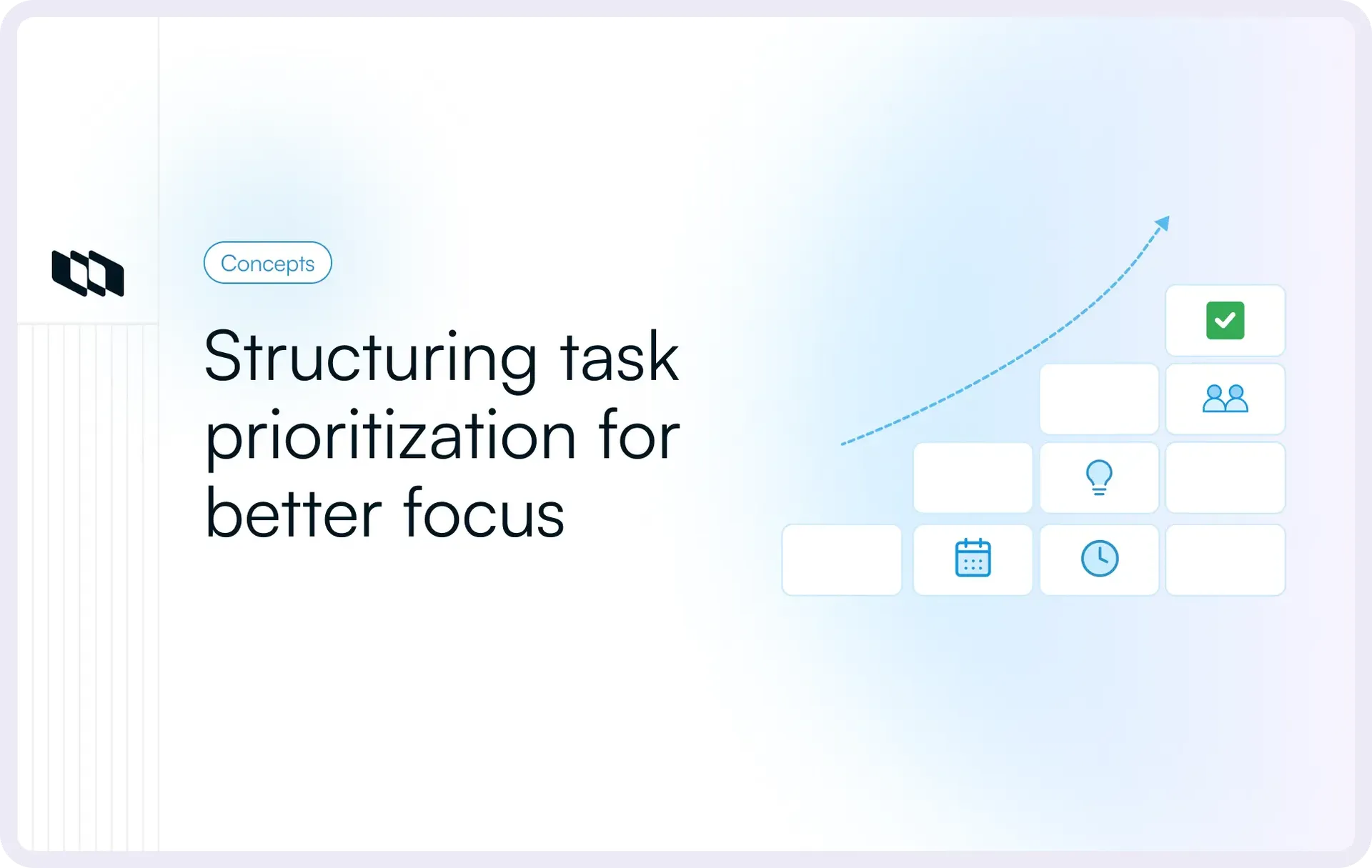
Introduction
Every professional juggles competing tasks, tight deadlines, and shifting priorities. The real challenge is knowing which work actually moves the needle and which just fills your calendar. This guide breaks down how to evaluate tasks by impact and urgency, walks through practical steps for prioritizing your workload, and covers the frameworks that PMs, engineers, and team leads rely on to make sharper, more consistent prioritization decisions.
What does it mean to prioritize tasks at work?
Every workday brings competing demands. Feature work, bug fixes, stakeholder requests, and operational tasks all compete for attention. Task prioritization creates a clear execution order, so teams focus on the work that moves projects forward. Let’s break down what task prioritization means and why it plays a critical role in everyday work.
Defining task prioritization
Task prioritization is the process of ranking work based on factors such as urgency, importance, deadlines, impact, and dependencies. Instead of approaching tasks randomly, professionals organize work in an order that supports project progress and delivery goals. Strong task prioritization methods help teams focus on high-impact work while maintaining steady execution across projects. Prioritization is the system that determines what gets your attention first, what gets scheduled, and what gets dropped entirely.
It accounts for:
- Urgency: Does this need to happen today or this week?
- Importance: Is completing this move a key goal forward?
- Deadlines: Are there hard commitments tied to this task?
- Impact: What breaks, stalls, or suffers if this task is delayed?
- Dependencies: Is another person or task blocked until this is done?
Why prioritizing tasks matters
Without a clear prioritization system, work defaults to whatever feels most pressing in the moment. That creates noise. Here is what a solid task prioritization practice delivers:
- Improved focus: You work on one meaningful thing at a time instead of spreading attention thin across ten.
- Better time management: High-priority work gets scheduled when your energy and bandwidth are at their peak.
- Fewer missed deadlines: Dependencies and due dates are visible, so nothing critical slips through.
- Clearer decision-making: When new requests land, you have a framework to evaluate them against existing priorities rather than reacting impulsively.
- More meaningful progress: At the end of the day, completed work maps to real outcomes rather than just a long list of checked boxes.
Task prioritization vs. staying busy
Staying busy and working on the right things are two entirely different outcomes. A full calendar and a packed task list can mask a serious prioritization problem.
The distinction is straightforward:
- Busy looks like: closing 20 tickets, attending back-to-back meetings, responding to every Slack message within minutes.
- Prioritized looks like: shipping the feature that unblocks three other teams, resolving the bug affecting enterprise customers, finishing the proposal that closes a deal.
Volume is a vanity metric for individual productivity. The goal of effective work prioritization is to make progress on the highest-leverage tasks, which requires conscious sequencing, not just high output.
Common challenges people face when prioritizing tasks
Even with the best intentions, prioritizing work effectively can get complicated fast. Most of these challenges are not about personal productivity habits but about the nature of modern work environments.
1. Too many incoming tasks and requests
Across most teams, tasks arrive from multiple directions simultaneously: stakeholder requests, bug reports, planned project work, ad hoc meetings, and review cycles. When everything lands in the same queue with no clear weight attached, deciding what to tackle first becomes genuinely difficult.
2. Unclear priorities from stakeholders
One of the more frustrating realities of work prioritization is that stakeholders often present their requests as equally urgent. When leadership, clients, and cross-functional partners all flag their work as high priority, the actual priority order becomes ambiguous, and teams end up making judgment calls they should not have to make on their own.
3. Tasks spread across multiple tools and channels
Work today lives everywhere: project management tools, Slack threads, email chains, shared docs, spreadsheets. When tasks are scattered across systems, getting a complete picture of your actual workload is harder than it should be. Prioritizing tasks at work becomes difficult when you cannot see them all in one place.
4. Reactive work interrupts planned work
Planned work and reactive work compete for the same hours. A critical customer issue, an urgent internal request, or an unplanned meeting can shift an entire day's priorities before 10 AM. Teams that operate primarily in reactive mode often find that structured prioritization frameworks fall apart under the pressure of day-to-day interruptions.
5. Difficulty estimating effort and impact
Prioritization decisions rely on reasonably accurate estimates of effort and impact. In practice, tasks often look smaller or larger than they are, and their downstream impact is easy to misjudge. Without reliable estimates, even a well-intentioned prioritization system can sequence work in ways that create bottlenecks or miss key outcomes.
Recognizing these patterns is the first step toward building a prioritization approach that actually holds up under real working conditions. The next sections cover exactly that.
Factors to consider when prioritizing tasks
Good prioritization comes down to evaluating tasks against a consistent set of criteria. Rather than relying on gut feel or whoever asked loudest, these six factors give you a structured way to assess where any task belongs in your queue.
1. Urgency
Urgency refers to how time-sensitive a task is. Some tasks require immediate attention because delays can lead to direct consequences: a system outage, a missed client deadline, or a blocker holding up the team. Urgency is often the most visible factor, which is also why it tends to dominate prioritization decisions even when it should not always come first.
2. Importance
Importance measures how meaningfully a task contributes to team goals, project outcomes, or longer-term objectives. An important task moves the needle on something that matters. It may or may not be urgent, but skipping or delaying it carries real costs over time. Separating importance from urgency is one of the most valuable habits in effective task management at work.
3. Deadlines
Deadlines introduce hard constraints into prioritization. Tasks tied to external commitments, contractual obligations, or release schedules carry fixed delivery timelines that cannot flex easily. Factoring deadlines in early helps avoid the pattern of work piling up right before a delivery date because earlier sequencing decisions did not account for them.
4. Impact
Impact looks at the value a completed task generates or the consequences of leaving it incomplete. A task with high impact might unblock three other teams, improve a metric that leadership tracks closely, or directly affect the customer experience. Thinking about impact shifts prioritization from activity-based to outcome-based, which tends to produce better sequencing decisions.
5. Effort required
Effort estimation accounts for the time, resources, and complexity a task demands. A high-impact task that requires two hours sits very differently in a priority queue than one that requires two weeks. Pairing effort with impact is particularly useful when managing and prioritizing multiple tasks at work, since it helps identify quick wins alongside longer investments.
6. Dependencies
Dependencies determine sequencing in ways that urgency and importance alone cannot. If Task B cannot begin until Task A is complete, then Task A inherits priority regardless of its standalone weight. Mapping dependencies before finalizing a priority order prevents the wrong task from being worked on first, which can cause downstream delays throughout the project.
With these six factors in hand, evaluating any task becomes a more deliberate and defensible process. The next section puts them into practice.
How to prioritize tasks at work: A step-by-step process
Knowing the theory behind task prioritization is one thing. Actually working through a backlog of competing tasks on a Tuesday morning is another. This process is designed to be practical, repeatable, and adaptable to how real work actually unfolds.
1. Capture all tasks in one place
The first move is deceptively simple: write everything down. Tasks living across your inbox, memory, Slack threads, and sticky notes are not a system. They are a liability. Pull all tasks, requests, and commitments into a single place before making any prioritization decisions.
A few things to capture upfront:
- Every pending task, regardless of size or source
- Verbal commitments and informal requests that never made it to a tracker
- Recurring responsibilities that often get assumed but never listed
- Any work in progress that still needs follow-up or completion
Until your full workload is in one view, any prioritization decision you make is based on incomplete information.
2. Break large tasks into smaller, actionable steps
"Launch campaign" or "finalize architecture" are outcomes, not tasks. They sit on lists for weeks because there is no clear first action attached. Break these down before you attempt to prioritize them.
Smaller tasks are easier to:
- Estimate accurately in terms of effort and time
- Assign to the right person
- Sequence based on dependencies
- Prioritize individually rather than as one overwhelming block
A two-week effort broken into daily actions becomes something you can actually plan around.
3. Add context to each task
Ranking tasks without context leads to guesswork. Before touching the priority order, make sure each task has enough information attached to it:
- Deadline: Is there a fixed delivery date or external commitment?
- Owner: Who is responsible for completing this?
- Dependencies: Does this task block anything else, or get blocked by anything else?
- Effort estimate: Is this a two-hour task or a two-week investment?
- Priority level: High, medium, or low based on initial assessment
Even a light layer of context transforms a flat list into something you can make real decisions with.
4. Identify urgent and important tasks
This is where most prioritization goes sideways. Urgent tasks create pressure. Important tasks create value. The two overlap sometimes, but often they do not. Before reordering your queue, ask: is this urgent, important, or both?
A quick way to think about it:
- Urgent + Important: Handle immediately
- Important, not urgent: Schedule with protected time
- Urgent, not important: Delegate where possible
- Neither: Drop it or park it for later review
Learning this distinction is at the core of every effective task prioritization method used by experienced PMs and team leads.
5. Rank tasks based on priority
The instinct is to sort by deadline. A deadline-only view misses impact, effort, and dependencies entirely. A more reliable approach weighs multiple factors together:
- Tasks high on urgency, importance, and impact move to the top
- Tasks urgent but low-impact get scheduled or delegated
- Tasks important but flexible get protected time later in the week
- Tasks low on all counts get parked or dropped
This approach is what separates reactive task management from deliberate work prioritization.
6. Decide what can be delegated or postponed
A prioritized list still has a bottom half. Some of those tasks belong to someone else, and some do not need to happen right now at all.
Ask these questions for tasks sitting in the lower half of your list:
- Is someone else better positioned to handle this?
- Does this need to happen this week, or can it move?
- What actually happens if this gets delayed by a week?
- Is this task tied to a real goal, or has it just been on the list for a while?
Delegation is not offloading. Postponing is not avoidance. Both are legitimate prioritization decisions when made deliberately.
7. Schedule prioritized tasks
A ranked list without a scheduled time is just an organized wish list. Top-priority tasks need actual execution windows assigned to them, whether that is a time block, a sprint slot, or a planned delivery date.
Before locking in the schedule, check for:
- Realistic fit: Do your top five priorities actually fit into available hours this week?
- Energy alignment: Are cognitively heavy tasks scheduled when focus is highest?
- Buffer room: Is there space for reactive work without derailing planned priorities?
- Team visibility: Does the rest of the team know what is being worked on and when?
8. Review and adjust priorities regularly
Priorities shift. New requests land, timelines move, and what was critical on Monday may look different by Thursday. A regular review rhythm keeps your priority order up to date without having to rebuild it from scratch each time.
A simple review cadence to consider:
- Daily: Quick scan to confirm today's top priorities still hold
- Weekly: Reorder the full list based on new inputs and completed work
- Per sprint or milestone: Reassess based on project progress and stakeholder feedback
- After major changes: Reprioritize immediately when timelines, scope, or team capacity shift
The goal is a system that adapts to real work conditions while keeping the team aligned on what matters most.
Popular task prioritization methods
No single prioritization framework works for every team or every type of work. The right method depends on your role, the nature of your tasks, and how your team operates. Here is a breakdown of the most widely used task prioritization methods, what each one does well, and where it fits best.
1. Eisenhower matrix
The Eisenhower Matrix organizes tasks into four quadrants based on two variables: urgency and importance. It is one of the most referenced frameworks in work prioritization because it forces a clear distinction between reactive and strategic work.
The four quadrants:
- Do first: Urgent and important. These are your immediate priorities.
- Schedule: Important but not urgent. These deserve protected time on your calendar.
- Delegate: Urgent but not important. These need to happen, but not necessarily by you.
- Eliminate: Neither urgent nor important. These should be dropped entirely.
Best for: Individual contributors and managers who need to cut through a noisy task list and separate high-leverage work from busywork.
2. ABC or ABCDE prioritization method
This method assigns a letter grade to every task based on its relative importance. It is straightforward to apply and scales well across large task lists.
How it works:
- A tasks: Must be done: Serious consequences if skipped or delayed.
- B tasks: Should be done: Mild consequences if postponed.
- C tasks: Nice to do: No real consequence if they do not happen today.
- D tasks: Delegate: Someone else can and should handle these.
- E tasks: Eliminate: These add no meaningful value.
Best for: Professionals managing large, mixed task lists who need a fast, repeatable way to rank work without a complex scoring system.
3. MoSCoW prioritization method
MoSCoW is widely used in product and project management to align teams and stakeholders on what is in scope for a given release or sprint.
The four categories:
- Must-have: Non-negotiable. The work cannot ship without these.
- Should-have: High value, but the delivery can proceed without them if necessary.
- Could-have: Desirable additions that make the cut only if time and capacity allow.
- Won't-have: Explicitly out of scope for this cycle, documented to manage expectations.
Best for: Product teams, project managers, and cross-functional groups that need a shared language for scope decisions and stakeholder conversations.
4. Eat that frog technique
Borrowed from Brian Tracy's productivity framework, Eat That Frog is built on one core idea: start your day with the most difficult or most important task on your list. Everything else follows after.
Why it works:
- Willpower and focus are highest earlier in the day for most people
- Completing a hard task early creates momentum that carries through the rest of the day
- It prevents high-priority work from getting pushed repeatedly by smaller, easier tasks
Best for: Individuals who tend to procrastinate on high-stakes tasks or find that important work consistently gets pushed to the end of the day.
5. Ivy Lee method
Developed in the early 1900s and still remarkably relevant, the Ivy Lee Method is a simple daily planning approach that removes decision fatigue from your morning routine.
How it works:
- At the end of each workday, write down the six most important tasks for tomorrow
- Rank them in order of true priority
- Start the next day with task one and work sequentially
- Move any unfinished tasks to the next day's list and repeat
Best for: Individuals who struggle with overloaded to-do lists and want a minimal, low-overhead system for daily task prioritization at work.
6. 1-3-5 prioritization rule
The 1-3-5 rule brings realistic structure to daily planning by acknowledging that not all tasks carry the same weight or take the same time.
The structure:
- 1 big task: Your primary focus for the day, the thing that matters most
- 3 medium tasks: Secondary priorities that move meaningful work forward
- 5 small tasks: Lower-effort items that still need to get done
The total adds up to nine tasks, which for most people represents a genuinely achievable day rather than an aspirational list that ends at 40% completion.
Best for: Anyone who consistently over-plans their day and ends up frustrated by how little of the list actually gets finished.
7. Timeboxing
Timeboxing assigns a fixed block of time to a specific task or type of work, regardless of whether the task is completed within that block. It is as much a focus technique as it is a prioritization method.
How teams use it:
- Assign 90-minute or two-hour blocks to high-priority tasks
- Use shorter 25-30 minute blocks for smaller tasks or focused bursts (similar to Pomodoro)
- Schedule reactive work, like email and Slack, into dedicated time slots rather than letting it interrupt deep work
- Review what was completed at the end of each block and adjust
Best for: Teams and individuals dealing with reactive work interrupting planned priorities, or anyone who struggles to estimate how long tasks actually take.
8. Impact vs. effort matrix
The Impact vs. Effort Matrix plots tasks on a two-axis grid: potential impact on one axis, effort required on the other. It is a practical tool for identifying where to focus when managing and prioritizing multiple tasks at work.
The four zones:
- Quick wins: High impact, low effort. Do these first.
- Major projects: High impact, high effort. Plan and resource these properly.
- Fill-ins: Low impact, low effort. Do these when capacity allows.
- Time wasters: Low impact, high effort. Avoid or eliminate these.
Best for: Product and engineering teams making resourcing decisions, or anyone trying to identify the highest-leverage work in a large backlog.
How to choose the right prioritization method
Having eight frameworks to choose from is useful until you actually need to pick one. The method that works best depends on the nature of your work, the size of your team, and the type of prioritization decision you are trying to make. Here is a practical way to think about it.
1. For individual daily planning
When the goal is to structure your day and protect time for high-priority work, simpler methods tend to outperform complex ones.
Good fits:
- Ivy Lee Method: if you want a low-overhead system that removes morning decision fatigue entirely
- 1-3-5 Rule: if you consistently over-plan and need a realistic daily structure
- Eat That Frog: if important work keeps getting pushed because smaller tasks feel easier to start
- Timeboxing: if reactive work regularly pulls you away from planned priorities
The common thread here is simplicity. Individual planning methods should take minutes to apply, not become a planning exercise in themselves.
2. For managing large or complex workloads
When you are dealing with a long backlog, multiple ongoing projects, or tasks coming in from several directions at once, you need a method that helps you evaluate and rank work systematically rather than relying on intuition.
Good fits:
- ABC or ABCDE Method for quickly grading a large task list by consequence and importance
- Eisenhower Matrix for cutting through urgency noise and protecting time for strategically important work
These methods give you a consistent evaluation lens so prioritization decisions hold up under scrutiny rather than shifting with whoever asked last.
3. For coordinating team projects
Team prioritization introduces variables that individual methods are not built to handle: shared capacity, cross-functional dependencies, stakeholder expectations, and competing definitions of what "high priority" actually means.
Good fits:
- MoSCoW method for aligning the team and stakeholders on scope before a sprint, release, or project phase begins
- Impact vs. Effort Matrix for making resourcing decisions visible and defensible across the group
- Timeboxing for protecting focused execution time across the team and reducing the cost of context switching
At the team level, the value of a framework is as much about creating shared language as it is about the ranking itself. When everyone uses the same criteria, priority conversations become faster and less political.
4. For evaluating competing initiatives
This is the highest-stakes prioritization context: choosing between projects, deciding what makes it into the roadmap, or determining where limited resources go across multiple competing priorities.
Good fits:
- MoSCoW for drawing clear boundaries around what is in and out of scope for a given cycle
- Impact vs. Effort Matrix for comparing initiatives side by side on a common set of dimensions
- Eisenhower matrix for stress-testing whether initiatives are genuinely important or just urgent in the moment
At this level, no single framework replaces good judgment and stakeholder alignment. These methods structure the conversation and make trade-offs visible, which is often exactly what is needed to move a decision forward.
A practical starting point
If choosing feels overwhelming, start here:
Context | Recommended Method |
Personal daily task planning | Ivy Lee or 1-3-5 Rule |
Large individual backlog | ABC Method or Eisenhower Matrix |
Sprint or release planning | MoSCoW Method |
Backlog grooming | Impact vs. Effort Matrix |
Deep work protection | Timeboxing |
Procrastinating on hard tasks | Eat That Frog |
The goal is to match the method to the decision, not to find one universal framework and force every prioritization problem through it.
How teams prioritize tasks effectively
Task prioritization becomes more complex in team environments. Multiple people contribute to the same project, dependencies exist across tasks, and priorities shift as projects evolve. Effective teams approach prioritizing tasks as a shared process rather than an individual decision. Clear alignment, ownership, and communication help teams execute work in the right order.
1. Align tasks with team goals and project objectives
Every task should connect to a larger objective. Teams that prioritize work effectively evaluate how each task contributes to project milestones, product goals, or delivery timelines.
When aligning tasks with goals, teams typically ask:
- Does this task move the project closer to a milestone?
- Does it support a key product objective?
- Does it improve delivery timelines or product quality?
This alignment ensures that task prioritization reflects meaningful outcomes rather than isolated activities.
2. Clarify task ownership and responsibilities
Clear ownership helps teams execute prioritized tasks efficiently. When responsibilities remain unclear, tasks often stall because multiple people assume someone else will handle the work.
Effective teams assign ownership early so that each prioritized task has:
- A clearly responsible person
- Defined expectations for completion
- Visibility across the team
This clarity keeps execution moving without confusion.
3. Identify dependencies between tasks
Many tasks rely on the completion of other work. A design review may depend on finalized requirements, while development tasks may depend on approved specifications.
Recognizing these relationships helps teams organize work in the correct sequence.
Teams usually identify:
- Tasks that unblock other work
- Tasks that depend on previous steps
- Tasks that multiple team members must coordinate on
Mapping dependencies helps teams avoid delays and maintain steady progress.
4. Communicate priority changes clearly
Project priorities evolve as teams receive new information. Feature scope changes, production issues appear, or stakeholder feedback reshapes delivery plans.
Clear communication keeps teams aligned when priorities shift.
Teams typically communicate changes through:
- Sprint planning discussions
- Project updates
- Shared task management tools
Regular communication ensures everyone understands which tasks require attention and why priorities have changed.
Common mistakes to avoid when prioritizing tasks
Task prioritization improves focus and execution when applied thoughtfully. Many teams still struggle to prioritize tasks at work because certain habits undermine the process. Recognizing these pitfalls helps professionals make better decisions about where to allocate time and effort. Let’s explore the common mistakes that reduce the effectiveness of task prioritization.
1. Treating every task as high priority
When every task carries the same level of importance, the idea of priority loses meaning. Teams often mark several tasks as urgent or critical, which creates confusion about where to begin. Effective task prioritization requires clear distinctions between high-impact tasks and routine work. A smaller set of truly important tasks allows teams to focus their attention on work that drives project progress.
2. Prioritizing only by urgency
Urgent tasks demand attention because they carry deadlines or immediate pressure. Teams sometimes prioritize urgent work over everything else, leading to constant reactive execution. Strong task prioritization techniques evaluate urgency alongside impact and long-term value. This approach ensures that important work receives the attention required for meaningful progress.
3. Focusing on easy tasks instead of impactful work
Quick tasks often provide a sense of accomplishment, so professionals naturally gravitate toward them. Completing several small tasks may feel productive, yet important work remains unfinished. Effective prioritization focuses on impact rather than convenience. Teams achieve stronger results when high-value tasks receive attention before routine work.
4. Failing to break down complex tasks
Large tasks often appear overwhelming because the actual steps required remain unclear. Without breaking them into smaller actions, teams struggle to estimate effort or decide where to begin. Breaking complex work into smaller tasks creates clarity and makes prioritizing tasks more accurate.
5. Ignoring dependencies
Many tasks rely on the completion of other work. When dependencies remain unclear, teams may prioritize tasks that cannot move forward yet. Identifying dependencies helps professionals organize tasks in the correct sequence and prevents delays across projects.
6. Not reviewing priorities regularly
Priorities evolve as projects progress. New tasks appear, deadlines shift, and stakeholder requests change the order of work. Teams that regularly review their task lists maintain clearer priorities and stronger alignment with project goals.
Tips for improving task prioritization at work
Frameworks and processes set the foundation. Daily habits are what keep prioritization working consistently over time. These are practical, low-overhead habits that make a real difference in how work gets managed day to day.
1. Keep a single source of truth for all tasks
Scattered tasks create scattered priorities. When work lives across email, chat, spreadsheets, and memory simultaneously, getting a reliable picture of your workload requires effort that should be going toward the work itself.
Consolidating everything into one system helps you:
- Make prioritization decisions without first assembling your task list mentally
- Give the rest of your team visibility into what is in progress
- Spot gaps, duplicates, and forgotten commitments that would otherwise stay hidden
2. Limit the number of daily priorities
A daily list with fifteen items is not a prioritized list. It is an inventory. The goal is to identify the two or three tasks that genuinely need to happen today, not catalog everything that could theoretically get done.
Limiting daily priorities forces a real decision:
- What absolutely needs to happen today?
- What can move to tomorrow without real consequence?
- What is on the list out of habit rather than genuine need?
That forcing function is where the actual prioritization happens.
3. Schedule and protect deep work time
High-priority tasks often require sustained focus to complete well. Fitting them into fragmented gaps between meetings produces slower, lower-quality work than a dedicated, focused block would.
Simple ways to protect deep work time:
- Block calendar time for top priorities before the week fills with meetings
- Batch meetings into specific parts of the day to preserve longer uninterrupted windows
- Treat focused work blocks the same way you would treat an external commitment
- Let the team know when you are in a focused block, so interruptions stay minimal
4. Batch similar tasks together
Context switching between different types of work carries a real cognitive cost. Moving from deep technical work to stakeholder emails to code review and back again fragments attention, slowing everything down.
A simple batching structure that works well:
- Communications: Handle emails, messages, and responses in one or two dedicated windows
- Reviews and approvals: Group feedback requests and review tasks into a single block
- Administrative work: Batch operational tasks rather than spreading them across the day
- Deep or creative work: Reserve for the time of day when focus is naturally at its highest
5. Review priorities at the start and end of each day
A ten-minute review at both ends of the day prevents a surprising number of prioritization problems from developing quietly over time.
Morning check:
- Do yesterday's unfinished priorities still hold their ranking?
- Has anything new arrived that genuinely needs to move up?
- What are the top two or three tasks before the day starts pulling in other directions?
End-of-day check:
- What got completed and what carried over?
- Does tomorrow's priority order need to be adjusted based on today?
- Is anything being repeatedly deferred? That is usually a signal worth looking into.
Wrapping up
Effective task prioritization is not about having a perfect system. It is about making deliberate decisions consistently, revisiting them as things change, and keeping the focus on work that actually moves the needle.
The frameworks, steps, and habits covered in this guide are only useful if they translate into how work actually gets planned and executed day to day. Start with what fits your current context, whether that is a simple daily ranking method or a team-wide prioritization framework, and build from there.
The goal was never to do more. It was always to do the right things first.
Frequently asked questions
Q1. What are the 4 D's of prioritization?
The 4 D's of prioritization help professionals decide how to handle tasks efficiently. The four actions are Do, Delegate, Defer, and Delete. Tasks that require immediate attention are completed, tasks suited for others are delegated, tasks that can wait are deferred, and tasks with minimal value are removed from the list.
Q2. What are the 5 priority levels for tasks?
Many teams organize tasks into five priority levels to clarify execution order. These levels typically include Critical, High, Medium, Low, and Optional. Critical tasks require immediate attention, while optional tasks carry the lowest urgency and impact.
Q3. What is the 3-3-3 rule for tasks?
The 3-3-3 rule helps professionals structure their workday around manageable priorities. The method focuses on completing three high-impact, three moderate, and three small tasks during the day. This structure encourages balanced productivity and prevents overloaded task lists.
Q4. What are the 4 P's of prioritization?
The 4 P's of prioritization refer to Purpose, Priority, Productivity, and Performance. This framework encourages professionals to connect tasks to a clear purpose, organize them by priority, execute work efficiently, and evaluate performance based on outcomes.
Q5. What is the ABC rule of prioritizing?
The ABC rule organizes tasks into categories based on importance. A tasks carry the highest importance and strong impact on goals, B tasks remain important yet less critical, and C tasks involve routine work with lower impact. This method helps professionals focus attention on the tasks that create the most meaningful progress.
Recommended for you



 Download for Mac
 Download for Android