What is continuous improvement? Definition, process and methods
Introduction
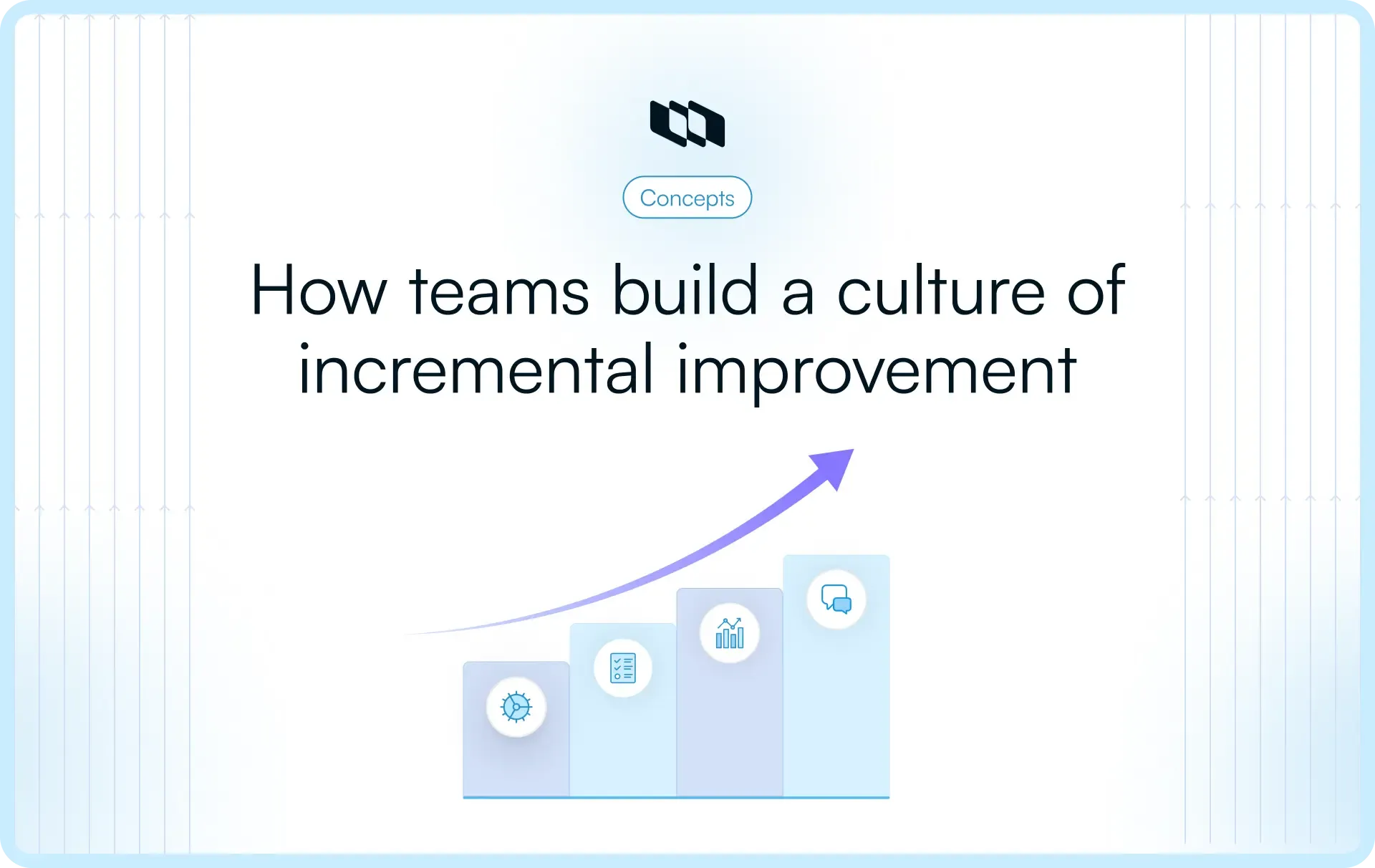
If you have ever wondered why some teams consistently deliver better results while others stay stuck fixing the same problems, the answer often comes down to one practice: continuous improvement. At its core, it is a structured approach to improving work incrementally and intentionally. This post walks you through why continuous improvement matters, where it came from, the goals it serves, and the principles that make it work in real teams.
What is continuous improvement?
Continuous improvement is the practice of regularly reviewing and refining how work gets done, through small, deliberate changes that compound into meaningful progress over time. Rather than waiting for a major overhaul, teams using continuous improvement make steady adjustments to their processes, systems, and ways of working, and those adjustments add up.
The idea is straightforward: no process is ever fully optimized. There is always something to streamline, a bottleneck to clear, or a workflow to tighten. Continuous improvement builds that belief into how a team operates day to day.
It is widely applied across a range of disciplines and industries, including:
- Project management, where teams refine planning, execution, and delivery workflows over successive cycles
- Agile software development, where retrospectives and iterative sprints are built-in improvement mechanisms
- Operations and manufacturing, where waste reduction and process efficiency are ongoing priorities
- ITSM (IT Service Management), where incident response, change management, and service quality are continuously evaluated
- Product development, where feedback loops from users directly inform what gets built, changed, or removed
What makes continuous improvement distinct is its consistency. It is less about occasional big leaps and more about building a reliable rhythm of reflection, adjustment, and progress across the entire team or organization.
Why continuous improvement matters
Continuous improvement is not just a productivity framework. It shapes how teams think, how organizations respond to change, and how quality gets built into everyday work. Here is what it actually delivers.
1. Helps teams identify inefficiencies early
In most teams, small process gaps go unnoticed until they snowball into something harder to fix. A continuous improvement cycle creates regular checkpoints where teams surface friction before it compounds. Catching a workflow bottleneck in week two is significantly easier than diagnosing a systemic breakdown three quarters later.
2. Improves operational efficiency
When teams consistently examine how work flows, they begin to eliminate the delays, redundant steps, and rework that quietly drain time and effort. Operational efficiency improves gradually but sustainably, because each small fix builds on the last rather than disrupting everything at once.
3. Encourages continuous learning
One of the more underrated outcomes of continuous improvement is its impact on team culture. Regular retrospectives, feedback loops, and structured reviews create an environment where reflection becomes habitual. Teams grow more comfortable questioning existing processes and proposing changes, which, over time, builds both capability and confidence.
4. Improves product and service quality
Frequent, incremental refinements tend to produce more reliable outcomes than infrequent large releases. When quality is treated as an ongoing effort rather than a milestone, teams catch issues sooner, incorporate user feedback faster, and deliver experiences that hold up consistently across time.
5. Helps organizations adapt faster
Markets shift, customer expectations evolve, and priorities change. Organizations that practice continuous improvement develop a structural ability to adjust, because their teams are already in the habit of revisiting and rethinking how they work. Adaptability becomes a byproduct of the process, not a separate initiative.
The main goals of continuous improvement
Organizations adopt continuous improvement for different reasons, but the underlying goals tend to follow a consistent pattern. Here is what most teams aim for when they commit to this practice.
1. Reduce waste and inefficiencies
Every process carries some degree of waste, whether that is duplicated effort, unnecessary approvals, idle time, or steps that once made sense but no longer do. Continuous improvement gives teams a systematic way to identify and eliminate that waste, freeing up time and resources for work that actually moves the needle.
2. Improve quality and consistency
Quality that depends on individual effort or heroics is fragile. Continuous improvement shifts the focus to the process itself, making it easier to produce reliable, consistent outcomes regardless of who is doing the work. Over time, fewer errors, fewer rework cycles, and more predictable delivery become the norm.
3. Increase productivity
Productivity gains from continuous improvement tend to be durable because they stem from better processes rather than from pushing people harder. When teams remove friction from their workflows, the same effort produces better output. That is a more sustainable path to higher throughput than simply adding headcount or extending working hours.
4. Improve customer satisfaction
Customers experience the downstream effects of how well a team's processes work. Faster delivery, fewer defects, more responsive support, and products that genuinely reflect user feedback are all outputs of a well-functioning continuous improvement culture. When internal processes improve, the customer experience tends to follow.
5. Build more resilient processes
Processes that have been regularly examined and refined are far better equipped to handle unexpected disruptions. Continuous improvement builds resilience by ensuring that workflows are lean, well-documented, and understood by the people running them. When something breaks or shifts, teams with strong improvement habits recover faster.
6. Create a culture of ongoing improvement
Perhaps the most lasting goal is cultural. When continuous improvement becomes part of how a team thinks and operates, it stops being a program and starts being a default behavior. Teams begin to surface ideas proactively, take greater ownership of their processes, and treat every sprint, quarter, or project cycle as an opportunity to get better.
The origins of continuous improvement
Continuous improvement has a well-documented history, and understanding its origins helps explain why it works as it does today.
Kaizen and japanese manufacturing
The most direct origin of continuous improvement as a formal practice is Kaizen, a Japanese philosophy that translates loosely to "change for the better." It emerged in post-World War II Japan, shaped significantly by the work of American quality theorists W. Edwards Deming and Joseph Juran, whose ideas found more traction in Japan than in their home country at the time. Kaizen placed improvement in the hands of every worker, not just managers or engineers, making it a ground-up practice built on small, frequent changes rather than top-down transformation.
Toyota production system
Toyota took the principles of Kaizen and built them into a full operating philosophy known as the Toyota Production System (TPS). TPS introduced concepts like just-in-time production, waste elimination, and standardized work that became the foundation of what the world now calls Lean manufacturing. The core idea was straightforward: study how work flows, find what adds no value, and remove it systematically. TPS has become one of the most studied management systems in history, and its influence on operational excellence thinking remains evident across industries today.
Modern Agile and operational workflows
As software development matured in the late 1990s and early 2000s, the principles behind continuous improvement found a natural home in Agile methodologies. The Agile Manifesto formalized the idea of iterative delivery and regular reflection through practices such as sprint retrospectives, which are essentially structured continuous-improvement cycles for software teams. The same thinking extended into DevOps, where continuous integration and continuous delivery pipelines reflect an improvement-oriented approach to shipping software. In ITSM, frameworks like ITIL built continuous improvement directly into service lifecycle management. What began on a factory floor in Japan now runs quietly beneath the surface of how most modern product and engineering teams operate.
Core principles of continuous improvement
Continuous improvement is built on a set of foundational principles that shape how teams approach their work. These are not abstract values; they are practical orientations that determine whether an improvement effort sticks or fades.
1. Small improvements over time
Large transformations are difficult to sustain and harder to measure. Continuous improvement operates on the belief that small, consistent changes compound into significant results over time. Each incremental fix reduces friction, closes a gap, or raises a baseline, and those gains accumulate across weeks, sprints, and quarters.
2. Employee involvement
Improvement works best when it comes from the people closest to the work. Frontline contributors, engineers, support staff, and individual contributors often have the clearest view of where processes break down. Continuous improvement actively draws on that knowledge, creating structured ways for teams at every level to surface problems and propose solutions.
3. Data-driven decision-making
Opinions about what needs fixing are useful starting points, but data determines what actually gets prioritized. Effective continuous improvement relies on measurable baselines, defined metrics, and evidence of change. Teams track cycle times, defect rates, customer satisfaction scores, or throughput to understand whether an improvement has actually worked.
4. Customer-focused improvements
Every improvement effort should trace back to a meaningful outcome for the customer or end user. Continuous improvement keeps customer needs at the center of prioritization decisions, ensuring that internal process changes translate into better experiences, faster delivery, or higher quality output on the receiving end.
5. Standardization after improvement
An improvement that lives only in one person's head or one team's practice is fragile. Once a better way of working is identified and validated, it needs to be documented, standardized, and adopted consistently. Standardization is what converts a one-time fix into a lasting operational baseline.
6. Continuous feedback loops
Feedback is the mechanism that keeps improvement cycles running. Regular retrospectives, user feedback sessions, performance reviews, and post-mortems all create structured opportunities to learn what is working and what still needs attention. Without consistent feedback loops, improvement efforts tend to lose momentum and direction over time.
7. Process visibility and transparency
Teams cannot improve what they cannot see. Process visibility means having a clear, shared understanding of how work flows, where it slows down, and who is responsible for each stage. Transparency across workflows makes it far easier to spot inefficiencies, have honest conversations about blockers, and align on where improvement effort is best spent.
Types of continuous improvement
Improvement efforts do not always happen at the same pace or scale. Depending on where a team is and what a process demands, continuous improvement can take two distinct forms.
1. Incremental Improvement
Incremental improvement refers to the small, ongoing adjustments that teams make as part of their regular working rhythm. These changes are usually low-risk, easy to test, and quick to implement. Some common examples include:
- Shortening a recurring meeting that consistently runs over time
- Simplifying a handoff process between two teams or functions
- Adjusting sprint workflows based on retrospective feedback
- Refining how bugs get triaged and assigned across an engineering team
- Updating documentation that no longer reflects how a process actually works
Individually, each change appears minor. Collectively, they shift how a team operates in measurable, durable ways. Incremental improvement works because the feedback cycle is short and the cost of experimentation is low.
2. Breakthrough Improvement
Breakthrough improvement happens when a more fundamental rethink is required. This typically occurs under conditions such as:
- A system has reached the limits of what incremental optimization can achieve
- Market conditions or customer expectations have shifted significantly
- Accumulated technical or operational debt makes patching the existing approach counterproductive
- A team is scaling rapidly, and existing processes cannot support the new volume or complexity
Breakthrough improvements involve larger changes to structure, tooling, architecture, or process design. They carry a higher risk and require more deliberate planning, but they reset the baseline from which incremental improvement can resume. In practice, most organizations cycle between periods of steady incremental gains and occasional breakthrough efforts, with the two types complementing rather than replacing each other.
How the continuous improvement process works
Continuous improvement is most effective when it follows a structured process. Without a repeatable framework, improvement efforts tend to be reactive, inconsistent, and hard to sustain. The steps below form a practical cycle that product teams, engineering leads, and project managers can apply across any workflow or operational context.
1. Identify a problem or opportunity
Every improvement cycle begins with identifying something worth improving. This could be a recurring problem, a process that consistently produces inconsistent results, a bottleneck that slows delivery, or simply an area where the team senses there is a better way. Identifying the right starting point matters because improvement efforts are finite and need to be directed well.
Some practical ways teams surface these opportunities include:
- Sprint retrospectives and post-mortems that surface recurring friction
- Customer feedback and support ticket patterns that point to quality gaps
- Performance metrics that show a consistent dip below expected baselines
- Team surveys or one-on-ones where contributors flag operational frustrations
- Monitoring tools and dashboards that highlight delays or failure rates in workflows
The goal at this stage is to be specific. A vague problem like "our deployment process is slow" is harder to act on than "our average deployment time has increased from 45 minutes to 3 hours over the last two sprints."
2. Analyze the current process
Once a problem or opportunity is identified, the next step is to understand the process's current state in detail. This means mapping out exactly how work flows today, who is involved at each stage, where handoffs happen, and where time or effort is being lost.
Tools commonly used at this stage include:
- Process mapping and flowcharts to visualize the end-to-end workflow
- Value stream mapping to distinguish steps that add value from steps that do not
- Time-tracking and cycle time analysis to quantify where delays are occurring
- Swimlane diagrams to clarify ownership and handoff points across teams or functions
The purpose of this analysis is to move from assumption to evidence. Teams often discover that the process they think runs a certain way actually runs quite differently in practice. That gap between the assumed and the actual is often where the most valuable improvements are found.
3. Identify root causes
Fixing symptoms without addressing root causes produces short-term relief but rarely solves the underlying problem. This step is about digging deeper to understand why the problem exists in the first place.
Two widely used techniques for root cause analysis are:
- The 5 Whys involves asking "why" repeatedly until the conversation moves from surface symptoms to structural causes. If a sprint consistently misses its goals, asking why five times might reveal that the root cause is unclear acceptance criteria at the planning stage, not poor execution during the sprint itself.
- Fishbone diagrams (also called Ishikawa diagrams) map potential causes across categories like people, process, tools, environment, and measurement. They are particularly useful when a problem has multiple contributing factors, and the team needs a structured way to visualize them together.
The output of this step should be a clear, evidence-backed understanding of what is actually driving the problem, not just what it looks like on the surface.
4. Develop improvement ideas
With a clear picture of the root cause, the team can begin generating solutions. This is a collaborative step where diverse perspectives tend to produce better options. Engineers, product managers, operations leads, and customer-facing team members often see the same problem from different angles, and that range of input leads to more well-rounded solutions.
At this stage, it helps to:
- Generate multiple options rather than defaulting to the first idea that surfaces
- Evaluate each option against effort, impact, and feasibility before committing
- Consider whether the improvement addresses the root cause or only a symptom
- Prioritize ideas that can be tested quickly and measured clearly
The goal is to arrive at a well-reasoned improvement hypothesis: if we change this specific thing in this specific way, we expect to see this measurable outcome.
5. Test the improvement
Before rolling out a change across an entire workflow or organization, it is worth testing it at a smaller scale. This is where the PDCA cycle's "Do" stage becomes particularly relevant. A controlled pilot or limited rollout allows teams to observe the change in action, collect early data, and identify unintended consequences before they become widespread.
Testing approaches vary by context:
- A software team might run a new code review process within a single squad before adopting it organization-wide
- An operations team might apply a revised handoff protocol to one workflow before extending it to all
- A product team might test a revised prioritization framework on one roadmap cycle before making it the standard
The key discipline here is keeping the test scope small enough to be manageable but large enough to produce a meaningful signal.
6. Measure results
Testing without measurement produces anecdote, not insight. After implementing the change, teams need to compare outcomes against the baseline established in the analysis stage. This is where predefined metrics matter enormously.
Useful metrics to track, depending on context, include:
- Cycle time and lead time for delivery workflows
- Defect rates and rework frequency for quality-focused improvements
- Customer satisfaction scores (CSAT) or Net Promoter Score (NPS) for experience-related changes
- Team velocity or throughput for Agile process improvements
- Incident frequency and mean time to resolution (MTTR) for ITSM and DevOps workflows
If the data shows the improvement worked, the team moves to standardization. If the results are inconclusive or the change introduced new problems, the team loops back to root cause analysis with the new information in hand.
7. Standardize successful changes
A validated improvement only delivers lasting value if it is properly standardized. This means updating process documentation, adjusting templates or playbooks, training team members on the new approach, and ensuring the change is reflected in how onboarding or handover processes work going forward.
Standardization is where many continuous improvement efforts fall short. Teams test a change, see positive results, and then gradually drift back to old habits because the new approach was never formally embedded. Building standardization into the improvement cycle prevents that drift and ensures the baseline keeps rising rather than resetting.
8. Repeat the process continuously
Continuous improvement is not a project with a finish line. Once a change is standardized, the cycle begins again. The newly improved process becomes the new baseline, and the team returns to step one to identify the next opportunity. Over time, this rhythm becomes part of how the team operates rather than something that requires a special initiative or dedicated program to activate.
This is the defining characteristic of organizations that improve consistently: they treat the improvement cycle itself as a core operating habit, not an occasional response to crisis.
The PDCA cycle
The Plan-Do-Check-Act (PDCA) cycle is one of the most widely used frameworks in continuous improvement. Developed by quality theorist Walter Shewhart and later popularised by W. Edwards Deming, it provides a structured, repeatable loop for testing and implementing changes in any process or workflow. Its strength lies in its simplicity: four stages, each with a clear purpose, that keep improvement efforts grounded in evidence rather than assumption.
1. Plan
The Plan stage is where the improvement effort takes shape. The team identifies a specific problem or opportunity, analyses the current process, determines the root cause, and defines a clear improvement goal. This stage also involves deciding how success will be measured, what change will be tested, and what scope the test will cover.
A well-executed Plan stage answers three questions clearly:
- What exactly is the problem, and what evidence supports that diagnosis?
- What change do we believe will address the root cause?
- How will we know whether the change has worked?
Skipping or rushing the Plan stage is one of the most common reasons improvement efforts produce weak results. The quality of the plan directly determines the quality of everything that follows.
2. Do
The Do stage involves implementing the planned change, but deliberately at a small scale. The purpose is to test the improvement in a controlled environment before committing to a wider rollout. This limits the risk of unintended consequences and makes it easier to isolate the effect of the change.
In practice, this might look like:
- Running a revised sprint planning process within one team before adopting it across an entire engineering department
- Applying a new customer escalation workflow to one support tier before extending it organization-wide
- Testing a revised code review standard within a single product squad for one sprint cycle
The Do stage is about generating real-world data, not theoretical outcomes. Keeping the scope small and the duration short makes the feedback loop faster and the learning more actionable.
3. Check
The Check stage is where the team evaluates what the data from the Do stage actually shows. Outcomes are compared against the baseline established during the Plan stage, and the team assesses whether the change produced the expected improvement, a partial improvement, or an unexpected result.
This stage requires honesty. The goal is accurate diagnosis, not confirmation of a preferred outcome. Teams examine:
- Whether the target metrics moved in the expected direction
- Whether any unintended side effects emerged during the test
- Whether the improvement held up consistently or only under certain conditions
- Whether the root cause was correctly identified or whether the data points to something deeper
The Check stage is where learning happens. Even an improvement that did not perform as expected yields valuable insights that sharpen the next cycle.
4. Act
The Act stage determines what happens next based on what the Check stage revealed. If the improvement worked, the team standardizes the change, updates documentation, and embeds the new approach into regular working practice. If the results were inconclusive or the change needs refinement, the team adjusts the approach and runs another cycle.
The Act stage feeds directly back into the Plan stage, which is what makes PDCA a cycle rather than a linear process. Each completed loop raises the baseline and informs the next improvement effort with better data and sharper context. Over time, teams that consistently run PDCA cycles develop a compounding advantage in improvement that is difficult to replicate through one-off initiatives.
Popular continuous improvement methods and frameworks
Several structured methodologies have been developed to support continuous improvement in practice. Each one approaches improvement from a slightly different angle, and many teams use a combination depending on their context and goals.
1. Kaizen
Kaizen is the foundational philosophy behind much of modern continuous improvement thinking. Originating in post-war Japan, it operates on the principle that everyone in an organization, regardless of role or seniority, has a part to play in improving work. Kaizen focuses on small, frequent improvements made consistently over time rather than periodic large-scale changes. Its power lies in the cultural shift it creates: improvement becomes a shared responsibility rather than a management directive.
2. Lean
Lean methodology centers on delivering maximum value to the customer while systematically eliminating waste from the process. Waste in Lean terms includes anything that consumes time, effort, or resources without contributing to a valuable outcome, such as unnecessary approvals, excess inventory, redundant handoffs, or waiting time. Lean gives teams a structured lens for examining their workflows and identifying where effort is being spent on activities that do not move the work forward.
3. Six Sigma
Six Sigma is a data-driven methodology focused on reducing variation and defects in processes. It uses statistical analysis to identify the sources of inconsistency and applies structured problem-solving frameworks, most notably DMAIC (Define, Measure, Analyze, Improve, Control), to drive measurable quality improvements. Six Sigma is particularly well-suited to environments where consistency and precision matter, such as manufacturing, finance, and large-scale service operations.
4. Kanban
Kanban is a visual workflow management method that makes work in progress visible, limits overload, and supports a steady, sustainable flow of delivery. Teams use Kanban boards to track work items through defined stages, making bottlenecks immediately visible and easier to address. Because Kanban surfaces flow problems in real time, it functions as a continuous improvement tool by design, prompting teams to optimize their process as work moves through it.
5. Total quality management (TQM)
Total Quality Management is an organization-wide approach to embedding quality into every function and process rather than treating it as the responsibility of a single team or department. TQM emphasizes customer focus, employee involvement, process standardization, and long-term thinking. It is less a specific toolkit and more a management philosophy that aligns an entire organization around the goal of continuous quality improvement.
6. Agile Retrospectives
In Agile teams, the retrospective is the built-in continuous improvement mechanism. Held at the end of each sprint or iteration, it creates a structured space for the team to reflect on what worked, what did not, and what one or two changes would make the next cycle more effective. Retrospectives are continuous improvement in its most practical, team-level form, making them one of the most accessible entry points for any team looking to build an improvement habit.
7. Root cause analysis
Root cause analysis (RCA) is a structured approach to identifying the underlying cause of a problem rather than addressing its visible symptoms. Common RCA techniques include the 5 Whys, fishbone diagrams, and fault tree analysis. Used well, RCA ensures that improvement efforts target the actual source of a problem, making solutions more durable and preventing the same issues from recurring across cycles.
8. The 5 Whys Technique
The 5 Whys is one of the simplest and most effective tools in continuous improvement. Developed as part of the Toyota Production System, it involves asking "why" repeatedly, typically five times, until the conversation moves from surface symptoms to structural root causes. It requires no special tools or training, works well in team settings, and consistently surfaces insights that more surface-level diagnoses tend to miss.
Benefits of continuous improvement
Organizations that commit to continuous improvement over time tend to see compounding returns across several dimensions. Here are the five benefits that matter most at both the team and organizational levels.
1. Better operational efficiency
When teams consistently examine and refine how work flows, inefficiencies get removed at the source rather than worked around. Over time, processes become leaner, handoffs become cleaner, and the same resources produce better output. Operational efficiency gained through continuous improvement tends to be more durable than efficiency driven by short-term cost-cutting, because it is built into the process itself rather than imposed on top of it.
2. Faster problem-solving
Teams that practice continuous improvement develop sharper diagnostic instincts over time. Regular retrospectives, structured root cause analysis, and consistent measurement create an environment where problems are identified earlier, understood more clearly, and resolved more decisively. Rather than spending weeks figuring out what went wrong, experienced improvement-oriented teams often surface and address issues within a single cycle.
3. Improved collaboration
Continuous improvement creates structured opportunities for cross-functional input. When engineers, product managers, operations leads, and customer-facing teams regularly come together to examine shared processes, it builds mutual understanding of how each function's work affects the others. That shared context reduces friction, improves communication, and makes collaborative problem-solving significantly more effective over time.
4. Higher customer satisfaction
The downstream effect of better processes is a better customer experience. Faster delivery, fewer defects, more consistent quality, and products that reflect real user feedback are all natural outcomes of a well-functioning continuous improvement culture. Customers may never see the internal process changes, but they consistently feel the difference in the quality and reliability of what they receive.
5. Greater adaptability and innovation
Organizations that already operate with a built-in improvement rhythm are structurally better positioned to adapt when conditions change. The habits of reflection, experimentation, and iteration that continuous improvement develops are the same habits that drive innovation. Teams that are comfortable questioning how things work and testing new approaches tend to respond to market shifts and new opportunities with considerably more agility than those operating on fixed processes.
How project and product teams manage continuous improvement
Understanding continuous improvement as a concept is straightforward. Running it consistently is where most teams struggle. Improvement ideas surface in retrospectives but never get tracked. Process changes get agreed upon, but drift back to old habits. Findings from root cause analysis sit in a meeting notes document that no one revisits.
The gap between intention and execution usually comes down to one thing: structure. Teams need a centralized workspace where improvement efforts are visible, owned, and followed through.This is where Plane fits in naturally.
Here is how teams use it to keep continuous improvement running in practice:
- Track improvement initiatives as dedicated issues or cycles, each with a clear owner, timeline, and measurable outcome
- Document retrospectives using Plane Pages, keeping findings and follow-up actions in one searchable location across all future cycles
- Capture process feedback through issues and comments, so inputs from team members are structured and actionable rather than buried in chat
- Monitor recurring issues by labeling and tagging patterns across cycles, making it easier to spot what keeps coming back
- Standardize workflows using customizable templates and issue types, so validated improvements become the default way of working
- Improve visibility across projects through cross-project views and dashboards that show where improvement initiatives stand at any given time
- Turn learnings into repeatable systems by building improvement cycles directly into how the team operates each sprint or quarter
When improvement efforts are tracked and structured the same way product work is, they are significantly more likely to stick.
Closing thoughts
Continuous improvement is not a one-time initiative or a framework reserved for large organizations with dedicated process teams. It is a working habit that any product, engineering, or project team can build into their operations, regardless of size or stage. The teams that benefit most from it are the ones that start small, stay consistent, and treat every cycle as an opportunity to raise the baseline by just a little.
The methods, frameworks, and principles covered in this post all point toward the same outcome: a team that gets measurably better over time, not by chance, but by design. Whether you are running Agile retrospectives, mapping value streams, or simply asking "why" five times before closing out a recurring issue, the practice of continuous improvement compounds in ways that are hard to replicate through any other means.
Frequently asked questions
Q1. What is continuous improvement?
Continuous improvement is a structured practice of making small, regular changes to processes, systems, and ways of working to increase efficiency, quality, and performance over time. It operates on the principle that no process is ever fully optimized and that consistent, incremental refinements compound into significant results across cycles. It is widely used in project management, Agile development, product teams, operations, manufacturing, and ITSM.
Q2. What are the 5 key principles of continuous improvement?
The 5 key principles of continuous improvement are:
- Small, incremental changes over large, infrequent overhauls
- Employee involvement at every level of the organization
- Data-driven decision-making based on measurable outcomes
- Customer focus, keeping end-user needs at the center of every improvement
- Standardization embeds validated changes into regular working practice, so gains are preserved over time
Q3. What are the 5 steps of the continuous improvement process?
The 5 steps of the continuous improvement process are:
- Identify a problem or opportunity for improvement
- Analyze the current process to understand how work actually flows
- Identify the root cause rather than addressing surface-level symptoms
- Test an improvement at a small scale before a wider rollout
- Measure and standardize results against a defined baseline and embed successful changes into standard practice
Q4. What are the 7 steps of Kaizen?
The 7 steps of the Kaizen improvement cycle are:
- Identify the problem or area for improvement
- Understand the current situation through direct observation and data
- Set a target, defining what a successful improvement looks like
- Analyze the root cause using tools like the 5 Whys or fishbone diagrams
- Develop and implement countermeasures to address the root cause
- Confirm results by comparing outcomes against the defined target
- Standardize the successful approach to sustain the improvement and prevent regression
Q5.What is the 7 step improvement process?
The 7-step improvement process, associated with the ITIL framework, is a structured cycle for managing service and operational improvements. The 7 steps are:
- Identify the improvement strategy aligned with business goals
- Define what will be measured and why
- Gather the relevant data
- Process the data into an analyzable format
- Analyze the data to identify gaps, trends, and opportunities
- Present and use the information to drive informed improvement decisions
- Implement the improvement and feed outcomes back into the next cycle
Recommended for you



 Download for Mac
 Download for Android