What is design thinking? Process, stages, and examples
Learn what design thinking is, explore its five stages, benefits, techniques, and real-world examples, and apply the process to product development.
Learn what design thinking is, explore its five stages, benefits, techniques, and real-world examples, and apply the process to product development.
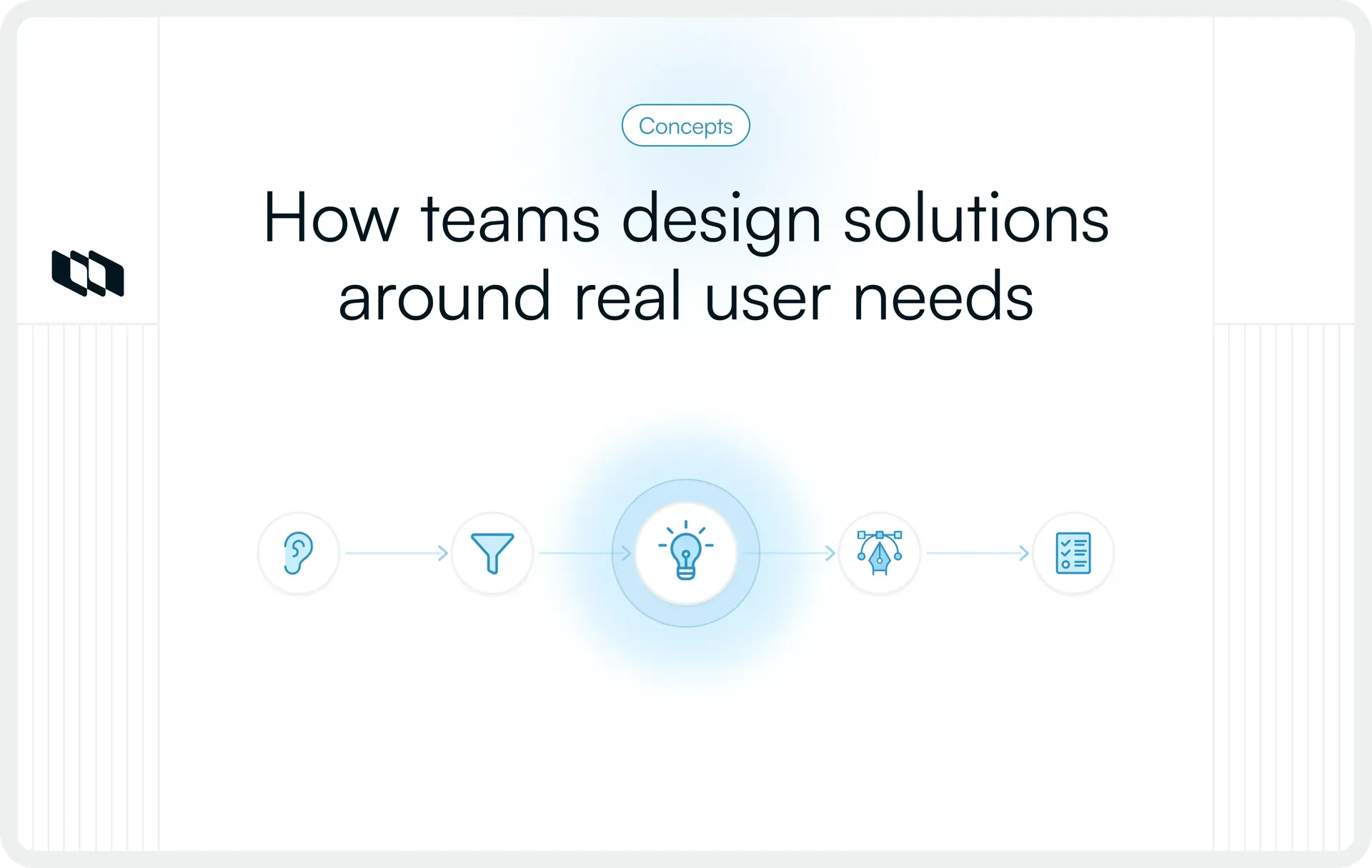
Teams often begin developing solutions before fully understanding the problems users experience. A product team might introduce a feature to improve onboarding, only to discover that users were struggling with an entirely different part of the experience. The development work may be complete, but the original problem remains unresolved.
Design thinking helps teams approach such challenges through user research, creative exploration, and experimentation. It provides a structured way to understand people's needs, investigate possible solutions, and refine ideas through feedback. This guide explains the design thinking process, its five stages, practical techniques, and real-world applications.
What is design thinking?
Design thinking is a human-centered, iterative approach to problem-solving that helps teams understand user needs, challenge assumptions, explore creative solutions, and validate ideas through experimentation. The design thinking methodology is widely used in product development, user experience design, business innovation, and service improvement.
The approach considers three important factors when evaluating potential solutions:
- Desirability: Does the solution address a genuine user need?
- Feasibility: Can the solution be implemented with available technology, resources, and capabilities?
- Viability: Can the solution deliver sustainable value within business and operational constraints?
For example, consider a product team investigating why customers abandon a software onboarding process. Their initial assumption might be that the interface needs fewer steps. However, user interviews could reveal that customers hesitate because they don't understand how certain configuration choices will affect their workspace.
Design thinking helps the team investigate the actual difficulty, consider different approaches, and evaluate potential improvements before committing to development.
This makes it particularly useful when organizations face unfamiliar problems, uncertain requirements, or situations where existing solutions have failed to meet user expectations.
What are the core principles of design thinking?
The design thinking principles guide how teams investigate problems, develop ideas, and make decisions. They establish the working practices that support the methodology across different industries and organizational contexts.
1. Human-centered problem-solving
Human-centered design begins with understanding the people affected by a problem. Teams examine what users are trying to accomplish, how they currently approach tasks, and which circumstances influence their behavior.
This involves gathering evidence directly from users and their experiences. Researchers may observe workflows, conduct interviews, or investigate the environments in which people interact with a product or service.
The resulting insights provide a foundation for defining the problem and evaluating potential solutions.
2. Collaboration across disciplines
Complex problems often involve competing considerations, including user expectations, technical limitations, operational requirements, and business objectives.
Design thinking brings relevant perspectives into the discussion. Product managers contribute customer and business context, designers examine interactions and usability, and engineers assess implementation possibilities.
Working together allows these contributors to identify constraints and opportunities earlier in the problem-solving process.
3. Divergent and convergent thinking
Design thinking alternates between expanding possibilities and narrowing choices.
- Divergent thinking encourages teams to explore different interpretations of a problem and generate multiple potential solutions.
- Convergent thinking involves evaluating those possibilities against available evidence, user needs, and practical constraints.
For example, a team might initially generate ten possible approaches to improving onboarding, then shortlist two concepts for prototyping based on their expected value and feasibility.
4. Experimentation and continuous learning
Design thinking treats early ideas as assumptions that require examination. Teams create opportunities to learn through sketches, prototypes, simulations, and other focused experiments.
The choice of experiment depends on the uncertainty involved. A clickable prototype may help investigate whether users understand an interface, while a technical proof of concept can help engineers evaluate implementation feasibility.
Each experiment should address a specific question that influences the next decision.
5. Iteration and adaptability
New evidence can change how teams understand a problem or evaluate a proposed solution.
Design thinking accommodates these discoveries by allowing teams to revisit previous decisions, modify concepts, and investigate alternative approaches.
The process remains flexible because the direction of the work depends on what teams learn throughout the investigation.
What are the five stages of the design thinking process?
The five stages of design thinking are empathize, define, ideate, prototype, and test. This widely used design thinking framework provides a structured approach to investigating problems and developing potential solutions.
The design thinking stages are often presented sequentially, although teams may move between them as new information becomes available. Testing can reveal a problem with the original assumptions, while prototyping may expose questions requiring additional research.
Stage | Primary objective | Expected output |
Empathize | Understand users and their experiences | Research findings and user insights |
Define | Identify the underlying problem | Clear problem statement |
Ideate | Explore possible solutions | Ideas and shortlisted concepts |
Prototype | Make selected ideas testable | Prototypes or experimental models |
Test | Evaluate proposed solutions with users | Feedback and recommendations for improvement |
To understand how the design thinking process works in practice, consider a hypothetical software product team investigating why customers struggle to complete workspace onboarding.
1. Empathize: Understand users and their needs
The empathize stage involves investigating how people experience a problem in their actual environment. Teams examine user behaviors, frustrations, expectations, and circumstances to understand the difficulties affecting their experience.
Common research activities include user interviews, contextual observation, customer feedback analysis, and empathy mapping.
Example: A project management application has a noticeable number of users abandoning workspace setup. The product team interviews administrators who recently attempted onboarding and observes how they configure their workspaces.
During these sessions, participants repeatedly hesitate when selecting permissions for new team members. Some are unsure whether a selected role will allow a colleague to edit project information or access restricted content.
The team records these observations alongside users' explanations and other relevant details.
Expected outcome: Research findings describing user experiences, recurring difficulties, and questions that require further investigation.
Teams looking to explore these methods in greater depth can refer to our guide on user research in product development.
2. Define: Identify the problem to solve
The define stage turns research observations into a focused problem statement. Teams organize findings, identify patterns, examine contributing factors, and determine which user need requires attention.
A useful problem statement should identify the affected users, their difficulty, and the context in which it occurs.
Example: After reviewing the onboarding research, the team concludes that uncertainty around permission settings is contributing to setup difficulties.
They formulate the following problem statement:
New workspace administrators need a clearer understanding of permission settings because they cannot confidently determine which access levels are appropriate for different team members.
The team then creates a guiding question:
How might we help workspace administrators choose appropriate permission settings confidently during onboarding?
This question gives the team a specific challenge to investigate while leaving room for different solutions.
Expected outcome: An evidence-supported problem statement that establishes the scope of the investigation and guides subsequent decisions.
3. Ideate: Generate and explore potential solutions
The ideate stage focuses on developing different approaches to the defined problem. Teams explore alternatives, combine ideas, and examine potential solutions from multiple perspectives.
Common techniques include brainstorming, mind mapping, sketching, and structured idea-generation exercises.
Example: The onboarding team considers several ways to help administrators understand permission settings:
- A guided configuration process with recommended access levels.
- Short explanations describing the capabilities associated with each role.
- An interactive preview showing what different users can access.
- Common permission presets for typical team structures.
The team evaluates these options based on the research findings, user needs, technical complexity, and implementation constraints.
Suppose they select the interactive permission preview for initial testing because it directly addresses the uncertainty observed during research.
Expected outcome: A shortlist of potential solutions, with the assumptions and questions that need validation before development.
4. Prototype: Build testable representations of ideas
Prototyping transforms selected ideas into representations that people can interact with or evaluate. The objective is to investigate important assumptions using an appropriate level of detail.
Depending on the problem, prototypes may include paper sketches, wireframes, clickable mockups, physical models, or simplified workflow simulations.
Example: The team creates a clickable prototype of the onboarding interface. When administrators select a permission level, the interface displays a preview explaining which actions the invited teammate can perform.
The prototype allows participants to explore different permission choices without requiring a complete implementation of the underlying access-control system.
Before testing, the team establishes a hypothesis:
Showing the practical effects of each permission level will help administrators select appropriate access for their teammates.
Expected outcome: A testable representation of the proposed solution, with clearly identified assumptions and evaluation criteria.
5. Test: Validate solutions through user feedback
The test stage examines how users interact with a proposed solution and whether it addresses the identified problem.
Teams observe user behavior, collect feedback, identify usability difficulties, and evaluate the evidence against their original assumptions.
Example: Researchers ask participants to complete two onboarding tasks using the prototype:
- Invite a colleague who should be able to view project information without editing it.
- Invite another colleague who needs permission to update project work.
During testing, the team observes whether participants choose suitable access levels, how often they hesitate, and whether they require additional explanations.
These observations help determine whether the proposed preview improves permission selection or needs further refinement.
If users continue struggling, the team can adjust the explanations, test another concept, or revisit the original problem definition.
Expected outcome: Evidence supporting a decision to improve the prototype, conduct further research, explore an alternative, or proceed toward implementation.
Together, these five stages help teams move from an initial problem to an evidence-informed solution. Similar practices also support continuous discovery, where customer research and experimentation regularly inform product decisions.
What are the benefits of design thinking?
Design thinking provides a practical approach to complex problems where user expectations, technical possibilities, and organizational priorities must be considered together. Its benefits extend across product quality, decision-making, collaboration, and innovation.
1. Improves understanding of customer needs
Research findings reveal the circumstances surrounding user difficulties, including motivations, expectations, and behaviors that may not be evident from feature requests or product analytics alone.
This understanding helps organizations identify meaningful customer problems and make better-informed product decisions.
2. Encourages creative problem-solving
Exploring multiple solutions gives teams opportunities to examine approaches beyond familiar patterns or previously implemented features.
This can be particularly valuable when existing solutions have produced limited results or when the organization is entering an unfamiliar problem space.
3. Reduces uncertainty before development
Early experiments can expose usability problems, flawed assumptions, and feasibility concerns before substantial implementation work begins.
Although experimentation cannot eliminate project risk, the findings can help teams evaluate competing options and make more deliberate investment decisions.
4. Improves product usability and customer experience
Evaluating proposed interactions with users helps teams identify confusing workflows, unnecessary steps, and gaps between intended functionality and actual user behavior.
Addressing these issues during design can improve the usability of products and services before broader implementation.
5. Supports cross-functional alignment and continuous improvement
Shared research findings give product, design, engineering, and business stakeholders a common reference for discussing priorities and trade-offs.
As solutions are tested and released, teams can use new evidence to refine their decisions and identify opportunities for further improvement.
What tools and techniques are used in design thinking?
Design thinking techniques help teams collect evidence, organize findings, explore ideas, and evaluate proposed solutions. The appropriate method depends on the problem, the stage of investigation, and the information required to make the next decision.
Technique | Purpose | Commonly used stage |
User interviews | Understand user experiences, motivations, and difficulties | Empathize |
Empathy mapping | Organize observations about user perspectives | Empathize |
User journey mapping | Examine interactions across a complete experience | Empathize, Define |
Affinity mapping | Group research observations into recurring themes | Define |
How Might We questions | Frame problems as opportunities for exploration | Define, Ideate |
Brainstorming and mind mapping | Generate and connect potential solutions | Ideate |
Storyboarding | Illustrate how a proposed experience might unfold | Ideate, Prototype |
Wireframes and interactive prototypes | Represent possible interfaces or workflows | Prototype |
Usability testing | Evaluate how users complete intended tasks | Test |
Teams can combine these methods according to the investigation's scope.
For example, improving an enterprise approval workflow may require interviews with requesters, reviewers, and administrators before mapping the complete process. A focused interface adjustment, however, may require only a small prototype and usability sessions when the underlying user problem is already well understood.
The choice of technique should follow the question being investigated and the evidence needed to resolve it.
What are some real-world examples of design thinking?
Real-world examples of design thinking in business illustrate how understanding human behavior can influence product and service decisions. The following cases demonstrate different applications of human-centered problem-solving, although each organization used its own approach rather than following an identical five-stage sequence.
1. Airbnb: Improving the accommodation booking experience
During Airbnb's early development, its founders recognized that photographs played an important role in helping potential guests evaluate unfamiliar accommodations.
Brian Chesky and Joe Gebbia visited hosts and personally photographed properties, gaining direct exposure to the hosting experience while improving how accommodations were presented.
As the service developed, Airbnb expanded its photography operations before eventually building supporting technology to coordinate the work.
The case illustrates how direct involvement in a customer's experience can reveal improvements that might be difficult to identify through internal discussions or assumptions.
Key takeaway: Observing a service in its actual environment can reveal specific opportunities to improve how customers experience it.
2. GE Healthcare: Making medical imaging less intimidating for children
Medical imaging procedures can be stressful for children, particularly when equipment appears unfamiliar or intimidating.
GE Healthcare designer Doug Dietz helped develop the Adventure Series, which incorporated imaginative themes, visual storytelling, and interactive elements into pediatric imaging environments.
Instead of changing the fundamental purpose of the equipment, the initiative focused on how children experienced the examination. Imaging rooms were transformed into themed environments designed to make procedures feel more approachable.
GE HealthCare describes reducing patient anxiety as a key objective of the program and identifies reduced sedation needs as a potential benefit, depending on the clinical setting.
Key takeaway: Understanding the emotional experience surrounding a service can reveal opportunities to improve how people interact with existing technology.
3. Bank of America: Making everyday saving easier
Bank of America's Keep the Change program demonstrates how everyday customer habits can inform financial service innovation.
Working with IDEO, the bank explored consumer saving behaviors, including the familiar practice of setting aside spare change after making cash purchases.
The resulting service applied a similar concept to debit card transactions. Eligible purchases are rounded up to the nearest dollar, and the difference is transferred from a linked checking account into savings.
The service translated an existing behavior into a financial product that could fit naturally into customers' daily transactions.
Key takeaway: Understanding familiar habits and behaviors can help organizations design services that work within people's existing routines.
These examples show how design thinking can influence different kinds of solutions, from digital experiences and service environments to financial products.
How can teams implement design thinking in product development?
Applying design thinking within an organization requires coordination between research, decision-making, and implementation. Product and project teams need a way to preserve user insights, evaluate ideas, and translate selected solutions into planned work.
The following six practices help make design thinking part of a repeatable workflow.
1. Identify a meaningful problem and define success criteria
Begin with a customer difficulty or organizational challenge supported by available evidence.
Establish what the team wants to understand and identify the outcomes that would indicate improvement. For a product onboarding challenge, relevant measures might include setup completion, time required to complete key tasks, or requests for assistance.
These criteria provide a reference for evaluating progress after a solution is introduced.
2. Bring together the right stakeholders and perspectives
Identify the contributors needed to understand the problem and evaluate potential solutions.
A software product initiative might involve product managers, designers, engineers, customer support representatives, and relevant business stakeholders.
Define responsibilities for research, facilitation, technical evaluation, and decision-making so contributors understand their roles throughout the initiative.
3. Establish structured research and experimentation practices
Determine how the team will collect evidence, investigate assumptions, and evaluate ideas.
Research methods should align with the problem being explored, while experiments should focus on uncertainties that could materially influence product decisions.
For focused challenges requiring concentrated collaboration, teams can use a design sprint to explore solutions and test a prototype within a defined period.
4. Document insights, assumptions, and decisions
Maintain accessible records of customer findings, problem statements, proposed solutions, experiment results, and important decisions.
Documentation should explain the reasoning behind the selected direction, which assumptions have supporting evidence, and what uncertainties remain.
This context is especially useful when work moves between teams or when contributors revisit an earlier decision during implementation.
5. Translate validated ideas into actionable work
Once the team has sufficient evidence to proceed, convert the selected solution into implementation requirements, development tasks, and planned deliverables.
Evaluate the work according to expected user value, business priorities, technical dependencies, and available capacity.
This transition connects design thinking with the broader product development lifecycle, where product concepts progress through planning, development, release, and ongoing improvement.
6. Measure outcomes and refine solutions continuously
After implementation, compare actual product performance with the success criteria established earlier.
Review relevant metrics alongside customer feedback to determine whether the solution addresses the original problem.
Unexpected results may require additional investigation into the problem definition, solution design, implementation, or surrounding conditions.
The findings should inform subsequent product decisions and improvement priorities.
What are the common challenges of design thinking?
Design thinking depends on the quality of available evidence, effective collaboration, and the ability to translate insights into decisions. Several common challenges can reduce its effectiveness.
Challenge | Why it creates problems | How to address it |
Incomplete or biased user research | Findings may reflect a narrow group of users or preconceived assumptions | Include relevant user segments and compare different evidence sources |
Poorly defined problems | Teams may investigate symptoms while overlooking underlying causes | Develop specific problem statements supported by research findings |
Premature solution selection | Early preferences can restrict exploration and influence evaluation | Explore alternatives before selecting a direction |
Conflicting stakeholder priorities | Different objectives can delay decisions or redirect attention | Establish shared evaluation criteria and clear decision ownership |
Treating the process as strictly linear | Teams may continue following outdated assumptions despite new findings | Revisit earlier activities whenever significant evidence changes |
Weak connection between insights and execution | Research findings may never influence actual product improvements | Assign ownership, document decisions, and connect validated ideas to planned work |
Another consideration is determining when design thinking is appropriate.
Well-understood maintenance tasks, routine operational work, and urgent incidents often benefit from established procedures and direct execution. More extensive research and experimentation are valuable when the underlying problem or potential solution carries meaningful uncertainty.
Teams should adapt the methodology to the complexity of the challenge and the decisions involved.
How is design thinking different from Agile, Lean, and design sprints?
Design thinking, Agile, Lean, and design sprints are commonly used in product development, but they address different aspects of problem-solving, process improvement, and delivery.
Approach | Primary focus | Common activities | Typical application |
Design thinking | Understanding human needs and exploring potential solutions | Research, problem framing, ideation, prototyping, testing | Investigating uncertain user problems |
Agile | Iterative delivery and adaptation | Planning, incremental development, reviews, feedback | Managing evolving product requirements |
Lean | Improving value delivery while reducing waste | Process analysis, experimentation, continuous improvement | Improving operational and product processes |
Design sprint | Investigating and testing a focused challenge within a defined period | Structured workshops, sketching, prototyping, user testing | Evaluating an important product idea quickly |
These approaches can complement one another within the same organization.
A team might use design thinking to investigate a customer problem, apply Lean principles to reduce unnecessary effort, and organize implementation through Agile project management.
Similarly, a design sprint can provide a concentrated format for exploring a specific challenge when the team needs evidence to support an upcoming decision.
The appropriate approach depends on the project's objectives, available resources, and level of uncertainty.
How can Plane help teams turn design thinking insights into action?
Design thinking produces research findings, problem statements, solution concepts, and decisions that eventually need to inform implementation. Keeping this context connected to planned work helps product and engineering teams maintain clarity as ideas progress toward delivery.
Plane provides a shared workspace for organizing documentation, coordinating responsibilities, and managing execution.
Teams can use Plane to:
- Document research and decisions: Use Pages to maintain problem statements, research summaries, requirements, and decisions alongside relevant projects.
- Translate solutions into work items: Create actionable work items for selected improvements, with descriptions, ownership, priorities, and relationships.
- Coordinate cross-functional execution: Organize related work into projects and modules while using cycles to plan time-boxed delivery.
- Maintain implementation visibility: Use project views to track progress, identify outstanding work, and coordinate activities across contributors.
- Support ongoing improvement: Manage subsequent fixes and enhancements as teams incorporate customer feedback and product performance findings.
Specialized research and prototyping tools can support interviews, interface exploration, and usability testing, while their findings inform planning and development work managed in Plane.
This helps teams maintain a clear connection between customer understanding, product decisions, and execution.
Wrapping up
Design thinking provides a structured way to understand user problems, explore possible solutions, and evaluate ideas before committing to implementation. Its five stages help teams approach complex challenges while remaining responsive to new evidence.
For product and engineering teams, applying the methodology effectively means connecting research findings with meaningful decisions. Clear problem definitions, focused experimentation, and coordinated implementation help turn validated ideas into improvements that address real customer needs.
Frequently asked questions
Q1. What are the five stages of design thinking?
The five stages of design thinking are empathize, define, ideate, prototype, and test. They help teams understand users, identify problems, explore solutions, develop prototypes, and evaluate ideas through feedback. The stages are iterative and can be revisited as new evidence emerges.
Q2. What is the main goal of design thinking?
The main goal of design thinking is to develop solutions that address meaningful human needs while considering technical feasibility and business viability. It helps teams make informed decisions by combining user understanding, creative exploration, and experimentation.
Q3. What is a simple example of design thinking?
A simple design thinking example involves improving an online checkout process. A team interviews customers, identifies confusing payment steps, explores alternative layouts, creates a prototype, and tests whether customers can complete purchases more easily. The findings inform the final design.
Q4. Is design thinking a linear or iterative process?
Design thinking is an iterative process. Although its stages are commonly presented in sequence, teams may revisit research, redefine problems, or develop additional prototypes based on new findings. The workflow adapts to the needs of the investigation.
Q5. Who can use design thinking?
Design thinking can be used by product managers, designers, engineers, project managers, founders, service teams, and other professionals involved in solving user or organizational problems. Its methods apply across software development, healthcare, financial services, education, and other industries.
Recommended for you



 Download for Mac
 Download for Android
