What is continuous discovery? Process, benefits, and examples
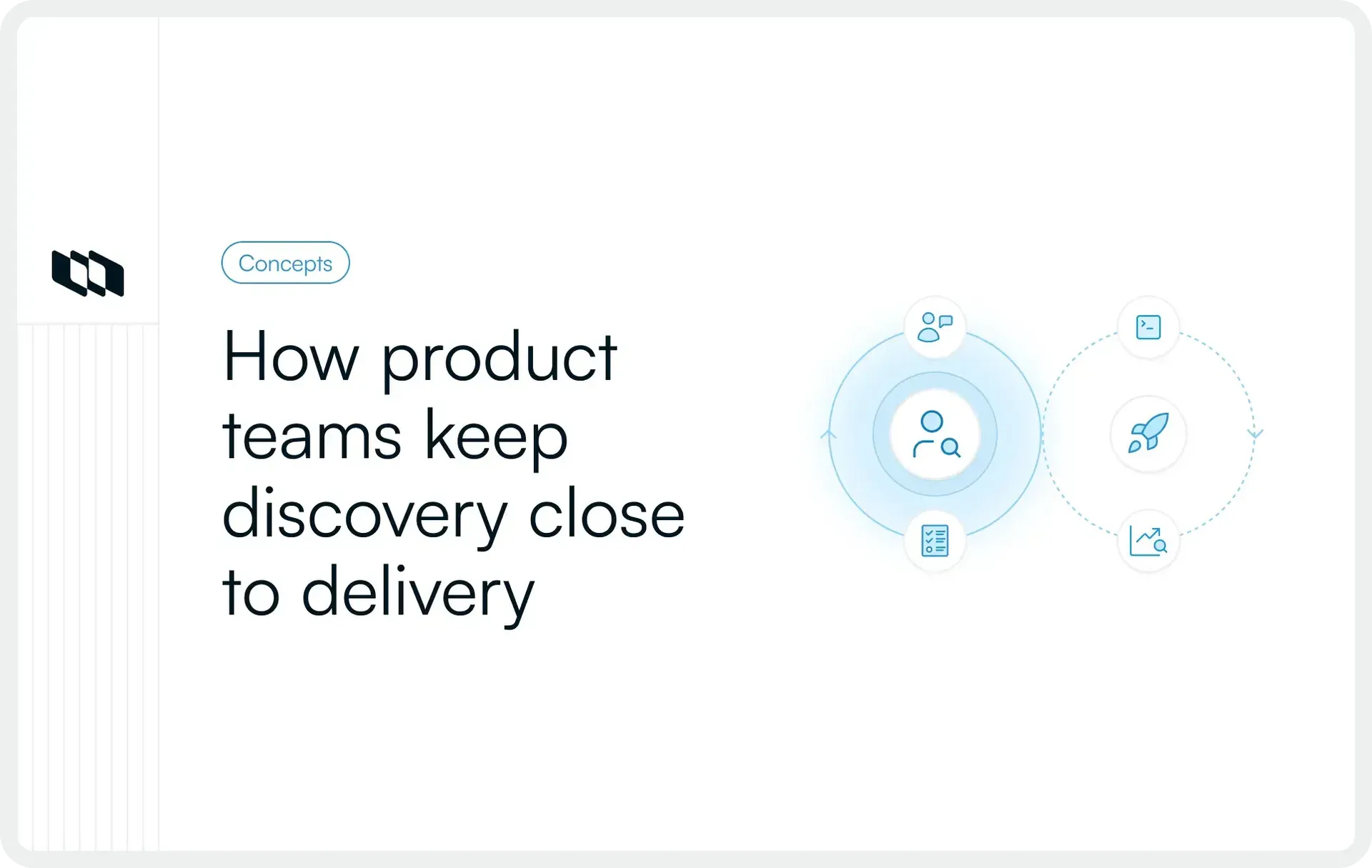
Product teams can spend weeks developing a feature only to discover that customers had a different problem in mind. By the time feedback arrives, requirements are finalized, development is complete, and changing direction becomes more complicated.
Continuous discovery helps teams address this gap by making customer research, feedback, and experimentation part of everyday product development. It creates regular opportunities to examine assumptions and refine decisions before committing to solutions.
This guide explains how continuous discovery works, its core principles and benefits, and how product teams can incorporate it into their development workflows.
What is continuous discovery?
Continuous discovery is an ongoing product development practice in which teams regularly engage with customers, investigate their needs, and test potential solutions to inform product decisions. It combines customer research, opportunity identification, and experimentation into a recurring process that helps teams understand which problems to solve and how proposed solutions might address them.
For example, a product team receiving repeated requests for advanced search filters might investigate how customers currently find information, where their searches fail, and which tasks require additional effort. These findings can help the team understand whether new filters, better search results, or changes to the information structure would address the problem.
The defining characteristic is continuity. Customer understanding develops through repeated interactions, with new evidence informing decisions as the product evolves.
How is continuous discovery different from traditional product discovery?
Traditional product discovery is often organized around specific research projects, planning periods, or major product decisions. Teams investigate a defined problem, document their findings, and use those findings to guide subsequent development.
Continuous discovery establishes a recurring learning process that operates alongside product delivery. The distinction primarily concerns research frequency, collaboration, and how customer evidence influences everyday decisions.
Comparison factor | Traditional or project-based discovery | Continuous discovery |
Research frequency | Periodic or project-driven | Regular and ongoing |
Timing | Often concentrated around specific initiatives | Integrated throughout product development |
Team involvement | May involve dedicated research or product teams | Typically shared across a cross-functional product trio |
Decision-making | Informed by findings from defined research periods | Incorporates continuously updated evidence |
Customer feedback | Collected around specific research questions | Gathered as product questions evolve |
Primary output | Research findings and recommendations | Ongoing learning that informs product decisions |
The comparison of continuous discovery vs. traditional product discovery also depends on the scope of the research.
A project-based study might investigate why customers abandon a particular workflow. Continuous discovery allows the team to revisit that problem while evaluating solutions, releasing improvements, and observing subsequent customer behavior.
Both approaches serve useful purposes. Formal research projects are valuable when entering unfamiliar markets, investigating complex customer behaviors, or making strategic decisions that require extensive evidence. Continuous discovery complements these efforts by maintaining regular customer engagement between larger research initiatives.
Why is continuous discovery important for product teams?
Product teams regularly make decisions with incomplete information. They must evaluate competing customer needs, estimate the value of proposed features, and commit engineering capacity before knowing exactly how users will respond.
Continuous product discovery helps teams manage this uncertainty by bringing customer evidence into product decisions more frequently.
1. Builds a deeper understanding of customer needs
Regular customer conversations reveal the circumstances surrounding user problems, including what customers are trying to accomplish, where they encounter difficulties, and how they currently work around those difficulties.
These interactions also help teams recognize changes in customer expectations that may not be visible through occasional research or feature requests.
2. Reduces the risk of building the wrong solutions
Every proposed feature involves assumptions about customer demand, usability, and technical feasibility.
Testing those assumptions early gives teams opportunities to identify weaknesses before committing substantial development effort. A prototype test, for example, may show that users struggle with a proposed interaction, allowing the team to revise the design before implementation.
3. Improves product prioritization
Product backlogs often contain requests from customers, stakeholders, sales teams, and internal departments. Each request may appear important when considered independently.
Discovery findings provide additional context about the problems behind those requests, helping teams evaluate opportunities according to customer needs, supporting evidence, and product objectives.
4. Strengthens cross-functional collaboration
Shared participation in discovery gives product managers, designers, and engineers a common understanding of the problems they are trying to solve.
Engineers can identify technical constraints early, designers can investigate interaction challenges, and product managers can assess how potential solutions relate to broader product goals.
5. Creates faster feedback and learning cycles
Smaller research activities make it possible to investigate focused questions without organizing a separate research project for every decision.
Teams can evaluate assumptions through interviews, prototypes, and experiments, then incorporate the findings into their next decisions. This makes learning more responsive to the questions arising during development.
6. Supports continuous product improvement
Customer needs continue evolving after launch. New user segments, changing workflows, and additional capabilities can introduce challenges that were absent during initial development.
Ongoing discovery helps teams identify these changes and investigate opportunities to improve usability, adoption, engagement, and other product outcomes.
What are the core principles of continuous discovery?
Effective continuous discovery depends on consistent research practices, shared ownership, and a clear connection between customer problems and product goals.
The following six principles provide a foundation for establishing sustainable continuous discovery habits.
1. Focus on outcomes rather than outputs
Product outcomes describe the customer behaviors or business results a team wants to influence. Outputs are the features, improvements, or other deliverables created to achieve those results.
For example, increasing the percentage of users who successfully complete onboarding is an outcome. Building an onboarding checklist is one possible output.
Starting with an outcome gives teams room to investigate different opportunities and compare potential solutions before making implementation commitments.
2. Maintain regular customer touchpoints
Recurring customer interactions help teams understand experiences, behaviors, and challenges as they emerge.
These touchpoints might involve interviews, observation sessions, or conversations about recent product experiences. Establishing a sustainable cadence helps ensure that discovery remains connected to current customer needs.
3. Involve a cross-functional product trio
A product trio typically includes a product manager, designer, and engineer who collaborate on discovery decisions.
Each role contributes a different perspective:
- Product manager: Connects customer opportunities to product objectives and business priorities.
- Designer: Investigates user experiences, interaction problems, and potential design approaches.
- Engineer: Evaluates technical possibilities, implementation constraints, and feasibility assumptions.
The trio shares responsibility for exploring opportunities and evaluating potential solutions. Dedicated researchers may also contribute expertise in research design, participant recruitment, and analysis.
4. Understand opportunities before proposing solutions
Customer requests often describe specific features, while the underlying needs may be broader.
For example, a request for automated reminders could indicate difficulty tracking deadlines, unclear task ownership, or limited visibility into pending work.
Investigating the actual problem allows teams to consider different approaches and understand which solution would be most relevant.
5. Test assumptions through small experiments
Proposed solutions depend on assumptions about customer value, usability, implementation feasibility, and business viability.
Focused experiments help teams investigate these uncertainties before making larger development commitments. The objective is to gather enough relevant evidence to support the next decision.
6. Treat discovery as a continuous learning process
Customer research produces evidence based on the experiences and conditions observed at a particular time.
As products change and new information becomes available, teams may need to revisit earlier conclusions. Maintaining a learning mindset helps them adapt priorities and refine their understanding without treating previous decisions as permanent.
How do you implement continuous discovery step by step?
A practical continuous discovery framework organizes research, opportunity identification, experimentation, and decision-making into a repeatable workflow.
Teams exploring how to implement continuous discovery can use the following seven steps, adapting the activities to their product maturity, research capacity, and development process.
Step 1. Define a clear product outcome
Begin by identifying the customer behavior or business result the team wants to improve.
A useful outcome should be measurable, relevant to the product's objectives, and specific enough to guide research decisions.
For example, a product team might want to increase the percentage of new users who invite a teammate during their first week.
Establish four details before beginning discovery:
- Desired outcome: What customer behavior should change?
- Baseline: How is the product currently performing?
- Measurement: Which metric will indicate progress?
- Timeframe: When will the team evaluate the results?
These details help teams prioritize research questions and assess which customer opportunities are relevant.
Step 2. Establish the product trio and discovery cadence
Define who will organize customer conversations, participate in research, review findings, and make decisions about potential solutions.
The team should establish a manageable routine for discovery activities, such as:
- Weekly customer conversations.
- Regular reviews of research findings.
- Focused experiments when important uncertainties arise.
- Periodic discussions about how discovery affects product priorities.
A consistent schedule helps teams maintain research activities alongside development commitments.
Step 3. Conduct regular customer research
Research should investigate customers' actual experiences, including the situations in which problems occur and the actions customers take to address them.
Recruit participants relevant to the selected product outcome. Depending on the problem, this might include active users, customers who abandoned a workflow, or people who required additional assistance.
During interviews, focus on specific experiences.
For example, asking someone to describe their most recent attempt to complete a task can reveal contextual details that general questions about preferences might overlook.
Record customer statements and observed behavior separately from the team's interpretations. This helps preserve the evidence behind subsequent decisions.
Step 4. Identify and organize customer opportunities
Review the research findings to identify recurring needs, obstacles, and desired outcomes.
An opportunity describes a customer problem that the team could potentially address. It should be specific enough to investigate while allowing room for different solutions.
For example:
- Users struggle to determine which project activities require their attention.
- New administrators are uncertain about the permissions required for different roles.
- Team members have difficulty locating the latest project decisions.
Group related opportunities, examine supporting evidence, and evaluate their relevance to the chosen product outcome.
Opportunity mapping can help organize these findings and identify which problems deserve further investigation.
Step 5. Explore and compare potential solutions
Once the team selects a promising opportunity, generate alternative ways to address it.
For a problem involving unclear task ownership, possible approaches might include clearer responsibility indicators, improved assignment workflows, or additional visibility into pending decisions.
An Opportunity Solution Tree can help organize these alternatives by connecting the desired outcome with customer opportunities, potential solutions, and assumptions requiring validation.
Compare options based on customer evidence, expected impact, technical considerations, and remaining uncertainty.
Step 6. Validate assumptions through small experiments
Identify the assumptions most likely to influence the success of each promising solution.
These generally involve four areas:
- Desirability: Will customers find the solution valuable?
- Usability: Can users understand and interact with it successfully?
- Feasibility: Can the team implement it within existing technical constraints?
- Viability: Does the solution make sense for the business?
Select an experiment suited to the uncertainty being investigated, such as a prototype test, usability session, or technical investigation.
Define the expected evidence before testing, then evaluate whether the findings support proceeding, revising the approach, or exploring alternatives.
Step 7. Apply discovery insights to product decisions and repeat
Translate the findings into product priorities and implementation requirements.
Document the selected opportunity, supporting evidence, proposed solution, and expected outcome. These details can inform roadmap discussions, backlog refinement, and development planning.
After implementation, assess whether the released change produces the intended customer behavior. Unexpected results or unresolved problems can guide subsequent discovery activities.
What frameworks and techniques are used in continuous discovery?
Different research methods support different stages of continuous discovery. Some help teams understand customer experiences, while others identify behavioral patterns, organize opportunities, or evaluate potential solutions.
Selecting a method depends on the question the team needs to answer and the evidence required to make the next decision.
1. Customer interviews and feedback analysis
Qualitative research provides context about customer needs, motivations, and experiences.
- Customer interviews: Explore how users approach tasks, encounter problems, and make decisions.
- Feedback analysis: Examine support conversations, feature requests, and customer reports to identify recurring concerns.
- Surveys: Investigate specific questions or patterns across a broader customer group.
These methods are particularly useful when teams need to understand the circumstances behind customer behavior.
2. Product analytics and behavioral research
Behavioral research helps teams examine what users do within a product and identify areas requiring investigation.
- Funnel analysis: Reveals stages where users abandon workflows or fail to complete actions.
- Product usage metrics: Show how customers adopt and interact with existing features.
- Session recordings: Provide observations of user navigation and interactions, subject to appropriate privacy and consent practices.
Combining behavioral evidence with qualitative research can help teams investigate both where problems occur and why customers experience them.
3. Opportunity mapping frameworks
Opportunity mapping provides structure for organizing customer evidence and connecting it to product objectives.
Opportunity Solution Tree
An Opportunity Solution Tree organizes discovery into four connected levels:
- Desired outcome: The measurable result the team wants to influence.
- Opportunities: Customer needs, pain points, and desires associated with that outcome.
- Solutions: Potential approaches for addressing selected opportunities.
- Assumption tests: Activities that evaluate uncertainties associated with proposed solutions.
The framework makes it easier to examine different paths toward an outcome and maintain a visible connection between research findings and potential solutions.
Experience mapping
Experience maps represent the stages, actions, and difficulties within a customer journey or workflow.
They help teams understand where friction occurs and how individual problems relate to the broader customer experience.
4. Assumption testing and experimentation
Experiments help teams gather evidence about the potential effectiveness of proposed solutions.
Method or technique | Primary purpose | When to use it |
Customer interviews | Understand customer needs and experiences | Investigating problems and opportunities |
Feedback analysis | Identify recurring requests and difficulties | Reviewing existing customer evidence |
Funnel analysis | Locate workflow abandonment or completion problems | Examining product behavior |
Experience mapping | Understand customer journeys and friction points | Investigating multi-step experiences |
Opportunity Solution Tree | Connect outcomes, opportunities, solutions, and tests | Organizing discovery decisions |
Prototype testing | Evaluate assumptions about proposed interactions | Before committing to implementation |
Usability testing | Assess whether users can complete intended tasks | Evaluating interfaces and workflows |
Technical research spike | Investigate implementation feasibility | When technical uncertainty affects a solution |
Teams can combine these methods as needed. The priority is selecting techniques that provide useful evidence for the decision being considered.
What does continuous discovery look like in practice?
Consider a hypothetical B2B SaaS company whose product team wants to improve new-user activation.
The product allows customers to create workspaces, invite colleagues, and organize projects. The team observes that some users begin setting up their workspace but leave before completing the process.
This scenario illustrates how customer evidence can guide product decisions.
Discovery stage | Illustrative team activity |
Desired outcome | Improve the percentage of users completing initial workspace setup |
Customer research | Interview users who completed, abandoned, or needed assistance during setup |
Opportunity identification | Investigate whether unclear instructions or configuration uncertainty contribute to abandonment |
Solution exploration | Compare guided setup, contextual instructions, and simplified configuration steps |
Assumption testing | Observe users completing setup tasks with different prototypes |
Product decision | Select an approach supported by the findings and measure its effect after release |
Suppose interviews suggest that users understand the purpose of creating a workspace but hesitate when configuring permissions.
This finding gives the team a more specific problem to investigate. A broad onboarding tutorial might have limited value if customers primarily struggle with understanding which permissions to assign.
The team could compare contextual explanations, recommended configurations, and a redesigned permissions interface.
Prototype testing would provide evidence about which approach customers understand, while engineering input would help evaluate technical and security considerations.
After releasing an improvement, the team would examine setup completion and related feedback to determine whether the problem had been addressed.
The example illustrates the relationship between customer research, identified opportunities, solution evaluation, and product outcomes. All findings are hypothetical.
How can product teams integrate continuous discovery with product delivery?
Discovery is most useful when its findings influence what teams plan, build, and improve. That requires clear connections between research activities, product priorities, and development workflows.
The following practices help teams maintain those connections.
1. Run discovery and delivery activities in parallel
Discovery helps teams investigate customer problems and evaluate potential solutions, while delivery focuses on implementation, release, and maintenance.
In dual-track agile, these activities operate concurrently. Teams can investigate upcoming opportunities while continuing development on previously selected work.
This allows product learning to inform future commitments without interrupting every ongoing development activity.
2. Connect discovery findings to product priorities
Translate selected opportunities into clear product requirements and implementation decisions.
Each prioritized item should retain the relevant customer problem, supporting evidence, intended outcome, and important assumptions.
This context helps teams understand why work was selected and provides a reference when implementation decisions arise.
3. Maintain shared research and decision documentation
Keep interview findings, opportunity statements, experiment results, and product decisions accessible to relevant team members.
Documentation should make the reasoning behind decisions understandable, particularly when requirements change or new contributors become involved.
A clear record also helps teams revisit assumptions without reconstructing earlier discussions.
4. Establish recurring cross-functional reviews
Use short, recurring discussions to evaluate findings and identify decisions requiring attention.
Reviews can focus on recent customer evidence, unresolved assumptions, changes to priorities, and upcoming validation activities.
Conclude with clear decisions and ownership so that useful findings translate into action.
5. Use delivery outcomes to inform future discovery
Released features provide additional evidence through customer behavior, usage patterns, and feedback.
Review these signals against the intended outcome and investigate unexpected results. This creates a connection between implementation results and the next set of research questions.
What are the common challenges of continuous discovery, and how can teams overcome them?
Establishing continuous discovery requires teams to balance research with development responsibilities, maintain access to relevant customers, and turn findings into decisions.
Six challenges deserve particular attention.
1. Limited access to customers
Challenge: Recruiting relevant research participants regularly can be difficult, particularly when teams serve specialized customer segments.
How to address it: Establish a repeatable recruitment process using opt-in research panels, customer outreach, and coordination with customer-facing teams. Maintain sufficient participant context to ensure research remains relevant to the selected outcome.
2. Insufficient time for discovery
Challenge: Delivery deadlines, planning activities, and operational responsibilities can leave limited capacity for customer research.
How to address it: Reserve recurring discovery time and prioritize focused activities tied to immediate decisions. Smaller interviews and experiments can fit more naturally into existing schedules.
3. Confirmation bias in research
Challenge: Teams may ask leading questions or interpret customer responses in ways that support solutions they already prefer.
How to address it: Use neutral interview questions, investigate specific experiences, and document alternative explanations. Define what evidence would challenge a proposed solution before testing it.
4. Difficulty converting insights into decisions
Challenge: Research findings can accumulate across interview notes, feedback records, and experiment results without producing clear priorities.
How to address it: Organize evidence into opportunity statements, connect those opportunities to product outcomes, and identify which uncertainties affect upcoming decisions.
5. Weak cross-functional participation
Challenge: When one function owns discovery entirely, other contributors may receive requirements without sufficient customer context.
How to address it: Involve relevant product, design, and engineering contributors in research reviews and solution evaluation. Shared participation helps teams consider different constraints while decisions are being formed.
6. Prioritizing feature requests over underlying problems
Challenge: Detailed customer requests can appear ready for development even when the team has limited understanding of the need behind them.
How to address it: Investigate the customer's intended outcome, existing workflow, and specific difficulty. Use that understanding to evaluate possible solutions before making development commitments.
How do you measure the success of continuous discovery?
Measuring continuous discovery requires evaluating whether research happens consistently, whether findings influence decisions, and whether product performance moves toward the intended outcomes.
Teams determining how to measure continuous discovery success should examine three categories of indicators.
1. Discovery activity metrics
Activity metrics show whether the team is maintaining its discovery practice.
Useful indicators include:
- Frequency of customer interactions.
- Number of focused assumption tests.
- Participation across product, design, and engineering.
- Consistency of the established research cadence.
These measures help evaluate research activity and sustainability, although higher activity does not automatically indicate better product decisions.
2. Learning and decision-making metrics
Learning measures examine how research findings influence the team's choices.
Relevant indicators include:
- Important assumptions investigated before development.
- Product decisions supported by customer evidence.
- Opportunities evaluated and prioritized.
- Proposed solutions revised following research or experiments.
These indicators may require qualitative review because the significance of an insight or decision depends on its context.
3. Product outcome metrics
Outcome metrics help teams assess whether the customer behavior associated with their discovery objective is improving.
Examples include:
- Onboarding and activation completion.
- Feature adoption.
- Customer retention and engagement.
- Task completion rates.
- Other customer or business indicators connected to the selected outcome.
Measurement category | Example indicators | What it evaluates |
Discovery activity | Customer interactions, experiments, participation | Consistency of discovery practices |
Learning and decisions | Assumptions tested, evidence-supported decisions, solution revisions | Influence of discovery on product choices |
Product outcomes | Activation, retention, adoption, task completion | Progress toward intended customer outcomes |
The strongest evaluation connects discovery evidence to specific product decisions and examines their subsequent results.
Because product performance depends on several factors, including implementation quality, customer behavior, and market conditions, teams should avoid attributing every improvement exclusively to discovery.
How can Plane help product teams connect discovery insights to execution?
Plane helps product teams organize work that follows discovery, keeping customer context connected to product planning and execution.
Teams can use:
- Intake: Collect and triage incoming requests before accepting relevant items into project workflows.
- Customer Requests: Organize customer-specific needs and connect them to related Work Items.
- Pages: Document research summaries, requirements, assumptions, and product decisions.
- Work Items: Convert selected opportunities into actionable development tasks with clear ownership.
- Cycles, Modules, and Initiatives: Coordinate planned work across development cycles and broader product objectives.
- Project views: Monitor progress, dependencies, and implementation priorities.
Feature availability varies by plan. Plane supports the documentation, planning, and execution aspects of the discovery-to-delivery workflow, while customer interviewing and experimentation remain separate research activities.
Talk to sales to explore how Plane can support your product team's workflow.
Final thoughts
Continuous discovery gives product teams an ongoing way to investigate customer needs and apply the findings to product decisions. By maintaining regular customer engagement, testing important assumptions, and keeping research connected to measurable outcomes, teams can make more informed choices about what to build and improve.
A sustainable practice begins with manageable research activities and clear ownership. As those habits become part of everyday product development, customer understanding can guide prioritization and support continuous improvement.
Frequently asked questions
1. What is the difference between continuous discovery and product discovery?
Product discovery includes the activities teams use to understand customer problems and determine what to build. Continuous discovery is an approach that emphasizes regular customer interactions, ongoing experimentation, and incorporating new evidence into product decisions throughout development.
2. How often should product teams conduct continuous discovery?
Weekly customer interactions are a commonly recommended starting point for continuous discovery. Teams can supplement these conversations with recurring feedback reviews, opportunity mapping, and assumption testing. The appropriate frequency depends on research needs and available capacity.
3. Who is responsible for continuous discovery in a product team?
Continuous discovery is typically shared by a product trio consisting of a product manager, designer, and engineer. They collaborate on research, opportunity evaluation, and solution decisions, with researchers and other contributors providing additional expertise where needed.
4. What is an Opportunity Solution Tree in continuous discovery?
An Opportunity Solution Tree is a visual framework that connects a desired product outcome with customer opportunities, potential solutions, and assumption tests. It helps teams organize research findings and evaluate different ways to achieve product goals.
5. Can small product teams practice continuous discovery?
Yes. Small teams can begin with regular customer conversations, focused research questions, and lightweight experiments. A consistent connection between customer evidence and product decisions is more important than having a large research function.
6. How does continuous discovery fit into agile development?
Continuous discovery supports agile development by investigating customer problems and validating potential solutions alongside ongoing delivery work. Findings can inform backlog refinement, sprint planning, and product prioritization, while released features provide new evidence for subsequent decisions.
7. Does continuous discovery replace traditional user research?
Continuous discovery complements traditional user research by maintaining regular learning between larger studies. Formal research remains valuable for complex investigations, unfamiliar markets, and strategic questions requiring extensive methods or deeper analysis.
Recommended for you



 Download for Mac
 Download for Android
