What is a north star metric? A practical guide
Introduction
Product teams track dozens of metrics, but only a few reveal whether customers are consistently getting value from the product. A north star metric gives teams a shared measure of that value and helps connect product decisions with long-term business outcomes.
A well-defined product north star metric also gives context to supporting product metrics, input metrics, and team goals. This guide explains what a north star metric is, how the north star metric framework works, how to choose one, and which north star metric examples can help you evaluate your own.
What is a north star metric?
A north star metric (NSM) is a measurable indicator of the core value customers repeatedly receive from a product. It gives product teams one shared signal for whether the product is helping users achieve the outcome it was built for.
For example, a collaboration product might track successful team activity, while a marketplace might focus on completed transactions between buyers and sellers.
How does a north star metric connect customer value to business outcomes?
A useful NSM connects three things:
- Customer value: the outcome users are trying to achieve.
- Product behavior: the action or usage pattern that shows they are receiving that value.
- Business outcomes: the longer-term results that can follow from repeated value delivery, such as retention, expansion, or revenue growth.
This connection is what makes the metric useful for product decision-making. Teams can observe whether customers are reaching meaningful value before longer-term financial outcomes appear.
Why is a north star metric considered a leading indicator?
A North Star Metric usually captures behavior that happens earlier in the customer journey than financial results.
For example: Customer receives value → repeats the behavior → stays engaged → contributes to longer-term business performance
This makes the NSM useful as an early signal of product health. The exact relationship still needs to be validated using product and business data rather than assumed.
To understand how product metrics, KPIs, customer-value signals, and North Star Metrics work together, see our guide to product metrics that matter.
Where does the north star metric fit among other product metrics?
The North Star sits at the top of a broader measurement system.
Teams typically track:
- North Star Metric: the primary measure of recurring customer value.
- Input metrics: the behaviors or conditions that influence the North Star.
- Product KPIs: measures of performance across areas such as adoption, retention, reliability, or conversion.
- Team-level metrics: measures individual teams can directly influence through their work.
This structure helps teams understand both the outcome they are trying to improve and the factors that contribute to it.
How is a north star metric different from a company vision or business objective?
These concepts operate at different levels:
- Company vision: describes the long-term direction the organization wants to pursue.
- Business objective: defines a specific result the organization wants to achieve.
- North Star Metric: measures whether the product is consistently delivering the customer value that supports those broader goals.
A strong NSM turns an abstract direction into something teams can observe, measure, and connect to product decisions.
For a deeper look at how vision, goals, strategy, and execution connect, read our guide to product strategy.
Why is a north star metric important?
A north star metric gives teams a common way to judge whether the product is creating more of the value customers came for. That shared reference point becomes especially useful as a company grows and different functions begin working against their own goals, roadmaps, and product KPIs.
1. Creates shared focus
Product, engineering, growth, marketing, and leadership naturally look at performance through different metrics. A North Star gives those teams a common outcome to work toward while allowing each function to retain the metrics it needs to manage its own work.
2. Keeps product decisions tied to customer value
Feature adoption, clicks, sign-ups, and usage volume can all be useful product metrics, but movement in those numbers does not automatically mean customers are receiving more value.
A well-defined North Star keeps the customer's desired outcome visible when teams evaluate new features, experiments, and product changes.
3. Improves prioritization
Teams rarely have enough capacity to pursue every promising idea. The North Star adds a consistent question to prioritization discussions: Which initiative is most likely to improve a meaningful driver of the outcome we care about?
This gives teams a stronger basis for comparing roadmap items alongside factors such as customer demand, strategic importance, effort, risk, and dependencies.
4. Connects strategy with execution
Strategy becomes easier to act on when teams can trace it to measurable outcomes. The north star metric framework creates that connection by breaking the headline metric into input metrics that individual teams can influence.
For example, one team may focus on activation while another works on repeated usage or workflow completion. Their immediate measures differ, but each can be connected back to the same broader product outcome.
5. Reduces local optimization
Individual metrics can improve while the overall customer experience remains unchanged or even deteriorates. A growth team might increase account creation, for example, while activation or sustained usage stays flat.
A shared North Star gives teams a broader reference point for evaluating these gains. Supporting metrics still matter, but their movement can be assessed in the context of the value the product is expected to deliver.
6. Provides an earlier signal of long-term performance
Many business outcomes take time to become visible. Revenue, renewal, and expansion often reflect customer behavior that developed over weeks or months.
A carefully chosen North Star can surface meaningful changes earlier by tracking the recurring behavior associated with receiving product value. Teams still need to validate that relationship with their own data, since a metric only works as a useful leading indicator when evidence shows that it connects to longer-term outcomes.
What makes a good north star metric?
A good north star metric should tell teams whether customers are receiving more of the product's core value while remaining useful enough to guide product decisions. The exact metric will differ by business model, but several criteria help distinguish a meaningful North Star from another number on a dashboard.
1. It reflects customer value
The metric should move when customers achieve an outcome they care about.
For example, total account creation tells a SaaS company how many people entered the product. A measure of customers successfully completing the product's core workflow says more about whether those customers actually received value.
A useful test is: If this metric improves, can we reasonably say customers are getting more value from the product?
If you want to go deeper into identifying the outcomes customers actually care about, our guide to the Jobs-to-be-Done framework explains how teams connect customer needs with desired outcomes.
2. It has a clear connection to business outcomes
Customer value and business performance should have a credible relationship. Repeatedly delivering meaningful value can contribute to outcomes such as retention, expansion, referrals, or monetization, depending on the product and business model.
Teams should validate that relationship with their own data rather than assuming that higher engagement automatically produces stronger business results.
3. Teams can influence its drivers
A North Star needs to be actionable enough to shape decisions.
Teams may not control the headline number directly, but they should be able to identify input metrics they can influence through onboarding improvements, product changes, reliability work, experiments, or other initiatives.
If nobody can explain what could cause the metric to move, it offers limited value for day-to-day product management.
4. It can be measured consistently
Everyone should be working from the same definition.
That means specifying:
- What event or outcome counts
- Which users, accounts, or transactions are included
- The measurement period
- Relevant exclusions
- The source of the underlying data
Reliable measurement also depends on having the analytics infrastructure needed to collect and interpret the data consistently.
5. It is easy to understand
People across product, engineering, marketing, customer success, and leadership should be able to explain what the metric measures and why it matters.
A complicated formula may be analytically sophisticated, but complexity makes the metric harder to use as a shared decision-making tool.
6. It moves frequently enough to guide decisions
Teams need enough feedback to see whether meaningful changes in customer behavior are occurring.
A metric that only becomes informative once or twice a year provides little feedback for product teams running experiments or evaluating initiatives. The appropriate measurement frequency will depend on how often customers naturally use and receive value from the product.
7. It remains relevant as the product evolves
A strong product north star metric should represent an enduring part of the product's value proposition.
Features, campaigns, and quarterly priorities can change frequently. The North Star should remain useful across those changes unless the underlying customer value, product strategy, or business model changes materially.
8. It is difficult to improve without creating real value
Teams should examine whether the metric can rise while the customer experience stays flat or deteriorates.
For example, increasing notifications might raise session frequency while frustrating users. Looking at the North Star alongside appropriate guardrail and product KPIs helps teams detect this kind of unhealthy optimization.
A practical way to evaluate a candidate metric is to ask three questions:
- Does an increase represent more customer value?
- Can teams explain and influence the drivers behind it?
- Does evidence connect it to outcomes the business cares about?
A candidate that performs well across all three is much closer to a useful North Star than a metric chosen simply because it is easy to track.
Can revenue be a north star metric?
Revenue is usually a weak north star metric because it is a lagging outcome. It shows what the business earned, but not whether customers are receiving more value from the product.
A revenue-based North Star can make sense when the transaction itself closely represents customer value, such as in marketplaces, payments, or commerce.
In most cases, revenue should sit alongside the North Star:
- North Star Metric: measures recurring customer value.
- Revenue metrics: track monetization and business performance.
- Input metrics: show what drives the North Star.
- Guardrail metrics: flag unhealthy trade-offs.
The key test is simple: Does higher revenue reliably mean customers are receiving more value? If not, revenue should remain a supporting business metric.
How does the north star metric framework work?
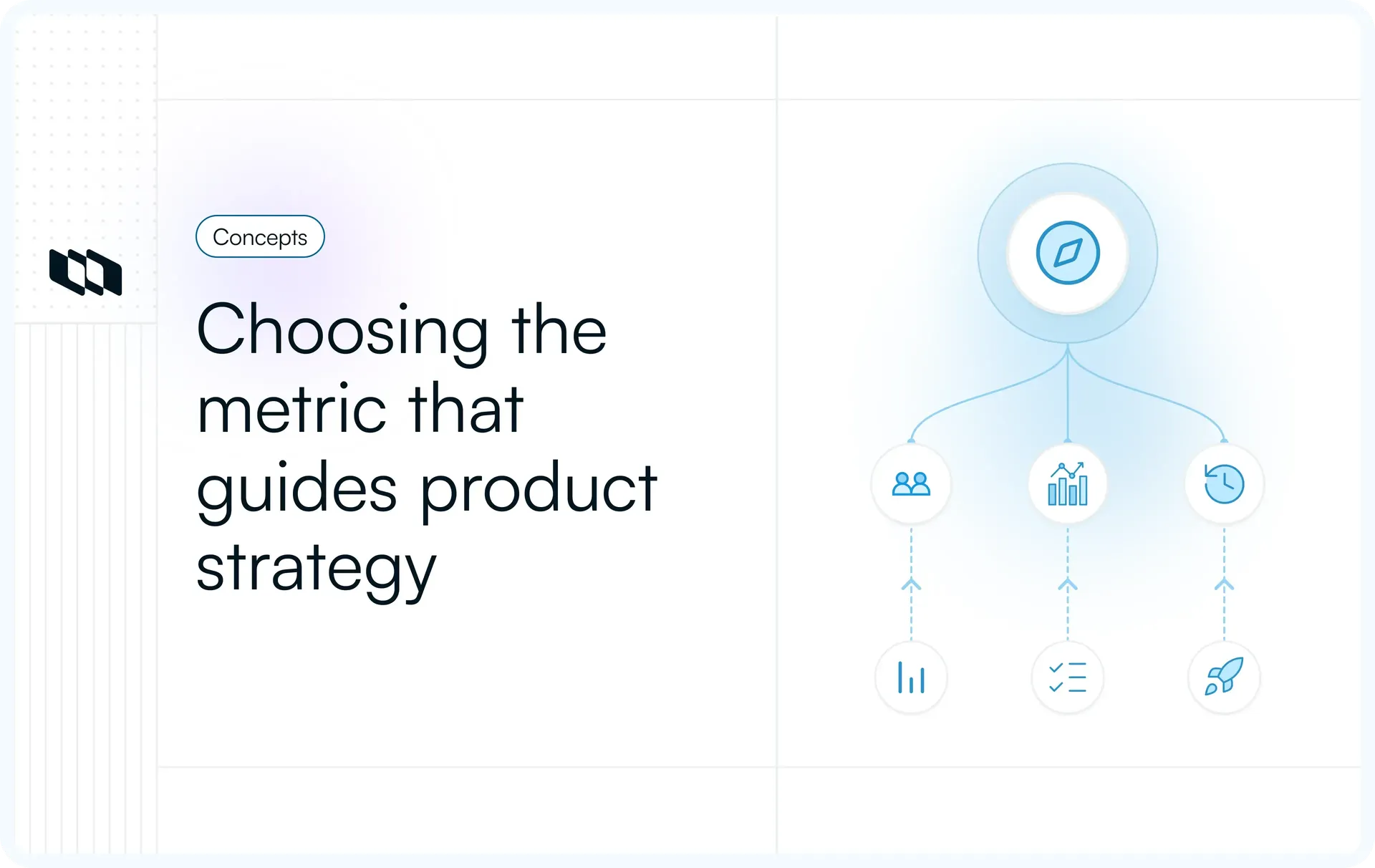
The north star metric framework turns a high-level product outcome into measurable drivers that teams can influence through their work.
A simple structure looks like this:
Customer value → North Star Metric → input metrics → team goals → initiatives and experiments
North Star Metric
The North Star Metric is the top-level measure of the value customers repeatedly receive from the product. It gives teams a shared outcome to work toward, but it is usually too broad to manage directly on a day-to-day basis.
Input metrics
Input metrics are the behaviors or conditions that contribute to movement in the North Star.
For example, if the North Star is weekly teams completing a core workflow, relevant inputs might include:
- Teams reaching activation
- Active users per team
- Core workflows started
- Core workflows successfully completed
These metrics help teams understand what is driving the headline number and where improvements are needed.
Guardrail metrics
Guardrail metrics help teams make sure progress in one area is not creating problems elsewhere.
Depending on the product, guardrails might include:
- Retention or churn
- Reliability
- Customer satisfaction
- Profitability
- Product quality
For example, a change might increase workflow completion while also increasing errors or support requests. Guardrails help teams catch those trade-offs early.
Team-level metrics and goals
Different teams can own different drivers beneath the same North Star.
For example:
- Growth: improve activation
- Product: increase successful workflow completion
- Engineering: improve reliability around the core workflow
- Customer success: increase adoption across customer accounts
This gives each team a measurable contribution while keeping their work connected to the same product outcome.
Initiatives and experiments
The final layer is the work teams do to improve those metrics.
That can include:
- Redesigning onboarding
- Removing friction from a workflow
- Improving reliability
- Testing a product experiment
- Improving feature discovery
- Running a targeted adoption campaign
The framework helps teams connect everyday work back to customer value, while still giving them specific metrics they can act on.
What are some examples of north star metrics?
The right north star metric depends on what customers use the product to accomplish. Two products in the same category can choose different metrics if their core customer value differs.
Business or product type | Core customer value | Possible North Star Metric | Why it works |
B2B SaaS | Customers repeatedly complete the workflow they adopted the product for | Weekly active accounts completing the core workflow | Measures recurring value at the account level rather than simple logins |
Project management software | Teams successfully plan and complete meaningful work | Weekly teams completing planned work | Connects product usage with the outcome teams use the software to achieve |
Collaboration tools | People work together successfully and repeatedly | Weekly teams completing collaborative actions | Captures active collaboration rather than individual account activity |
These are illustrative north star metric examples. The exact definition should reflect the product's value model, customer behavior, and business context.
Examples of north star metrics from real companies
Company examples need careful qualification because metrics change as products and strategies evolve. Many examples repeated online are historical or commonly cited rather than current, company-confirmed North Stars.
A few publicly documented examples include:
Company or product | North Star Metric | What it measures |
Atlassian Rovo Search | Query Success Rate | Whether a search interaction successfully helps a user find what they need |
Jira Product Discovery team | Annual revenue target | Progress toward a defined business outcome for the product |
LogMeIn | Remote control sessions | Customers reaching the product's core remote-access experience |
The examples also show why there is no universal formula for how to define a north star metric. One product may measure a completed customer outcome, another may measure repeated usage of its core capability, while another may choose a commercial outcome when that best fits its strategy.
The useful question is always the same: Which measurable outcome best represents the value this product is trying to create and the progress the team needs to influence?
How do you choose a north star metric?
Choosing a north star metric starts with understanding how customers receive value from the product. The goal is to identify a metric that reflects that value, connects to long-term business performance, and gives teams something they can influence through their work.
Step 1: Define the core customer value
Start with the outcome customers expect from the product.
Ask:
- What problem are they trying to solve?
- What does successful product usage help them accomplish?
- What outcome would make them keep using the product?
For a project management tool, for example, the value may come from helping teams plan, coordinate, and complete work more effectively.
Step 2: Identify the customer's value moment
Look for the behavior or outcome that shows the customer has actually received that value.
This should be more meaningful than surface-level activity such as:
- Logging in
- Opening a page
- Creating an account
- Clicking a feature
A stronger signal is usually tied to completing a meaningful workflow or reaching a useful outcome.
Step 3: Generate several candidate metrics
Do not settle on the first metric that seems plausible.
Create a shortlist of possible North Star Metrics and compare them. This helps prevent teams from choosing a metric simply because it is already easy to track.
Step 4: Evaluate each candidate
Test every candidate against the same criteria:
- Customer value: does it represent a meaningful outcome for users?
- Business relevance: does it have a credible connection to long-term performance?
- Actionability: can teams influence its drivers?
- Measurability: can it be tracked reliably?
- Simplicity: can people across teams understand it?
- Frequency: does it move often enough to support learning?
- Resistance to gaming: can it improve without creating more customer value?
Step 5: Validate it against long-term outcomes
A candidate should be tested against outcomes such as:
- Retention
- Repeat usage
- Expansion
- Revenue
- Renewal
Look for evidence that customers who perform the behavior represented by the metric are also more likely to remain successful over time.
Step 6: Define the metric precisely
Once you have a strong candidate, document exactly how it is calculated.
Specify:
- What is being measured
- Which users or accounts are included
- What behavior qualifies
- The measurement period
- Any exclusions
- The underlying data source
A vague definition creates inconsistent reporting and makes the metric harder to trust.
Step 7: Identify input and guardrail metrics
Break the North Star into input metrics that teams can influence directly.
Then add guardrails that help detect negative trade-offs. Depending on the product, these might cover retention, reliability, quality, cost, or customer satisfaction.
Step 8: Align the teams responsible for moving it
The final step is making sure the metric works across the organization.
Product, engineering, growth, marketing, customer success, and leadership should understand:
- What the metric represents
- Why it matters
- Which inputs they influence
- How their goals connect to it
A North Star becomes useful when teams can trace their work back to the customer outcome the metric represents.
How do you turn a north star metric into day-to-day work?
A north star metric becomes useful when teams can connect it to the work they plan, prioritize, and ship.
1. Break the North Star into input metrics
Identify the smaller behaviors or conditions that influence the North Star.
For example, if the North Star is weekly teams completing a core workflow, input metrics might include:
- Teams reaching activation
- Workflows started
- Workflows completed
- Active users per team
These give teams more specific levers to work on.
2. Assign clear ownership
Each important input metric should have a team or function responsible for improving it.
Ownership should also cover relevant guardrail metrics so that teams can see whether progress is creating trade-offs elsewhere.
3. Connect team goals to the right input metric
Team goals should explain which part of the north star metric framework they are expected to influence.
For example:
- Growth may focus on activation.
- Product may focus on workflow completion.
- Engineering may focus on reliability that affects successful completion.
- Customer success may focus on account adoption.
4. Define the expected impact before starting major work
Before committing to a significant initiative, teams should state:
- Which input metric the work is expected to affect
- Why they expect it to move
- How success will be measured
- Which guardrails need to remain healthy
This makes it easier to evaluate the initiative after launch.
5. Use the framework during prioritization
When comparing roadmap items, consider how strongly each initiative connects to an important driver of the North Star.
The metric should inform prioritization alongside customer needs, strategic importance, effort, risk, and dependencies.
6. Review the North Star and its drivers together
Tracking only the headline metric makes it difficult to understand why it changed.
During planning and performance reviews, look at:
- Movement in the North Star
- Changes in key input metrics
- Guardrail performance
- Initiatives shipped during the period
- Evidence linking those initiatives to the observed outcome
7. Learn from shipped work
Experiments and product releases help teams test whether their assumptions about the metric are correct.
If an initiative improves an input metric but the North Star does not move, the relationship may be weaker than expected. That is useful evidence. Teams can refine the metric tree, reconsider the input, or change where they invest next.
The goal is to create a clear line between strategy, measurable drivers, team goals, and the work happening every day.
What are the common north star metric mistakes?
Most North Star Metric problems come from choosing the wrong signal or using the metric without enough context. Five mistakes matter most.
1. Choosing a vanity metric
Metrics such as total registrations, downloads, page views, or raw session counts can grow without showing whether customers are receiving meaningful value.
A stronger North Star should reflect an outcome or behavior tied to successful product usage.
2. Measuring activity instead of customer value
High activity does not always mean high value.
For example, more clicks, sessions, or messages may indicate increased usage, but they do not necessarily show that users achieved what they came to the product for. The metric should represent a meaningful customer outcome rather than volume alone.
3. Selecting a metric teams cannot influence
A North Star loses practical value when teams cannot identify the behaviors or input metrics that drive it.
If the metric moves for reasons largely outside the team's control, it becomes difficult to use for prioritization, experimentation, or product decisions.
4. Tracking the North Star without input and guardrail metrics
The headline metric tells teams whether the outcome changed. It does not explain why.
Input metrics help identify the drivers behind that movement, while guardrail metrics show whether improvement is creating problems elsewhere. Tracking all three gives teams a more complete view of product performance.
5. Copying another company's North Star
A metric that works for one company may be irrelevant for another.
The right product north star metric depends on the product's value proposition, customer behavior, business model, and growth mechanics. Teams should define and validate their own metric instead of adopting a popular example without evidence.
Can a company have more than one north star metric?
Yes, but most companies are better served by one primary north star metric for each clearly defined product or value exchange. The purpose of the metric is to create focus, so too many North Stars can weaken that clarity.
Multiple North Star Metrics may make sense when a company has:
- Distinct products with different customer outcomes
- Customer segments with fundamentally different value exchanges
- A multi-sided platform serving different participant groups
- Independent business units with separate products and strategies
When multiple product-level North Stars exist, they should still support a coherent company-level direction.
The practical rule is simple: use more than one North Star only when the underlying customer value is genuinely different. Avoid creating separate North Stars for every team, feature, or department.
When should you change your north star metric?
A north star metric should stay relatively stable so teams can build alignment around it and compare progress over time. It should not change every quarter or planning cycle.
Revisit the metric when:
- The product’s core value proposition changes.
- The business model changes materially.
- The company expands into fundamentally different products.
- Customer behavior shifts in a meaningful way.
- The metric no longer correlates with important customer or business outcomes.
- Teams can improve the metric without creating additional customer value.
There is an important difference between reviewing and replacing the metric. Teams should review the North Star regularly to confirm that it still reflects customer value and business progress. Replacing it should happen only when there is clear evidence that the existing metric no longer serves that purpose.
Wrapping up
A useful north star metric gives teams a shared way to measure whether the product is delivering meaningful customer value over time. It works best when it is specific, measurable, connected to long-term business outcomes, and supported by clear input and guardrail metrics.
The real value of a North Star comes from how teams use it. When product, engineering, growth, and customer-facing teams can connect their goals and initiatives back to the same outcome, prioritization becomes clearer and progress becomes easier to evaluate. The metric should stay stable enough to guide long-term decisions, while still being reviewed as the product, customer behavior, and business model evolve.
Frequently asked questions
Q1. What do North Star metrics mean?
A North Star Metric is the primary metric a company or product team uses to measure the recurring value customers receive from a product. It helps teams align around one meaningful outcome while supporting metrics explain what is driving progress toward it.
Q2. What is the difference between North Star Metrics and KPIs?
A North Star Metric represents the core customer value a product delivers over the long term, while KPIs measure performance across specific areas such as activation, retention, revenue, reliability, or conversion. A company will usually track many KPIs, while its North Star provides a higher-level measure that helps connect those metrics to a shared product outcome.
Q3. What are examples of North Star metrics?
Examples of North Star Metrics depend on the product and the value customers receive. A B2B SaaS product might track weekly active accounts completing a core workflow, a project management platform might track teams completing planned work, and a collaboration tool might measure teams completing meaningful collaborative actions.
Q4. What makes a good north star metric?
A good North Star Metric reflects real customer value, has a credible connection to long-term business outcomes, and can be influenced through product and team decisions. It should also be measurable, easy to understand, difficult to game, and stable enough to guide decisions over time.
Q5. Can a company have more than one north star metric?
Yes, a company can have more than one North Star Metric when it has distinct products, customer segments, business units, or value exchanges. However, each North Star should represent a clearly different customer outcome, and the overall set of metrics should still support a coherent company-level direction.
Recommended for you



 Download for Mac
 Download for Android