Introduction
Every team makes decisions daily, from prioritizing features to allocating resources to choosing the right technical approach. The sheer volume of these choices makes decision-making feel routine, but the quality of those decisions determines whether a team moves fast with confidence or gets stuck in endless debate and second-guessing.
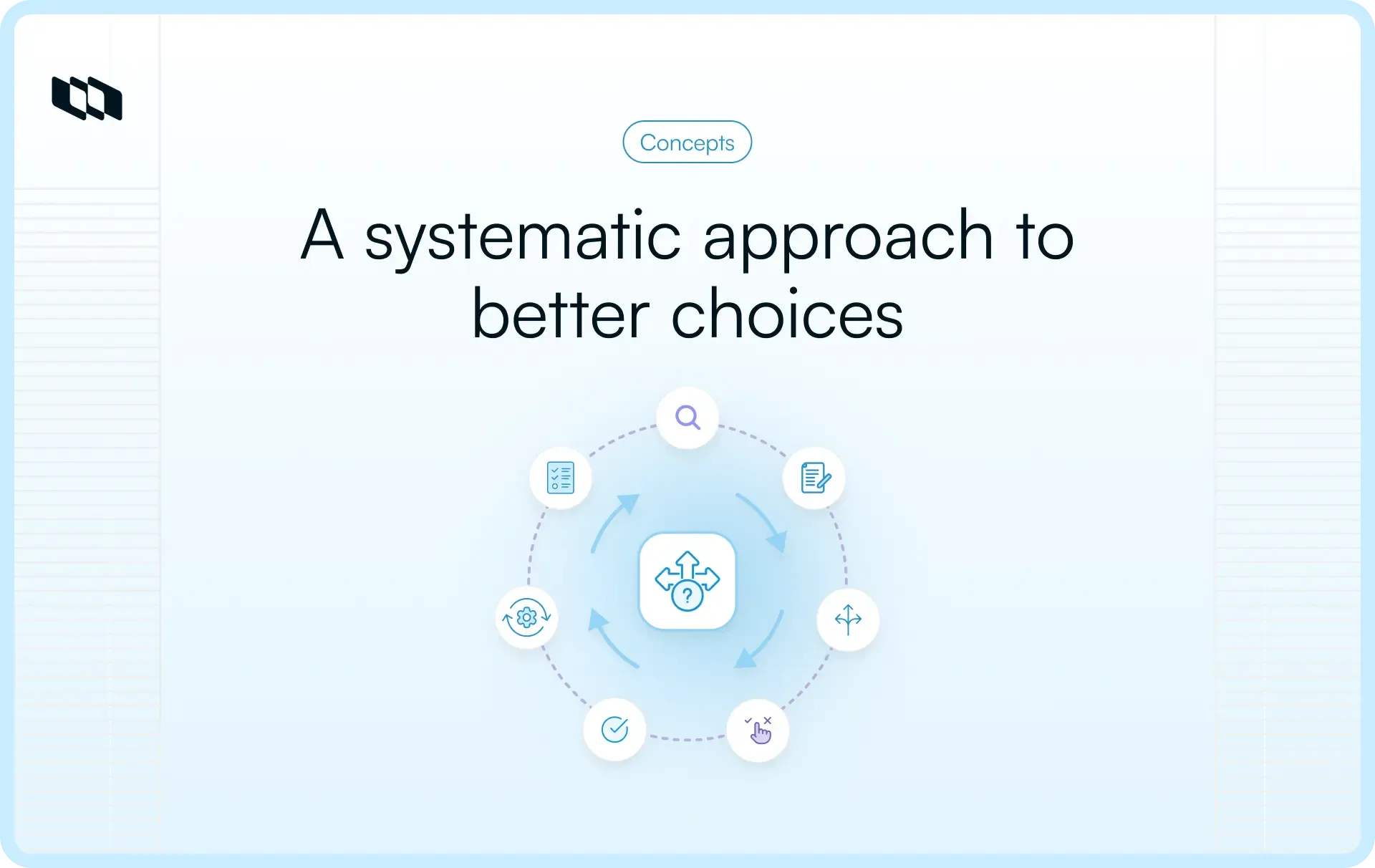
Effective teams rely on a structured decision-making process to evaluate options clearly, reduce risk, and consistently reach better outcomes. This article covers what the decision-making process is, the steps involved in executing it well, popular decision-making models used by product and engineering teams, and practical tips to sharpen your team's decision-making at work.
What is the decision-making process?
The decision-making process is a structured approach used to identify a problem or opportunity, analyze available options, and select the most suitable course of action. It brings clarity to complex situations by breaking decisions into manageable steps and ensuring that choices are based on relevant information rather than assumptions.
In project environments, this process helps teams move from discussion to clear outcomes, especially when multiple stakeholders and trade-offs are involved.
Why the decision-making process matters
A well-defined decision-making process improves how teams think, collaborate, and execute. It creates a shared understanding of how decisions are made and ensures that choices are consistent across projects.
Teams that follow a structured approach to decision-making in project management experience several benefits.
- Better alignment across stakeholders: When teams follow a common process, everyone understands how decisions are evaluated and why a specific direction is chosen.
- Reduced uncertainty and risk: Decisions are based on data, context, and clearly defined criteria, which reduces guesswork.
- Faster execution after decisions: Clear decisions remove ambiguity, allowing teams to move quickly into implementation.
- More transparent reasoning: Documented decisions make it easier to explain trade-offs, revisit assumptions, and improve future decisions.
Decision-making vs. problem-solving
Decision-making and problem-solving are closely related, but they serve different purposes.
- Problem-solving focuses on identifying and developing possible solutions to a specific issue. It explores what can be done.
- Decision-making focuses on selecting the best option from the available alternatives. It determines what should be done next.
In practice, teams often use problem-solving to generate options and the decision-making process to evaluate and choose the most effective path forward.
Key elements of an effective decision-making process
Before teams apply the steps in a decision-making process, a few foundational elements shape how effective those decisions will be. Without these, even well-structured decision-making models or techniques fail to produce reliable outcomes.
1. A clearly defined problem or objective
Every decision starts with clarity on what needs to be addressed. Teams that define the problem precisely avoid misalignment later in the process. A well-defined objective ensures that discussions stay focused and that all alternatives are evaluated against the same goal.
2. Relevant information and data
Strong decisions rely on accurate and relevant inputs. Teams need access to data, past insights, and contextual information that reflect the current situation. In project management decision-making, this often includes timelines, resource availability, technical constraints, and stakeholder expectations.
3. Multiple possible alternatives
High-quality decisions come from comparing multiple viable options. When teams consider only one or two paths, they limit their ability to evaluate trade-offs effectively. Generating alternatives encourages broader thinking and helps teams identify better approaches that may not be obvious at first.
4. Decision criteria
Decision criteria define how options will be evaluated. Without clear criteria, teams rely on subjective opinions, which leads to inconsistent outcomes. Common criteria include impact, cost, risk, effort, and feasibility. Establishing these early ensures that all alternatives are assessed using the same standards.
5. Defined stakeholders and decision roles
Effective decision-making requires clarity on who is involved and what role each person plays. Teams need to distinguish between contributors, decision-makers, and those responsible for execution. Clear roles reduce confusion, streamline discussions, and ensure accountability once a decision is made.
Decision-making process: Step-by-step
Most teams struggle with decisions because the process is informal, inconsistent, and undocumented. The following seven-step decision-making framework gives teams a repeatable structure to move from ambiguity to action with confidence.
Step 1: Identify the decision
Before any alternative gets considered, the team needs clarity on what decision actually needs to be made. A few things worth aligning on at this stage:
- What triggered the need for this decision?
- What does a successful outcome look like?
- Is the team solving the real problem or a symptom of it?
For example, a drop in feature adoption is a symptom. The actual decision might involve onboarding redesign, deprecation, or investment in user education. Getting the framing right here shapes everything that follows.
Step 2: Gather relevant information
Once the decision is defined, the next step is building an accurate picture of the landscape. For product and engineering teams, this typically includes:
- User feedback and usage data
- Technical feasibility assessments
- Competitive or market context
- Input from people closest to the problem
The goal is to reduce uncertainty enough to evaluate options with reasonable confidence, without letting information-gathering become a substitute for actually deciding.
Step 3: Identify possible alternatives
With solid information in hand, the team generates a set of viable options. A few principles worth keeping in mind here:
- Aim for at least three to five genuinely distinct alternatives
- Avoid minor variations of the same approach
- In a make-or-buy decision, building in-house, purchasing a tool, and partnering with a third party represent meaningfully different paths, each carrying a different risk and resource profile
Investing time here almost always improves the quality of the final decision.
Step 4: Evaluate the alternatives
Each alternative gets assessed against the same set of criteria: expected benefits, associated risks, implementation cost, time to impact, and strategic fit. Tools that help here:
- A decision matrix for scoring options consistently
- A risk-impact grid for visualizing trade-offs
- Structured stakeholder input to surface blind spots
Scoring options against agreed criteria shifts the conversation from opinion-based to evidence-based, making the final choice easier to explain and defend.
Step 5: Choose the best alternative
After evaluation, the team selects the option that best satisfies the decision criteria. A couple of things that help at this stage:
- Aim for the best available decision given current information, not a perfect one
- Ensure the person or group with defined decision authority makes the final call
- Keep input collaborative but ownership clear
Conflating collective input with collective decision authority is a common source of organizational gridlock.
Step 6: Implement the decision
Once the choice is made, it needs to translate into an action plan. For product and engineering teams, this typically involves:
- Updating the roadmap or backlog
- Assigning clear ownership and timelines
- Creating relevant tickets or workstreams
- Communicating the decision and its rationale to stakeholders
Teams execute more effectively when they understand not just what was decided, but why.
Step 7: Review and evaluate the results
The process closes with a structured review of outcomes. Key questions to ask:
- Did the decision achieve its intended objective?
- What went as expected, and what did not?
- What would the team approach differently next time?
Building even a lightweight retrospective into the process, a 30-minute async review, transforms each decision into organizational learning that compounds over time.
Popular decision-making models that teams should know
A decision-making process gives teams a sequence of steps. Decision-making models guide how teams think within those steps. They shape how options are evaluated, how quickly decisions move, and how much input different stakeholders have.
Different situations call for different models. A high-impact product decision backed by sufficient data requires a different approach from a time-sensitive operational call. Understanding these models helps teams choose the right way to decide, not just what to decide.
1. Rational decision-making model
This model follows a structured and analytical approach. Teams evaluate all available alternatives against defined criteria and select the option that delivers the best outcome.
It works well when:
- The problem is clearly defined
- Reliable data is available
- The impact of the decision is high
- Time allows for thorough evaluation
For example, choosing between multiple vendor solutions or evaluating long-term architectural changes fits this model.
2. Bounded rationality model
In real-world scenarios, teams operate with limited time, incomplete information, and competing priorities. The bounded rationality model accounts for these constraints. Instead of searching for the optimal solution, teams aim for a solution that is good enough to move forward.
This model is useful when:
- Decisions need to be made quickly
- Information is incomplete or evolving
- The cost of delay is higher than the cost of imperfection
It reflects how most decisions happen in day-to-day project management.
3. Intuitive decision-making model
This model relies on experience and pattern recognition. Instead of formal analysis, individuals draw on past knowledge to make quick decisions.
It works best when:
- The decision-maker has deep domain expertise
- Similar situations have been encountered before
- Speed is more critical than a detailed evaluation
For example, an experienced engineering lead identifying the root cause of a recurring issue may rely on intuition to act quickly.
4. Vroom-Yetton decision-making model
This model helps leaders determine the level of team involvement a decision requires. It focuses on choosing the right level of participation rather than the decision itself.
Leaders consider:
- The importance of decision quality
- The need for team alignment
- The availability of information
- Time constraints
Based on these factors, the decision may be made individually, with consultation, or through group input.
5. Recognition-primed decision model
This model is used in fast-moving or high-pressure environments. Experienced individuals recognize patterns from past situations and act based on what has worked before.
It is effective when:
- Quick decisions are required
- There is little time for comparison
- The decision-maker has strong contextual experience
For example, incident response teams often rely on this model to resolve production issues.
6. Creative decision-making model
Some problems require new thinking rather than selecting from existing options. The creative decision-making model focuses on generating innovative solutions.
Teams typically:
- explore multiple ideas without immediate evaluation
- challenge assumptions
- combine different perspectives
This model works well for ambiguous or open-ended problems, such as designing a new product experience or exploring new markets.
7. Consensus decision-making model
This model focuses on reaching an agreement across the group before moving forward. It prioritizes alignment and shared ownership.
It is useful when:
- Decisions affect multiple stakeholders
- Long-term commitment from the team is important
- Collaboration and trust are key outcomes
However, it requires careful facilitation to ensure discussions remain focused and decisions move forward within a reasonable timeframe.
How to choose the right decision-making model
Choosing a decision-making model is a decision in itself. The right approach depends on the context surrounding the choice, not habit or preference. Teams that consistently make better decisions take a moment to evaluate the situation before selecting how to proceed.
Here are five factors that help determine which decision-making model fits best.
1. Based on decision complexity
The more complex a decision is, the more structure it requires. Complexity usually shows up through multiple variables, competing trade-offs, and dependencies across teams or systems.
A few signals that deeper evaluation is needed:
- The decision affects multiple teams or workflows
- Trade-offs between options are difficult to compare
- Reversing a wrong decision would be costly or time-consuming
In these cases, structured approaches such as rational decision-making or decision matrices help teams break down the problem and compare options more clearly. For simpler decisions, a lightweight approach works better. Applying a heavy model to a straightforward choice slows teams down without improving outcomes.
2. Based on time constraints
Time changes how decisions should be made. When urgency increases, the approach needs to adapt. Some useful questions to guide this:
- What is the cost of delaying this decision by a day or two
- Does the team have prior experience with similar situations
- Is a good decision now, more valuable than a better decision later
When time is limited, teams rely more on experience and pattern recognition. Models such as intuitive or recognition-primed decision-making become more effective.
When time is available, teams can evaluate options more thoroughly and involve more stakeholders. The key is to match the depth of the process with the actual urgency of the decision.
3. Based on available information
The structure of the decision-making process should reflect the amount of reliable information available.
When strong data exists:
- Teams can compare options using defined criteria
- Structured models produce more reliable outcomes
When information is incomplete or evolving:
- Teams rely on bounded rationality
- Decisions are made using the best available inputs
In fast-moving environments, information often changes while decisions are being made. In such cases, an iterative approach works better than a single, rigid evaluation. Recognizing the limits of available data helps teams avoid false confidence.
4. Based on stakeholder involvement
The level of stakeholder involvement should match the nature of the decision. Some decisions benefit from speed and can be handled by a single owner. Others require broader input to ensure quality and alignment.
Situations where broader involvement adds value:
- The decision affects how other teams operate
- Execution depends on stakeholder commitment
- Different perspectives improve the quality of options
In these cases, models like Vroom-Yetton help determine the level of participation required.
When involvement is needed mainly for alignment, structured consultation works better than full consensus. This allows teams to gather input without slowing down decision-making.
5. Based on potential risk and impact
The higher the impact of a decision, the more rigorous it requires. Risk and impact determine how careful the evaluation should be. Key questions to consider:
- What is the worst realistic outcome if this decision goes wrong
- Is the decision reversible or long-term
- How far do the consequences extend across the organization
Low-risk, reversible decisions can move quickly with lightweight approaches.
High-impact decisions, such as architectural changes or strategic product direction, require structured evaluation, clear criteria, and documented trade-offs. Investing time up front in these cases reduces the cost of mistakes later.
Choosing the right decision-making model is about aligning the approach with the situation. Teams that do this well make decisions faster, with greater clarity, and with fewer downstream corrections.
Team decision-making: Roles and collaboration
Individual decisions and team decisions operate differently. When multiple people are involved, the process needs a clear structure around who contributes, who decides, and how disagreements get handled productively. Here is what that looks like in practice.
1. Involving the right stakeholders
The goal is to involve the right people, not the most people. Every additional participant adds input, but also increases coordination overhead.
A few signals that someone should be involved:
- They are directly affected by the outcome of the decision
- They bring domain expertise that improves the quality of the evaluation
- They are responsible for executing the decision
For example, a product decision may require input from engineering on feasibility, design on user experience, and business teams on impact. At the same time, involving unrelated stakeholders can slow discussions without improving outcomes.
Careful stakeholder selection ensures that decisions benefit from relevant insights without becoming difficult to move forward.
2. Clarifying decision ownership
One of the most common reasons decisions stall is unclear ownership. When no one is explicitly responsible for making the final call, discussions continue without resolution.
Every decision should clearly define:
- Who provides input
- Who makes the final decision
- Who is responsible for execution
Frameworks such as RACI or DACI help teams formalize these roles, especially in cross-functional settings.
Clear ownership creates accountability. It also reduces repeated discussions, since everyone understands where the final authority lies.
3. Encouraging open discussion
High-quality decisions come from well-informed debate. Teams need an environment where different viewpoints can surface and be evaluated.
Effective discussions usually involve:
- sharing perspectives early, before conclusions form
- questioning assumptions behind each option
- evaluating trade-offs rather than defending positions
The focus should remain on improving the decision, not winning the argument. When teams separate ideas from individuals, discussions stay constructive and productive.
4. Avoiding unnecessary consensus
Consensus can improve alignment, but it is not always the most effective approach. Requiring full agreement for every decision often slows progress and leads to diluted outcomes.
It is useful to distinguish between:
- decisions that require alignment for successful execution
- decisions where clear ownership and communication are sufficient
For example, a cross-team process change may benefit from broader agreement, while a technical implementation choice may be better handled by a smaller group with domain expertise. Strong teams aim for clarity and commitment, not uniform agreement. When roles are defined and reasoning is transparent, teams can move forward even when preferences differ.
Decision-making tools and techniques
A well-structured decision-making process benefits from the right tools at the right stage. The following techniques help teams move from gut feel to grounded analysis, each suited to a different type of decision or team context.
1. SWOT analysis
SWOT (Strengths, Weaknesses, Opportunities, Threats) is a foundational framework for evaluating a decision within its broader context. It works particularly well when a team is assessing a strategic option and needs a structured way to map internal capabilities against external conditions. Best used for:
- Product strategy or market entry decisions
- Build vs. buy vs. partner evaluations
- Assessing whether a proposed initiative aligns with current organizational strengths
SWOT is most effective as a structured conversation tool rather than a static document. The real value comes from the discussion it generates, not the completed quadrant.
2. Decision matrix
A decision matrix scores each alternative against a set of predefined criteria, with each criterion weighted according to its importance. The option with the highest weighted score becomes the analytically preferred choice. It is particularly useful when:
- Multiple alternatives are genuinely competitive and hard to compare intuitively
- Stakeholders weigh criteria differently, and a neutral scoring system reduces bias
- The decision needs to be documented and explained to people outside the room
Building the matrix collaboratively, especially the weighting of criteria, is often more valuable than the final scores it produces.
3. Decision tree
A decision tree maps out a sequence of choices and their probable outcomes in a branching visual format. Each branch represents a possible decision or event, with associated probabilities and consequences. Teams find this tool useful when:
- A decision involves multiple sequential steps rather than a single choice
- Outcomes are probabilistic, and teams need to visualize best-case, worst-case, and expected scenarios
- Communicating decision logic to stakeholders who need to understand the reasoning visually
Decision trees work best for decisions with a manageable number of branches. Highly complex scenarios can produce trees that are difficult to interpret and maintain.
4. Cost-benefit analysis
Cost-benefit analysis compares the expected gains of each option against its associated costs, both financial and non-financial, to determine which alternative delivers the strongest net value. Relevant inputs often include:
- Direct and indirect implementation costs
- Expected revenue impact, efficiency gains, or risk reduction
- Time investment and opportunity cost of pursuing one option over another
The discipline of quantifying benefits and costs forces teams to make their assumptions explicit, which frequently surfaces disagreements that would otherwise only emerge during execution.
5. The 5 Whys technique
The 5 Whys is a root cause analysis technique that involves asking "why" repeatedly, typically five times, until the team reaches the underlying cause of a problem rather than its surface symptom. It is most valuable in the early stages of the decision-making process, specifically:
- Before generating alternatives, ensure the team is solving the right problem
- During incident reviews or retrospectives, to identify systemic issues
- When initial solutions keep failing because the root cause remains unaddressed
The 5 Whys works best in a facilitated group setting where answers are challenged collaboratively rather than accepted at face value.
6. Six thinking hats
Developed by Edward de Bono, the Six Thinking Hats technique assigns different modes of thinking to different colored hats, each representing a distinct perspective: data and facts (white), emotions and intuition (red), caution and risk (black), optimism and opportunities (yellow), creativity and alternatives (green), and process and facilitation (blue). Teams use it to:
- Ensure all angles of a decision get examined, not just the dominant perspective in the room
- Separate emotional responses from analytical ones during contentious discussions
- Give quieter team members a structured entry point into the conversation
It is particularly effective for cross-functional decisions where different roles naturally default to different thinking modes.
7. Nominal group technique
The Nominal Group Technique (NGT) is a structured facilitation method that combines individual idea generation with group prioritization. Participants first generate ideas independently, then share them in a round-robin format, discuss them briefly, and finally vote to rank the options. It works well when:
- Group dynamics or seniority differences risk biasing open discussion
- The team needs to surface and prioritize a large number of options efficiently
- Remote or async teams need a fair, structured way to reach collective prioritization
NGT produces results that reflect the genuine distribution of team thinking rather than the preferences of whoever dominates an unstructured meeting.
Common challenges in the decision-making process
Even with a structured decision-making process, teams often run into patterns that reduce decision quality. These challenges usually show up as slow decisions, repeated discussions, or outcomes that feel off in hindsight. Recognizing these early helps teams correct course before they affect execution.
1. Unclear problem definition
Decisions often struggle when the problem itself is not clearly defined. Teams begin evaluating options without aligning on what they are trying to solve. This leads to scattered discussions, misalignment across stakeholders, and decisions that do not fully address the core issue.
2. Too much or too little information
Information imbalance creates friction in decision-making. Too little information leads to assumptions and weak confidence. Too much information slows teams down, making it harder to identify what actually matters. Strong teams focus on relevant inputs rather than volume.
3. Limited alternatives
When teams evaluate only one option, the process becomes approval rather than decision-making. Without multiple alternatives, trade-offs remain unclear, and better approaches often go unexplored. Generating options improves decision quality significantly.
4. Cognitive biases
Biases influence how teams interpret information and evaluate options. These patterns often operate without being noticed. For example, teams may favor ideas that align with existing beliefs or place greater weight on recent experiences. Awareness helps teams challenge assumptions and think more objectively.
5. Groupthink
Groupthink occurs when teams prioritize agreement over evaluation. Discussions move toward alignment too quickly, without exploring alternatives. This often happens when strong voices dominate or when teams avoid conflict. Encouraging diverse perspectives improves decision quality.
6. Decision fatigue
Frequent decisions without prioritization reduce the quality of thinking over time. As cognitive load increases, teams rely on shortcuts. This leads to slower decision-making, reduced attention to detail, and a tendency to choose familiar options over better ones.
7. Lack of accountability
When ownership is unclear, decisions remain unresolved or get revisited repeatedly. Teams may discuss options multiple times without closure, or execution becomes inconsistent. Clear ownership ensures decisions move forward.
Practical tips to improve decision-making at work
Frameworks and models build the foundation. The following habits actually change how decisions are made day to day.
1. Clearly define the decision before discussing solutions
Solution discussions that begin before the problem is precisely defined tend to circle back repeatedly. Before opening the floor to options, get the team aligned on a single, written problem statement that everyone agrees captures what actually needs to be decided. This one habit eliminates a significant portion of the misalignment that derails decision-making in cross-functional teams.
2. Establish evaluation criteria early
Agreeing on what a good decision looks like before evaluating options keeps the process objective. When criteria are set after options are already on the table, they tend to get shaped, consciously or otherwise, around the option someone already prefers. Setting criteria upfront creates a neutral standard against which every alternative is measured equally.
3. Separate brainstorming from evaluation
Combining idea generation and critique in the same conversation consistently produces fewer and weaker alternatives. When people know their ideas will be immediately evaluated, they self-censor. Running a dedicated divergent-thinking phase first, where volume and variety are the goals, and then shifting to structured evaluation produces a richer set of options and a more honest assessment of each.
4. Encourage diverse perspectives
Homogeneous teams with similar backgrounds, roles, and mental models tend to identify the same options and share the same blind spots. Deliberately including perspectives from different functions, experience levels, and areas of expertise surfaces trade-offs and alternatives that a narrower group would miss. For high-stakes decisions, this is worth the additional coordination cost.
5. Document assumptions and reasoning
The decision itself is only part of what needs to be recorded. The assumptions underlying it and the reasoning that led to it are equally important. When outcomes differ from expectations, documented reasoning helps determine whether the decision logic was flawed or circumstances changed in ways that could not have been anticipated. It also significantly reduces the time spent reconstructing context when decisions get revisited months later.
6. Assign clear decision ownership
Every decision needs one named owner before the process begins. This person is accountable for driving the process to a conclusion, making the final call when input has been gathered, and owning the outcome. Distributing ownership across a group diffuses accountability, reliably producing slower decisions and weaker follow-through.
7. Set deadlines for making decisions
Open-ended decisions expand to fill available time. Setting an explicit deadline, even an internal one, creates a productive constraint that keeps the process moving and signals to stakeholders that deliberation has a defined endpoint. For recurring decision types, standardizing timelines removes the overhead of negotiating a new deadline each time.
8. Review outcomes to improve future decisions
Closing the loop on past decisions is one of the highest-leverage habits a team can build. A brief structured review after a decision plays out, covering what the team expected, what actually happened, and what the reasoning gap was, compounds into significantly better decision-making over time. Teams that skip this step keep encountering the same avoidable mistakes in slightly different forms.
Closing thoughts
Decision-making is one of those skills that looks straightforward until you are inside a high-stakes conversation with competing priorities, incomplete information, and a room full of smart people who disagree. The steps, models, and tools covered in this article are practical instruments that reduce the cognitive and organizational friction that makes decision-making harder than it needs to be. Having a working familiarity with a range of approaches means teams can match the right method to the right context rather than defaulting to habit.
The habits that matter most are simple: define the problem precisely before generating solutions, set evaluation criteria before options are on the table, name a decision owner before deliberation begins, and review decisions after they play out. Teams that build these habits do not make perfect decisions. They build a process rigorous enough that when outcomes fall short, they know exactly where to improve.
Frequently asked questions
Q1. What are the 5 steps of the decision-making process?
The 5-step decision-making process is a simplified version of the full framework. It typically includes:
- Identifying the decision
- Gathering relevant information
- Evaluating alternatives
- Choosing the best option
- Implementing and reviewing the decision
Many teams expand this into 7 steps to more clearly separate evaluation and review.
Q2. What are the 7 C's of decision-making?
The 7 C’s of decision-making provide a structured way to approach decisions:
- Clarify the decision
- Collect relevant information
- Consider alternatives
- Compare options
- Choose the best option
- Communicate the decision
- Confirm the outcome
This framework emphasizes clarity, comparison, and follow-through.
Q3. What are the 4 stages of decision-making?
The 4 stages of decision-making group the process into broader phases:
- Intelligence: identifying and understanding the problem
- Design: developing possible solutions
- Choice: selecting the best option
- Implementation: executing and reviewing the decision
This model is often used in management and organizational theory.
Q4. What is decision-making and its process?
Decision-making is the process of selecting the best course of action from a set of alternatives.
The decision-making process provides a structured approach to this, guiding teams through defining the problem, evaluating options, choosing a direction, and reviewing outcomes. It helps reduce uncertainty and improve consistency in decision-making in project management.
Q5. What are the 5 types of decision-making?
Common types of decision-making include:
- Rational decision-making: based on data and structured evaluation
- Intuitive decision-making: based on experience and instinct
- Bounded rationality: selecting a satisfactory option under constraints
- Creative decision-making: generating innovative solutions
- Consensus decision-making: reaching an agreement across a group
Each type fits different situations depending on complexity, time, and available information.
Recommended for you




 Download for Mac
 Download for Android