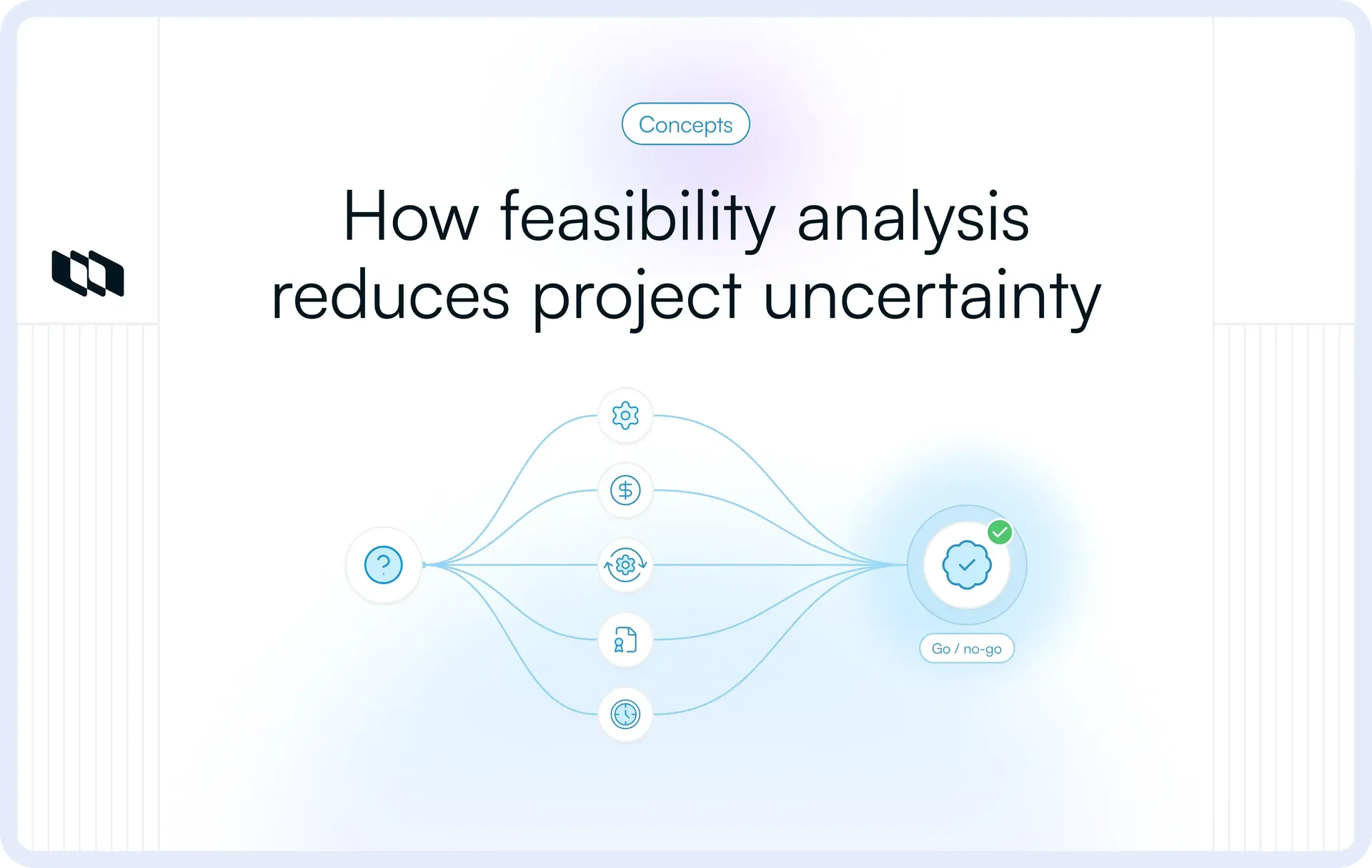
A promising project proposal can quickly become an expensive commitment if its technical requirements, costs, and delivery constraints are poorly understood. Before approving an initiative, teams need to establish whether the proposed solution is achievable and worth pursuing.
Project feasibility analysis helps organizations answer these questions before committing significant resources. It provides a structured approach to examining project viability, evaluating alternatives, and identifying potential obstacles. This guide covers the different types of feasibility analysis, the assessment process, and how teams use their findings to make informed project decisions.
What is project feasibility analysis?
Project feasibility analysis is the systematic evaluation of whether a proposed project can be completed successfully within its technical, financial, operational, and other relevant constraints. It helps organizations determine whether an initiative is practical, achievable, and justified before committing significant resources.
Feasibility analysis in project management examines several questions:
- Technical readiness: Does the organization have the technology and expertise required?
- Financial viability: Are the expected benefits sufficient to justify the investment?
- Operational readiness: Can existing teams and processes support the proposed solution?
- Delivery constraints: Can the project meet its required timeline and resource commitments?
- Project risks: What uncertainties could affect successful execution?
The findings help decision-makers approve a proposal, request changes, investigate alternatives, or discontinue an initiative.
For example, before developing a customer-facing integration, a software company may evaluate API compatibility, engineering capacity, development costs, and implementation risks. The assessment helps determine whether the proposed integration deserves a place on the product roadmap.
To understand how feasibility findings are investigated, documented, and presented to stakeholders, explore our guide to feasibility studies in project management.
Why is project feasibility analysis important?
Project feasibility analysis helps organizations distinguish promising opportunities from initiatives that may be difficult to deliver or economically unjustified. It also provides a common basis for evaluating competing proposals.
1. Identifies potential risks before execution
Early evaluation can expose technical limitations, vendor dependencies, approval requirements, and other obstacles while teams still have flexibility to change their approach.
For example, discovering that a critical third-party API lacks required functionality may lead an engineering team to investigate alternatives before committing to implementation.
2. Improves budget and resource allocation
Organizations operate with limited funding, engineering capacity, and competing priorities. Feasibility findings help decision-makers understand which initiatives can realistically be supported.
This allows teams to consider the opportunity cost of assigning resources to one project over another.
3. Validates project objectives and assumptions
Project proposals often depend on assumptions about customer demand, implementation effort, expected benefits, or available capabilities.
Feasibility analysis tests these assumptions against available evidence and identifies where further investigation is necessary.
4. Supports informed investment decisions
Decision-makers can compare proposals using consistent criteria, including expected costs, benefits, delivery requirements, and uncertainty.
This is especially valuable when several initiatives compete for the same budget or team capacity.
5. Strengthens stakeholder alignment
Product, engineering, finance, and operations teams may have different expectations for the same initiative.
A documented feasibility assessment gives stakeholders a shared understanding of the project's requirements, trade-offs, and unresolved concerns.
6. Establishes realistic project expectations
Feasibility findings provide useful inputs for subsequent planning, particularly when estimating budgets, defining delivery boundaries, and identifying resource needs.
They help stakeholders understand what can reasonably be committed to before execution begins.
When should project feasibility analysis be conducted?
Project feasibility analysis generally takes place during project initiation, after an opportunity has been identified and before significant execution commitments are made.
It is particularly useful in the following situations:
- New project proposals: Determining whether an initiative should receive funding and organizational support.
- Major technology investments: Evaluating technical compatibility, implementation complexity, and long-term costs.
- Product development decisions: Assessing customer demand, engineering requirements, and commercial potential before prioritizing substantial new capabilities.
- Complex cross-functional projects: Investigating dependencies and organizational readiness across multiple teams.
- Significant project changes: Reassessing viability when scope, funding, deadlines, or essential assumptions change.
The depth of analysis should reflect the project's size, uncertainty, and potential impact. A familiar internal improvement may require a brief assessment, while an expensive platform migration involving multiple systems will usually warrant a more detailed investigation.
An existing project may also need reassessment when new constraints materially affect the original approval decision.
What are the different types of project feasibility analysis?
The types of project feasibility analysis represent different dimensions of project viability. Each focuses on a particular condition that must be understood before an initiative can proceed.
The TELOS framework identifies five common dimensions: technical, economic, legal, operational, and schedule feasibility. Additional assessments, such as market and environmental feasibility, may be relevant depending on the project's objectives.
1. Technical feasibility analysis
Technical feasibility examines whether a proposed solution can be implemented using available technology, infrastructure, and expertise.
It considers system compatibility, integration requirements, architecture, scalability, performance expectations, and specialized skills.
Example: An engineering team evaluates whether its existing infrastructure can support real-time data synchronization with an external platform.
2. Economic and financial feasibility analysis
Economic feasibility examines whether the anticipated benefits justify the resources required. Financial feasibility also considers whether sufficient funding is available and whether the organization can meet the project's financial obligations.
The assessment may involve implementation costs, ongoing expenses, expected returns, cash requirements, and opportunity costs.
Example: A SaaS company evaluates whether anticipated revenue and retention benefits justify developing and maintaining a new premium feature.
3. Operational feasibility analysis
Operational feasibility determines whether the organization can implement, adopt, and maintain the proposed solution.
It examines existing workflows, staffing, training requirements, operational responsibilities, and the changes necessary to support the project after implementation.
Example: A company introducing automated customer onboarding evaluates whether support and operations teams can manage exceptions and maintain the new workflow.
4. Legal and regulatory feasibility analysis
Legal feasibility evaluates whether the proposed project can satisfy applicable laws, regulations, contractual obligations, and licensing requirements.
For technology projects, this may involve data protection, intellectual property, accessibility, and industry-specific obligations.
Example: A company expanding its software service into another region examines the applicable data-processing and contractual requirements before finalizing its implementation approach.
5. Schedule feasibility analysis
Schedule feasibility evaluates whether the proposed work can be completed within the required timeframe.
It considers estimated effort, resource availability, dependencies, external approvals, and the flexibility of project deadlines.
Example: An engineering team determines whether it can migrate a legacy application before an existing infrastructure agreement expires.
6. Market feasibility analysis
Market feasibility assesses whether sufficient demand or commercial opportunity exists for a proposed product, service, or expansion.
It draws on customer research, competitive conditions, potential adoption, and evidence of willingness to pay.
Example: Before developing an enterprise reporting feature, a product team evaluates whether customer requirements and potential commercial value justify the investment.
7. Environmental feasibility analysis
Environmental feasibility examines the potential environmental impacts and requirements associated with a project.
Depending on the initiative, considerations may include energy use, waste management, resource consumption, location-specific constraints, and required approvals.
Example: An organization planning a new data center evaluates power consumption, cooling requirements, and applicable environmental obligations.
The relevant dimensions depend on the project. A software integration may require extensive technical and contractual evaluation, while a physical infrastructure project may demand a broader environmental assessment.
How do you conduct a project feasibility analysis?
The project feasibility analysis process follows a sequence of activities that moves from defining the proposed initiative to presenting an evidence-based recommendation.
The following eight steps provide a practical approach to conducting a project feasibility analysis.
Step 1. Define project objectives and scope
Begin by identifying the problem the project aims to solve, the intended outcomes, and the boundaries of the proposed work.
Document the business objective, intended users, major deliverables, and stakeholders. These details establish what the assessment should evaluate.
For example, a proposal to improve reporting performance should identify the expected improvement, affected users, and systems involved.
Step 2. Identify project requirements and constraints
List the conditions necessary for implementation, including technical requirements, budget limits, available expertise, delivery deadlines, and relevant approvals.
Separate essential requirements from those that can be adjusted.
A regulatory requirement may be mandatory, while a preferred launch date or additional feature could offer more flexibility.
Step 3. Establish feasibility criteria and benchmarks
Define how stakeholders will judge whether the project meets its requirements.
Criteria may include acceptable implementation costs, minimum system capabilities, required delivery dates, expected benefits, and resource availability.
Establishing these benchmarks before the assessment helps prevent decisions from being shaped solely by a preferred outcome.
Step 4. Gather relevant data and explore alternatives
Collect evidence from technical documentation, previous projects, cost estimates, customer research, vendor information, and internal capacity assessments.
Investigate reasonable alternatives to the original proposal.
For instance, a team considering an internally developed integration might also evaluate an existing integration service or a smaller implementation scope.
Step 5. Assess the relevant feasibility dimensions
Evaluate each applicable dimension against the established criteria.
Technical specialists may validate system requirements, finance teams may assess investment estimates, and operational stakeholders may evaluate implementation readiness.
Document the evidence supporting each finding and identify assumptions that still require validation.
Step 6. Evaluate risks, resources, timelines, and dependencies
Examine uncertainties that could affect the project's delivery or economic justification.
These may include resource conflicts, vendor dependencies, untested technologies, external approvals, and unreliable estimates.
Identify which concerns can be addressed through mitigation and which could materially affect the decision to proceed.
For a deeper understanding of how to identify, assess, and prioritize potential project risks, check out our guide to risk analysis in project management.
Step 7. Compare findings and determine project viability
Bring the assessments together and compare the available options against the project's objectives and constraints.
Consider the trade-offs between costs, implementation complexity, expected benefits, and remaining uncertainty.
Where alternatives perform differently, document why one approach is preferable and what compromises it requires.
Step 8. Document findings and recommend a decision
Prepare a feasibility report summarizing the evidence, key assumptions, unresolved concerns, and recommended course of action.
The recommendation should explain whether the project can proceed under the proposed conditions or requires changes, additional investigation, or rejection.
Specify any actions that must be completed before formal approval.
How do you determine whether a project is feasible?
A project feasibility evaluation brings the individual findings together to answer a central question: Does the available evidence support moving forward with this proposal under the proposed conditions?
A useful way to approach this decision is to distinguish mandatory requirements from factors that can be compared or negotiated.
Establish measurable feasibility indicators
Define indicators that reflect the project's actual objectives and constraints.
For a software initiative, these might include:
- Technical compatibility and implementation readiness.
- Estimated development and maintenance costs.
- Available engineering capacity.
- Expected customer or business value.
- Critical delivery dependencies.
- Security, legal, and contractual requirements.
Where possible, establish acceptable thresholds for each indicator. These thresholds should reflect the project's specific circumstances rather than arbitrary universal benchmarks.
Compare findings using a feasibility assessment matrix
A feasibility assessment matrix helps stakeholders review the evidence across multiple dimensions.
Feasibility dimension | Evaluation criteria | Findings | Assessment |
Technical | Required system capabilities | Core integration validated; additional testing required | Conditional |
Financial | Affordable implementation costs | Estimates within available budget | Feasible |
Operational | Team and support readiness | Support ownership requires clarification | Conditional |
Schedule | Achievable delivery deadline | Dependent on vendor approval | At risk |
Legal | Mandatory contractual requirements | Review pending | Pending |
The matrix provides a concise view of outstanding issues and the conditions affecting approval.
Teams can also use weighted scoring to compare alternatives, provided the weights and evidence are documented.
However, an attractive overall score cannot compensate for an unresolved mandatory legal, safety, or technical requirement.
Make a go/no-go decision
The assessment should lead to a recommendation appropriate to the evidence:
- Proceed: Essential requirements are satisfied, and the investment is justified.
- Proceed with conditions: Approval depends on completing clearly defined actions.
- Revise: Changes to scope, design, budget, or timing could improve viability.
- Defer: The proposal requires information or resources that are currently unavailable.
- Reject: Essential requirements cannot be satisfied, or the investment lacks sufficient justification.
The recommendation should identify who has authority to approve the project and any conditions that must be resolved before execution.
What is an example of project feasibility analysis?
Consider a hypothetical SaaS company evaluating whether to develop a third-party billing integration.
Several enterprise customers have requested the capability, and the product team wants to understand whether development should become a roadmap priority.
Project overview
The proposed integration would allow customers to synchronize selected billing information between the SaaS platform and an external system.
Before approving development, the team needs evidence about API capabilities, ongoing vendor costs, customer demand, engineering capacity, and data-processing requirements.
Feasibility assessment
The following table illustrates how the team's preliminary findings might be documented.
Dimension | Hypothetical findings | Assessment |
Technical | API supports the required operations, but synchronization reliability needs testing | Conditional |
Financial | Initial development appears affordable; ongoing vendor charges remain uncertain | Conditional |
Operational | Engineering ownership is available; customer support responsibilities need definition | Conditional |
Schedule | Delivery depends on third-party technical validation | At risk |
Legal | Contractual data-access requirements need review | Pending |
Market | Several customers have expressed interest; broader demand is unconfirmed | Conditional |
The assessment identifies a potentially viable project with unresolved requirements.
Initial technical findings suggest that the proposed approach may work. However, production reliability, commercial justification, and contractual permissions require additional evidence.
Final recommendation
The team recommends deferring full development approval until three actions are completed:
- Validate synchronization behavior and error handling through a limited proof of concept.
- Confirm vendor costs and contractual data-access requirements.
- Establish sufficient customer demand to justify implementation and ongoing support.
If these conditions are satisfied, the proposal can move into detailed planning. If testing identifies major limitations, the team may need to reduce scope or consider another integration approach.
This hypothetical project feasibility analysis example demonstrates how an assessment can preserve a potentially useful opportunity while preventing premature resource commitments.
What tools and techniques are used in project feasibility analysis?
Feasibility analysis uses different techniques depending on the type of uncertainty teams need to investigate.
The following methods are commonly useful during project feasibility assessments.
1. Cost-benefit analysis
Compares estimated implementation and operating costs with expected financial and non-financial benefits.
It helps teams assess whether the expected value of a project justifies the resources required.
2. Return on investment (ROI) analysis
Evaluates anticipated financial returns relative to the investment.
ROI can support comparisons between financially measurable opportunities, while payback analysis can help estimate how long it may take to recover an initial investment.
3. SWOT analysis
Examines strengths, weaknesses, opportunities, and threats associated with the proposal.
It is useful during early strategic evaluation, particularly when internal capabilities and external conditions may influence project viability.
4. Risk assessment matrix
Categorizes project risks according to their estimated likelihood and impact.
This helps teams prioritize uncertainties requiring further investigation or mitigation before approval.
5. Technical proof of concept (PoC)
Tests a specific technical assumption through a limited experiment or implementation.
A PoC is particularly valuable when an initiative depends on unfamiliar technology, complex integrations, or uncertain system behavior.
6. Feasibility scoring and decision matrices
Compare project alternatives using predefined evaluation criteria and, where appropriate, weighted scores.
These methods make trade-offs more visible when stakeholders must choose between several viable approaches.
Technique | Primary purpose | Suitable use case |
Cost-benefit analysis | Evaluate costs against expected value | Investment justification |
ROI analysis | Assess financial returns | Comparing investment options |
SWOT analysis | Identify strategic considerations | Early project screening |
Risk assessment matrix | Prioritize uncertainties | High-risk initiatives |
Technical PoC | Validate technical assumptions | Unfamiliar technologies |
Decision matrix | Compare alternatives consistently | Selecting an implementation approach |
Teams should select methods based on the decision being made. A small, familiar internal project may need limited analysis, while a complex technology investment may require several complementary techniques.
What should a project feasibility analysis report include?
A project feasibility analysis report consolidates the findings into a form that stakeholders can review, challenge, and use when making an approval decision.
The report should preserve the evidence behind the recommendation and distinguish verified findings from unresolved assumptions.
Report component | What it should include |
Executive summary | Overall findings and recommended decision |
Project overview | Objectives, scope, business context, and expected outcomes |
Evaluation criteria | Assessment methods, requirements, and acceptance thresholds |
Feasibility findings | Results from relevant technical, financial, operational, and other assessments |
Cost and resource analysis | Investment estimates, expected benefits, and resource requirements |
Risk assessment | Major uncertainties, dependencies, and constraints |
Alternative solutions | Options evaluated and their principal trade-offs |
Final recommendation | Proposed decision, approval conditions, and next steps |
The level of detail should match the significance of the investment and the expectations of the decision-makers.
For complex projects, supporting material such as cost models, technical assessments, and vendor information can be maintained separately and referenced from the report.
What is the difference between project feasibility analysis, a feasibility study, a business case, and a project plan?
These activities support related decisions during project initiation and planning, although their purposes and outputs differ.
Concept | Primary purpose | Typical output |
Project feasibility analysis | Evaluate whether a proposed project is viable | Assessment findings and recommendation |
Feasibility study | Investigate and document project feasibility | Feasibility study report |
Business case | Explain why the organization should invest in the proposal | Investment justification and recommendation |
Project plan | Define how approved work will be organized and executed | Scope, schedule, resources, and delivery approach |
Project feasibility analysis and feasibility study are closely related terms and are often used interchangeably. Feasibility analysis commonly refers to the evaluation activities, while a feasibility study encompasses the broader investigation and its documented findings.
A business case considers whether the proposed investment supports organizational objectives and represents a worthwhile use of resources. Findings from a feasibility assessment often inform this justification.
A project plan translates an approved initiative into an execution approach. It defines how teams intend to coordinate the scope, schedule, resources, and delivery activities.
The exact sequence varies by organization, and some of these activities may develop iteratively.
Once a project is considered feasible, the next step is translating its objectives and constraints into an actionable plan. Explore our guide to project planning to understand the stages, steps, and key components involved.
What are the common challenges in project feasibility analysis?
Feasibility analysis depends on incomplete information about work that has yet to happen. Even a structured assessment can become unreliable when important uncertainties are overlooked or poorly represented.
1. Unclear project objectives and requirements
When stakeholders disagree about the intended outcome or expected scope, they may evaluate different assumptions about the same project.
This makes assessment findings difficult to compare and reduces confidence in the recommendation.
2. Inaccurate cost and timeline estimates
Early estimates often contain uncertainty, particularly when requirements are incomplete or unfamiliar technologies are involved.
Treating preliminary estimates as firm commitments can distort the project's apparent affordability or schedule feasibility.
3. Limited or unreliable project data
Teams may lack relevant historical information, customer evidence, technical documentation, or dependable vendor estimates.
Weak evidence increases uncertainty and makes it harder to distinguish viable proposals from optimistic assumptions.
4. Overlooked technical and resource constraints
Assessments may focus heavily on the proposed solution while giving insufficient attention to integration dependencies, specialized skills, maintenance obligations, or competing team commitments.
These omissions can materially affect implementation readiness.
5. Inadequate risk and dependency assessment
Some projects depend on external approvals, vendors, critical infrastructure, or decisions made by other teams.
When these dependencies remain unexamined, feasibility conclusions may rely on conditions that are outside the project's direct control.
6. Conflicting stakeholder priorities
Different stakeholders may place greater importance on cost, speed, technical quality, or business value.
Without agreed evaluation criteria, these differences can lead to inconsistent assessments or delayed decisions.
7. Bias toward preferred project outcomes
A proposal may already have strong internal support before its feasibility is evaluated.
This can influence which alternatives are considered, which assumptions are challenged, and how unfavorable findings are interpreted.
What are the best practices for conducting project feasibility analysis?
An effective assessment should produce a recommendation that stakeholders can understand, evaluate, and revisit when circumstances change.
The following practices help improve the quality and usefulness of project feasibility findings.
1. Assign clear ownership for the assessment
Identify who will coordinate the analysis, contribute specialist evaluations, and approve the final recommendation.
Clear accountability helps prevent important findings from remaining unresolved between teams.
2. Record the evidence behind important assumptions
Document the information supporting cost estimates, technical conclusions, expected benefits, and resource commitments.
Include the source, date, and relevant limitations of evidence where appropriate.
3. Evaluate uncertainty through realistic scenarios
For projects with substantial uncertainty, consider how changes in cost, delivery effort, customer adoption, or resource availability could affect viability.
Scenario analysis can reveal whether a proposal remains attractive when important assumptions change.
4. Define approval conditions explicitly
When the assessment recommends conditional approval, identify the actions required, their owners, and how completion will be verified.
This makes the recommendation actionable and reduces ambiguity during the transition into planning.
5. Preserve alternative approaches and decision rationale
Document why the preferred solution was selected and which alternatives were considered.
This context becomes useful when stakeholders revisit the decision or encounter changes during implementation.
6. Establish triggers for reassessment
Identify the developments that should prompt another feasibility review, such as substantial scope changes, funding reductions, technical discoveries, or new regulatory requirements.
This keeps the approval decision connected to the conditions under which it was originally made.
7. Review the assessment independently where appropriate
For significant or high-risk investments, involve reviewers who can challenge important estimates and assumptions without being responsible for delivering the proposed outcome.
An independent perspective can help identify gaps that the originating team may have overlooked.
Final thoughts
Project feasibility analysis helps organizations understand whether an initiative can realistically deliver its intended outcomes under the available technical, financial, and operational conditions. A well-supported assessment gives decision-makers the evidence needed to approve viable projects, reconsider uncertain proposals, and avoid unnecessary commitments.
Once a project is approved, the focus shifts toward organizing and delivering the work. Plane helps teams manage projects, coordinate work items, and maintain visibility into execution. Talk to sales to explore how Plane can support your team's project management workflows.
Frequently asked questions
1. What is the main purpose of project feasibility analysis?
The main purpose of project feasibility analysis is to determine whether a proposed project is practical, achievable, and worth pursuing before significant resources are committed. It evaluates technical requirements, financial viability, operational readiness, delivery constraints, and risks to support informed project decisions.
2. What are the five main types of feasibility analysis?
The five main types are technical, economic, legal, operational, and schedule feasibility, commonly represented by the TELOS framework. Depending on the project, organizations may also evaluate market demand, environmental impacts, and other specific requirements.
3. Who is responsible for conducting a project feasibility analysis?
Project managers or business analysts commonly coordinate feasibility assessments, with contributions from engineering, finance, operations, legal, and other relevant specialists. Project sponsors or authorized decision-makers typically review the findings and determine whether the proposed initiative should proceed.
4. What is the difference between feasibility analysis and a feasibility study?
Feasibility analysis is the process of evaluating a project's viability across relevant criteria. A feasibility study generally refers to the broader investigation that includes the analysis and its documented findings. In practice, the terms are frequently used interchangeably.
5. How do you measure project feasibility?
Project feasibility is measured by evaluating a proposal against predefined technical, financial, operational, schedule, and other relevant criteria. Teams use supporting evidence, estimates, technical assessments, and comparison matrices to determine whether requirements are satisfied and whether unresolved risks are acceptable. There is no universal feasibility score suitable for every project.
6. What happens if a project is found to be infeasible?
If a project is found to be infeasible, decision-makers may revise its scope, change the implementation approach, seek additional resources, postpone the initiative, or reject the proposal. The appropriate response depends on whether the constraints can be resolved at an acceptable cost and level of risk.
7. How long does project feasibility analysis take?
The duration depends on project complexity, available information, technical uncertainty, stakeholder involvement, and the depth of assessment required. A straightforward proposal may need only a limited review, while a major technology or infrastructure investment may require extensive investigation and multiple evaluation cycles.
Recommended for you



 Download for Mac
 Download for Android
