What is human-in-the-loop AI?
Introduction
Human-in-the-loop AI describes systems where people step in at defined points to review, guide, correct, or approve what an AI system does. This approach is becoming more important as AI moves beyond generating outputs and starts taking actions through agents, workflows, and connected tools.
The challenge is deciding where human judgment adds real value. Some tasks can run independently, while others need oversight because the cost of an error is higher. This guide explains how human-in-the-loop AI works, where it fits across the AI lifecycle, and when teams should use it.
What is human-in-the-loop AI?
Human-in-the-loop AI, or HITL AI, is an approach where people participate at defined points in an AI system’s workflow to review, guide, correct, approve, or override its outputs and actions.
The “loop” is the cycle between the AI system and the human involved in supervising or improving it.
What does the AI do?
Depending on the system, AI may:
- Analyze data
- Generate text, images, or code
- Make predictions
- Recommend a decision
- Trigger or propose an action
What does the human do?
A person steps in when the workflow requires judgment, context, accountability, or approval. They may:
- Review an AI-generated output
- Correct an error
- Approve or reject a proposed action
- Escalate an unusual case
- Provide feedback that improves future performance
For example, an AI system might draft customer support responses automatically. Routine requests can move forward, while messages involving refunds, legal concerns, or sensitive customer issues are routed to a support agent for approval before sending.
Human involvement does not happen at every step
HITL does not require someone to manually inspect every AI decision. Teams usually define specific intervention points based on factors such as:
- Risk
- Model confidence
- Complexity
- Data sensitivity
- Cost of an incorrect decision
- Whether an action can be reversed
This allows AI to handle routine work while humans focus on cases where their judgment has the most value.
HITL during model development vs live AI operation
Human involvement can happen at two broad stages:
- During model development: People label training data, evaluate outputs, correct errors, or provide human feedback in AI training.
- During live operation: People review outputs, approve decisions, handle exceptions, or authorize actions before an AI system or AI agent proceeds.
This distinction matters because modern human-in-the-loop AI covers both how models learn and how AI systems behave once they are operating in real workflows.
How does human-in-the-loop AI work?
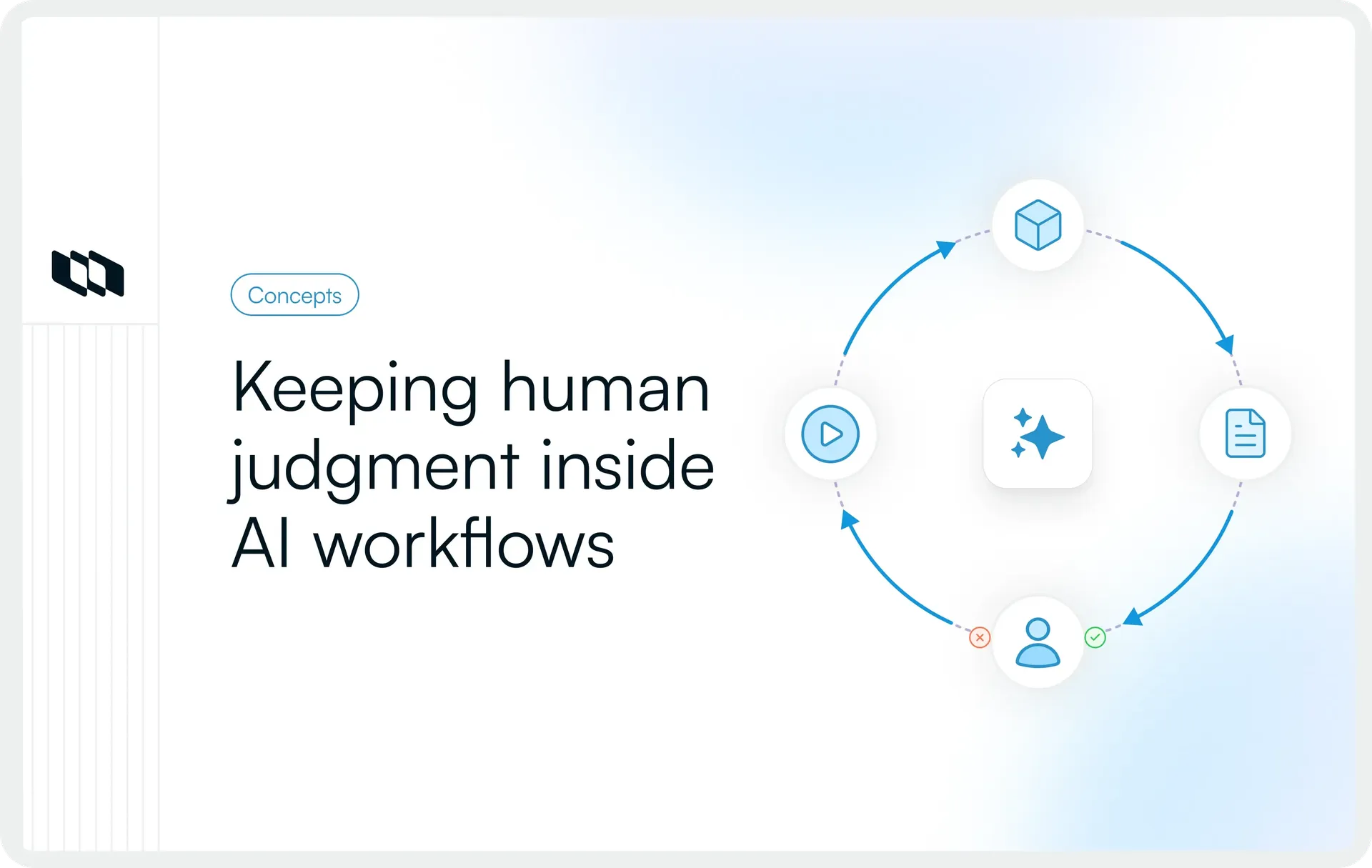
Human-in-the-loop AI works by introducing defined checkpoints where a person can review what the system has produced or intends to do. The exact workflow varies, but the basic pattern is consistent.
The human-in-the-loop workflow
- Input or task
The AI receives data, a prompt, a request, or a goal. - AI processing
The model analyzes the input and produces a prediction, recommendation, response, or proposed action. - Decision point
The system checks whether the result can continue automatically or needs human review. - Human intervention
A reviewer may approve, reject, edit, correct, or escalate the result. - Execution
The workflow continues based on that decision. An approved action may proceed, while a rejected or corrected one may be changed before execution. - Feedback
The human decision can be recorded and, where appropriate, used to improve prompts, routing rules, evaluations, or the model itself.
What triggers human review?
Teams usually define clear conditions for when human AI collaboration is required. Common triggers include:
- Low confidence: The model is uncertain about its prediction or output.
- High-risk actions: A mistake could create financial, legal, operational, or safety consequences.
- Policy rules: Internal controls require approval for certain decisions or actions.
- Ambiguous cases: The situation falls outside common patterns or requires contextual judgment.
- Sensitive data: The workflow involves confidential, personal, or restricted information.
- Explicit approval requirements: A person must authorize the action before the system can proceed.
For example, an AI system processing expense claims might approve routine, low-value submissions automatically. A claim with missing information, an unusual amount, or a policy exception could be routed to a finance reviewer before payment.
This is how human-in-the-loop AI works in practice: automation handles predictable cases, while defined signals determine when human judgment should enter the workflow.
Where can humans enter the AI lifecycle?
Human-in-the-loop AI can appear at several stages of the AI lifecycle. In traditional machine learning, human involvement often centers on training data and model improvement. In production systems, people may also review decisions, approve actions, and monitor outcomes after deployment.
1. Data preparation and labeling
Before a model is trained, people may help prepare the data it learns from. This can involve:
- Classifying examples
- Annotating text, images, audio, or video
- Correcting mislabeled data
- Validating whether examples meet quality standards
The quality of these decisions directly affects what the model learns.
2. Model training
During training, human feedback in AI can help shape model behavior. People may evaluate outputs, rank responses, correct mistakes, or indicate which results are preferable.
This includes techniques such as supervised learning, active learning, and reinforcement learning from human feedback, or RLHF.
3. Evaluation and testing
Before deployment, teams need to understand how a model performs beyond benchmark scores. Subject-matter experts can review outputs for:
- Factual errors
- Bias
- Unsafe responses
- Poor handling of edge cases
- Failures within specific domains or workflows
Human evaluation is especially useful when output quality depends on context or professional judgment.
4. Runtime review and approval
Once an AI system is in production, people can enter the loop while work is happening.
A human might review an AI-generated recommendation, approve a transaction, check a customer response, or authorize an AI agent before it performs a sensitive action.
This form of AI oversight is increasingly important as AI systems gain access to tools, APIs, business data, and operational workflows.
5. Monitoring and feedback
Human involvement can continue after an AI decision has been executed. Teams may review outcomes, investigate failures, identify recurring problems, and use those findings to improve the system.
That feedback might lead to changes in:
- Training data
- Prompts
- Evaluation criteria
- Approval rules
- Confidence thresholds
- Model behavior
Across these stages, human-in-the-loop machine learning and production HITL serve different purposes. One helps improve how models learn, while the other helps teams control how AI behaves when it is used in real workflows.
What are the main human-in-the-loop methods?
Human-in-the-loop methods vary depending on where people enter the AI workflow and what kind of input they provide. Some methods help improve a model during development, while others govern how a live system behaves.
1. Human annotation and supervised learning
People provide labeled examples that the model learns from. This can include tagging images, classifying text, marking relevant data, or correcting existing labels.
The goal is to give the model clear examples of what the expected output should look like.
2. Active learning
In active learning, the system identifies examples where it is least certain and sends those cases to a human for labeling or review.
This makes human effort more targeted because reviewers focus on the examples that are most likely to improve the model.
3. Reinforcement learning from human feedback
Reinforcement learning from human feedback, or RLHF, uses human preferences to shape model behavior.
Reviewers may compare multiple responses, rank them, or indicate which output better follows the intended criteria. Those preference signals are then used during training to improve how the model responds.
4. Human validation and correction
A person reviews an AI-generated output before it is accepted or used. They may correct a prediction, edit generated content, verify extracted information, or reject an inaccurate result.
This method is common when the AI can handle most of the task but still needs a quality check for certain cases.
5. Approval and escalation workflows
In production systems, AI can operate independently until a defined condition requires human intervention.
For example, a workflow might escalate a decision when:
- Confidence falls below a threshold
- A transaction exceeds a certain value
- Sensitive information is involved
- The system encounters an exception
- Organizational policy requires approval
These workflows are especially relevant for human-in-the-loop AI agents, where the system may be able to take actions through connected tools or APIs.
6. Continuous feedback loops
Human corrections and decisions can also become an ongoing source of feedback.
Teams may use that feedback to refine prompts, adjust escalation rules, improve evaluation criteria, update training data, or retrain models. Over time, this helps align the system more closely with real-world expectations and reduces repeated mistakes.
Human-in-the-loop vs human-on-the-loop vs human-out-of-the-loop
Human-in-the-loop, human-on-the-loop, and human-out-of-the-loop describe different levels of AI oversight. The main differences are when people can intervene, whether approval is required, and how much autonomy the system has.
Approach | Human role | When humans intervene | AI autonomy | Best suited for |
Human-in-the-loop (HITL) | Reviews, corrects, or approves specific decisions and actions | Before or during execution | Limited or conditional | Higher-risk, ambiguous, or sensitive tasks |
Human-on-the-loop (HOTL) | Monitors the system and steps in when needed | During operation, when an issue or exception appears | Higher | Systems that can usually operate independently but still require supervision |
Human-out-of-the-loop (HOOTL) | Has little or no role in individual decisions | Rarely, or only through broader system changes | High | Predictable, low-risk tasks with well-defined boundaries |
Human-in-the-loop
With HITL, the workflow includes explicit points where a person reviews or influences the AI's decision.
For example, an AI agent may prepare a contract update but require a legal reviewer to approve the change before it is sent. This approach gives humans direct control over selected decisions and works well when errors carry meaningful consequences.
Human-on-the-loop
With HOTL, the AI can continue operating independently while a person monitors its behavior and retains the ability to intervene.
A fraud detection system, for example, might process transactions automatically while analysts monitor alerts, investigate unusual patterns, and adjust controls when necessary. Human involvement happens through supervision rather than approval of each individual action.
Human-out-of-the-loop
In a human-out-of-the-loop system, AI handles decisions or actions within predefined boundaries without routine human intervention.
This approach is more appropriate for predictable workflows where the cost of an incorrect action is relatively low, and the system has been tested sufficiently for the task.
Oversight can vary within the same AI system
Teams do not need to choose a single oversight model for every action.
An AI system might:
- Complete routine data classification autonomously
- Ask for review when confidence falls below a threshold
- Require approval before changing permissions or sending external communications
- Allow operators to monitor overall system behavior and intervene when patterns look unusual
This kind of tiered human AI collaboration helps teams match the level of oversight to the risk and consequence of each action. In practice, the question of human-in-the-loop vs human-on-the-loop is often less about choosing one permanent model and more about deciding how much control each part of a workflow requires.
Why is human-in-the-loop AI important?
Human involvement is most useful when an AI system reaches a point where judgment, accountability, or additional context can improve the outcome.
- Improve accuracy and reliability: Humans can review uncertain outputs, catch mistakes, and resolve cases where the model lacks enough context to make a reliable decision.
- Reduce risk in high-impact workflows: Human approval can stop an incorrect recommendation or action before it creates financial, operational, legal, or safety consequences.
- Handle edge cases and complex judgment: People can apply domain knowledge, situational context, and organizational rules when a case falls outside the patterns the AI handles well.
- Create clear accountability: Defined review and approval points make it easier to establish who is responsible for important decisions and when human authorization is required.
- Improve AI performance over time: Human corrections, overrides, and feedback can reveal recurring weaknesses and help teams refine training data, prompts, evaluation criteria, or workflow rules.
When should humans be in the loop?
The question of when humans should be in the loop in AI usually comes down to risk, uncertainty, and consequence. Human review adds the most value when an AI system reaches a decision that requires judgment or could create meaningful harm if handled incorrectly.
Human intervention is especially useful when:
- The AI is uncertain: Low confidence scores, conflicting signals, or ambiguous inputs can trigger review instead of allowing the system to proceed automatically.
- The decision has significant consequences: Financial approvals, access decisions, healthcare recommendations, or other high-impact outcomes often justify additional human oversight.
- The action is difficult to reverse: Sending external communications, deleting data, changing permissions, moving money, or triggering downstream workflows may require approval before execution.
- Sensitive information is involved: Workflows involving personal, confidential, financial, or restricted data may need a person to verify whether the proposed action is appropriate.
- Context and judgment matter: Policy exceptions, unusual cases, and decisions with several possible interpretations often benefit from domain expertise that cannot be captured fully through predefined rules.
- The system encounters something unusual: AI can escalate cases that fall outside familiar patterns, such as an unexpected request, rare input, or behavior that differs significantly from previous examples.
- Governance requires documented oversight: Regulations, security policies, or internal controls may require a named person to review or authorize certain AI-assisted decisions.
When lighter human oversight makes sense
Human review also has a cost. Sending too many routine decisions through an approval queue can slow workflows and create reviewer fatigue.
More autonomous processing may be appropriate for:
- Routine, low-risk tasks with clear boundaries
- Repetitive decisions where the system has demonstrated reliable performance
- High-volume workflows where individual review provides little additional value
- Time-sensitive processes that cannot tolerate review delays
- Outputs that humans cannot meaningfully assess without additional expertise or information
The level of AI oversight should reflect the risk of the action. Low-risk work can often run with greater autonomy, while uncertain, sensitive, or consequential decisions receive stronger human involvement.
What are some examples of human-in-the-loop AI?
The clearest human-in-the-loop AI examples are workflows where AI handles the repetitive or computational part of a task, while people step in when judgment or approval is needed.
1. Customer support
AI can classify incoming requests, retrieve relevant information, and draft replies. Routine questions may be handled automatically, while refunds, sensitive complaints, or unusual requests are routed to a support agent for review.
2. Healthcare
AI systems can help analyze medical images, summarize clinical information, or prioritize cases for review. Clinicians assess the AI's findings alongside patient history and other evidence before making clinical decisions.
3. Financial services and fraud detection
Models can screen large volumes of transactions and flag activity that appears unusual. Analysts then investigate uncertain or higher-risk cases before accounts are restricted, transactions are blocked, or other consequential steps are taken.
4. Software development
AI coding tools can generate code, suggest fixes, write tests, or propose changes across a codebase. Developers review those changes for correctness, security, maintainability, and compatibility before they are merged or deployed.
Across these examples, the value of human-AI collaboration comes from assigning automation and human judgment to the parts of the workflow where each is most useful.
What are the challenges of human-in-the-loop AI?
Human-in-the-loop AI adds useful oversight, but it also introduces operational trade-offs. The main challenges usually appear when review volume grows or when the approval process is poorly designed.
- Cost and scalability: Human review becomes expensive as the number of escalated cases increases. If too many decisions require approval, review teams can quickly become a bottleneck.
- Latency: Waiting for a person to review an output or approve an action can slow workflows, especially in systems that depend on fast or real-time decisions.
- Inconsistent human judgment: Different reviewers may interpret the same case differently. Bias, varying expertise, and unclear guidelines can make human feedback less reliable than expected.
- Reviewer fatigue and weak oversight: Repeated approvals can become routine, making reviewers more likely to accept AI recommendations without examining them closely. This can turn HITL into a procedural checkpoint rather than meaningful oversight.
Poorly designed HITL workflows can therefore add cost and delay without improving decision quality. The review process needs clear triggers, appropriate reviewers, and enough context for people to make informed decisions.
How do you design an effective human-in-the-loop workflow?
An effective human-in-the-loop workflow depends on clear intervention points, the right reviewers, and enough context for people to make useful decisions.
1. Define where human judgment is required
Start by separating routine automation from decisions where mistakes carry meaningful consequences.
Use factors such as:
- Risk
- Model confidence
- Data sensitivity
- Action type
- Policy requirements
- Reversibility
These criteria should determine when the system proceeds automatically and when it escalates to a person.
2. Assign the right reviewer
Route decisions to people with the expertise, responsibility, and permissions needed to assess them properly. A technical issue may need an engineer, while a pricing exception or policy decision may require a manager or operations lead.
3. Give reviewers enough context
A reviewer should be able to understand what the AI is proposing and why the case reached them.
Useful context can include:
- The proposed output or action
- Relevant source information
- Confidence or risk signals
- Applicable policies
- Potential consequences
4. Define what reviewers can do
Make the available actions explicit. Depending on the workflow, reviewers may be able to:
- Approve
- Reject
- Edit
- Retry
- Escalate
Clear options make decisions faster and easier to audit later.
5. Plan for exceptions and delays
Define what happens if a reviewer is unavailable, an approval times out, or the case cannot be resolved at the first level of review. The workflow may pause, route the case to another reviewer, escalate it, or stop the action entirely.
6. Record decisions and interventions
Track what the AI proposed, who reviewed it, what decision was made, and whether the original output was changed. This creates traceability and gives teams evidence for improving AI governance and review policies over time.
7. Measure outcomes and use feedback
Track whether human intervention is actually improving the workflow.
Useful metrics include:
- Escalation rate
- Approval and rejection rate
- Review time
- Error rate
- Override rate
- False escalation rate
Human corrections can then inform changes to prompts, models, evaluation criteria, routing rules, or approval policies.
8. Adjust autonomy over time
Oversight levels should evolve as the system becomes better understood.
Reliable, low-risk actions may require fewer approvals, while recurring failures or higher-risk actions may need stronger controls. This keeps human-in-the-loop AI focused on the decisions where human judgment contributes the most.
How does human-in-the-loop work with AI agents?
With traditional HITL, human involvement often centers on reviewing an AI-generated output. Human-in-the-loop AI agents introduce another layer because agents can take actions through connected tools, systems, and APIs.
An agent may update records, send messages, access business data, create tasks, or trigger downstream workflows. Human oversight therefore needs to account for what the agent is allowed to do, when it should pause, and which actions require explicit approval.
1. Require approval for consequential actions
High-impact or difficult-to-reverse actions should have clear approval points.
For example, a human may need to approve an agent before it:
- Changes permissions
- Deletes or modifies important records
- Sends external communications
- Triggers a financial transaction
- Executes a production change
2. Set clear permission boundaries
Agents should have access only to the tools, data, and actions required for their role. Permissions can also vary by action, allowing routine work while restricting sensitive operations.
3. Match autonomy to risk
Low-risk actions can often proceed automatically, while higher-risk or unusual cases are routed for review. A product agent might summarize customer feedback independently, for example, while requiring approval before changing the priority of a critical roadmap item.
4. Define escalation and exception paths
Agents need clear rules for when to stop and involve a person. Common triggers include low confidence, missing information, conflicting instructions, policy exceptions, or an action outside the agent's permitted scope.
5. Keep agent actions traceable
Teams should be able to see what an agent proposed, which tools it used, what action it took, and where a human intervened. This level of traceability supports AI governance and makes it easier to investigate errors, refine controls, and understand how decisions were made.
As teams gain confidence in an agent's performance, they can adjust oversight for specific workflows. Reliable, low-risk actions may receive greater autonomy, while sensitive actions continue to require human approval.
Final thoughts
Human-in-the-loop AI gives teams a practical way to balance automation with human judgment. The strongest workflows define clear boundaries for where AI can act independently, where review is required, and how exceptions should be handled.
As AI systems become more capable, especially through agents that can take actions across tools and workflows, these decisions become more important. Teams that design HITL around risk, context, permissions, and accountability can use AI more confidently while keeping meaningful human oversight in the places where it matters most.
Frequently asked questions
Q1. What is human-in-the-loop AI?
Human-in-the-loop AI, or HITL AI, is an approach where people participate at defined points in an AI workflow to review, correct, approve, guide, or override outputs and actions. Human involvement can happen during model training, evaluation, live operation, or post-deployment monitoring.
Q2. How does human-in-the-loop AI work?
Human-in-the-loop AI works by adding review or approval checkpoints to an AI workflow. The system processes an input, produces an output or proposed action, and evaluates whether human involvement is required. A person may then approve, reject, edit, correct, or escalate the result before the workflow continues.
Q3. What is an example of human-in-the-loop AI?
A common example is customer support. AI can draft responses to incoming requests, while sensitive complaints, refunds, or unusual cases are routed to a human agent for review before the response is sent.
Q4. What is the difference between human-in-the-loop and human-on-the-loop?
In human-in-the-loop systems, people directly review or approve specific AI decisions or actions before or during execution. In human-on-the-loop systems, AI operates with greater autonomy while humans monitor its behavior and intervene when necessary.
Q5. What is the difference between HITL and RLHF?
HITL is a broader approach that includes human involvement at different stages of an AI system, such as data labeling, evaluation, runtime approval, and monitoring. Reinforcement learning from human feedback, or RLHF, is one specific training technique that uses human preferences to improve model behavior.
Recommended for you



 Download for Mac
 Download for Android