What is an Enterprise PMO (EPMO)?
Introduction
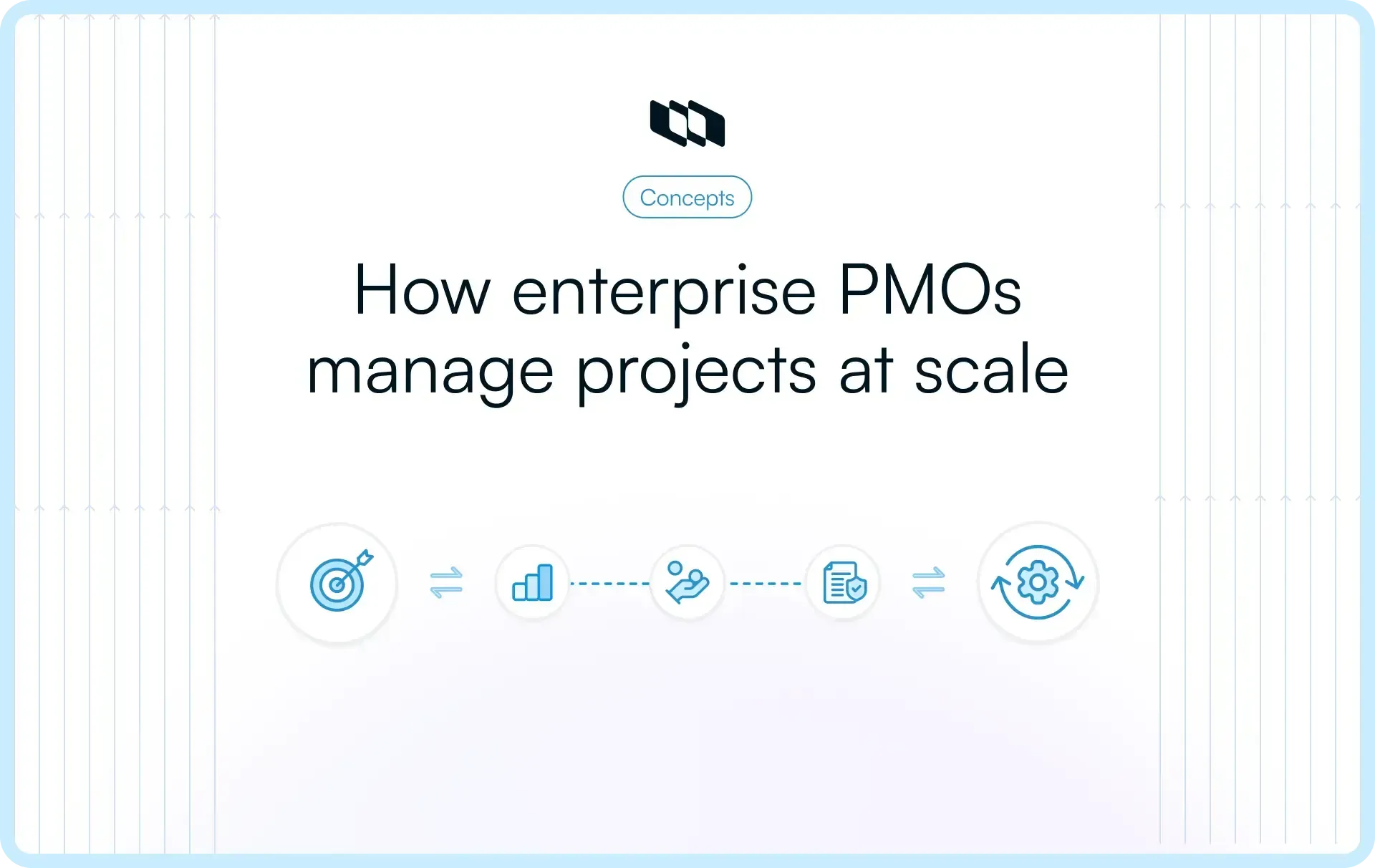
When every team has its own priorities, tools, and reporting style, leadership starts seeing activity before clarity. Projects may be moving, but the organization still struggles to know which work matters most, where capacity is constrained, and whether strategic goals are actually progressing. This is where an enterprise PMO, or EPMO, helps. It gives organizations a way to connect project execution with strategy, governance, funding, and outcomes across the business.
What is an enterprise PMO (EPMO)?
An enterprise PMO, or EPMO, is a function that helps an organization align its projects, programs, and portfolios with business strategy. The full form of EPMO is Enterprise Project Management Office.
In simpler terms, it gives leadership a clear way to see which work is happening, why it matters, how it connects to business priorities, and whether the organization has the capacity to deliver it.
EPMO meaning in project management
In project management, the EPMO meaning is tied to enterprise-wide coordination. It looks beyond one project team or department and helps connect work across functions, business units, and leadership goals.
That scope matters because large organizations rarely struggle with project tracking alone. They usually struggle with prioritization, resource conflicts, duplicated work, unclear ownership, inconsistent reporting, and limited visibility into outcomes.
What an enterprise PMO focuses on
An enterprise PMO usually focuses on:
- Strategic alignment across projects and programs
- Portfolio visibility for leaders and decision-makers
- Governance for intake, prioritization, approvals, and reporting
- Resource coordination across teams and departments
- Outcome tracking after major initiatives are delivered
The EPMO does not need to manage every task inside every project. Its role is to make sure the right work is selected, supported, governed, and measured at the enterprise level.
How this differs from managing individual projects
Individual project management focuses on delivery: scope, timelines, owners, risks, tasks, and milestones. An enterprise PMO works one level above that. It helps the organization understand whether the project portfolio is aligned with strategy, whether teams have the capacity to deliver, and whether completed work is creating the expected business value.
What does an EPMO do?
An EPMO turns strategy into a managed system of work. It helps leaders decide which projects should move forward, how resources should be allocated, which risks need attention, and whether completed initiatives are producing the expected value.
The exact responsibilities vary by organization, but most enterprise PMO roles and responsibilities fall into six areas.
1. Align projects with business strategy
An EPMO helps ensure that major projects are connected to approved business goals.
Without this layer, teams can end up working on initiatives that look important locally but do not support the company’s broader direction. The EPMO creates a clearer link between strategic priorities and the work being planned across departments.
This usually includes:
- Mapping projects to company goals
- Reviewing whether new initiatives support current priorities
- Identifying work that no longer fits the strategy
- Helping leaders compare competing initiatives using shared criteria
For example, if the business is focused on improving customer retention, the EPMO can help prioritize initiatives tied to onboarding, reliability, support quality, product adoption, or account health instead of treating every project request with equal weight.
2. Manage enterprise demand and intake
In larger organizations, new work comes from many places: product teams, engineering, sales, customer success, operations, finance, compliance, and leadership. If every request enters the system differently, prioritization becomes messy very quickly.
An EPMO creates a structured intake process for new project requests.
That process usually defines:
- Who can submit new work
- What information is required
- How requests are reviewed
- Who approves, rejects, defers, or reshapes the request
- How approved work moves into planning
This helps the organization avoid scattered side requests, unclear ownership, and projects that begin before anyone has confirmed their value, cost, or capacity impact.
3. Prioritize the project portfolio
One of the most important EPMO responsibilities is portfolio prioritization.
Every organization has more ideas than available time, people, or budget. The EPMO helps leadership compare initiatives across business value, urgency, risk, dependencies, effort, and available capacity.
This gives leaders a more reliable way to decide:
- Which projects should start now
- Which projects should wait
- Which projects need more discovery
- Which projects should stop receiving investment
- Which initiatives need executive review
This is where EPMO vs PMO responsibilities often become clearer. A traditional PMO may help a team deliver an approved project well. An EPMO helps decide whether that project belongs in the enterprise portfolio in the first place.
4. Coordinate resources and capacity
Strategic projects often compete for the same people. A product launch may need engineering, design, security, marketing, customer support, and legal involvement at the same time another major initiative needs those teams too.
The EPMO helps surface these capacity conflicts before they become delivery problems.
It can help leaders understand:
- Which teams are overloaded
- Which initiatives depend on the same people
- Where timelines are unrealistic
- Which projects need sequencing
- Where hiring, vendor support, or scope reduction may be required
This does not mean the EPMO owns every resource decision. In many organizations, functional leaders still own staffing. The EPMO gives them the visibility needed to make those decisions with a full view of enterprise priorities.
5. Standardize governance and reporting
A common problem in growing organizations is inconsistent reporting. One team marks a project as “on track” based on timeline. Another uses budget. A third uses stakeholder confidence. By the time leadership sees the portfolio, the data is difficult to compare.
An EPMO creates shared standards for governance and reporting.
This can include:
- Project health definitions
- Status reporting formats
- Risk and issue escalation paths
- Portfolio review cadences
- Approval workflows
- Decision logs
- Ownership models
Good governance gives leaders enough structure to make decisions without turning every project update into a heavy administrative process.
6. Track outcomes and benefits
Project completion does not always mean business value was delivered. A project can finish on time and still fail to improve the metric it was supposed to influence.
An EPMO helps close that gap by tracking outcomes after delivery.
This may include:
- Comparing expected benefits with actual results
- Reviewing whether business goals were met
- Capturing lessons from completed initiatives
- Identifying projects that need follow-up work
- Reporting value delivered across the portfolio
This outcome-focused view is one of the main EPMO benefits. It keeps the organization from measuring success only by delivery activity and helps leaders understand whether strategic work is actually moving the business forward.
EPMO vs PMO: What is the difference?
The simplest way to understand EPMO vs PMO is to look at the level each function operates at.
A traditional PMO helps teams improve project delivery. It brings structure to planning, reporting, execution, and governance within a defined area. An enterprise PMO works across the organization. It helps leaders connect projects and programs to strategy, capacity, funding, risk, and measurable business outcomes.
Here is how the two usually differ:
Dimension | Traditional PMO | Enterprise PMO |
Scope | Department, function, program, or group of projects | Enterprise-wide portfolio |
Main focus | Project delivery and execution consistency | Strategy alignment and portfolio-level decision-making |
Reporting line | Department head, functional leader, or PMO leader | Senior leadership or executive sponsor |
Work managed | Projects within a defined area | Projects, programs, portfolios, and strategic initiatives |
Authority | Delivery standards, reporting, support, and governance | Prioritization, portfolio governance, and resource trade-offs |
Metrics | Schedule, budget, scope, and delivery health | Strategic alignment, portfolio health, and benefits realization |
Stakeholders | Project managers, delivery teams, and functional leaders | Executives, business leaders, PMOs, finance, and operations |
Time horizon | Current project delivery | Long-term strategy execution |
How a traditional PMO works
A traditional PMO usually focuses on helping teams deliver projects in a consistent way. It may define project templates, reporting formats, delivery methods, risk processes, and governance checkpoints.
For example, an engineering PMO may help product and engineering teams plan releases, track dependencies, report risks, and improve delivery predictability. Its work is valuable, but the scope is usually tied to a department, function, or specific group of projects.
How an enterprise PMO works
An enterprise PMO looks at the organization’s full project portfolio. It helps leadership understand whether the right initiatives are moving forward, whether teams have enough capacity, and whether investments are tied to business priorities.
For example, an EPMO may help executives compare a customer retention initiative, a platform modernization program, a compliance project, and a new market expansion plan. Each may be important, but they cannot all receive the same priority if they depend on the same teams, budget, or leadership attention.
Can a PMO and EPMO coexist?
Yes. In many organizations, PMOs and EPMOs work together.
A departmental PMO supports local delivery. The EPMO sets enterprise-level direction, creates portfolio visibility, defines common governance standards, and helps leaders make trade-off decisions across the business.
This distinction matters because an EPMO should not become a heavier version of a traditional PMO. Its value comes from helping the organization make better decisions about priorities, capacity, risk, and outcomes across the full portfolio of work.
PMO, PgMO, PfMO, and EPMO: Related but different
Project management terms can get confusing once an organization starts adding more governance layers. PMO, PgMO, PfMO, and EPMO are related, but each one operates at a different level of work.
Office type | Full form | Main focus |
PMO | Project management office | Supports project standards, delivery practices, reporting, and governance for a team, department, or group of projects |
PgMO | Program management office | Coordinates related projects that together support a larger program outcome |
PfMO | Portfolio management office | Helps select, prioritize, balance, and track a portfolio of projects or programs |
EPMO | Enterprise project management office | Connects strategy, funding, capacity, governance, execution, and outcomes across the enterprise |
- A PMO is usually closest to project delivery. It helps teams manage scope, timelines, risks, dependencies, and reporting.
- A PgMO works one level above individual projects. It coordinates related projects that need to move together to achieve a broader program goal, such as a product launch, business transformation, or infrastructure modernization effort.
- A PfMO focuses on portfolio decisions. It helps leaders compare initiatives, allocate resources, manage risk, and track value across a collection of projects and programs.
- An EPMO operates at the enterprise level. It brings these layers together so leadership can see how work across the organization connects to strategy, available capacity, governance standards, and expected business outcomes.
Why do organizations create an EPMO?
Organizations usually create an EPMO when project work has outgrown local coordination. At that point, the challenge is no longer only about whether teams can deliver individual projects. The harder problem is knowing whether the organization is investing in the right work, assigning capacity wisely, and tracking outcomes consistently.
The EPMO gives leaders a clearer operating layer for decisions that cut across departments, functions, and business units.
1. Stronger strategic alignment
One of the main EPMO benefits is better alignment between project work and business goals.
In many organizations, projects begin because a team has a valid need, a leader has a request, or a department has budget to spend. Each project may make sense on its own, but that does not always mean it supports the company’s most important priorities.
An enterprise PMO helps create a clearer connection between strategy and execution. It can help leaders review whether initiatives support current goals, identify work that has drifted from its original purpose, and make sure teams are not spending time on projects with limited strategic value.
2. Better executive visibility
Executives need more than status updates from individual teams. They need to understand portfolio health across the organization.
An EPMO gives leadership a consolidated view of:
- Which initiatives are active
- Which projects are delayed or at risk
- Which teams are overloaded
- Which dependencies need attention
- Which decisions are blocked
- Which outcomes are being achieved
This kind of visibility helps leaders move from reactive follow-ups to informed portfolio decisions. Instead of waiting for problems to surface late, they can see risk, capacity pressure, and priority conflicts earlier.
3. Improved resource allocation
Most organizations have more planned work than available capacity. The same engineering teams, product managers, finance partners, legal reviewers, security teams, or operations specialists may be needed across several high-priority initiatives.
An EPMO helps make these conflicts visible.
It gives leaders a way to compare demand against capacity, sequence work more realistically, and decide where people, budget, and tools should be allocated. This is especially useful when several initiatives appear urgent, but only a few can move forward without overloading the organization.
4. Consistent governance
As companies grow, project governance often becomes uneven. One team may have a detailed intake process, another may start work through informal approvals, and another may report progress only when asked.
An enterprise project management office creates shared standards for how work is requested, reviewed, approved, tracked, escalated, and reported.
Good governance does not mean slowing every team down with the same process. It means creating enough consistency for leaders to compare work, understand risk, and make decisions using reliable information.
5. Better cross-functional coordination
Strategic initiatives rarely stay inside one department. A product launch may involve product, engineering, design, marketing, sales, customer success, finance, legal, and support. A compliance project may need input from security, operations, procurement, and leadership.
Without enterprise-level coordination, teams can make local decisions that create problems elsewhere.
An EPMO helps reduce duplicated work, disconnected planning, and siloed execution. It gives cross-functional initiatives a clearer structure, with shared ownership, visible dependencies, and a common way to surface blockers.
6. Clearer value tracking
Project completion is only one part of the story. Leaders also need to know whether the work delivered the outcome it was approved for.
An EPMO helps connect completed work back to expected business value. That may include revenue impact, cost reduction, customer retention, compliance readiness, operational efficiency, platform stability, or another measurable outcome.
This is where an EPMO becomes especially useful for strategy-to-execution alignment. It helps the organization look beyond activity and delivery volume and evaluate whether its project portfolio is creating the value it was meant to create.
Signs your organization may need an EPMO
An EPMO usually becomes relevant when project complexity starts showing up as decision-making complexity. Teams may still be delivering work, but leaders struggle to see how that work connects, which initiatives deserve attention, and where the organization is overcommitted.
Here are eight signs that your organization may need an enterprise PMO.
1. Teams are busy, but strategic priorities are unclear
High activity can hide weak alignment. Teams may be working hard, shipping projects, and closing tasks, while the organization still struggles to answer a basic question: which work matters most right now?
This often happens when every department plans around its own goals. Product may prioritize customer requests, engineering may focus on platform stability, sales may push for revenue commitments, and operations may focus on process improvements. Each priority may be valid, but without an enterprise view, the organization can end up spreading capacity across too many disconnected initiatives.
An EPMO helps connect active work to approved business priorities, so leaders can see where effort is aligned and where it is drifting.
2. Different departments run projects in different ways
Some variation is healthy. Product, engineering, finance, legal, and operations will not manage work in the same way. The problem starts when every team uses different planning methods, approval paths, status definitions, and reporting formats.
That makes portfolio-level decisions difficult. A “green” project in one department may mean the timeline is safe, while another team may use the same status to mean the budget is safe. Leadership receives updates, but the information is hard to compare.
An enterprise project management office can create shared standards for intake, reporting, risk escalation, and portfolio reviews while still allowing teams to manage their day-to-day work in ways that fit their function.
3. Executives lack one reliable view of portfolio health
If leaders need to chase updates across spreadsheets, slide decks, dashboards, and team meetings, portfolio visibility is already fragmented. This creates delays in decision-making. Risks surface late, blocked initiatives stay blocked, and leaders spend more time reconciling information than acting on it.
An EPMO gives executives a clearer view of portfolio health across active projects, major risks, dependencies, capacity constraints, and expected outcomes. The goal is to make portfolio reviews useful for decisions, rather than turning them into status collection exercises.
4. Resource conflicts are slowing important work
Resource conflicts are one of the clearest signs that local project planning is no longer enough.
Several initiatives may depend on the same engineering team, product manager, data analyst, security reviewer, legal partner, or operations lead. Each project may have a strong business case, but the organization cannot deliver all of them at the same pace with the same people.
An EPMO helps leaders compare demand against available capacity. It can make trade-offs visible early, so the organization can sequence work, adjust scope, change timelines, or decide which initiatives should receive priority.
5. Similar projects are happening across teams
Duplicated work often appears when departments plan in isolation. Two teams may build similar internal processes, buy overlapping tools, solve the same customer problem separately, or run parallel transformation efforts without realizing it.
This wastes time and makes outcomes harder to measure. It can also create confusion for teams that are asked to support multiple versions of the same initiative.
An EPMO helps identify overlap across the project portfolio. It gives leaders a way to consolidate related work, clarify ownership, and reduce duplicated effort before it becomes expensive.
6. Project reporting is inconsistent or manual
Manual reporting can work at a small scale. It becomes fragile when dozens or hundreds of projects need to be reviewed across teams.
If status updates depend on last-minute spreadsheets, copied slides, or manually assembled reports, leaders may be making decisions from stale or incomplete information. The reporting process itself also becomes a burden for project managers and team leads.
An EPMO can define consistent reporting standards and improve the quality of portfolio data. This includes project health, owners, timelines, dependencies, risks, decisions, and expected outcomes.
7. Leadership cannot see which work is creating business value
A project can be delivered on time and still fall short of its intended outcome. This is common when teams track delivery metrics but do not return to the original business case after the work is complete.
Leadership may know what shipped, but not whether it improved retention, reduced cost, increased reliability, improved compliance readiness, or created the expected operational impact.
An EPMO helps connect project completion with benefits realization. That makes it easier to understand which initiatives created value, which ones need follow-up, and which types of work should be prioritized in the future.
8. Strategic initiatives keep stalling between departments
Enterprise initiatives often fail in the handoffs. A project may start with leadership support, move into planning, then slow down when ownership crosses departments. Dependencies remain unclear, decisions wait for the right forum, and teams optimize for their local priorities.
This is where an EPMO can be especially useful. It gives cross-functional work a clearer operating structure, with visible owners, decision paths, dependencies, escalation routes, and portfolio-level oversight.
Smaller organizations may not need a full EPMO yet. A traditional PMO, lightweight portfolio review, or simple work operating model may be enough until the organization reaches a level of scale where enterprise-wide prioritization, governance, and visibility become necessary.
Common EPMO structures
There is no single EPMO structure that works for every organization. The right model depends on company size, project complexity, leadership involvement, delivery maturity, and how much autonomy business units need.
Most enterprise PMO structures fall into three broad models.
1. Centralized EPMO
A centralized EPMO is one enterprise-level function that owns portfolio standards, governance, prioritization, reporting, and executive visibility across the organization.
This model works well when leadership needs a consistent way to evaluate work, allocate resources, and track progress across departments. It gives the organization one operating layer for project intake, portfolio reviews, status reporting, risk escalation, and benefits tracking.
A centralized EPMO is useful when:
- Projects are highly interdependent across teams
- Leadership needs tighter control over funding and prioritization
- Reporting standards vary widely across departments
- Strategic initiatives need stronger executive oversight
- Resource conflicts need to be managed at the enterprise level
The trade-off is that a centralized model can feel heavy if it is designed too rigidly. It works best when the EPMO creates clarity for decision-making without forcing every team to manage daily work in the same way.
2. Hub-and-spoke EPMO
A hub-and-spoke EPMO combines enterprise-level governance with local delivery ownership. The central EPMO acts as the hub. Departmental PMOs, business-unit PMOs, or functional delivery teams act as the spokes.
In this model, the central EPMO usually defines portfolio standards, reporting expectations, prioritization criteria, and executive review rhythms. Local PMOs continue to manage delivery details within their own departments or business units.
A hub-and-spoke EPMO is useful when:
- The organization has multiple business units
- Existing PMOs already support local delivery
- Teams need common portfolio standards without losing functional context
- Leadership wants enterprise visibility without centralizing every delivery decision
- Different departments have different operating models
This is often a practical structure for large organizations because it allows the EPMO to create alignment across the business while letting teams keep the delivery practices that fit their work.
3. Federated or hybrid EPMO
A federated or hybrid EPMO gives business units more autonomy while still maintaining enterprise-level alignment. The EPMO coordinates priorities, governance principles, portfolio visibility, and executive reporting, but local teams have more flexibility in how they plan and deliver work.
This model works well when the organization needs alignment across strategy, funding, capacity, and outcomes, but does not want a highly centralized governance layer.
A federated or hybrid EPMO is useful when:
- Business units operate with different planning cycles
- Teams need flexibility in delivery methods
- The organization wants shared visibility without slowing execution
- Strategic priorities need coordination across several semi-autonomous groups
- Central governance should guide decisions rather than control every process
The challenge with this structure is consistency. If the EPMO does not define a minimum set of shared data, reporting standards, and decision rights, the model can drift back into fragmented planning. A strong federated EPMO gives teams room to operate while keeping enterprise priorities visible and comparable.
Key roles in an EPMO
An EPMO does not need a large team to be effective. The right structure depends on the organization’s size, portfolio complexity, delivery maturity, and the level of authority the EPMO has.
In some companies, the enterprise PMO may be a small strategic function supported by existing PMOs and delivery leaders. In larger organizations, it may include dedicated roles for portfolio management, resource planning, governance, reporting, and change management.
1. Head of EPMO or EPMO director
The head of EPMO owns the overall mandate of the enterprise project management office. This person usually works closely with senior leadership to connect strategy, funding, priorities, governance, and portfolio execution.
Their responsibilities may include:
- Defining the EPMO operating model
- Setting portfolio governance standards
- Facilitating executive portfolio reviews
- Managing trade-off discussions across business units
- Ensuring strategic initiatives stay aligned with company goals
- Representing portfolio health to senior leadership
This role is most effective when it has enough executive access to influence priority and resource decisions.
2. Portfolio manager
The portfolio manager focuses on the health and performance of the project portfolio. They help leaders understand which initiatives are active, how they are progressing, where risks exist, and how work maps to business priorities.
Their responsibilities may include:
- Maintaining portfolio visibility
- Supporting prioritization decisions
- Tracking portfolio risks and dependencies
- Reviewing strategic alignment across initiatives
- Comparing demand against available capacity
- Reporting portfolio health to leadership
In many organizations, this role becomes central to EPMO decision-making because it connects project-level updates with enterprise-level priorities.
3. Program manager
A program manager coordinates related projects that need to move together to achieve a larger business outcome.
For example, a company-wide platform modernization effort may include infrastructure work, product changes, security reviews, migration planning, customer communication, and internal enablement. Each project may have its own owner, but the program manager keeps the broader outcome on track.
Their responsibilities may include:
- Managing cross-project dependencies
- Coordinating timelines across teams
- Escalating risks and blockers
- Keeping stakeholders aligned
- Tracking progress against program goals
- Supporting execution across multiple project teams
4. Enterprise project manager
An enterprise project manager leads large, complex, or cross-functional projects that affect multiple parts of the organization.
This role is different from a project manager working inside a single department. Enterprise project managers usually deal with broader stakeholder groups, higher dependency risk, and stronger executive visibility.
Their responsibilities may include:
- Planning enterprise-wide initiatives
- Coordinating work across functions
- Managing timelines, risks, owners, and dependencies
- Preparing executive-ready updates
- Keeping delivery aligned with approved outcomes
- Supporting issue escalation and decision-making
5. PMO or portfolio analyst
A PMO or portfolio analyst supports the EPMO with data, reporting, analysis, and operational coordination.
This role helps turn project updates into useful portfolio information. That includes cleaning up data, preparing reports, identifying inconsistencies, and helping leaders compare work across teams.
Their responsibilities may include:
- Maintaining portfolio dashboards
- Preparing status reports
- Tracking risks, issues, and dependencies
- Reviewing data quality
- Supporting portfolio review meetings
- Analyzing delivery trends and performance metrics
This role is especially important when project reporting is manual, fragmented, or inconsistent across departments.
6. Resource or capacity planning lead
The resource or capacity planning lead helps the organization understand whether it has enough people and skills to deliver approved work.
This role works closely with functional leaders, portfolio managers, and delivery teams to surface capacity constraints before they affect strategic initiatives.
Their responsibilities may include:
- Mapping demand against available capacity
- Identifying overloaded teams
- Supporting resource trade-off discussions
- Helping sequence work realistically
- Highlighting skill gaps
- Informing hiring, vendor, or scope decisions
In an EPMO, capacity planning is less about assigning every person to every task and more about helping leaders make better portfolio-level decisions.
7. Governance lead
The governance lead defines and maintains the decision-making structure around project and portfolio work.
This role helps ensure that intake, approvals, escalations, portfolio reviews, and reporting standards are clear enough for teams to follow and light enough to avoid unnecessary process overhead.
Their responsibilities may include:
- Defining intake and approval workflows
- Setting reporting standards
- Managing decision rights and escalation paths
- Supporting governance forums
- Maintaining portfolio review cadences
- Ensuring teams understand required processes
A good governance lead creates clarity without turning the EPMO into a slow approval layer.
8. Executive sponsor or steering committee
The executive sponsor or steering committee gives the EPMO the authority it needs to influence enterprise-level decisions.
Without this support, the EPMO may collect reports and surface risks, but struggle to resolve priority conflicts, funding decisions, or resource constraints.
Their responsibilities may include:
- Approving portfolio priorities
- Resolving major trade-offs
- Reviewing strategic initiative health
- Supporting funding and resource decisions
- Removing executive-level blockers
- Holding teams accountable for outcomes
This role matters because an EPMO depends on leadership alignment. Portfolio governance only works when decision-makers are willing to act on the information the EPMO provides.
9. Change management lead
A change management lead helps teams adopt the EPMO’s processes, standards, and operating rhythms.
This role is especially useful when the organization is moving from informal planning to a more structured enterprise PMO model. Teams need to understand why the change is happening, what is expected of them, and how the new process helps them make better decisions.
Their responsibilities may include:
- Communicating EPMO process changes
- Supporting team onboarding
- Creating guidance and enablement material
- Gathering feedback from teams
- Helping reduce resistance to new governance practices
- Reinforcing consistent ways of working
The EPMO roles and responsibilities should match the organization’s maturity and needs. A growing company may start with a small EPMO led by one senior operator and supported by existing delivery leaders. A large enterprise may need a more formal structure with dedicated portfolio, governance, capacity, and reporting roles.
The EPMO operating model: From strategy to execution
The best way to understand an EPMO is to look at the operating model it creates. An enterprise PMO helps work move through a clearer path, from strategic intent to measurable outcomes.
A practical EPMO operating model usually follows this flow:
Strategy → intake → prioritization → planning → execution → reporting → outcomes
This flow matters because enterprise work often fails in the gaps between strategy and execution. The EPMO bridges these silos by providing a defined, integrated system for every stage of the workflow.
1. Strategy
The EPMO starts with strategy. Before projects are approved, the organization needs clarity on what it is trying to achieve.
This may include goals such as entering a new market, improving product reliability, reducing operational costs, increasing customer retention, modernizing infrastructure, or meeting regulatory requirements.
The EPMO helps translate those priorities into investment themes or strategic focus areas. This gives leaders a better way to evaluate project requests. Instead of reviewing work in isolation, they can ask whether an initiative supports an approved business goal.
2. Intake
Once strategic priorities are clear, the organization needs a consistent way to collect new work requests.
Intake is where project ideas, business cases, compliance needs, technical improvements, customer commitments, and operational initiatives enter the system. Without a structured intake process, work often begins through side conversations, leadership requests, urgent escalations, or department-level planning.
An EPMO intake process usually captures:
- Business objective
- Expected value
- Requesting team or sponsor
- Required teams and functions
- Estimated effort
- Known risks and dependencies
- Target timeline
- Success criteria
This makes project requests easier to compare before they move into planning.
3. Prioritization
Prioritization is where the EPMO helps leadership make trade-offs.
Most organizations have more proposed work than available capacity. A strong EPMO does not treat every request as equal. It helps compare initiatives using shared criteria, such as business value, urgency, strategic fit, risk, customer impact, compliance need, effort, and available resources.
This step helps leaders decide which projects should move forward now, which should wait, which need more discovery, and which should be stopped before they consume more capacity.
Prioritization is also where the difference between a traditional PMO and an enterprise PMO becomes visible. A traditional PMO may help deliver approved work. An enterprise PMO helps decide which work deserves approval in the first place.
4. Planning
After work is prioritized, the EPMO helps move it into structured planning.
This does not mean the EPMO plans every task for every team. The goal is to make sure approved initiatives have enough clarity before execution begins.
Planning usually covers:
- Initiative owner
- Delivery teams involved
- Timeline and key milestones
- Resource needs
- Cross-functional dependencies
- Risks and assumptions
- Governance checkpoints
- Reporting expectations
- Success metrics
This stage prevents a common enterprise problem: projects are approved at a high level, then handed to teams without enough clarity on ownership, capacity, dependencies, or expected outcomes.
5. Execution
Execution is where approved initiatives move into the teams doing the work.
For product and engineering organizations, this may involve breaking a strategic initiative into projects, cycles, milestones, modules, work items, technical tasks, releases, documentation, and decision records. For other business functions, it may involve workflows, operational plans, vendor work, enablement, or compliance activities.
The EPMO’s role during execution is to maintain visibility without taking over day-to-day delivery. Teams still manage their own work, but the EPMO helps ensure that progress, blockers, changes, and dependencies remain visible at the portfolio level.
6. Reporting
Reporting should help leaders make decisions. If reporting only describes what happened last week, it has limited value.
An EPMO creates a consistent reporting rhythm for portfolio reviews, executive updates, risk escalation, and strategic initiative tracking. This gives leadership a clearer view of what is progressing, what is blocked, what has changed, and which decisions need attention.
Useful EPMO reporting usually includes:
- Portfolio health
- Project status
- Key risks and issues
- Major dependencies
- Capacity pressure
- Timeline changes
- Budget or scope changes
- Decisions needed
- Expected outcomes
The goal is to reduce surprise. Leaders should not learn about major delivery risks only when a project has already missed its window.
7. Outcomes
The final stage is outcomes. This is where the EPMO checks whether completed work delivered the value it was expected to create. That may mean reviewing revenue impact, customer retention, product adoption, compliance readiness, cost savings, operational efficiency, platform reliability, or another business measure tied to the original project case.
This step is often missed in project-led organizations. Teams move from one delivery cycle to the next, while the original business goal is rarely revisited. An EPMO helps close that loop by comparing expected value with actual results.
Over time, this improves portfolio decisions. Leaders can see which types of initiatives create meaningful value, which ones need stronger discovery, and which investments should be reconsidered before similar work is approved again.
How to set up an EPMO
Setting up an EPMO requires more than naming a central team and asking every department for project updates. The function needs a clear mandate, executive backing, practical governance, reliable data, and enough trust from teams to become useful.
The goal is to create an enterprise-level operating layer that helps leaders make better decisions without burying delivery teams in process.
1. Define the EPMO mandate
Start by clarifying what the EPMO is expected to own, influence, and support.
This matters because many EPMOs struggle when their authority is vague. They are asked to improve portfolio visibility, but they cannot influence priorities. They are expected to report risks, but they cannot escalate decisions. They are asked to standardize governance, but every department continues to follow its own process.
A useful EPMO mandate should define:
- Which portfolios the EPMO covers
- Which decisions the EPMO can recommend or approve
- Which processes it owns
- Which standards teams are expected to follow
- How it works with departmental PMOs
- How conflicts around scope, budget, priority, and capacity are resolved
The mandate should also make clear that the EPMO exists to improve decision-making across the portfolio. When teams see it only as a reporting layer, adoption becomes harder.
2. Secure executive sponsorship
An enterprise PMO needs strong executive sponsorship because its work often touches funding, priorities, staffing, and trade-offs between business units.
Without leadership backing, the EPMO may surface useful information but fail to drive action. It may show that a strategic project is under-resourced, but no one changes staffing. It may show that teams are overloaded, but new work still gets approved. It may identify duplicated initiatives, but no department wants to pause its own project.
Executive sponsors help the EPMO:
- Resolve priority conflicts
- Approve portfolio-level decisions
- Reinforce governance standards
- Support difficult trade-offs
- Hold teams accountable for outcomes
- Keep strategy and execution connected
The sponsor does not need to manage the EPMO day-to-day. Their role is to give the function enough authority to influence enterprise-level decisions.
3. Decide the scope
The EPMO does not have to cover every project in the organization from day one. In many cases, that would create too much process too quickly.
Start by deciding what kind of work belongs under EPMO oversight.
That may include:
- All enterprise-wide initiatives
- Strategic transformation programs
- Product and engineering portfolios
- IT and infrastructure portfolios
- Regulatory, compliance, or security programs
- Cross-functional work involving multiple business units
- High-investment projects with executive visibility
This scope decision is important because the EPMO should focus where coordination and visibility matter most. A small team-level improvement project may not need enterprise governance. A multi-department initiative with shared capacity, customer impact, and executive funding probably does.
4. Design the intake and prioritization process
A strong EPMO needs a clear path for how work enters the portfolio.
Without intake discipline, projects can start through side conversations, executive escalations, department-level planning, or urgent requests that never go through proper review. Over time, the portfolio becomes crowded with work that was never compared against strategy, capacity, or expected value.
The intake process should answer:
- Who can submit new work?
- What information is required?
- Who reviews the request?
- What criteria are used for prioritization?
- Who approves, rejects, defers, or reshapes the request?
- How does approved work move into planning?
- How are decisions documented?
Prioritization should be based on clear criteria, such as strategic fit, business value, customer impact, urgency, risk, effort, cost, dependencies, and available capacity. This helps leaders compare requests more fairly and avoid treating every new idea as equally urgent.
5. Standardize portfolio data
An EPMO depends on reliable data. If every team reports work differently, portfolio visibility becomes hard to trust.
Standardization does not mean every team must use the same delivery method. It means the organization agrees on the minimum information needed to understand work across the portfolio.
That usually includes:
- Initiative owner
- Business sponsor
- Strategic goal
- Current status
- Timeline and major milestones
- Health indicators
- Risks and blockers
- Cross-functional dependencies
- Capacity needs
- Budget or investment range
- Expected outcome
- Decisions needed
This gives leaders a consistent view of work without forcing product, engineering, finance, operations, and legal teams into one rigid delivery model.
6. Define success metrics
Before scaling the EPMO, define how its success will be measured.
The first mistake is measuring the EPMO only by process adoption, such as the number of reports collected or the number of portfolio meetings held. Those signals may show activity, but they do not prove that the EPMO is improving enterprise decision-making.
Better success metrics include:
- Percentage of initiatives tied to approved business priorities
- Portfolio health across active strategic work
- Reduction in duplicated or low-value initiatives
- Improvement in resource visibility
- Faster escalation and resolution of blocked decisions
- Better delivery predictability for strategic initiatives
- Clearer benefits realization after project completion
These metrics help the EPMO stay focused on outcomes instead of becoming a process function.
7. Roll out gradually
The safest way to set up an enterprise PMO is to start with a focused scope and expand once the operating model works.
That could mean starting with one strategic portfolio, one transformation program, one business unit, or one group of cross-functional initiatives. The EPMO can test its intake process, portfolio review cadence, reporting standards, governance model, and success metrics before applying them more widely.
A gradual rollout also gives teams time to adapt. They can learn what information is expected, how decisions are made, and how the EPMO helps them avoid unclear priorities, duplicated work, and late-stage escalations.
Once the model is trusted, the EPMO can expand to more portfolios, departments, and strategic planning cycles.
How to measure EPMO success
An EPMO should be measured by the quality of decisions it helps the organization make. If leaders can prioritize better, resolve conflicts faster, and understand whether strategic work is creating value, the EPMO is doing its job.
Here are the most useful EPMO success metrics to track.
1. Strategic alignment rate
Track how many active initiatives are tied to approved business goals. This shows whether the project portfolio reflects the organization’s current priorities or has become a collection of disconnected work.
2. Portfolio health
Measure the overall health of active initiatives across risk, delays, blockers, dependencies, and delivery confidence. This gives leadership a practical view of where attention is needed.
3. Benefits realization
Review whether completed initiatives delivered the outcomes they were approved for. This may include revenue impact, customer retention, operational efficiency, compliance readiness, cost reduction, or product reliability.
4. Resource utilization and capacity balance
Track whether teams are staffed against the most important work. This helps leaders spot overloaded teams, under-supported initiatives, and projects that need to be sequenced more realistically.
5. Decision cycle time
Measure how quickly leaders can approve, pause, reprioritize, or stop work. A strong EPMO should make trade-off decisions clearer and faster, especially when priorities or capacity change.
6. Delivery predictability
Track how consistently strategic initiatives move from planning to execution. This helps the EPMO understand whether teams have enough clarity around ownership, timelines, dependencies, and risks before work begins.
7. Stakeholder confidence
Measure whether executives and teams trust the portfolio data being used for decisions. This can be gathered through leadership feedback, portfolio review participation, and how often teams rely on the EPMO’s data instead of creating separate reports.
Best practices for running an effective EPMO
An EPMO works best when it helps the organization make clearer decisions. If it becomes a reporting layer that collects updates without influencing priorities, capacity, or outcomes, teams will quickly see it as administrative overhead.
Here are a few best practices that matter most.
1. Start with strategy, not reporting
Reporting is useful only when it helps leaders understand whether the right work is moving forward.
An effective EPMO starts with business priorities, then connects projects, programs, and portfolios back to those priorities. This keeps the function focused on strategic alignment instead of becoming a central place for status updates.
2. Keep governance practical
Governance should make decisions easier. The EPMO should define clear intake, approval, escalation, and portfolio review processes, but those processes should match the complexity of the work. A major transformation program may need detailed review. A small departmental project may need a lighter path.
This is especially important when departmental PMOs already exist. The EPMO should create enterprise-level consistency without duplicating local delivery management.
3. Use portfolio reviews for decisions
Portfolio reviews should help leaders decide what to start, pause, reprioritize, fund, or escalate.
If every review becomes a round of status updates, the EPMO loses strategic value. The agenda should focus on trade-offs, risks, capacity constraints, blocked decisions, and changes in business priority.
4. Track outcomes after delivery
The EPMO should help the organization understand whether completed initiatives created the value they were expected to deliver.
This means revisiting business cases after delivery, comparing expected benefits with actual results, and using those learnings to improve future prioritization. Without this loop, the organization may keep approving work based on assumptions that are never tested.
5. Adapt the model as the organization matures
An EPMO should evolve with the business. A company may start with a simple portfolio review process, then add stronger intake, capacity planning, governance, benefits tracking, and executive reporting over time. The goal is to build the right level of structure for the organization’s current scale, rather than creating a heavy operating model before teams are ready for it.
Wrapping up
An enterprise PMO gives organizations a clearer way to connect strategy, project execution, capacity, governance, and outcomes. It helps leaders see which initiatives matter most, where work is getting blocked, and whether the project portfolio is creating measurable business value.
A traditional PMO can bring discipline to project delivery within a team, department, or function. An EPMO works across the enterprise, helping leadership make better decisions about priorities, resources, risks, and long-term strategy execution.
The right model depends on the organization’s size, maturity, and operating complexity. For some companies, a lightweight PMO or portfolio review process may be enough. For others, an enterprise project management office becomes necessary when disconnected planning, inconsistent reporting, and resource conflicts start affecting strategic work.
Frequently asked questions
Q1. What does EPMO stand for?
EPMO stands for enterprise project management office. It is a function that helps organizations align projects, programs, and portfolios with business strategy, executive priorities, resource capacity, and expected outcomes.
Q2. What is an enterprise project management office (EPMO)?
An enterprise project management office, or EPMO, is an enterprise-level function that gives leadership visibility into strategic work across the organization. It helps manage portfolio governance, project prioritization, resource coordination, reporting standards, and benefits realization.
Unlike a traditional PMO, which usually supports project delivery within a department or function, an EPMO works across the enterprise and helps leaders make portfolio-level decisions.
Q3. What are the three types of PMO?
The three commonly referenced types of PMO are:
- Supportive PMO: Provides templates, guidance, best practices, and project management support with limited control over teams.
- Controlling PMO: Sets standards, processes, reporting rules, and governance expectations that teams are expected to follow.
- Directive PMO: Takes a stronger role in managing projects directly, often assigning project managers and owning delivery oversight.
Some organizations also use broader models such as departmental PMOs, program management offices, portfolio management offices, and enterprise PMOs, depending on their scale and maturity.
Q4. What is the difference between EPMO and PMO?
The main difference between EPMO and PMO is scope. A PMO usually focuses on project delivery within a specific team, department, business unit, or group of projects. An EPMO works at the enterprise level, helping leadership align projects and programs with company strategy.
A traditional PMO may define delivery standards, support project managers, and improve reporting. An EPMO usually focuses on strategic alignment, portfolio governance, prioritization, resource trade-offs, executive visibility, and benefits realization.
Q5. What are EPMO structures and roles?
Common EPMO structures include centralized, hub-and-spoke, and federated or hybrid models.
A centralized EPMO owns enterprise standards, governance, portfolio visibility, and prioritization from one central function. A hub-and-spoke model combines a central EPMO with departmental or business-unit PMOs. A federated or hybrid EPMO gives business units more autonomy while keeping enterprise-level priorities, reporting, and governance aligned.
Typical EPMO roles include the head of EPMO or EPMO director, portfolio manager, program manager, enterprise project manager, PMO analyst, resource planning lead, governance lead, executive sponsor, steering committee, and change management lead.
Recommended for you



 Download for Mac
 Download for Android