Software development life cycle (SDLC): Stages and models
Introduction
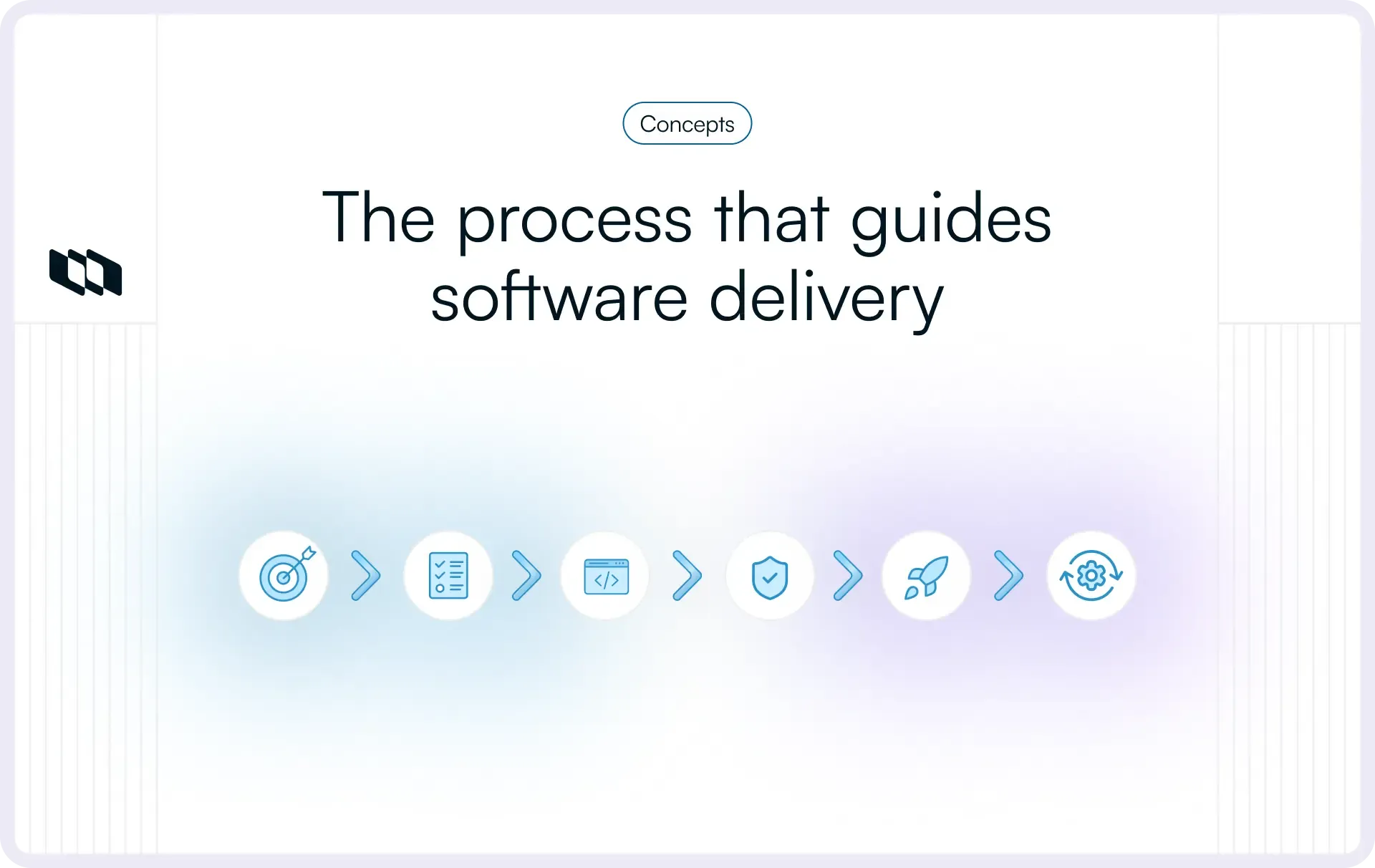
Every software product begins with an idea, but successful products reach users through a repeatable process. Features move through planning, requirements, design, development, testing, deployment, and continuous improvement before they create value. The software development life cycle (SDLC) gives teams the structure to manage each step with clarity and consistency. In this guide, you'll learn what the software development life cycle is, explore the SDLC phases and models, and understand how modern teams deliver high-quality software faster.
What is the software development life cycle (SDLC)?
Every software product follows a series of steps before it reaches users. Teams define requirements, design the solution, write code, test functionality, deploy releases, and continue improving the product over time.
The software development life cycle (SDLC) is a structured framework that defines the stages, activities, and deliverables involved in planning, building, testing, deploying, and maintaining software throughout its lifecycle. It gives product, engineering, and quality assurance teams a consistent approach to delivering software that meets business requirements, user expectations, and quality standards.
What does SDLC mean in software engineering?
In software engineering, the SDLC acts as a roadmap that organizes every stage of product development. It establishes clear workflows, responsibilities, and quality checks so teams can build software efficiently while maintaining alignment across product, engineering, design, and quality assurance.
Why do software teams use the SDLC?
Software teams adopt the SDLC to create a repeatable and predictable development process. It helps them:
- Plan projects with clear goals and requirements.
- Improve collaboration across cross-functional teams.
- Detect issues earlier through structured testing and reviews.
- Deliver higher-quality software with consistent release processes.
- Support ongoing maintenance and future product improvements.
How does SDLC relate to software project management?
The software development life cycle defines how software is built, while software project management focuses on how the work is planned, coordinated, and delivered. Together, they help teams balance technical execution with timelines, resources, budgets, and stakeholder expectations, creating a structured approach to building and shipping software successfully.
Why is the software development life cycle important?
As products grow in complexity, every stage of development requires clear planning and execution. The software development life cycle (SDLC) provides the structure that keeps projects organized, helping teams make informed decisions, manage risks, and deliver software consistently. Let’s explore why the SDLC remains a cornerstone of successful software engineering.
1. Improves project planning
The SDLC begins with planning, ensuring teams define project objectives, scope, timelines, technical requirements, and resource allocation before development starts. This creates a shared understanding of what needs to be built and how success will be measured.
2. Creates development consistency
A standardized development process helps teams follow the same workflows across projects. Clear stages, responsibilities, and review checkpoints improve execution and make it easier for new team members to contribute effectively.
3. Reduces project risks
Potential risks become easier to identify and address when requirements, design decisions, testing activities, and reviews follow a structured framework. Early visibility into technical and project risks supports faster resolution and smoother delivery.
4. Improves software quality
Quality becomes an integral part of the development lifecycle rather than a final checkpoint. Regular testing, code reviews, validation, and quality assurance activities help teams deliver reliable software that meets functional and technical expectations.
5. Enhances collaboration across teams
Software development involves product managers, designers, developers, testers, security teams, and stakeholders. The SDLC establishes clear ownership and communication throughout the project, enabling cross-functional teams to stay aligned from planning through release.
6. Supports predictable software delivery
Defined milestones, review cycles, and release processes improve visibility into project progress. Teams can estimate timelines more accurately, track dependencies, and deliver software through a more predictable release cadence.
7. Simplifies long-term maintenance
Software continues to evolve after deployment through bug fixes, performance improvements, feature enhancements, and security updates. The SDLC provides a structured foundation for maintaining applications throughout their lifecycle, making future updates easier to plan, implement, and manage.
The 7 stages of the software development life cycle
Every software project follows a sequence of activities that transform an idea into a working product. While organizations may use different terminology or combine certain stages, the core software development life cycle (SDLC) remains largely the same. Each stage has a distinct objective, specific activities, and clear deliverables that prepare the team for the next phase of development.
1. Planning
The planning stage establishes the project's direction by defining what the team wants to build, why it matters, and how it will be delivered. It helps stakeholders align on business goals before technical work begins.
During this stage, teams typically:
- Define project goals and expected business outcomes.
- Establish the project scope and priorities.
- Conduct technical, financial, and operational feasibility assessments.
- Estimate budgets, timelines, and resource requirements.
- Identify major risks, assumptions, and project dependencies.
Primary outcome: A project plan that outlines the scope, timeline, resources, feasibility, and overall project strategy.
2. Requirements gathering and analysis
Once the project is approved, teams gather and refine the requirements needed to build the right solution. This stage ensures everyone shares a common understanding of user needs, business objectives, and technical expectations.
Teams focus on:
- Gathering business and user requirements.
- Defining functional and non-functional requirements.
- Identifying technical constraints and compliance needs.
- Creating user stories and acceptance criteria.
- Prioritizing requirements with stakeholders.
Primary outcome: A comprehensive requirements document that guides design and development.
3. System design
The design stage translates requirements into a technical blueprint for the application. It defines how the software will function, how components will interact, and which technologies will support the solution.
Teams typically:
- Design the overall software architecture.
- Plan databases, APIs, and system integrations.
- Create user interface and user experience flows.
- Select frameworks, programming languages, and infrastructure.
- Prepare technical specifications for developers.
Primary outcome: A detailed system design that provides a clear implementation roadmap.
4. Development
The development stage transforms approved designs into working software. Engineers build application features, integrate services, and collaborate closely to maintain code quality throughout implementation.
Common activities include:
- Writing and reviewing application code.
- Building frontend and backend components.
- Integrating databases, APIs, and third-party services.
- Managing source code through version control.
- Performing peer reviews and resolving implementation issues.
Primary outcome: A functional software application ready for comprehensive testing.
5. Testing
Testing verifies that the application performs as expected before reaching users. It helps teams identify defects, validate requirements, and improve overall software quality.
Testing activities often include:
- Functional testing.
- Integration testing.
- Performance and load testing.
- Security testing.
- User acceptance testing and bug resolution.
Primary outcome: A validated application that meets quality, performance, and business requirements.
6. Deployment
Deployment makes the application available in production environments for end users to access. Teams prepare the release carefully to ensure a stable transition from development to production.
This stage usually involves:
- Preparing production environments.
- Deploying application builds.
- Running configuration and database migrations.
- Monitoring release health after deployment.
- Documenting release notes and rollback procedures.
Primary outcome: A successfully deployed software release available to users.
7. Maintenance
Software continues to evolve after deployment. The maintenance stage focuses on keeping the application secure, reliable, and aligned with changing business and user needs.
Teams typically:
- Monitor application performance and reliability.
- Resolve bugs and production issues.
- Release security patches and software updates.
- Improve features based on user feedback.
- Optimize performance and plan future enhancements.
Primary outcome: A stable, secure, and continuously improving software product.
SDLC stages and deliverables
Each stage of the software development life cycle (SDLC) has a specific purpose and produces deliverables that guide the next phase of development. These outputs ensure consistency throughout the software development process, improve collaboration among cross-functional teams, and provide clear documentation for planning, execution, testing, and maintenance. The table below summarizes the primary objective and common deliverables for each stage of the SDLC.
Stage | Primary objective | Common deliverables |
Planning | Define the project's vision, scope, feasibility, and roadmap. | Project plan, business case, feasibility report, project scope, timeline, risk assessment |
Requirements gathering and analysis | Understand business goals, user needs, and technical requirements. | Software Requirements Specification (SRS), user stories, acceptance criteria, functional and non-functional requirements |
System design | Create the technical blueprint for the application. | System architecture, database schema, UI/UX wireframes, API specifications, technical design document |
Development | Build the software according to the approved design. | Source code, feature implementations, code repository, build artifacts, technical documentation |
Testing | Validate software quality, functionality, performance, and security. | Test cases, QA reports, bug reports, automated test results, User Acceptance Testing (UAT) report |
Deployment | Release the software into production environments. | Production build, deployment checklist, release notes, deployment scripts, rollback plan |
Maintenance | Monitor, support, and improve the application after release. | Bug fixes, security patches, performance reports, enhancement backlog, maintenance logs |
Popular SDLC models and methodologies
Each model follows the same fundamental lifecycle but differs in how work is planned, executed, reviewed, and delivered. Understanding these approaches helps teams choose a development methodology that aligns with their product goals and delivery process.
1. Waterfall model
The Waterfall model follows a linear, sequential approach in which each phase of the software development process is completed before the next begins. Planning, requirements, design, development, testing, deployment, and maintenance occur in a fixed order, with limited changes once development is underway.
This model works well for projects with stable requirements, clearly defined scope, and strict documentation needs. Industries such as government, healthcare, and finance often adopt Waterfall for projects that require extensive approvals, compliance, and predictable delivery.
2. Agile model
The Agile model divides software development into short, iterative cycles that deliver working software incrementally. Teams gather feedback throughout development, refine priorities, and continuously improve the product in response to changing user and business needs.
Agile is well suited for products that evolve frequently or require rapid feature delivery. Regular collaboration between product managers, developers, designers, and stakeholders enables teams to respond quickly while maintaining a steady delivery cadence.
3. Iterative model
The Iterative model builds software through repeated development cycles, with each iteration adding new functionality or improving existing features. Teams begin with a basic version of the product and gradually expand it based on testing results and stakeholder feedback.
This approach helps teams validate ideas early, identify improvements sooner, and reduce the risk of discovering major issues late in the project. It is commonly used for large systems that benefit from continuous refinement.
4. Spiral model
The Spiral model combines iterative development with continuous risk assessment. Each development cycle includes planning, risk analysis, engineering, and evaluation before progressing to the next iteration.
Because risk management drives every phase, the Spiral model is often chosen for large, complex, or high-risk projects where technical uncertainty, security, or compliance plays a significant role.
5. V-model
The V-model, or Verification and Validation model, extends the Waterfall approach by pairing every development stage with a corresponding testing activity. Each design decision has a corresponding validation process to ensure requirements are verified throughout development.
This structured approach places strong emphasis on quality assurance and traceability, making it a good fit for industries where software reliability and regulatory compliance are critical.
6. Rapid application development (RAD)
The Rapid Application Development (RAD) model focuses on quickly building working prototypes and refining them through continuous user feedback. Instead of investing heavily in upfront planning, teams prioritize rapid iterations and collaboration with end users.
RAD works best for projects that require fast delivery, evolving requirements, and frequent stakeholder input. It allows teams to validate ideas early while reducing the time between concept and deployment.
7. DevOps model
The DevOps model extends the traditional SDLC by integrating development, testing, deployment, and operations into a continuous workflow. Automation, continuous integration, continuous delivery (CI/CD), and monitoring enable teams to release software more frequently and reliably.
Rather than treating deployment as the final stage, DevOps encourages continuous collaboration across the entire software lifecycle. This approach improves release speed, software quality, operational stability, and feedback loops between development and operations teams.
How DevSecOps strengthens the software development life cycle
DevSecOps integrates security throughout the SDLC, shifting it from a final checkpoint to a shared, continuous responsibility. By embedding security at every stage, teams identify vulnerabilities early, maintain compliance, accelerate delivery, and improve software quality.
Let’s explore how DevSecOps fundamentally strengthens the software development lifecycle.
1. Shift-left security
Shift-left security brings security activities closer to the beginning of the software development process. Teams evaluate security requirements during planning, review architecture during design, and identify potential vulnerabilities before development progresses.
Addressing security earlier reduces remediation costs, shortens feedback cycles, and helps teams build more resilient applications.
2. Secure coding practices
Developers follow secure coding standards throughout implementation to reduce common vulnerabilities and strengthen application security. Security becomes part of everyday development instead of a separate activity before deployment.
Common secure coding practices include:
- Validating user inputs.
- Managing authentication and authorization securely.
- Encrypting sensitive data.
- Protecting secrets and credentials.
- Conducting peer code reviews with security checks.
3. Automated security testing
Modern development pipelines integrate automated security testing alongside functional and performance testing. This enables teams to detect vulnerabilities consistently without interrupting development workflows.
Automated security testing may include:
- Static Application Security Testing (SAST).
- Dynamic Application Security Testing (DAST).
- Dependency and open-source package scanning.
- Container and infrastructure security scanning.
- Secret detection and vulnerability analysis.
4. Continuous monitoring
Security continues after deployment. Teams continuously monitor applications, infrastructure, and production environments to identify unusual activity, performance issues, and emerging threats.
Continuous monitoring helps organizations:
- Detect security incidents early.
- Monitor application health.
- Respond to vulnerabilities faster.
- Improve operational reliability over time.
5. Compliance requirements
Many organizations operate within regulatory frameworks that require secure software development practices. Integrating compliance into the SDLC simplifies audits, improves traceability, and helps teams maintain consistent documentation throughout the software lifecycle.
Depending on the industry, teams may need to align with standards such as ISO 27001, SOC 2, GDPR, HIPAA, or PCI DSS, making security and compliance an ongoing part of software delivery rather than a one-time review before release.
Common challenges in the software development life cycle
A structured software development life cycle (SDLC) improves software delivery, but successful execution still depends on clear planning, collaboration, and continuous improvement. The following challenges commonly affect software projects and can impact quality, timelines, and delivery outcomes.
1. Unclear requirements
Incomplete or ambiguous requirements create confusion during design, development, and testing, often leading to rework and changing priorities.
2. Scope creep
New feature requests and evolving business needs can gradually expand the project scope, affecting timelines, budgets, and resource planning.
3. Communication gaps
Software development relies on close collaboration across product, engineering, design, QA, and operations. Misalignment between teams can slow progress and delay decision-making.
4. Technical debt
Prioritizing short-term delivery over long-term maintainability can increase technical debt, making future enhancements, debugging, and maintenance more complex.
5. Security and compliance risks
Security vulnerabilities and compliance requirements require continuous attention throughout the software development process to protect applications and user data.
SDLC best practices for modern software teams
Following the software development life cycle (SDLC) provides structure, but consistent execution determines project success. These best practices help software teams improve collaboration, maintain quality, and deliver reliable software throughout the development lifecycle.
1. Define requirements clearly
Start every project with well-defined business goals, user requirements, and acceptance criteria. Clear requirements reduce ambiguity and help teams make informed decisions throughout development.
2. Foster cross-functional collaboration
Successful software delivery depends on close collaboration between product managers, designers, developers, QA engineers, security teams, and stakeholders. Shared ownership keeps priorities aligned across every SDLC stage.
3. Build quality into every stage
Quality should remain a continuous focus rather than a final checkpoint. Code reviews, automated testing, and regular validation help teams identify issues early and maintain reliable software.
4. Integrate security from the start
Include security considerations during planning, design, development, testing, and deployment. Embedding security throughout the software development process helps reduce vulnerabilities and supports compliance requirements.
5. Continuously improve the development process
Review completed projects, gather team feedback, monitor development metrics, and regularly refine workflows. Continuous improvement helps teams adapt to changing requirements and deliver software more efficiently over time.
SDLC example: Building a customer feedback platform
Let's see how the software development life cycle (SDLC) works in practice. Imagine a SaaS company wants to build a customer feedback platform where users can submit ideas, vote on feature requests, and track product updates. Here's how the project progresses through each stage of the SDLC.
SDLC stage | How the customer feedback platform moves through the stage |
Planning | The product team identifies the need for a centralized feedback portal, defines the project scope, estimates development effort, sets timelines, and aligns engineering and design teams on project goals. |
Requirements gathering and analysis | Product managers interview customers and internal stakeholders to identify core features, including feedback submission, voting, commenting, search, notifications, and an admin dashboard. Success criteria are defined for every feature. |
System design | Designers create user flows and wireframes, while engineers define the application architecture, database structure, APIs, and technology stack needed to support the platform. |
Development | Developers build the frontend, backend, APIs, authentication, and notification services. Code reviews and version control help maintain quality throughout implementation. |
Testing | QA engineers validate every workflow, including submitting feedback, voting, searching requests, managing user permissions, and sending notifications. Performance and security tests ensure the application is production-ready. |
Deployment | The completed application is released through a production-configured CI/CD pipeline and closely monitored to ensure a smooth rollout for customers. |
Maintenance | After launch, the team monitors usage, fixes reported issues, improves performance, and introduces new features such as AI-powered feedback categorization based on customer requests. |
Result: Instead of treating software development as a collection of independent tasks, the SDLC provides a structured path that helps product, engineering, design, and QA teams collaborate from the initial idea through continuous product improvement.
Final thoughts
The software development life cycle (SDLC) provides a structured framework for turning ideas into reliable software. From planning and requirements gathering to deployment and maintenance, each stage helps teams improve collaboration, maintain quality, and deliver software with greater consistency.
While every organization adapts the SDLC to fit its workflows, goals, and delivery model, the underlying principles remain the same: clear planning, effective collaboration, continuous validation, and ongoing improvement. Choosing the right SDLC model and following proven development practices enables product and engineering teams to build software that meets user needs while remaining scalable, secure, and easier to maintain over time.
Frequently asked questions
Q1. What are the 7 phases of SDLC?
The seven phases of the software development life cycle (SDLC) are planning, requirements gathering and analysis, system design, development, testing, deployment, and maintenance. Together, these stages provide a structured framework for building, releasing, and maintaining software while improving quality, collaboration, and project visibility.
Q2. What are the 8 steps of SDLC?
Some organizations describe the SDLC in eight steps, either by separating feasibility analysis from planning or by including retirement as the final stage. A common eight-step SDLC includes feasibility analysis, planning, requirements gathering, system design, development, testing, deployment, and maintenance. The exact terminology may vary, but the overall software development lifecycle remains the same.
Q3. What are the 4 phases of SDLC?
The four-phase SDLC is a simplified version of the software development life cycle commonly used for smaller projects. It includes planning, development, testing, and maintenance. Many organizations combine requirements gathering with planning and include deployment within development or maintenance, depending on their workflow.
Q4. What are the 7 phases of STLC?
The Software Testing Life Cycle (STLC) consists of seven phases: requirement analysis, test planning, test case development, test environment setup, test execution, defect reporting and retesting, and test closure. While the SDLC manages the entire software development process, the STLC focuses specifically on software testing and quality assurance.
Q5. What are the 5 SDLC models?
The five widely used SDLC models are Waterfall, Agile, Iterative, Spiral, and V-model. Each model follows the same software development life cycle but differs in how development activities are planned, executed, tested, and delivered. The right model depends on factors such as project complexity, requirement stability, team size, and release frequency.
Recommended for you


 Download for Mac
 Download for Android