How to use AI for product discovery: A practical guide
Introduction
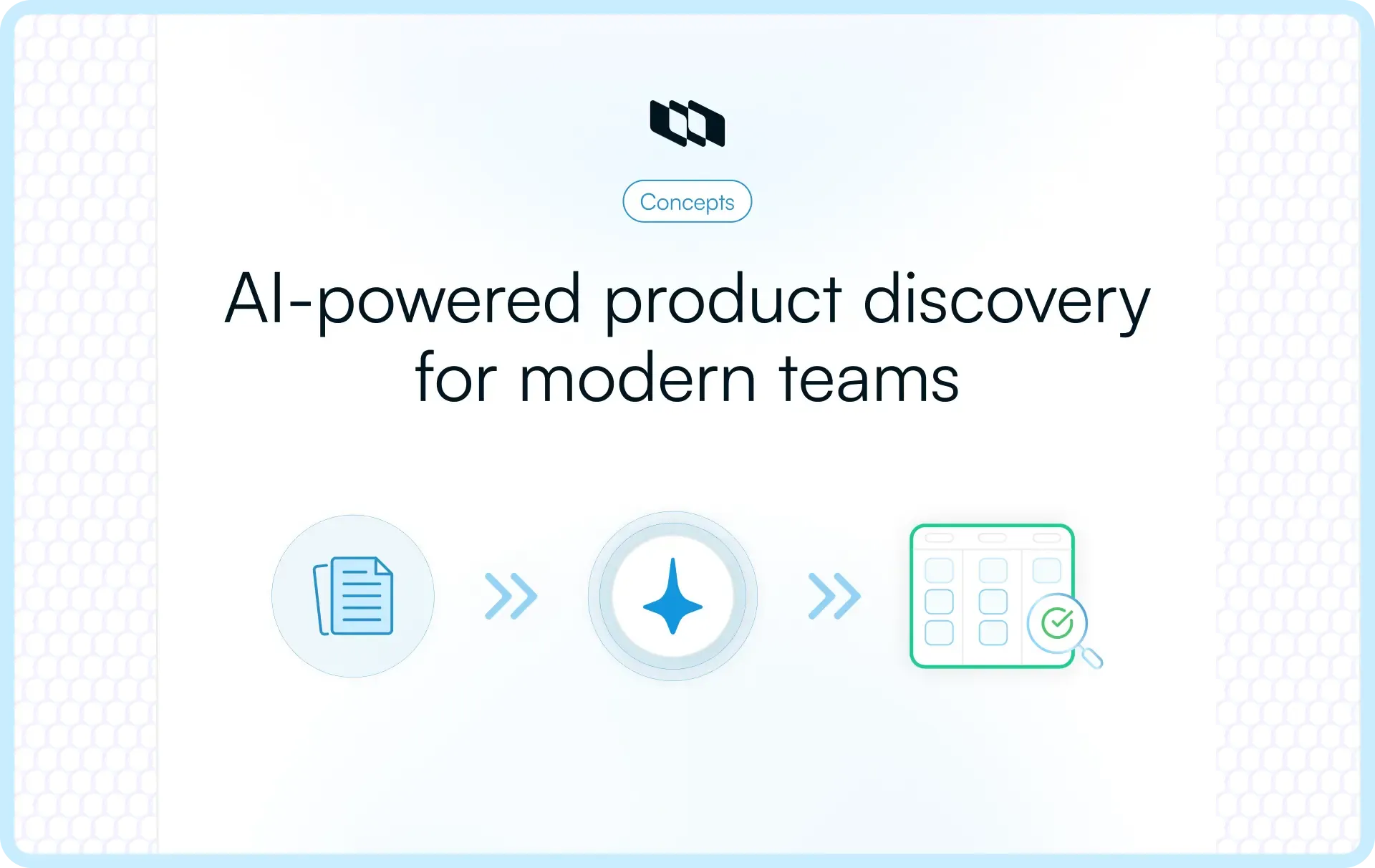
Product teams have more customer feedback, product analytics, and market signals than ever before. The challenge is turning that information into decisions before opportunities pass. Learning how to use AI for product discovery helps teams analyze research faster, uncover recurring customer needs, and validate ideas with greater confidence. AI-powered product discovery supports every stage of the process, from user research to prioritization, while leaving strategic decisions where they belong, with the people building the product. This guide explains how to use AI effectively throughout the product discovery process.
What is AI-powered product discovery?
Let's look at what product discovery involves, how AI fits into the process, and why human judgment remains central to building successful products.
What is product discovery?
Product discovery is the process of identifying the right problems to solve before investing engineering effort. Rather than starting with features, teams begin by understanding customer needs, validating assumptions, researching the market, and exploring potential solutions.
A typical product discovery process includes activities such as:
- Conducting user research and customer interviews
- Analyzing customer feedback and product analytics
- Identifying pain points and unmet needs
- Evaluating market opportunities
- Generating and validating solution ideas
- Prioritizing opportunities based on customer value and business impact
The goal is to reduce risk by ensuring the team is solving a meaningful problem before moving into product delivery.
What is AI-powered product discovery?
AI-powered product discovery applies artificial intelligence to support the research, analysis, and decision-making activities that happen throughout product discovery. Instead of manually reviewing hundreds of interviews, support tickets, survey responses, or feature requests, teams can use AI to organize information, identify recurring themes, summarize research, and surface insights more efficiently.
Teams commonly use AI for product discovery to:
- Summarize customer interviews and user research
- Analyze customer feedback from multiple channels
- Cluster similar feature requests and pain points
- Identify trends across qualitative and quantitative data
- Generate hypotheses and explore potential solutions
- Draft research summaries and product documentation
By reducing the time spent on repetitive analysis, AI allows product managers to focus more on interpreting insights, validating opportunities, and making informed product decisions.
How AI changes the traditional product discovery process
AI doesn't change the goals of product discovery; it changes how quickly teams can move through each stage. Activities that once required hours of manual review, such as organizing interview notes or analyzing hundreds of support conversations, can now be completed in minutes with AI-assisted workflows.
This allows product teams to review more customer evidence, explore a wider range of ideas, and iterate on product hypotheses faster. Instead of replacing established discovery practices, AI makes existing workflows more efficient and scalable.
Why AI supports rather than replaces product managers
AI can identify patterns, summarize information, and generate suggestions, but it cannot understand customer context, evaluate business trade-offs, or define product strategy. Those responsibilities still belong to product managers and the teams they work with.
Successful product discovery depends on customer empathy, strategic thinking, and continuous validation. AI provides faster access to information and helps teams work through large volumes of data, while product managers determine which problems matter, which opportunities align with business goals, and which ideas deserve investment.
The strongest product teams use AI as a research and analysis partner, allowing technology to handle repetitive work while people remain responsible for the decisions that shape the product.
Why AI is becoming essential for product discovery
Product teams today process customer feedback, research, analytics, and market signals from more sources than ever before. AI helps make sense of this growing volume of information and supports faster, evidence-based discovery. Let's look at the key reasons more product teams are making AI part of their discovery workflows.
1. Managing large volumes of customer feedback
Feedback arrives through interviews, support tickets, surveys, sales calls, reviews, and community discussions. AI for customer feedback analysis helps teams group similar responses, identify recurring pain points, and summarize large volumes of qualitative data.
2. Accelerating user and market research
Research often slows down because teams spend significant time organizing notes and comparing findings. AI can summarize interviews, analyze survey responses, and consolidate market research, helping teams reach useful insights sooner.
3. Finding patterns across multiple data sources
A single customer problem may appear across product analytics, support conversations, and user research. AI-powered product discovery helps connect these signals, giving teams a clearer view of which problems recur and are worth exploring further.
4. Validating ideas faster
AI can help teams review supporting evidence, refine hypotheses, and prepare questions for customer interviews or concept tests. This shortens the time between identifying an idea and determining whether it deserves further investment.
5. Reducing manual analysis and repetitive work
Tasks such as tagging feedback, summarizing interviews, organizing research, and drafting reports take time without directly improving product judgment. AI tools for product discovery can handle much of this work, leaving teams with more time for customer conversations and strategic decisions.
6. Improving confidence in product decisions
AI helps teams work with a broader set of evidence before prioritizing an opportunity. By making research easier to review and compare, it supports decisions that are grounded in customer needs, market context, and product data.
Where AI fits in the product discovery lifecycle
AI can support nearly every stage of the product discovery process, from understanding customer problems to documenting validated opportunities. While the activities remain the same, AI helps teams complete them faster by organizing information, surfacing insights, and reducing manual effort. Let's look at how AI fits into each stage of the product discovery lifecycle.
1. Discover customer problems
The first step in product discovery is understanding what customers are trying to achieve and where they encounter friction. These insights often come from multiple channels, making it difficult to manually identify the most important issues.
AI helps product teams:
- Analyze customer feedback from support tickets, reviews, and community discussions.
- Summarize customer interviews to highlight key takeaways.
- Identify recurring pain points across different feedback sources.
- Detect emerging trends before they become widespread customer requests.
Instead of reviewing every conversation individually, teams can quickly understand which problems appear consistently and deserve further investigation.
2. Conduct user research
User research generates valuable qualitative data, but organizing and interpreting that information takes time. AI helps researchers and product managers spend less effort on documentation and more on understanding customer behavior.
AI can help teams:
- Organize interview notes and qualitative research.
- Build customer personas from research findings.
- Analyze survey responses at scale.
- Segment customers based on shared behaviors or needs.
This makes research easier to revisit and compare as new insights emerge.
3. Perform market and competitive research
Understanding the market is just as important as understanding customers. Product teams need to monitor competitors, changing customer expectations, and industry trends throughout the discovery process.
AI supports this work by helping teams:
- Identify potential market opportunities.
- Monitor industry news and emerging trends.
- Analyze competitor features and product updates.
- Compare product positioning across multiple solutions.
Rather than replacing strategic analysis, AI speeds up information gathering so teams can focus on interpreting its meaning.
4. Generate product ideas
Once teams understand the problem, they can begin exploring possible solutions. AI expands brainstorming by generating multiple directions that product teams can evaluate and refine.
Teams commonly use AI to:
- Brainstorm feature ideas.
- Explore different solution approaches.
- Refine problem statements.
- Generate product hypotheses for validation.
These suggestions provide additional perspectives, while product managers determine which ideas align with customer needs and business goals.
5. Validate product concepts
Every proposed solution needs evidence before development begins. AI helps organize that evidence and makes it easier to compare findings from different research activities.
During validation, AI can:
- Evaluate assumptions against available research.
- Summarize findings from interviews and usability studies.
- Analyze customer feedback related to proposed concepts.
- Assess signals that indicate potential customer demand.
This allows teams to move into prioritization with a stronger understanding of which ideas are supported by research.
6. Prioritize opportunities
Discovery often produces more opportunities than a team can pursue. Prioritization requires balancing customer value, business impact, and engineering effort.
AI helps support these discussions by:
- Grouping similar feature requests and customer problems.
- Estimating customer impact based on research patterns.
- Comparing opportunities using consistent criteria.
- Summarizing evidence for prioritization workshops and planning sessions.
The final prioritization decisions still depend on product strategy, but AI makes the supporting information easier to review.
7. Document and communicate discoveries
The final stage of product discovery is sharing what the team has learned. Clear documentation helps align engineering, design, leadership, and other stakeholders before development begins.
AI can assist by:
- Drafting discovery reports.
- Creating first drafts of product requirement documents (PRDs).
- Preparing stakeholder updates.
- Summarizing research outcomes into concise documentation.
Well-organized documentation preserves the context behind product decisions and ensures valuable discovery work remains accessible long after the research is complete.
Practical ways to use AI for product discovery
Once teams understand where AI fits in the product discovery lifecycle, the next question is how to use it in daily work. AI tools for product discovery are most useful when they reduce manual effort around research, synthesis, ideation, and documentation. Let’s look at the workflows where they create the clearest value.
1. Generate customer interview questions
Customer interviews are only useful when the questions are specific enough to reveal real behavior. AI can help product managers prepare sharper interview guides based on the problem area, user segment, product usage data, or feature idea being explored.
For example, if a team wants to understand why users drop off during onboarding, AI can generate questions around first impressions, setup friction, unclear terminology, missing guidance, and moments where the user expected something different. The product manager can then refine those questions based on the customer profile and research goal.
A useful prompt might look like: “Create 12 customer interview questions for product managers researching onboarding friction in a B2B SaaS product. Focus on actual user behavior, decision points, confusion, and unmet expectations.”
AI is especially helpful for producing a first draft, removing leading questions, and making sure the interview covers different angles. The final interview guide should still be reviewed by the team to ensure the questions align with the research objective.
2. Summarize interview transcripts
Interview transcripts often contain valuable insights, but reviewing them manually takes time. AI can summarize long transcripts into themes, quotes, pain points, objections, desired outcomes, and open questions.
This is one of the simplest ways to use AI for user research. Teams can process interviews faster and compare findings across multiple conversations without losing the original context. For example, after five customer interviews, AI can help identify which problems recurred, which were isolated, and which comments require deeper follow-up.
A good transcript summary should include:
- Key problems mentioned by the customer
- Current workarounds
- Emotional signals such as frustration, hesitation, or urgency
- Feature requests or solution ideas
- Quotes worth preserving
- Follow-up questions for the next interview
The important part is to keep the transcript accessible. AI summaries are useful for navigation, but product managers should still return to the original conversation when an insight affects prioritization or product strategy.
3. Cluster customer feedback into themes
Customer feedback usually arrives in messy, inconsistent language. Ten customers may describe the same problem in ten different ways. AI for customer feedback analysis helps teams group related comments into themes so they can understand the underlying problem more clearly.
For example, users might submit feedback such as:
- “I cannot find older tasks.”
- “Search does not show what I need.”
- “Filters are confusing.”
- “I keep losing track of work items.”
Individually, these look like separate requests. Together, they may point to a broader discoverability problem. AI can help group this feedback under themes such as search, navigation, filtering, information architecture, or task visibility.
This helps product teams avoid reacting to every request as a separate feature idea. They can look at the pattern behind the feedback and ask a better question: what problem are customers repeatedly trying to solve?
4. Identify feature requests and recurring problems
Product teams often receive feature requests through support tickets, sales calls, community posts, internal Slack messages, and customer success notes. Without a clear system, these requests become scattered and hard to evaluate.
AI can help extract feature requests from unstructured feedback and connect them to recurring customer problems. This is useful because customers often ask for a specific solution, while the product team needs to understand the need behind it.
For example, a customer may ask for “custom dashboards,” but the real problem could be that their team cannot track project health across multiple workspaces. AI can help separate the requested feature from the underlying pain point, then group similar requests for review.
This workflow is especially useful when paired with a product management system where insights can be linked to work items, requirements, or roadmap discussions. The value comes from preserving the relationship between customer evidence and product decisions.
5. Create customer personas
Personas are useful when they are based on real research rather than assumptions. AI can help synthesize interview notes, survey responses, CRM data, and product usage patterns into persona drafts that product teams can refine.
A strong AI-assisted persona should include:
- Role and responsibilities
- Primary goals
- Common workflows
- Key frustrations
- Decision-making context
- Tools already used
- Success criteria
- Buying or adoption concerns, if relevant
For example, a product team building for engineering managers may use AI to compare feedback from different segments: startup engineering leads, platform teams, and enterprise engineering managers. The output can help identify where needs overlap and where the product experience may need to differ.
The best personas stay grounded in evidence. AI can organize the material, but the team should validate whether the persona reflects actual customers.
6. Analyze competitors more efficiently
Competitive research can consume a lot of time because information is spread across websites, changelogs, docs, pricing pages, customer reviews, analyst reports, and social conversations. AI helps consolidate this information into structured summaries that are easier to compare.
Product teams can use AI to analyze:
- Competitor positioning
- Feature coverage
- Pricing and packaging
- Product gaps
- Customer complaints
- Messaging changes
- Release patterns
- Differentiation claims
For example, a team evaluating how competitors handle project timelines can ask AI to compare public documentation, feature pages, and customer reviews, then organize the findings by usability, collaboration, reporting, and deployment model.
The team should verify anything that affects positioning, pricing, security, or roadmap decisions. Competitive analysis works best when AI speeds up the first pass, and humans review the claims that matter.
7. Generate product hypotheses
A product hypothesis connects a customer problem, a proposed solution, and an expected outcome. AI can help turn raw research into clear hypotheses that teams can test.
For example: “If product managers can group related customer feedback by theme, they will identify high-priority opportunities faster and reduce time spent manually reviewing support tickets.”
AI can generate multiple hypotheses from the same research set, helping teams explore different angles before committing to one solution. This is useful during early discovery, when the goal is to determine what to validate next.
A good hypothesis should be specific enough to test. It should include the target user, the problem, the expected change in behavior, and the metric or signal that would indicate progress.
8. Brainstorm multiple solution approaches
Once a team understands the problem, AI can help generate a broader set of solution ideas. This is useful when teams feel anchored to the first obvious feature or when they need to explore different levels of effort.
For example, if the problem is “users cannot understand project progress quickly,” AI can suggest solution directions such as:
- A project health summary
- A timeline view
- Progress indicators on work items
- Automated weekly status updates
- A dashboard for blocked work
- A digest of changes since the last review
The point is to widen the solution space before narrowing it. Product managers, designers, and engineers can then evaluate which ideas fit the customer need, product strategy, and technical constraints.
This workflow also helps engineering teams participate earlier in the discovery process. AI-generated options can serve as a starting point for feasibility discussions, trade-off analyses, and small-scale experiments.
9. Draft product requirement documents
PRDs often become time-consuming because product managers need to translate research into clear requirements for design and engineering. AI can create a structured first draft from discovery notes, customer insights, product hypotheses, and agreed priorities.
A useful AI-assisted PRD draft may include:
- Problem statement
- Target users
- Customer evidence
- Goals and non-goals
- Proposed solution
- User stories
- Functional requirements
- Edge cases
- Success metrics
- Open questions
- Dependencies
This reduces the time spent creating the initial structure. The product manager still needs to refine the scope, clarify trade-offs, remove weak assumptions, and work with engineering on feasibility.
In a product management workflow, tools like Plane are especially useful. Discovery notes, requirements, work items, cycles, and roadmap discussions need to stay connected so teams can see why a feature exists, what customer problem it solves, and how it moves through delivery.
10. Create discovery summaries for stakeholders
Discovery work loses value when the findings stay inside interview notes, research docs, or scattered conversations. Stakeholders need a clear summary of what the team learned, the evidence supporting it, and the recommended decision.
AI can help turn research material into concise discovery updates for leadership, engineering, design, sales, support, or customer success teams.
A useful discovery summary should cover:
- What problem was explored
- Which customer segments were studied
- What evidence was reviewed
- What patterns emerged
- Which assumptions were validated or challenged
- What the team recommends next
- What decisions or inputs are needed from stakeholders
This makes product discovery easier to communicate across the organization. It also helps teams maintain a clear record of why certain opportunities were prioritized, delayed, or rejected. For product and engineering teams working in fast-moving environments, that context is often what prevents discovery from becoming disconnected from delivery.
How AI improves each product discovery activity
AI works best when it strengthens the discovery practices teams already use. It helps product managers move faster through research, synthesis, and documentation without removing the need for customer judgment. The table below compares how common product discovery activities change when AI is integrated into the workflow.
Product discovery activity | Traditional approach | AI-assisted approach |
Customer interviews | Product managers manually prepare questions, take notes, review transcripts, and extract key takeaways after each conversation. | AI helps generate interview guides, summarize transcripts, highlight pain points, preserve useful quotes, and suggest follow-up questions for deeper research. |
Feedback analysis | Teams review support tickets, feature requests, sales notes, reviews, and customer messages manually, often across disconnected tools. | AI groups similar feedback, identifies recurring themes, separates feature requests from underlying problems, and helps teams spot patterns across large volumes of input. |
Survey analysis | Responses are exported, cleaned, tagged, and reviewed manually, which can delay the generation of insights when response volume is high. | AI analyzes open-ended responses, clusters themes, summarizes sentiment, and highlights differences across user segments or customer groups. |
Competitive research | Product teams manually review competitor websites, docs, changelogs, pricing pages, reviews, and public messaging. | AI consolidates competitor information, compares features and positioning, summarizes customer complaints, and helps teams identify gaps worth investigating. |
Idea generation | Teams rely on brainstorming sessions, internal opinions, and past experience to explore possible solutions. | AI generates multiple solution directions, reframes problem statements, expands the range of ideas, and helps teams explore alternatives before narrowing the scope. |
Documentation | Product managers spend significant time turning research notes into PRDs, discovery summaries, stakeholder updates, and planning docs. | AI creates structured first drafts from research inputs, helping teams document decisions, requirements, evidence, open questions, and next steps more efficiently. |
Prioritization | Teams compare opportunities using meetings, spreadsheets, customer anecdotes, and manually collected evidence. | AI summarizes supporting evidence, groups related requests, compares customer impact signals, and provides teams with clearer input for prioritization discussions. |
The biggest improvement is consistency. Traditional product discovery often depends on how much time a team has to clean, review, and connect scattered information. AI helps create a more repeatable discovery workflow by keeping research organized, making patterns easier to see, and giving product teams better inputs before they make decisions.
Benefits of using AI for product discovery
When used thoughtfully, AI helps product teams make discovery faster, more organized, and easier to connect with product decisions. The value is highest when AI supports research and synthesis, while the team keeps ownership of judgment, prioritization, and strategy. Let’s look at the main benefits.
1. Speeds up research and analysis
Research often slows down because teams need to review interviews, surveys, support tickets, product analytics, and market notes before finding useful patterns. AI reduces that review time by summarizing inputs, extracting key themes, and making large amounts of information easier to scan. This helps product managers move from raw research to usable insight faster.
2. Uncovers insights from large datasets
As products grow, customer signals become harder to track manually. A recurring problem may appear across feedback forms, sales calls, support tickets, and user research, but remain hidden because the data is spread across different places. AI-powered product discovery helps connect those signals and surface patterns that may be easy to miss in manual review.
3. Reduces repetitive manual work
A lot of product discovery work involves necessary but repetitive tasks: tagging feedback, cleaning notes, summarizing calls, organizing research, and preparing updates. AI can handle the first pass on these tasks, giving teams more time for customer conversations, problem framing, and decision-making.
4. Enables broader idea exploration
Product teams often move quickly toward the first solution that seems reasonable. AI helps widen the exploration phase by generating alternate approaches, reframing problems, and suggesting different ways to test an idea. This gives product managers, designers, and engineers more options to evaluate before choosing a direction.
5. Supports more evidence-based decision-making
Using AI for product discovery helps teams bring more evidence into prioritization conversations. Instead of relying only on recent feedback or the loudest customer request, teams can review patterns across a broader set of research inputs. That makes product decisions easier to explain, defend, and revisit later.
6. Improves cross-functional collaboration
Product discovery works best when product, design, engineering, sales, support, and leadership share the same context. AI helps turn research into clear summaries, PRDs, stakeholder updates, and opportunity briefs. When discovery findings are easier to understand, teams can align faster on what matters, why it matters, and what should happen next.
Challenges and limitations of using AI for product discovery
AI can accelerate discovery, but it also introduces risks that product teams need to manage carefully. The quality of the output depends on the quality of the inputs, prompts, review process, and human judgment behind it. The following limitations are important to understand before making AI a core part of discovery.
1. AI can generate inaccurate or misleading outputs
AI can confidently summarize research, even when the summary omits context, overstates a pattern, or includes details that were never present in the source material. This is especially risky in product discovery because a small misunderstanding can influence roadmap decisions, user stories, or prioritization.
Product teams should treat AI outputs as drafts that need review. Any insight that affects product direction should be checked against the original interview, feedback thread, survey response, analytics report, or customer conversation.
2. AI reflects the quality of the input data
AI works with the information it receives. If the input data is incomplete, outdated, biased, or poorly organized, the output will inherit those weaknesses.
For example, if a team only analyzes feedback from enterprise customers, AI may surface enterprise-heavy priorities while missing needs from smaller teams or newer users. If support tickets are poorly tagged, AI may group unrelated issues together. Good discovery still requires clean research inputs, clear segmentation, and careful interpretation.
3. Customer empathy cannot be automated
AI can summarize what customers said, but it cannot fully understand hesitation, urgency, frustration, motivation, or context in the same way a product manager can during a real conversation. Some of the most useful discovery insights come from follow-up questions, pauses, contradictions, and details that only become clear through direct interaction.
AI helps teams process customer research, but product managers still need to spend time with users. Discovery loses depth when teams only read summaries and stop listening to customers directly.
4. Privacy and security considerations
Product discovery often involves sensitive information: customer names, company context, usage patterns, internal workflows, pricing concerns, roadmap requests, and support history. Sending this data into AI tools without the right controls can create privacy, compliance, or security risks.
Teams should be clear about what data can be shared, which tools are approved, how customer information is handled, and whether sensitive inputs need to be anonymized. For self-hosted or regulated environments, these questions matter even more because discovery data may include information that cannot leave controlled infrastructure.
5. Bias in AI-generated insights
AI can amplify bias in the data it analyzes. If the loudest customers submit the most feedback, AI may make their problems appear more important than they are. If research participants come from a narrow user segment, AI may generalize their needs across the entire customer base.
Bias can also appear in how prompts are written. A prompt that asks AI to “prove demand for this feature” will produce a different result from one that asks it to evaluate both supporting and conflicting evidence. Product teams should look for counter-signals, carefully segment findings, and avoid treating frequency alone as proof of importance.
6. Human validation remains essential
AI can help identify patterns, summarize evidence, and suggest product hypotheses, but validation still requires real customer feedback, product judgment, and business context. A theme that appears often in feedback may still have low strategic value. A feature request may be common but technically expensive. A promising idea may fail when tested with actual users.
The role of AI is to support discovery work with faster synthesis and broader analysis. The responsibility for deciding what to build stays with the team. Product managers, designers, engineers, and stakeholders need to review the evidence, challenge assumptions, and validate ideas before they are added to the roadmap.
How to implement AI into your product discovery process
AI works best when it is introduced into a clear discovery workflow, not added randomly across research tasks. The goal is to make evidence easier to collect, compare, and act on. The following framework explains how to use AI for product discovery from problem definition to stakeholder alignment.
Step 1. Define the customer problem
Start with a clear problem area before bringing AI into the workflow. A vague prompt will produce vague output, and vague output rarely helps product decisions.
The team should first define:
- Which customer segment is affected
- What behavior or outcome needs to be understood
- Where the problem appears in the product experience
- What evidence already exists
- What decision the discovery work needs to support
For example, “users are asking for better reporting” is too broad. A stronger problem statement would be: “Engineering managers need a faster way to understand project health across multiple teams before weekly planning meetings.”
That level of clarity gives AI a useful frame. It can then help generate research questions, identify related feedback, summarize existing evidence, and suggest what the team should investigate next.
Step 2. Gather customer and market data
AI needs strong inputs to produce useful outputs. Before using AI for product discovery, bring together the research and signals that already exist across the organization.
Useful sources include:
- Customer interviews
- Support tickets
- Sales and customer success notes
- Feature requests
- Product analytics
- Survey responses
- App reviews
- Community discussions
- Competitor research
- Market reports
- Changelog and release notes from competing products
The goal is to create a broader view of the problem rather than relying on one loud request or one recent conversation. For product teams, this step is often where the real work begins. AI can help later, but the quality of discovery depends heavily on the quality and range of evidence the team collects.
Step 3. Organize and synthesize information using AI
Once the inputs are collected, AI can help turn scattered data into a structured research base. This is one of the clearest uses of AI-powered product discovery because it reduces the manual effort required to review and sort information.
Teams can use AI to:
- Summarize interview transcripts
- Group similar support tickets
- Tag feedback by theme
- Identify recurring pain points
- Extract feature requests
- Compare survey responses
- Highlight open questions
- Create research summaries
For example, a product manager might upload interview notes from ten customers and ask AI to group the findings by problem, workflow, urgency, user segment, and existing workaround. This gives the team a cleaner starting point for analysis without having to manually tag every note.
The output should still be reviewed carefully. AI synthesis improves speed and structure, while the product team determines which insights are meaningful.
Step 4. Identify patterns and opportunities
After synthesis, look for repeated signals across different sources. A strong opportunity usually appears in more than one place: interviews, support tickets, analytics, sales conversations, or market research.
AI can help answer questions such as:
- Which problems appear most often?
- Which customer segments mention the problem?
- Which pain points seem urgent?
- Where are customers creating workarounds?
- Which requests point to the same underlying need?
- Which problems connect to business goals?
- Which findings need more validation?
This step moves the team from raw feedback to opportunity discovery. Instead of treating every request as a roadmap candidate, the team can identify larger patterns and decide which problems deserve deeper exploration.
For example, five separate requests for dashboards, exports, status reports, timeline views, and project summaries may all point to the same opportunity: customers need a clearer way to understand progress across workstreams.
Step 5. Generate and refine solution ideas
Once the opportunity is clear, AI can help expand the solution space. This is useful because teams often move too quickly from problem to feature, especially when customer feedback arrives as direct requests.
Product teams can ask AI to generate different solution approaches based on:
- Customer problem
- User segment
- Current workflow
- Existing product behavior
- Technical constraints
- Desired outcome
- Success metric
For example, if the problem is “project leads cannot quickly understand what changed across active initiatives,” AI could suggest a weekly digest, an activity summary, a dashboard widget, a timeline filter, a project health view, or a notification workflow.
The team should then refine these ideas with design and engineering. Some solutions may be too complex, some may solve only part of the problem, and some may introduce friction elsewhere in the product. AI helps generate options, while product and engineering judgment determines which ones are realistic.
Step 6. Validate assumptions with customers
Every solution idea carries assumptions. Customers may want the outcome, but reject the proposed workflow. They may describe a problem often, but only experience it in a narrow context. They may ask for a feature because they do not know a better alternative exists.
Use AI to identify the assumptions behind each idea before validation begins. For example:
- Which user has this problem?
- How often does the problem occur?
- What happens when the problem is unresolved?
- What workaround does the customer use today?
- Why would the proposed solution be better?
- What would make the solution fail?
- What signal would prove the idea is worth pursuing?
AI can also help create concept test scripts, usability questions, survey drafts, and follow-up interview guides. The validation itself should happen with real customers. This is where product managers need direct conversations, careful listening, and the ability to challenge their own assumptions.
Step 7. Prioritize opportunities based on evidence
Once the team has validated a set of opportunities, AI can help prepare the evidence for prioritization. This matters because prioritization discussions often become opinion-heavy when research is scattered or hard to compare.
AI can help summarize each opportunity by:
- Customer segment affected
- Frequency of the problem
- Severity of the pain point
- Supporting research
- Business impact
- Product area affected
- Dependencies
- Risks and open questions
- Possible success metrics
This creates a clearer basis for deciding what should move forward. Product managers can compare opportunities using evidence rather than isolated anecdotes, while engineering teams can add feasibility, complexity, and implementation context.
Step 8. Document insights and align stakeholders
The final step is turning discovery work into shared context. A decision is easier to support when stakeholders understand the customer problem, the evidence behind it, the options considered, and why the team chose a specific direction.
AI can help create:
- Discovery summaries
- PRD drafts
- Opportunity briefs
- Stakeholder updates
- Research reports
- Decision notes
- Planning inputs for design and engineering
A strong discovery summary should answer a few practical questions: what problem did we study, what did customers say, what patterns did we find, what assumptions did we validate, what are we recommending, and what happens next?
This is also where product discovery connects with execution. Teams need a clear trail from customer insight to product decision to planned work. When that context is documented well, engineers understand why a feature matters, designers understand the user problem, and leadership can see how the work connects to product strategy.
Common mistakes to avoid when using AI for product discovery
AI can make discovery faster, but only when teams use it with clear inputs, real customer evidence, and careful review. Most problems stem from treating AI outputs as finished answers rather than as working material. The following mistakes are worth avoiding.
1. Treating AI as the decision-maker
AI can summarize feedback, identify patterns, and suggest next steps, but product decisions still need human judgment. Product managers need to weigh customer needs, business priorities, technical constraints, and timing before deciding what moves forward. Use AI as a research assistant, then let the team make the call.
2. Skipping customer research
AI can work with existing research, but it cannot replace direct customer conversations. If the team only relies on AI-generated assumptions, discovery becomes disconnected from real user behavior. The strongest use of AI for product discovery starts with customer interviews, feedback, support conversations, product analytics, and market research.
3. Accepting AI outputs without verification
AI can produce summaries that sound complete while missing important context. It may overstate a pattern, group unrelated feedback together, or ignore a detail that matters. Before using an AI-generated insight in prioritization or roadmap planning, review the original source. This is especially important for customer quotes, product gaps, pricing research, and competitive claims.
4. Using AI without clear discovery goals
AI performs better when the team knows what it is trying to learn. A broad request like “analyze this feedback” often produces broad results. Give AI a clear frame: the customer segment, product area, research question, decision to support, and type of output needed. The more specific the discovery goal, the more useful the analysis becomes.
5. Ignoring qualitative customer insights
Quantitative signals can show what is happening, but qualitative research helps explain why. Product teams lose important context when they only ask AI to summarize numbers, categories, or feedback volume. User research, interview notes, and open-ended feedback help teams understand motivation, urgency, workflow constraints, and emotional friction. Those details often shape better product decisions.
6. Relying on a single AI tool or model
Different AI tools handle research, synthesis, transcription, search, and documentation differently. Relying on one tool for every part of AI-powered product discovery can limit the quality of the output.
Use the right tool for the task, compare outputs when the decision matters, and keep the discovery process grounded in source material rather than generated summaries alone.
The future of AI in product discovery
AI in product discovery is moving from isolated tasks toward continuous workflows that help teams learn, decide, and document faster. The next phase will be less about one-off prompts and more about systems that keep customer intelligence active across the product lifecycle. Let’s look at what that shift may look like.
1. Continuous customer intelligence
Product discovery is becoming more continuous. Instead of waiting for quarterly research projects or scattered feedback reviews, teams will increasingly use AI to monitor customer signals as they arrive.
This could include support tickets, product analytics, sales notes, churn reasons, customer calls, community discussions, and feature requests. AI can help organize these signals into themes, detect changes in customer behavior, and show which problems are becoming more frequent.
For product teams, this creates a more active feedback loop. Discovery becomes easier to integrate into roadmap planning because insights are captured throughout the year rather than only when a new initiative begins.
2. AI-powered product research assistants
AI-powered research assistants will become more common in product management workflows. These assistants may help product managers prepare interview guides, summarize customer conversations, compare findings, and suggest follow-up questions based on previous research.
A product manager exploring onboarding friction, for example, could ask an assistant to pull related feedback, summarize past interviews, identify open assumptions, and recommend the next set of users to speak with. This speeds up research preparation while keeping the product manager focused on the actual customer problem.
The value will come from context. AI assistants that understand the product, customer segments, existing roadmap, and past discovery work will be far more useful than generic chat interfaces.
3. Predictive opportunity discovery
As AI systems become better at connecting signals, product teams may be able to identify opportunities earlier. Predictive opportunity discovery could help teams spot patterns before they become obvious through volume alone.
For example, a small rise in support tickets, lower usage of a specific workflow, recurring sales objections, and similar feedback from customer interviews may collectively suggest an emerging product gap. AI can help connect those signals and bring them to the team’s attention sooner.
This will not remove the need for validation. It will give teams earlier signals to investigate, helping them decide which opportunities deserve deeper research before they become urgent problems.
4. AI-generated prototypes and experiments
AI will also make prototyping faster. Product teams will be able to move from problem statements to wireframes, workflow drafts, copy variations, user flows, and experiment ideas with less manual setup.
This can help product managers and designers test more directions before committing engineering effort. A team might generate several onboarding flows, compare different dashboard concepts, or create multiple versions of a feature explanation for user testing.
The best use of AI-generated prototypes will be early exploration. They help teams make ideas tangible, collect feedback sooner, and refine the direction before design and engineering invest in production-ready work.
5. Human-AI collaboration in product management
The future of AI-powered product discovery will depend on how well product teams combine automation with judgment. AI can process information, identify patterns, and create drafts, but product management still requires taste, context, empathy, and decision-making.
Product managers will spend less time organizing research and more time asking better questions: which customer problem matters most, what evidence is strong enough, what trade-offs are acceptable, and which opportunity aligns with the product strategy.
The teams that benefit most from AI will be the ones that build strong discovery habits around it. Clear research goals, good source material, careful validation, and shared documentation will matter even more as AI becomes part of everyday product work.
Final thoughts
Using AI for product discovery works best when it improves the habits product teams already rely on: listening to customers, reviewing evidence, testing assumptions, and documenting decisions clearly. It can reduce the time spent sorting feedback, summarizing research, comparing inputs, and preparing discovery artifacts, giving teams more room to focus on judgment and strategy.
The real value comes from keeping discovery connected to execution. When research insights, product hypotheses, PRDs, work items, and roadmap decisions stay linked, teams can see why something is being built, who it serves, and what outcome it should create.
Frequently asked questions
Q1. How can AI be used for product discovery?
AI can support product discovery by analyzing customer feedback, summarizing user interviews, organizing research, identifying recurring pain points, generating product hypotheses, and helping teams validate ideas more efficiently. It speeds up research and synthesis, allowing product managers to spend more time making informed decisions.
Q2. Can AI replace product managers in the product discovery process?
No. AI can process information and surface insights, but it cannot understand customer context, evaluate business trade-offs, or define product strategy. Product managers remain responsible for validating opportunities, prioritizing work, and making product decisions.
Q3. What are the benefits of using AI for product discovery?
Using AI for product discovery helps teams analyze research faster, uncover patterns across large datasets, reduce repetitive manual work, generate solution ideas, and make more evidence-based product decisions. It also improves collaboration by making research easier to document and share.
Q4. What types of product discovery activities can AI assist with?
AI can assist with customer feedback analysis, user research, market and competitive research, interview summaries, persona creation, idea generation, product hypothesis development, PRD drafting, and discovery documentation. It is most effective when used to support research and analysis rather than replace customer validation.
Q5. What are the biggest challenges of using AI in product discovery?
Some common challenges include inaccurate AI-generated outputs, low-quality input data, research bias, privacy concerns, and overreliance on AI recommendations. Teams should always validate AI-generated insights with customer research and use human judgment before making product decisions.
Recommended for you



 Download for Mac
 Download for Android