How to evaluate agent-ready work management platforms
Four buying criteria for shared work, agent governance, and flexibility as AI adoption grows.
Four buying criteria for shared work, agent governance, and flexibility as AI adoption grows.
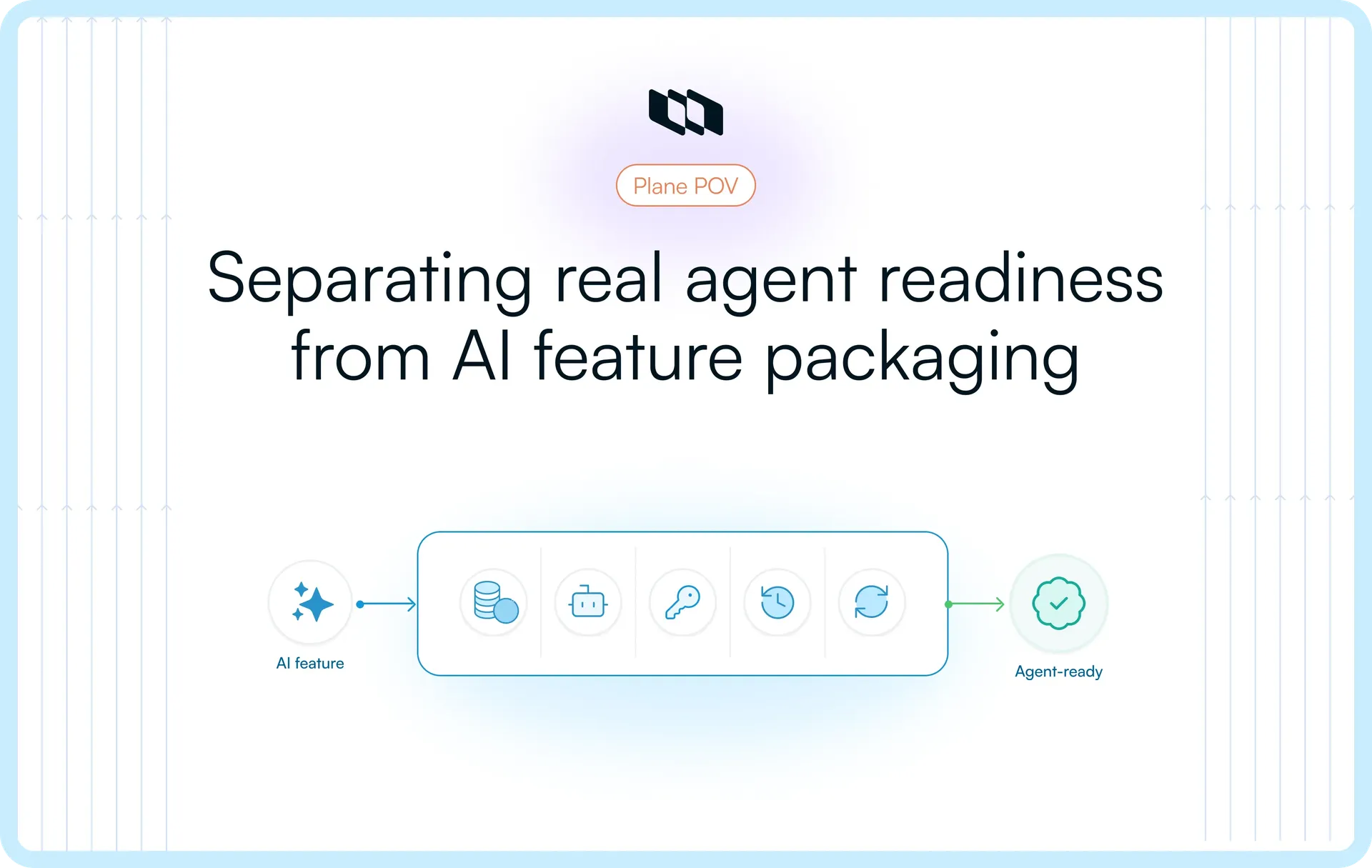
Evaluating AI in work management software used to be relatively straightforward. Buyers looked at features such as summarization, search, and drafting assistance, while the underlying work system remained largely unchanged.
That changes now that agents can act on work directly. An agent-ready work management platform lets agents participate in the same operational work as humans, with identifiable activity and control over where they operate.
An agent that creates work items, changes states, or responds to triggers now operates inside the system of record. No buyers need to evaluate the platform itself: how that work is recorded, how agents are administered, how additional agents participate, and what happens as adoption grows. Four criteria cover those requirements.
Agents work on the same system of record as people
The first property to establish is whether agent work becomes ordinary work inside the platform. An agent should write to the same work items, states, and history people already use, and its output should land where the team already plans and reviews.
Skip this check and the likely result is a product that keeps agent work in a separate space and syncs it back. Picture an agent that triages incoming bugs overnight. If that triage sits in a parallel store reconciling on a schedule, the engineer who opens the board in the morning sees stale priorities, two people disagree about which view is authoritative, and work that should have been settled gets sorted out again by hand.
Work an agent produced should stay intact if that agent or its vendor is removed, so the record outlives whatever acted on it. A shared work record preserves that continuity, and structured context gives agents the relationships they need to act on it, which is the subject of Plane's piece on the work graph for AI agents. Two checks tell you most in a demo: does an agent's change appear in the record a person actually opens, and does that work remain once the agent is switched off.
Agents can be administered as workspace participants
An agent acting on real work has to be visible and governable, starting with a distinct identity. Without one, its actions blur into a shared service account or a person's login, and after an incident the basic questions get hard to answer: which changes it made, what it could reach at the time, and who approved its setup. Overlooking this leaves an audit gap that only appears once something has gone wrong.
Past identity, the practical controls are ownership, project scope, and access an administrator can adjust or revoke in one place. These belong at the platform level. When each integration or agent client carries its own access model, governance has to be rebuilt for every new actor, and the seams between those models are where problems collect.
The mechanics of role-based access, delegation, approvals, and auditability are covered in Plane's guide to agent governance. For a platform evaluation, the test is narrower: can an administrator give each agent an identity, confine it to specific projects, and withdraw its access centrally when the work changes.
The platform should support multiple agents without creating vendor dependence
Few organizations will settle on one kind of agent. An engineering team might use coding agents in its repositories, Plane Agents inside project workflows, ChatGPT or Claude for other tasks, and custom agents connected to internal systems. That mix will evolve as new capabilities and providers emerge.
The work platform needs to accommodate those changes without fragmenting the work itself. Native and external agents should be able to operate on the same underlying records, with appropriate access controls for each. Open interfaces such as MCP and APIs make this possible, allowing supported agents to interact with existing projects and workflows without creating separate copies of the work.
The longer-term consideration is vendor dependence. An organization might replace an agent provider, retire a particular client, or introduce new agents as its requirements change. Those decisions should not require migrating project records, rebuilding established workflows, or losing the history accumulated by earlier agents. Projects, dependencies, decisions, and activity should remain accessible regardless of which agent originally worked on them.
For buyers, the evaluation comes down to three questions:
- Can native, external, and custom agents work with the same underlying records?
- Does introducing or replacing an agent require rebuilding existing workflows?
- Does the work remain intact when an agent or its provider is removed?
Agent administration should still work at organizational scale
Administering one agent in one project is contained. The problem changes shape once agents accumulate across teams. Picture a company six months into adoption: support runs an agent that files and tags incoming issues, engineering has two that open follow-up work from incidents, marketing has one drafting release notes, and each was set up by a different owner with its own scope and configuration. Each works on its own. Together, no one can say how many agents exist, which still have access to which projects, or which configurations have gone stale.
This is a different problem from governing any single agent. As the number grows, an administrator has to keep ownership, scope, and configuration legible without opening each setup in turn, and disabling an agent should end its activity while keeping the record of what it did.
Runtime behavior is a separate concern. Monitoring long-running agents, handling retries, and recovering from failures belong to the execution layer. What a buyer is assessing here is administrative coherence, whether a growing set of agents stays visible and governable or becomes a roster of operators no one fully tracks.
How Plane approaches agent-ready work
In Plane, these considerations show up in how agents participate and where their work lives.
One work layer
Plane Agents operate on the same projects and work items as the people in a workspace. Their actions become part of the work record in Plane, in the same history as human activity, so a person can continue from an agent's change without switching to a separate app. External agents and clients can reach that same work through MCP and public APIs, which lets a team use other clients without copying the project record into each one. The work remains in Plane regardless of which supported agent or client acts on it.
Governed participation
Each Plane Agent has its own identity, and its activity is recorded in the workspace rather than folded into a person's account. An agent is configured for selected projects, which determines where it is set up to work, and it operates within the Plane workspace it belongs to. Its configuration covers instructions, Skills, triggers, Memory, and the tools it uses through MCP, which together define its responsibility, the context it carries, when it runs, and what it can use while running. This configuration is part of Plane AI.
Workspace-level agent visibility
Plane's Agents and apps view provides a workspace-wide record of agents and connected applications, including their type, creator, and last activity. Admins can also view active and inactive Plane Agents and enable or disable them from the Agents list.
Instructions, project access, triggers, and tools are managed within each Agent's configuration. This gives administrators visibility across the workspace while keeping configuration management at the individual Agent level.
Buyer checklist
Carried into an evaluation, the four criteria compress into a short checklist.
Criterion | What to look for |
Same system of record | Agent changes land directly in the same work items and history people use, with continuity across handoffs |
Administered workspace participants | Each agent has its own identity, project scope, revocable access, and attributable activity |
Multiple agents without vendor lock-in | Native, external, and custom agents can work on the same records, while work and history remain intact when agent providers change. |
Manageable at organizational scale | Ownership, scope, configuration, and access remain legible as agent use spreads across teams and projects |
Look beyond today's agent capabilities
Agent capabilities will keep changing, but the work records, integrations, and governance decisions around them last much longer. A platform evaluation should weigh that difference. The useful questions are what happens when an agent vendor changes, when another client joins the workflow, and when administration grows beyond a handful of agents.
Once a platform is embedded in how an organization works, those decisions are expensive to revisit. The agent features shown today will change. Whether the underlying work stays coherent as it does is the part of the decision worth the most attention.
Build your agent-ready workflows in Plane. Talk to our team to explore how Plane can support your organization's workflows, governance, and agent adoption at scale.
Recommended for you



 Download for Mac
 Download for Android
