Why is self-hosting making a comeback
The cloud is here to stay, but after two decades of unquestioned cloud-first strategies, a shift is underway. Here's what's driving enterprises, governments, and engineering teams back to owning their own stack.
The cloud is here to stay, but after two decades of unquestioned cloud-first strategies, a shift is underway. Here's what's driving enterprises, governments, and engineering teams back to owning their own stack.
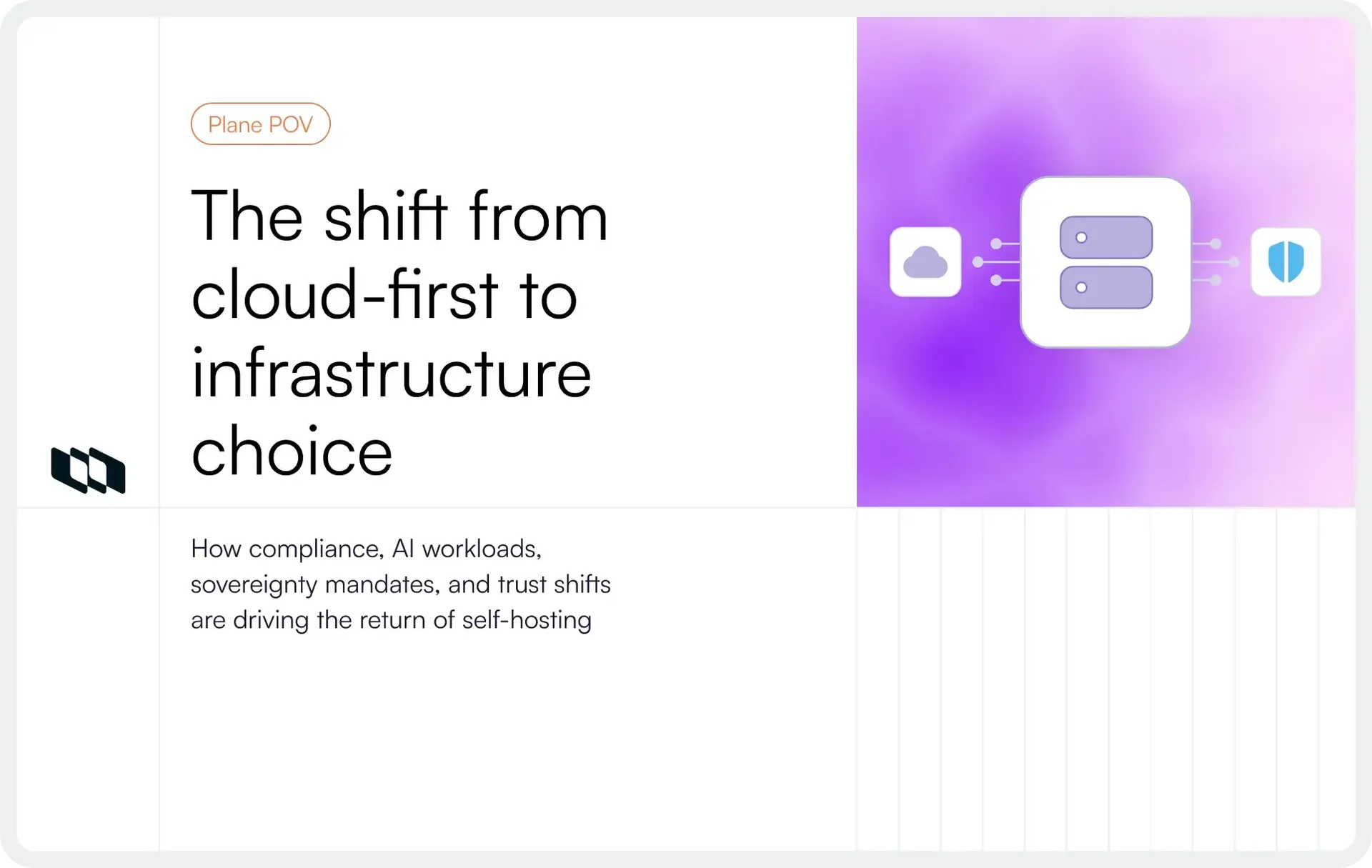
Enterprise infrastructure oscillates between centralization and distribution. Mainframes gave way to client-server. Client-server gave way to cloud. Now, cloud is giving way to something else-not a return to the data center, but a new settlement where organizations choose, workload by workload, what runs where.
The shift has five drivers, all intensifying simultaneously: compliance, trust, AI, sovereignty, and tooling. Anyone would create pressure. Together, they're unwinding assumptions that have governed infrastructure decisions since AWS launched EC2 in 2006.
This isn't nostalgia for the data center era. And it's not a rejection of cloud computing. It's the end of cloud-as-default and the beginning of genuine infrastructure choice. The numbers tell the story. Barclays' Q4 2024 CIO Survey found 86% of CIOs now plan to move some public cloud workloads back on-premises, double the rate measured in 2020. When the overwhelming majority of technology leaders are reconsidering a two-decade architectural assumption, it's worth understanding why.
The historical pattern
Self-hosted was the only option for decades. Then Salesforce launched in 1999, AWS introduced EC2 in 2006, and by 2013 "cloud-first" had become gospel.
The SaaS market exploded from $31.4 billion in 2015 to $206 billion by 2023, a 7x increase fueled by near-zero interest rates and growth-at-all-costs capital allocation. The average company went from 8 SaaS applications to 130 in the same period. Large enterprises accumulated north of 500.
The intellectual turning point came in May 2021, when Andreessen Horowitz published "The Cost of Cloud, a Trillion Dollar Paradox." Martin Casado and Sarah Wang argued that the top 50 public software companies were collectively losing $100–200 billion in market value due to cloud's impact on margins, with cloud spending consuming 50% or more of cost of revenue. They estimated repatriation could cut infrastructure costs by 33–50%. The paper was careful ("this isn't a blanket 'get out of the cloud' message") but it gave CIOs and CFOs the analytical framework to question what had become an unexamined assumption.
The most visible proof point followed in October 2022, when DHH of 37signals announced his intention to leave AWS, projecting $7 million in savings over five years. By 2025, actual savings exceeded $10 million, achieved without adding a single operations hire.
But here's the distinction that gets lost in the repatriation discourse: moving cloud infrastructure workloads on-premises to cut compute costs is a different decision from self-hosting software. The 37signals story is about infrastructure economics. The self-hosting resurgence is about something else entirely: compliance, security, data control, and the organizational conviction that critical systems shouldn't depend on a vendor's continued goodwill. Cost savings on the software license are rarely the driver. In fact, self-hosting often costs more when you account for the infrastructure you now own and operate. At Plane, cloud and self-hosted are priced identically, dollar for dollar. When users come to us looking primarily to cut costs, we tell them to use the cloud, because self-hosted means paying the same license fee plus their own infrastructure. The organizations that choose self-hosted anyway aren't optimizing for price. They're optimizing for control.
The SaaS trust tax
If the cloud repatriation story is about infrastructure economics, the self-hosted software story is about something harder to quantify: trust.
SaaS pricing has inflated at roughly 5x the rate of general inflation, 11.4% year-over-year versus 2.7% across G7 economies. Salesforce raised prices 9% in July 2023, then another 6% in August 2025. Slack increased Enterprise pricing 40–125% in August 2024. Adobe raised Creative Cloud prices 16.7%, bundling AI features users didn't request with no opt-out. Monday.com, 29%. Snowflake, 31%. In nearly every case, the justification was identical: AI capabilities bundled in, and you're paying whether you use them or not.
The pricing is a symptom. The disease is dependency. When your project management tool, your communication platform, your analytics stack, and your CRM all live in someone else's infrastructure under someone else's terms, you don't have a software stack. You have a collection of ongoing negotiations where the other party can change terms unilaterally. Zylo's 2025 SaaS Management Index found that only 47.3% of provisioned licenses are actually used. Organizations aren't just overpaying. They've lost visibility into what they're paying for.
This isn't an argument that SaaS is bad. It's an argument that SaaS-only is a risk posture, and an increasing number of engineering leaders are recognizing it as one.
Trust broke, and forks flourished
The pricing trends eroded trust gradually. Then a cascade of vendor decisions between 2021 and 2024 shattered it.
The pattern is now grimly recognizable: a company builds an open-source product, achieves massive adoption on the implicit promise of community governance, then changes the license or pricing in ways that betray that promise. The community forks the project. The fork gains traction in weeks, not years. And the original vendor discovers that the thing they were actually selling-trust-is the one thing they can't recapture.
The most consequential incident was Broadcom's $61 billion acquisition of VMware in November 2023. Broadcom eliminated perpetual licenses, forced subscription-only bundles, and discontinued products that SMBs depended on. Price increases of 800% to 1,500% were widely reported; AT&T received a 1,050% proposal. A Dutch court ruled Broadcom "acts in breach of its duty of care," imposing €250,000/day penalties. Gartner projects VMware's market share will fall from 70% in 2024 to 40% by 2029. The primary beneficiary: Proxmox VE, an open-source virtualization platform that grew to over 1.5 million installed hosts, a 650% increase.
The same script played out across the stack. HashiCorp switched Terraform to BSL in August 2023; within a month, the OpenTofu manifesto had 33,000 GitHub stars and 140 companies pledged support. Redis changed its license in March 2024; eight days later, the Linux Foundation announced Valkey, backed by AWS, Google Cloud, and Oracle. Elastic changed Elasticsearch's license in 2021; AWS forked it as OpenSearch, which crossed 300 million cumulative downloads by 2023. Even Unity's retroactive Runtime Fee announcement drove Godot Engine to double its user base in a single month.
Each incident reinforced the same lesson: depending on a single vendor for critical infrastructure is existential risk poorly disguised as convenience. And the speed of community response revealed something structural. The open-source ecosystem has matured to the point where credible forks emerge in days, not years. The switching costs that proprietary vendors relied on are eroding faster than their pricing models account for.
AI rewrote the infrastructure math
The most powerful forcing function isn't historical grievance. It's forward-looking demand.
AI workloads require GPU clusters that don't fit neatly into existing cloud economics. Training runs that cost millions. Inference that needs to happen at the edge. Data that can't leave the premises for regulatory or competitive reasons. Organizations building serious AI capabilities are building infrastructure, and once you have infrastructure for AI, the marginal cost of self-hosting everything else drops.
The 2024 State of AI Infrastructure Survey found that 67% of enterprises now run AI workloads on hybrid or on-premises infrastructure, up from 41% in 2022. NVIDIA's DGX sales, CoreWeave's $23 billion valuation, and the GPU shortage that dominated 2023 all point to the same conclusion: organizations are building their own compute again, at scale, for the first time since cloud became dominant.
This creates a flywheel. GPU clusters require operational expertise. Operational expertise makes self-hosting other workloads feasible. Feasibility becomes preference when the alternative is shipping sensitive training data to a third party's servers.
Sovereignty became procurement
Governments are no longer content to recommend. They're mandating.
Germany's BSI now requires federal agencies to evaluate open-source and self-hosted alternatives before procuring proprietary SaaS. France's DINUM maintains a sovereign software catalog. The EU's Gaia-X initiative is building a federated data infrastructure explicitly designed for European sovereignty. China has required domestic cloud providers for government systems since 2015, accelerating after US export controls.
The numbers are substantial. Germany's Schleswig-Holstein state committed to replacing Microsoft Office with LibreOffice across 30,000 government workstations. France's National Gendarmerie has run Ubuntu Linux on over 72,000 desktops since 2014, saving an estimated €30+ million. Italy mandated open-source preference for public administration in 2012. Brazil requires government preference for open standards.
OpenForum Europe is proposing an EU-wide Sovereign Tech Fund with a minimum budget of €350 million. When governments invest hundreds of millions in self-hosted alternatives and mandate their adoption across tens of thousands of workstations, they're creating demand that reshapes markets.
For engineering leaders in regulated industries-finance, healthcare, defense, critical infrastructure-this isn't an abstract policy discussion. Sovereignty requirements are becoming procurement requirements. The ability to self-host isn't a feature. It's a market access condition.
The infrastructure caught up
Every previous self-hosting wave crashed against the same objection: it's too hard. That objection no longer holds.
Docker adoption among IT professionals jumped from 80% to 92% in a single year, with the Stack Overflow 2025 survey recording a 17-percentage-point increase in developer usage, the largest single-year jump of any technology surveyed. Kubernetes reached 80% production adoption in 2024. K3s, a lightweight distribution that runs on a Raspberry Pi, has made container orchestration accessible to teams that would never have considered it five years ago.
A new generation of platforms has reduced self-hosting to something that resembles an app store. Coolify, an open-source Heroku/Vercel alternative with 35,000+ stars, offers 280+ one-click services. CasaOS and Umbrel provide graphical dashboards for homelab users. Portainer wraps Docker and Kubernetes in a web GUI.
The community signal is unambiguous. The r/selfhosted subreddit has grown to 553,000 members, roughly 7x its size five years ago. The awesome-selfhosted GitHub repository has accumulated 273,000 stars, nearly tripling since 2021 and ranking among the top 50 most-starred repositories on all of GitHub. These numbers represent a flywheel: as more people self-host, documentation improves, deployment gets easier, edge cases get solved, and more people self-host.
The gap between "we could self-host this" and "we can actually operate this in production" has narrowed to the point where it's a staffing decision, not a technology bet. That changes the calculus entirely.
The counterarguments are real, and bounded
Self-hosting costs more than most advocates admit.
A senior DevOps engineer runs $160,000–$350,000 in total compensation. A small self-hosting team of 3–5 people costs $500,000–$1.5 million annually before hardware. The 2025 Verizon DBIR found exploitation of known vulnerabilities accounts for 20% of breaches, up 34% year-over-year, and self-hosted systems bear the full burden of patch management. The average data breach costs $4.88 million.
Munich's LiMux project migrated 15,000 desktops to Linux, saved €11.7 million, then reversed the decision in 2017 at a cost of €49.3 million. The post-mortem blamed organizational failures, not technical ones, but the lesson still applies: self-hosting requires institutional commitment that survives leadership changes and political headwinds.
The counterarguments apply most forcefully to early-stage companies without predictable workloads, to organizations without existing operations capability, and to elastic use cases where the cloud's pay-per-use model genuinely delivers value. They apply least to the fastest-growing segment: organizations with regulatory requirements, data sensitivity concerns, AI infrastructure ambitions, and the engineering talent to operate their own stack.
The question isn't self-host-everything or self-host-nothing. It's: which workloads require the control that only self-hosting provides? If your software only runs in someone else's cloud, the answer is made for you.
The convergence
Any one of these forces-the compliance imperative, the trust fractures, the AI infrastructure boom, the sovereignty mandates, the tooling maturation-would generate meaningful movement toward self-hosting. What makes this moment structurally different is that all five are operating simultaneously, and each one amplifies the others.
AI infrastructure investment creates the operational foundation that makes self-hosting everything else cheaper at the margin. Sovereignty mandates create procurement requirements that favor self-hosted options. Vendor trust collapses create migration urgency. Tooling maturity removes the practical barriers that previously kept organizations locked in even when they wanted to leave.
This is why self-hosting adoption is accelerating across every category simultaneously: analytics (Grafana, 20 million self-hosted users), knowledge management (AppFlowy, 60,000 GitHub stars in its first year), CRM (Twenty, 20,000 stars in 18 months), communication (Matrix, deployed by NATO and the Bundeswehr), file storage (Nextcloud, €250 million sovereignty investment), and project management, (Plane, 46,000+ GitHub stars, 100K+ Docker pulls, and 44K+ Kubernetes deployments as the #1 open-source project management tool on GitHub).
The market is moving from subscription-as-default to portfolio-as-strategy. Organizations are learning to treat infrastructure the way sophisticated investors treat asset allocation: diversified, intentional, and matched to the specific requirements of each workload. Some things belong in the cloud. Some things belong on your own metal. The ability to make that choice, rather than having it made for you by a vendor's pricing page or a compliance officer's veto, is the real shift.
The oscillation continues. But for the first time in two decades, it swings toward distribution with the tooling, the talent, and the institutional will to make it stick.
Recommended for you



 Download for Mac
 Download for Android