What is project development?
Introduction
Every project starts with an idea, but that idea needs structure before a team can act on it. Project development provides that structure by defining goals, testing feasibility, planning resources, mapping timelines, and preparing the work for execution. In this guide, we cover the project development process from initiation through closure, explain the key project development stages, and show how project planning and project management support the full project development lifecycle.
What is project development?
Project development is the structured process of turning an idea, need, or opportunity into a viable project and carrying it through planning, execution, monitoring, and completion. It helps teams define what they want to achieve, assess whether the work is feasible, organize the resources required, and create a clear path for delivery.
The exact scope of project development can vary by organization and industry. In some contexts, it refers mainly to early-stage activities such as feasibility, business justification, and project planning. In others, it covers the full project development lifecycle from initiation through project closure.
Key components of project development
Most projects are shaped by a common set of elements:
- Goals and objectives: Define the outcome the project is expected to achieve and the value it should create.
- Scope: Establish what work is included, where the project boundaries sit, and what falls outside them.
- Stakeholders: Identify the people or groups who influence the project, contribute to it, approve decisions, or are affected by its outcome.
- Requirements: Capture the conditions, capabilities, or expectations the final deliverables need to meet.
- Deliverables: Specify the tangible or measurable outputs the project is expected to produce.
- Tasks and dependencies: Break the work into manageable activities and identify where one piece of work relies on another.
- Timeline and milestones: Set target dates, sequencing, and key checkpoints for measuring progress.
- Resources: Determine the people, skills, tools, and capacity needed to complete the work.
- Budget: Estimate and manage the financial resources required across the project development process.
- Risks and constraints: Identify factors that could affect scope, cost, timing, quality, or execution.
- Success criteria: Define how the team and stakeholders will evaluate whether the project achieved its intended outcome.
Project development vs. project management
Project development and project management are closely related, and organizations do not always draw the boundary between them in the same way.
- In general, project development focuses on shaping the project itself, from the initial idea and feasibility work through planning and delivery.
- Project management provides the methods and controls used to organize that work, coordinate people, manage resources, track progress, and respond to change.
The overlap becomes especially strong once project planning and execution begin. At that point, activities such as scheduling, risk management, stakeholder communication, dependency tracking, and progress reporting are part of both the project development process and day-to-day project management.
Area | Project development | Project management |
Primary focus | Shaping a viable project and developing it from concept through completion | Organizing, coordinating, and controlling the work required to deliver the project |
Typical activities | Feasibility, defining objectives, scope, requirements, planning, execution, evaluation | Scheduling, assigning work, managing resources, risks, dependencies, communication, and reporting |
When it begins | Usually starts when an idea, need, or opportunity is first explored | Typically becomes more formal once the project is approved and structured, though practices may begin earlier |
Key outputs | Business case, project scope, development plan, deliverables, completed project outcomes | Project schedules, work plans, status reports, risk logs, change records, and progress data |
Who is involved | Sponsors, project managers, specialists, delivery teams, users, and stakeholders | Project managers, team leads, contributors, sponsors, and other stakeholders involved in delivery |
For most teams, the practical value lies in understanding how the two work together. Project development defines and evolves the project, while project management helps keep the work coordinated and visible as it moves through the project development lifecycle.
Why is project development important?
A structured project development process helps teams evaluate whether an idea is viable, define the work clearly, and create a stronger foundation for delivery. It also reduces uncertainty by bringing goals, resources, risks, stakeholders, and success criteria into the same planning process.
1. Determine whether the project is worth pursuing
Early feasibility work helps teams assess expected value, costs, constraints, available resources, and potential risks before committing significant time or budget.
2. Clarify objectives, scope, and expected outcomes
Project development gives teams a shared understanding of what the project should achieve, what work is included, and how success will be evaluated.
3. Align stakeholders and organizational priorities
Involving the right stakeholders early helps clarify expectations, decision ownership, and priorities while ensuring the project supports broader business or operational goals.
4. Improve resource, budget, and risk planning
Teams can estimate the people, skills, tools, capacity, funding, dependencies, and constraints required across the project development lifecycle before execution begins.
5. Create a clear basis for execution and progress tracking
A well-developed project plan gives teams a common view of responsibilities, milestones, timelines, and deliverables, while providing reference points for monitoring progress and making informed decisions as conditions change.
What are the stages of project development?
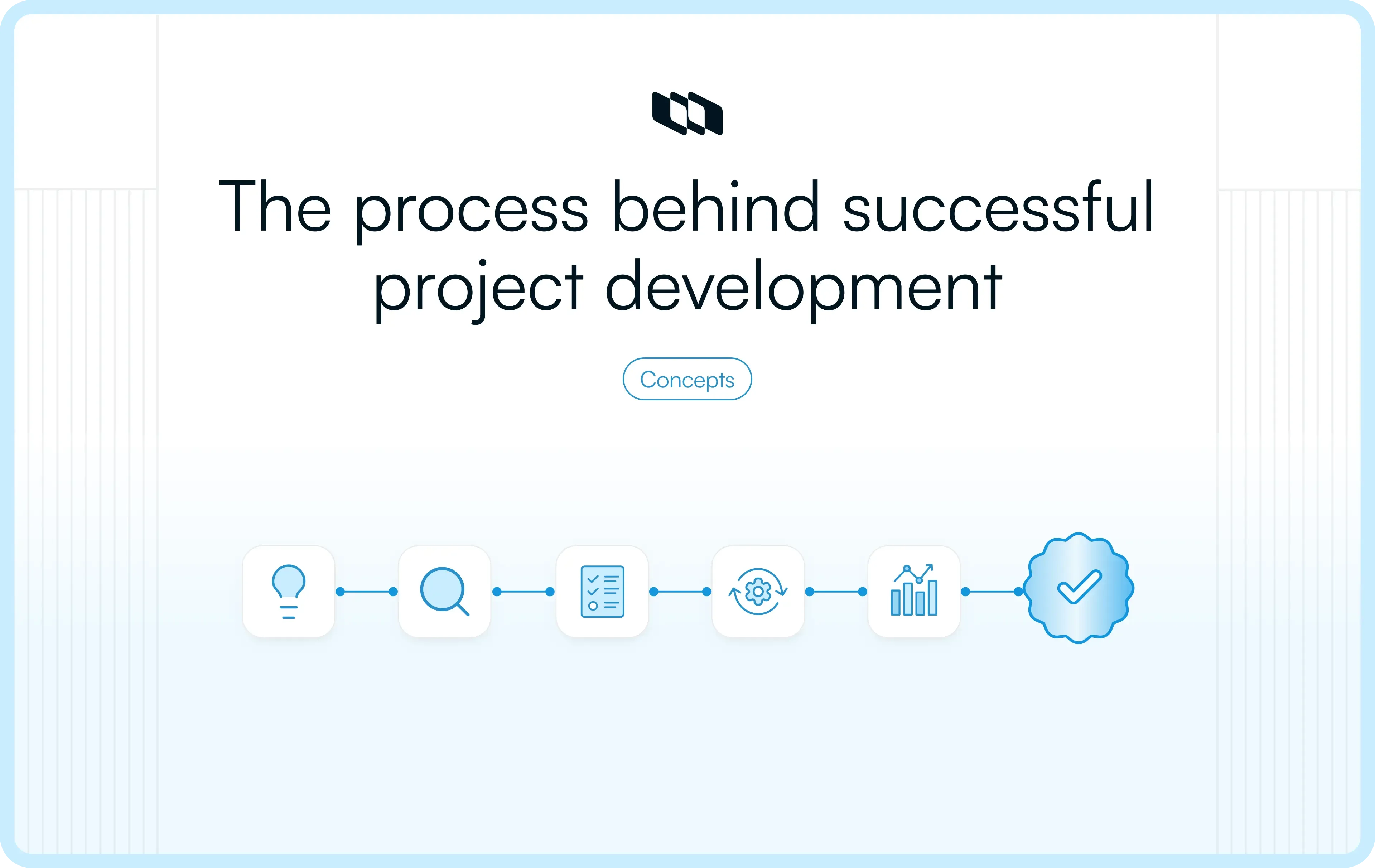
The project development lifecycle usually moves through initiation, feasibility, planning, execution, monitoring, and closure. These stages provide structure, but they do not always happen in a strict sequence. Teams may revisit scope, resources, risks, or requirements as new information emerges, especially during execution.
1. Initiation and concept development
Initiation is where the project begins to take shape. The team identifies the problem, opportunity, or need behind the work and defines the outcome the project is expected to achieve.
At this stage, teams typically establish high-level objectives, identify key stakeholders, define a preliminary scope, and assess how the proposed project aligns with broader organizational priorities. Initial success criteria are also useful here because they give decision-makers an early reference point for evaluating whether the project is moving in the right direction.
2. Feasibility and project evaluation
Before committing significant resources, teams need to determine whether the proposed project is viable. Feasibility analysis helps answer whether the organization has the capacity, technology, funding, and strategic reason to move forward.
This may include evaluating technical feasibility, expected costs and benefits, available resources, operational constraints, risks, and potential stakeholder or user impact. The depth of the assessment depends on the size and complexity of the project. The outcome is usually a clearer recommendation on whether to proceed, revise the proposal, or stop the project before further investment.
3. Project planning and design
Once the project is approved, the team turns the concept into an actionable project development plan. This is where broad objectives become defined deliverables, responsibilities, timelines, and measurable targets.
Teams typically refine the scope, gather requirements, break the work into tasks, identify dependencies, assign ownership, estimate resources, build the budget, and establish milestones. Risk planning, communication practices, and success metrics should also be defined at this stage so the team has a shared framework for managing execution.
4. Project execution
Execution is where planned work is carried out, and project deliverables begin to take shape. Teams assign and coordinate tasks, manage resources, work through dependencies, and collaborate across functions and stakeholders.
This stage also requires active problem-solving. Blockers, changing requirements, resource constraints, or new information may require teams to adjust how the work is delivered. Keeping documentation and decisions current helps preserve context as the project evolves.
5. Monitoring and control
Monitoring and control usually run alongside execution rather than after it. Teams compare actual progress with the project plan and use that information to identify issues early and make informed adjustments.
Typical activities include tracking milestones, scope, schedule, budget, resource usage, risks, quality, and success metrics. Teams may also review stakeholder feedback and manage changes that affect priorities or delivery. When performance starts to diverge from the plan, the project team can reassess assumptions and update timelines, scope, or resources accordingly.
6. Project closure and handover
Closure begins once the planned work is complete, and the final deliverables are ready for validation or handover. Teams confirm that requirements have been met, secure relevant approvals, transfer ownership where necessary, and close any remaining work.
A strong closure process also includes reviewing performance against the original objectives and success criteria. Teams can document lessons learned, capture stakeholder feedback, record unresolved issues, archive important project information, and release or reassign resources. These insights can then inform future project planning and development.
What is a project development plan?
A project development plan is the shared roadmap that turns project objectives, assumptions, and planning decisions into executable work. It gives the team a clear view of what needs to be delivered, who is responsible, how the work will be sequenced, which resources are required, and how progress will be measured.
The project development process covers the broader journey from idea and feasibility through execution and closure. The project development plan is the working reference used to guide that process once the project has been defined well enough to organize the work.
What should a project development plan include?
Component | What it covers |
Project background or problem statement | The need, opportunity, or problem the project is intended to address |
Objectives | The outcomes the project is expected to achieve |
Success criteria | The measures used to evaluate whether the project has achieved its goals |
Scope | The work included in the project and its defined boundaries |
Requirements | The conditions, capabilities, or expectations the deliverables must meet |
Deliverables | The outputs the project team is expected to produce |
Tasks or work breakdown | The activities required to complete each deliverable |
Dependencies | The relationships between tasks, teams, systems, or external inputs |
Timeline | The planned sequence and duration of the work |
Milestones | Key checkpoints used to track progress through the project |
Roles and responsibilities | Who owns decisions, tasks, approvals, and delivery |
Resources | The people, skills, tools, and capacity required |
Budget | The expected costs and financial limits for the project |
Risks and mitigation plans | Potential issues that could affect delivery and how the team plans to respond |
Stakeholders | The people or groups who influence, contribute to, approve, or are affected by the project |
Communication approach | How updates, decisions, risks, and changes will be shared |
Monitoring and reporting approach | How progress, performance, and project health will be tracked and communicated |
The level of detail should match the size and complexity of the project. A small internal initiative may need a lightweight plan, while a large cross-functional project may require more detailed schedules, risk controls, reporting practices, and approval points.
Who is involved in project development?
Project development usually involves several people with different responsibilities across the project development lifecycle. The exact mix depends on the size, complexity, and type of project, and responsibilities may shift as the work moves from evaluation and planning into execution and closure.
1. Project sponsor or leadership
The project sponsor provides strategic direction, helps secure funding or organizational support, and makes high-level decisions when the project needs executive input. Sponsors are often responsible for confirming that the project remains aligned with broader business priorities.
2. Project manager
The project manager coordinates project planning and delivery. Their responsibilities may include managing scope, timelines, resources, risks, dependencies, communication, and progress reporting while keeping stakeholders aligned throughout execution.
3. Project development manager
Some organizations have a dedicated project development manager, particularly in industries where feasibility, investment decisions, approvals, or early-stage planning require substantial work. This role typically focuses on developing the project from initial concept through feasibility and approval before or alongside formal project management.
4. Project team and specialists
The project team performs the work required to produce the deliverables. Depending on the project, this may include engineers, designers, product managers, researchers, analysts, operations specialists, or other functional experts. Their input during planning is also important for estimating effort, identifying dependencies, and assessing technical constraints.
5. Resource and finance owners
Finance teams, department leads, and resource owners help determine whether the project has sufficient budget, people, skills, and capacity. They may also review spending, approve additional resources, or help resolve competing demands across projects.
6. Customers, users, and other stakeholders
Customers and end users can provide requirements, feedback, and context about the problem the project is intended to solve. Other internal or external stakeholders may influence decisions, provide approvals, contribute expertise, or be affected by the project's outcome.
The people involved will vary from one project to another. What matters is that decision-making authority, ownership, and stakeholder responsibilities are clear enough for the team to know who needs to contribute at each stage.
How project development varies across industries
The core project development process is broadly similar across industries, but the emphasis changes depending on the type of work, regulatory environment, investment required, and number of stakeholders involved.
Industry | How project development typically differs |
Software and IT | Feasibility often centers on technical architecture, integrations, security, capacity, and delivery dependencies. Work may progress iteratively through shorter planning and execution cycles. |
Product development | Teams place greater emphasis on customer needs, market validation, requirements, experimentation, and feedback before and during delivery. |
Business initiatives | Projects may focus more heavily on strategic alignment, expected business impact, budget, change management, and coordination across functions. |
Construction | Development usually involves detailed design, permits, procurement, contractors, site constraints, safety requirements, and longer approval cycles. |
Infrastructure | Feasibility, funding, public or regulatory approvals, environmental impact, stakeholder consultation, and long-term operational considerations often play a larger role. |
Real estate | Site selection, market demand, financing, zoning, approvals, design, and commercial viability can shape the project before construction begins. |
Across these contexts, the same underlying questions remain important: Is the project viable? What should it achieve? Who needs to be involved? What resources are required? What could affect delivery? The answers shape how each organization structures its project development lifecycle.
Common project development challenges
Even a well-structured project development process can run into problems when assumptions, priorities, or planning decisions change. The most common challenges usually affect scope, feasibility, resources, stakeholder alignment, and execution.
1. Unclear objectives and scope
When objectives are vague, or project boundaries are poorly defined, teams can struggle to prioritize work, estimate effort, and agree on what successful delivery looks like. This often creates confusion later in the project development lifecycle.
2. Weak feasibility assessment
Projects can lose momentum when technical, financial, operational, or resource constraints are discovered too late. A weak feasibility assessment can lead to unrealistic commitments and costly changes during execution.
3. Unrealistic timelines and resource plans
Schedules become difficult to maintain when teams underestimate effort, overlook capacity limits, or assume resources will be available when needed. The result is often delayed milestones, overloaded teams, and rushed delivery.
4. Poor stakeholder alignment and communication
Misaligned expectations can affect priorities, approvals, requirements, and decision-making. When stakeholders are involved too late, or communication is inconsistent, teams may spend time reworking decisions that could have been resolved earlier.
5. Disconnect between planning and execution
A project development plan loses value when it is not updated as work progresses. Changing priorities, new dependencies, emerging risks, and delivery constraints need to feed back into planning so teams can make decisions using current information.
Best practices for successful project development
Strong project development depends on making the right decisions early, keeping planning connected to execution, and updating the project as conditions change. These practices help teams stay aligned without adding unnecessary process.
1. Start with a clear problem and desired outcome
Define why the project exists, what problem it should solve, and what a successful outcome looks like before breaking the work into detailed tasks.
2. Evaluate feasibility before making major commitments
Test assumptions around value, resources, costs, technical constraints, risks, and delivery capacity early. This helps teams avoid building plans around conditions that may not hold.
3. Involve stakeholders and the project team early
Bring decision-makers, contributors, and affected stakeholders into planning while key choices are still being made. Their input can improve estimates, expose dependencies, and clarify requirements before execution begins.
4. Keep scope, resources, timelines, and risks connected
Changes in one planning variable often affect the others. Teams should review scope, capacity, budget, dependencies, timelines, and risks together so the project development plan reflects realistic delivery conditions.
5. Track outcomes and feed learning back into the project
Use milestones, success criteria, progress data, and stakeholder feedback to assess whether the project is producing the intended results. Use lessons from execution and completed projects to inform current decisions and improve future project planning.
How project management software supports project development
Project management software gives teams a shared place to connect the project development plan with the work happening during execution. Instead of managing scope, tasks, milestones, risks, and progress across separate documents and tools, teams can keep project information current as conditions change.
The most useful capabilities typically include:
- Centralized project information: Keep objectives, requirements, decisions, documentation, and project context accessible in one place.
- Task and work tracking: Break deliverables into actionable work, assign ownership, set priorities, and track progress.
- Custom workflows: Adapt work stages to different teams, project types, and approval processes.
- Project views: Use lists, boards, timelines, calendars, or other views to understand work from different perspectives.
- Timelines, milestones, and dependencies: See how work is sequenced, where key checkpoints sit, and which activities rely on others.
- Collaboration and documentation: Keep discussions, updates, decisions, and supporting information close to the work they affect.
- Risk and issue tracking: Record blockers, risks, and open issues so teams can review and respond to them during execution.
- Progress reporting and dashboards: Give project managers and stakeholders a current view of project health, milestones, workload, and delivery status.
- Resource visibility: Help teams understand ownership, capacity, and where competing priorities may affect delivery.
- Automations and integrations: Reduce repetitive coordination and connect project workflows with the tools teams already use.
AI can also support parts of the project development process by helping teams summarize project information, surface relevant context, generate routine updates, or automate repetitive coordination. Its value depends on how well those capabilities fit into the team’s existing project planning and execution workflows.
How Plane helps teams manage project development
Plane gives teams a shared workspace for carrying project development from planning into execution without losing context along the way. Teams can organize initiatives through Projects, break work into Work Items, structure greater efforts with Modules and Milestones, and use Cycles when delivery happens iteratively.
Dependencies, Pages, multiple project views, and Dashboards help keep project context, sequencing, documentation, and progress visible as the work evolves. Flexible workflows and automations can also support different delivery processes without forcing every team into the same structure.
For project development, the main value is continuity: plans, decisions, work, and progress stay connected as the project moves through the lifecycle.
Wrapping up
Project development gives teams a structured way to move from an initial idea to a viable, executable project. The strongest processes connect feasibility, project planning, execution, monitoring, and closure while keeping scope, resources, risks, stakeholders, and expected outcomes aligned.
The process also needs room to adapt. Assumptions change, dependencies emerge, and priorities shift during delivery. Teams that keep their project development plan current and use progress data, feedback, and lessons learned to guide decisions are better equipped to carry projects through the full project development lifecycle.
Frequently asked questions
Q1. What is the meaning of project development?
Project development is the process of turning an idea, need, or objective into a structured project that can be planned, executed, monitored, and completed. It typically involves defining goals, scope, requirements, resources, timelines, risks, and the work needed to deliver the intended outcome.
Q2. What are the five stages of project development?
A common five-stage project development lifecycle includes:
- Initiation: Define the project need, objectives, feasibility, and key stakeholders.
- Planning: Establish scope, requirements, timelines, resources, risks, and responsibilities.
- Execution: Carry out the planned work and coordinate people, tasks, and resources.
- Monitoring and control: Track progress, manage changes and risks, and adjust the plan when needed.
- Closure: Complete deliverables, obtain approval, document outcomes, and close the project.
Q3. What are the four stages of project development?
A simplified project development model usually groups the work into four stages: initiation, planning, execution, and closure. In this model, monitoring and control take place throughout execution rather than being treated as a separate stage.
Q4. What are the 7 steps of a project?
A practical seven-step project process can include:
- Define the project goal.
- Identify stakeholders and requirements.
- Define the project scope.
- Build the project plan and schedule.
- Assign resources and responsibilities.
- Execute, monitor, and adjust the work.
- Complete the project and review the results.
The exact number of steps can vary depending on the methodology and type of project.
Q5. What is the project development process?
The project development process is the structured sequence teams use to take a project from an initial idea through planning, delivery, monitoring, and completion. It helps teams define what needs to be achieved, organize the work, allocate resources, manage risks and dependencies, track progress, and evaluate the final outcome.
Recommended for you


 Download for Mac
 Download for Android