What is a cost-benefit analysis?
Introduction
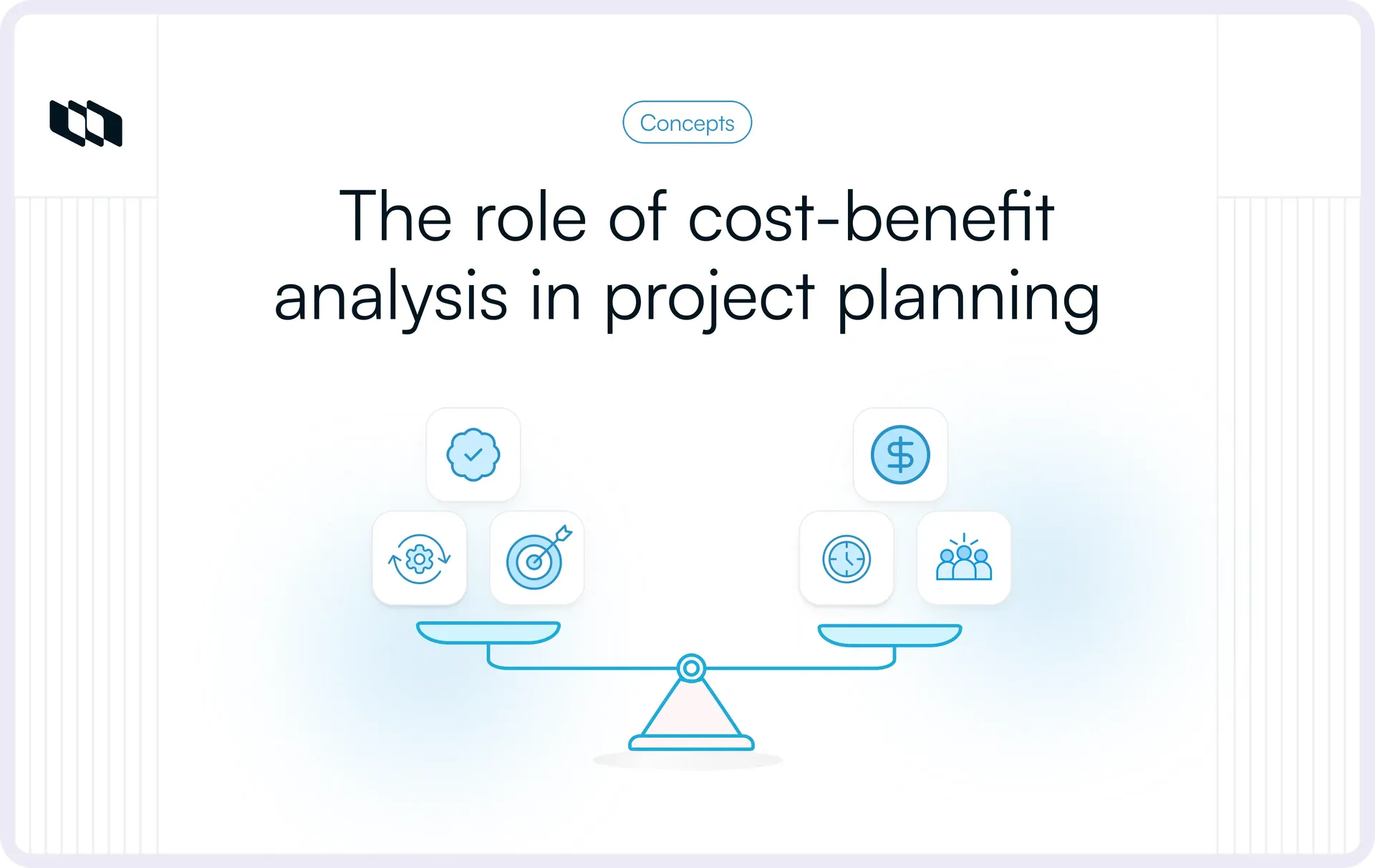
Should we build this, buy it, automate it, or leave things as they are? Teams make decisions like these constantly, often with incomplete information. A cost-benefit analysis helps turn that uncertainty into a structured comparison of what an initiative will require and what it is expected to return. This guide explains how cost-benefit analysis works, how to calculate net benefit and the benefit-cost ratio, and how project teams can use the findings to compare options and make better investment decisions.
What is a cost-benefit analysis?
A cost-benefit analysis (CBA) is a structured way to evaluate whether a proposed decision is worth pursuing. It identifies the expected costs and benefits, assigns values to them where possible, and compares the two to understand the likely economic value of the decision.
At its simplest, CBA looks at net benefit:
Net benefit = Total benefits − Total costs
A positive net benefit suggests that the expected gains outweigh the expected costs. A negative result suggests the opposite. The calculation is useful for evaluating a single proposal, such as adopting a new tool, or comparing several alternatives competing for the same budget, time, or team capacity.
How does cost-benefit analysis work?
The process follows a straightforward sequence:
- Define the decision: Clarify what is being evaluated and what outcome the analysis should support.
- Identify the effects: List the costs, benefits, risks, and other consequences associated with each option.
- Estimate their value: Assign monetary values where possible, using data, forecasts, benchmarks, or reasonable assumptions.
- Compare costs and benefits: Calculate the expected net benefit and use additional measures where they help clarify the result.
- Use the findings to inform the decision: Consider the numbers alongside risk, strategic priorities, resource constraints, and uncertainty.
Timing also matters. A cost incurred today and a benefit expected three years from now are not directly equivalent. For longer-term decisions, teams may convert future costs and benefits into present values so they can be compared on a consistent basis.
Why is cost-benefit analysis important?
Cost-benefit analysis gives teams a practical way to test whether a proposed project, investment, or change is worth the resources it will consume. Its value becomes clearer when several initiatives are competing for the same budget, people, or time.
1. Assess project or investment viability
CBA helps teams estimate whether the expected benefits justify the total cost of moving forward. This can prevent weak proposals from advancing simply because their upfront costs look manageable or their benefits sound promising.
2. Compare competing alternatives
When several options could solve the same problem, cost-benefit analysis creates a common basis for comparison. Teams can examine how each option differs in cost, expected return, implementation effort, and long-term impact.
3. Improve resource allocation
Budgets and team capacity are finite. CBA helps decision-makers direct those resources toward initiatives expected to create greater value, while making the opportunity cost of choosing one option over another more visible.
4. Support project prioritization
For teams evaluating a portfolio of proposed projects, CBA can provide one useful input into project prioritization, alongside strategic fit, dependencies, urgency, and capacity. It helps clarify which initiatives have stronger economic justification before strategic fit, dependencies, urgency, and capacity are considered alongside them.
5. Make assumptions and trade-offs visible
Every cost-benefit analysis depends on assumptions about factors such as implementation cost, adoption, time savings, revenue, or project duration. Recording those assumptions makes the reasoning behind a recommendation easier to examine and challenge.
6. Surface hidden costs and benefits
Some of the most important effects are easy to miss during early planning. Training time, maintenance effort, transition costs, productivity gains, opportunity costs, and reduced operational risk can materially change the outcome once they are included.
7. Give stakeholders evidence behind a recommendation
A recommendation is easier to evaluate when stakeholders can see the estimates, assumptions, and trade-offs behind it. CBA creates a clear record of why a team believes an initiative deserves investment and where uncertainty remains.
8. Consider risk before committing resources
Expected outcomes rarely unfold exactly as forecast. A good cost-benefit analysis considers how delays, cost overruns, lower-than-expected benefits, or other risks could affect the result before the organization commits significant resources.
When should you use a cost-benefit analysis?
A cost-benefit analysis is most useful when a decision requires meaningful investment and the consequences can be estimated with reasonable confidence. It gives teams a consistent way to compare options before committing budget, time, or capacity.
1. Launching a new project
Before approving a project, teams can use CBA during early project management planning to compare expected outcomes with implementation and operating costs. This helps test whether the initiative has enough potential value to justify moving forward.
2. Comparing project or investment options
When several alternatives compete for the same resources, CBA makes their trade-offs easier to compare. Teams can evaluate which option offers the strongest expected return relative to its cost.
3. Making major purchasing or technology decisions
Large software, infrastructure, or equipment purchases often involve more than the purchase price, which is why they should be considered alongside the wider project budget. Cost-benefit analysis can account for implementation, training, maintenance, migration effort, productivity gains, and long-term savings.
4. Evaluating process changes or automation
For automation and process improvement initiatives, CBA can compare implementation costs with expected gains such as reduced manual effort, faster cycle times, fewer errors, or additional team capacity.
5. Allocating limited resources
When budget, engineering capacity, or specialist expertise is constrained, CBA can help teams understand which initiatives are likely to generate the most value from those scarce resources.
6. Assessing operational or policy changes
Organizations can use CBA to evaluate proposed changes to workflows, policies, service models, or operating practices, especially when those changes affect several teams or create ongoing costs.
7. Evaluating expansion or infrastructure investments
Expansion decisions often involve substantial upfront spending and benefits that appear over several years. CBA helps compare those future gains with the full cost of the investment, including financing, maintenance, staffing, and operational requirements.
When a cost-benefit analysis may be unnecessary
A full CBA can add more effort than value for small, inexpensive, easily reversible decisions. It can also be a poor fit when the most important outcomes cannot be estimated or compared credibly.
Some decisions are primarily shaped by regulatory obligations, ethical considerations, safety requirements, or strategic commitments. In those cases, cost-benefit analysis may still provide useful context, but it should remain one input among several.
What are the key components of a cost-benefit analysis?
A useful cost-benefit analysis depends on more than a list of expenses and expected gains. Teams need to account for the full range of costs and benefits, the period over which they occur, and the assumptions used to estimate their value.
Types of costs
- Direct costs: These are expenses directly tied to the project or decision. Examples include salaries, contractor fees, software licenses, equipment, materials, implementation work, and training.
- Indirect costs: Indirect costs support the initiative without being attributable to a single activity. Administrative overhead, shared infrastructure, support functions, utilities, and management time often fall into this category.
- Intangible costs: Some costs affect the organization without appearing clearly in a budget. A difficult rollout might reduce employee morale, create customer frustration, or damage trust in a product or service. These effects may still matter even when assigning an exact monetary value is difficult.
- Opportunity costs: Opportunity cost is the value of what the organization gives up by choosing one option over another. If an engineering team spends a quarter building an internal tool, for example, the cost includes the work that could have been delivered with that same capacity.
- Risk-related costs: Projects can also carry potential costs from delays, failures, rework, security incidents, cost overruns, or lower-than-expected adoption. These risks should be estimated where possible rather than left outside the analysis.
- One-time and recurring costs: It helps to separate initial investment from ongoing operating costs. A software rollout may require migration and implementation work upfront, followed by recurring subscription, maintenance, support, or infrastructure costs over several years.
Types of benefits
- Direct or tangible benefits: These benefits can usually be measured in financial terms. Examples include additional revenue, reduced operating costs, lower vendor spend, or measurable savings from replacing a manual process.
- Indirect benefits: Some benefits appear further downstream. Faster delivery, for example, may improve customer retention or reduce support demand even if those gains are harder to attribute directly to the original project.
- Efficiency and productivity gains: Projects often create value by reducing the time or effort required to complete work. Automation, improved tooling, or process changes may free up team capacity, shorten cycle times, or reduce repetitive work.
- Intangible benefits: Customer satisfaction, employee experience, brand reputation, and better cross-functional collaboration can all influence the value of an initiative. These benefits may be represented through proxies, ranges, supporting metrics, or qualitative evidence when a precise monetary estimate is unreliable.
- Strategic or long-term benefits: Some initiatives create capabilities that become more valuable over time. A new platform, internal system, or technical foundation may enable future products, improve scalability, or reduce constraints on later work even when the immediate financial return is modest.
- Timeframe and discount rate: The timeframe of the analysis determines which costs and benefits belong in the calculation. A one-year analysis may produce a very different result from a five-year analysis, especially when an initiative requires substantial upfront investment but generates benefits gradually.
For longer-term decisions, teams also need to consider the time value of money, the principle that money available today is worth more than the same amount received in the future. Future costs and benefits can therefore be converted into present value using a discount rate.
The appropriate timeframe and discount rate depend on the type of investment, the organization, and the level of uncertainty involved. The important part is to make both assumptions explicit so the comparison remains consistent.
How to conduct a cost-benefit analysis
A strong CBA starts with a clearly framed decision and ends with a recommendation that stakeholders can trace back to the underlying assumptions. The steps below provide a practical framework for teams evaluating projects, investments, process changes, or competing alternatives.
Step 1: Define the decision, objective, and scope
Start with the exact question the analysis needs to answer. For example, a team might be deciding whether to automate a reporting workflow, replace an existing tool, or invest in a new internal system.
Define the outcome you are trying to achieve, the project scope, the boundaries of the analysis, and the period you want to evaluate. It also helps to document the current state as a baseline so you can compare the proposed change against what happens if the organization continues as it is.
Step 2: Identify alternatives and stakeholders
List the options being considered, including the status quo when that is a realistic choice. Comparing several alternatives often produces a more useful result than evaluating one proposal in isolation.
Then identify the people and teams affected by the decision. Finance may understand budget implications, engineering can estimate implementation effort, operations can surface ongoing costs, and customer-facing teams may highlight impacts that are easy to miss during early planning.
Step 3: Identify and categorize costs and benefits
Build a complete inventory of the effects associated with each option. Include direct expenses and measurable gains, along with indirect costs, opportunity costs, recurring expenses, intangible effects, and risks.
This step is where many analyses become too narrow. A technology change, for example, may involve licensing fees, migration work, training time, temporary productivity loss, maintenance effort, and the opportunity cost of engineering capacity. The benefit side may include faster workflows, lower operating costs, fewer errors, or additional capacity for higher-value work.
Step 4: Estimate the value of each cost and benefit
Use the strongest available evidence for each estimate. Depending on the decision, that might include historical project data, vendor quotes, market prices, internal benchmarks, usage data, forecasts, or established project estimation methods.
Assign monetary values where they can be estimated credibly. For harder-to-quantify effects, use documented proxies, ranges, or supporting metrics rather than forcing an artificial level of precision.
Record where each number came from and what assumptions sit behind it. This makes the analysis easier to review and update later.
Step 5: Account for when costs and benefits occur
Map costs and benefits across the full analysis period. Many initiatives require significant spending upfront while delivering value gradually over several months or years.
For longer-term decisions, convert future values into present value using an appropriate discount rate. This keeps the comparison consistent and reflects the fact that the timing of cash flows affects their economic value.
Document both the timeframe and discount rate so stakeholders can understand how they influence the result.
Step 6: Calculate and compare costs and benefits
Once the inputs are complete, calculate the total expected costs and benefits for each option.
Start with net benefit:
Net benefit = Total benefits − Total costs
You can then use the benefit-cost ratio (BCR) or net present value (NPV) when they add useful context. ROI, IRR, and payback period can also help answer specific questions about return, timing, or investment performance.
The goal is to create a comparable view of the alternatives rather than rely on a single metric.
Step 7: Test assumptions and uncertainty
Cost-benefit analysis depends on estimates, so the next step is to see how sensitive the result is to changes in those estimates.
Run scenarios such as:
- implementation costs rising above forecast
- expected benefits arriving later
- benefits being lower than projected
- demand or adoption changing
- timelines slipping
- another high-impact assumption turning out differently
Focus on the variables that have the greatest effect on the outcome. If a small change in one assumption reverses the recommendation, stakeholders should know that before committing resources.
Step 8: Interpret the results and make a recommendation
Bring the financial result back to the original decision. Compare each alternative against the objective, baseline, available resources, and known constraints.
A recommendation should explain more than which option produced the highest number. Include the assumptions behind the result, the major risks, the level of uncertainty, and any non-financial considerations that could affect the decision.
The final recommendation may be to proceed, choose a different option, change the scope, postpone the investment, or reject the proposal altogether. A good analysis makes that reasoning visible enough for others to challenge, approve, or revisit later.
Cost-benefit analysis formulas and key metrics
The calculations behind a cost-benefit analysis help teams answer slightly different questions. Some show whether an initiative creates value overall, while others help compare efficiency, timing, or return.
1. Net benefit
The simplest cost-benefit formula is:
Net benefit = Total benefits − Total costs
This shows the estimated value left after all identified costs are deducted from the expected benefits.
- A positive net benefit means estimated benefits exceed estimated costs.
- A zero net benefit means estimated benefits and costs are equal.
- A negative net benefit means estimated costs exceed estimated benefits.
Net benefit is useful for a quick comparison, but it does not show how efficiently resources are being used or account for when future costs and benefits occur.
2. Benefit-cost ratio (BCR)
The benefit-cost ratio compares the present value of expected benefits with the present value of expected costs:
BCR = Present value of benefits ÷ Present value of costs
The result is usually interpreted as follows:
- BCR > 1: Expected benefits exceed expected costs.
- BCR = 1: Expected benefits and costs are equal.
- BCR < 1: Expected costs exceed expected benefits.
For example, a BCR of 1.4 means the analysis estimates $1.40 in benefits for every $1.00 of cost. This makes BCR useful when comparing projects of different sizes.
3. Present value and net present value (NPV)
Present value converts future costs and benefits into today's money. This matters because receiving $100,000 three years from now is economically different from receiving the same amount today.
A simplified present value formula is:
Present value = Future value ÷ (1 + discount rate)^number of periods
Net present value (NPV) then compares the present value of all expected benefits and costs across the analysis period:
NPV = Present value of benefits − Present value of costs
A positive NPV indicates that discounted benefits exceed discounted costs. An NPV of zero means they are roughly equal, while a negative NPV indicates that discounted costs are higher.
NPV is especially useful for longer-term initiatives where spending and returns occur at different points in time.
Other metrics used alongside CBA
Several additional measures can add context to a cost-benefit analysis.
1. Return on investment (ROI)
ROI expresses the return relative to the amount invested:
ROI = (Net benefit ÷ Total cost) × 100
It is useful when stakeholders want to compare the percentage return of different investments.
2. Internal rate of return (IRR)
IRR is the discount rate at which an investment's NPV equals zero. Organizations may use it to compare projects with different cash-flow patterns or assess whether an investment clears a required rate of return.
3. Payback period
The payback period measures how long it takes for cumulative benefits or cash inflows to recover the initial investment. It is useful when the speed of recovering capital matters.
These measures answer different questions, so they are best used as supporting views rather than substitutes for the broader CBA.
Cost-benefit analysis example
Consider a product operations team that spends several hours every week collecting project data, updating spreadsheets, and preparing a recurring management report. The team is considering automating most of that workflow.
Rather than walking through the eight-step process again, we can look at the decision as a simple business case.
The decision at a glance
Item | Current state | Proposed automation |
Reporting time | 8 hours/week | 2 hours/week |
Loaded employee cost | $45/hour | $45/hour |
Working weeks analyzed | 50 | 50 |
Annual reporting effort | 400 hours | 100 hours |
Annual labor cost | $18,000 | $4,500 |
Automation is expected to save 300 hours of employee time per year, worth:
300 hours × $45 = $13,500
What will the automation cost?
Assume the team expects the following first-year costs:
Cost | Amount |
Implementation and setup | $5,000 |
Software subscription | $1,800 |
Training | $1,200 |
Maintenance and support | $1,000 |
Total first-year cost | $9,000 |
The implementation and training costs are largely one-time expenses. The subscription and maintenance costs are recurring and would need to be included again in a multi-year analysis.
What benefits could the team expect?
The largest measurable benefit is the reduction in manual reporting time.
Benefit | Estimated annual value |
300 hours of employee time saved | $13,500 |
Fewer reporting errors and rework | $2,500 |
Total estimated benefits | $16,000 |
The team may also gain less easily quantified benefits, such as more consistent reporting, faster access to project information, and less repetitive administrative work. These can be documented separately if assigning them a credible monetary value would require too many assumptions.
Calculate the net benefit
Using the basic cost-benefit analysis formula:
Net benefit = Total benefits − Total costs
$16,000 − $9,000 = $7,000
The automation produces an estimated first-year net benefit of $7,000.
Calculate the benefit-cost ratio
Next, calculate the benefit-cost ratio:
BCR = Total benefits ÷ Total costs
$16,000 ÷ $9,000 = 1.78
A BCR of 1.78 means the team expects about $1.78 in benefits for every $1 spent during the first year.
What if the time savings are overestimated?
The original estimate assumes the automation saves six hours each week. Suppose the team tests a more conservative scenario where it saves only four.
That would create:
4 hours × 50 weeks × $45 = $9,000 in annual time savings
Add the estimated $2,500 reduction in errors and rework:
Total benefits = $11,500
The revised calculations become:
Net benefit = $11,500 − $9,000 = $2,500
BCR = $11,500 ÷ $9,000 = 1.28
The project still produces a positive estimated return, although the margin is considerably smaller.
What should the team decide?
Based on these assumptions, the automation has a positive net benefit in both the expected and more conservative scenarios. That gives the team reasonable economic support for proceeding.
The recommendation should still record the assumptions behind the calculation, especially the expected time savings and reduction in rework. Once the automation is in use, the team can compare actual results with those estimates and determine whether the expected benefits were realized.
How do you interpret the results of a cost-benefit analysis?
The calculation gives you a useful signal, but the result still needs context.
- Positive result: Expected benefits exceed expected costs.
- Break-even result: Expected benefits and costs are roughly equal.
- Negative result: Expected costs exceed expected benefits.
If you are comparing several options, look beyond whether each one is positive. The size of the net benefit, benefit-cost ratio, timing of returns, and level of uncertainty can all change which option is more attractive.
Confidence also depends on the assumptions behind the numbers. A result built on stable historical data carries more weight than one that depends heavily on uncertain forecasts.
Before making the final decision, bring the CBA into the broader decision-making process, alongside strategic alignment, available budget, team capacity, dependencies, risk, and regulatory requirements. Cost-benefit analysis should support the decision, while the broader business context determines whether the project should move forward.
Advantages of cost-benefit analysis
A well-structured CBA gives teams a repeatable way to examine decisions and compare options on a common basis.
1. Creates a consistent evaluation framework
Using the same categories, assumptions, and calculations across proposals makes comparisons easier and reduces ad hoc decision-making.
2. Makes trade-offs visible
CBA forces teams to surface what they are spending, what they expect to gain, and what they may give up by choosing one option over another.
3. Reveals overlooked costs and benefits
Indirect costs, opportunity costs, recurring expenses, productivity gains, and longer-term benefits often become clearer once the analysis is structured properly.
4. Helps compare alternatives
When several options could solve the same problem, CBA provides a common lens for evaluating their relative value.
5. Supports prioritization and resource allocation
Teams can use the results alongside strategic priorities, capacity, and risk to decide where limited budget and effort should go.
6. Creates a reviewable rationale
Because the assumptions and calculations are documented, stakeholders can understand, challenge, and revisit the reasoning behind a recommendation.
Limitations of cost-benefit analysis
Cost-benefit analysis is useful, but its reliability depends heavily on how the analysis is built. The five limitations that matter most are:
1. Results depend on the quality of the inputs
Weak estimates, incomplete data, or outdated assumptions can distort the final result. A precise-looking number is only as credible as the evidence behind it.
2. Long-term forecasts become less reliable
The further costs and benefits extend into the future, the harder they are to predict accurately. Changes in demand, pricing, technology, or operating conditions can materially affect the outcome.
3. Intangible effects are difficult to value
Benefits such as employee experience, customer trust, reputation, or strategic flexibility may matter greatly while remaining difficult to express in monetary terms.
4. Assumptions can materially change the result
Forecast growth, implementation time, discount rates, adoption levels, and expected savings can all shift the outcome. Sensitivity analysis helps show how dependent the recommendation is on those assumptions.
5. CBA can miss important non-financial considerations
A financially attractive option may still conflict with strategic priorities, regulatory requirements, ethical concerns, environmental considerations, or resource constraints.
These limitations make documentation especially important. Teams should record assumptions, test uncertain variables, and treat the final calculation as one part of the broader decision-making process.
Cost-benefit analysis vs. related decision-making methods
Cost-benefit analysis is one of several methods teams can use to evaluate a proposed initiative. The right method depends on the question you need to answer.
Method | Main question it answers |
Cost-benefit analysis (CBA) | Do the expected benefits justify the expected costs? |
Return on investment (ROI) | What percentage return does the investment generate relative to its cost? |
Cost-effectiveness analysis (CEA) | Which option achieves a defined outcome at the lowest cost? |
Feasibility analysis | Can the proposed project realistically be delivered? |
Business case | Should the organization pursue the initiative when value, strategy, risk, resources, and feasibility are considered together? |
These methods often complement one another. A team might use CBA to estimate economic value, feasibility analysis to test whether delivery is realistic, and a business case to bring those findings together with strategic and operational considerations.
How to use cost-benefit analysis in project planning
Cost-benefit analysis becomes more useful when the assumptions behind the decision stay connected to the project after approval.
1. Use CBA during project intake and prioritization
Teams can use CBA to compare proposed initiatives before they enter the delivery pipeline. It adds economic context to prioritization alongside strategic value, urgency, risk, dependencies, and available capacity.
2. Document the assumptions behind the decision
Record the expected costs, benefits, timeframe, and major assumptions used in the analysis. This gives project teams a clear reference point once execution begins and makes later reviews more meaningful.
3. Connect the decision to the project plan
Once an initiative is approved, translate the recommendation into clear objectives, scope, milestones, ownership, and planned work. This creates a direct link between the value the organization expects and the work required to deliver it.
4. Monitor actual costs during execution
Track spending, effort, delays, and resource use as the project progresses. If actual costs begin to diverge significantly from the original estimates, teams can reassess the economics of the initiative before the gap becomes larger.
5. Revisit the analysis when conditions change
A major scope increase, timeline shift, dependency, pricing change, or revised benefit estimate can alter the original case. Updating the CBA helps teams decide whether to continue, adjust, or reconsider the project.
6. Compare expected benefits with actual outcomes
After delivery, review whether the anticipated benefits were realized. Comparing forecasts with actual results improves future estimates and helps teams understand where assumptions were accurate or overly optimistic.
Key takeaways
A cost-benefit analysis gives teams a disciplined way to evaluate whether a project, investment, or change is worth pursuing. Its usefulness comes from making the underlying costs, expected benefits, assumptions, and trade-offs visible before resources are committed.
The strongest analyses remain useful after approval as well. When teams revisit the original assumptions during execution and compare expected benefits with actual outcomes, CBA becomes part of a broader planning and learning process rather than a one-time calculation.
Frequently asked questions
Q1. What is a cost-benefit analysis?
A cost-benefit analysis (CBA) is a method for comparing the expected costs of a decision with the benefits it is likely to produce. Teams use it to evaluate projects, investments, process changes, and competing alternatives before committing resources.
Q2. What are the 5 steps of cost-benefit analysis?
A simple five-step cost-benefit analysis process is:
- Define the decision and scope.
- Identify all relevant costs and benefits.
- Estimate the value of each cost and benefit.
- Compare total costs with total benefits.
- Interpret the results and make a recommendation.
For larger or longer-term decisions, teams may also account for discounting, uncertainty, and sensitivity analysis.
Q3. How do you calculate a cost-benefit analysis?
The simplest cost-benefit analysis formula is:
Net benefit = Total benefits − Total costs
You can also calculate the benefit-cost ratio (BCR):
BCR = Present value of benefits ÷ Present value of costs
A BCR above 1 means expected benefits exceed expected costs, while a BCR below 1 means expected costs are higher.
Q4. What is a good example of cost-benefit analysis?
A common cost-benefit analysis example is evaluating whether to automate a manual reporting process. A team would compare implementation, software, training, and maintenance costs with benefits such as time saved, fewer errors, and lower operating costs. If the estimated benefits exceed the total costs by a sufficient margin, the project may be worth pursuing.
Q5. What is the difference between cost-benefit analysis and ROI?
Cost-benefit analysis compares the total expected costs and benefits of a decision to determine whether it creates value. Return on investment (ROI) expresses the financial return as a percentage of the investment cost.
CBA provides a broader view of the decision, while ROI focuses specifically on the rate of return.
Recommended for you



 Download for Mac
 Download for Android