What is a strategic initiative? Examples and lifecycle
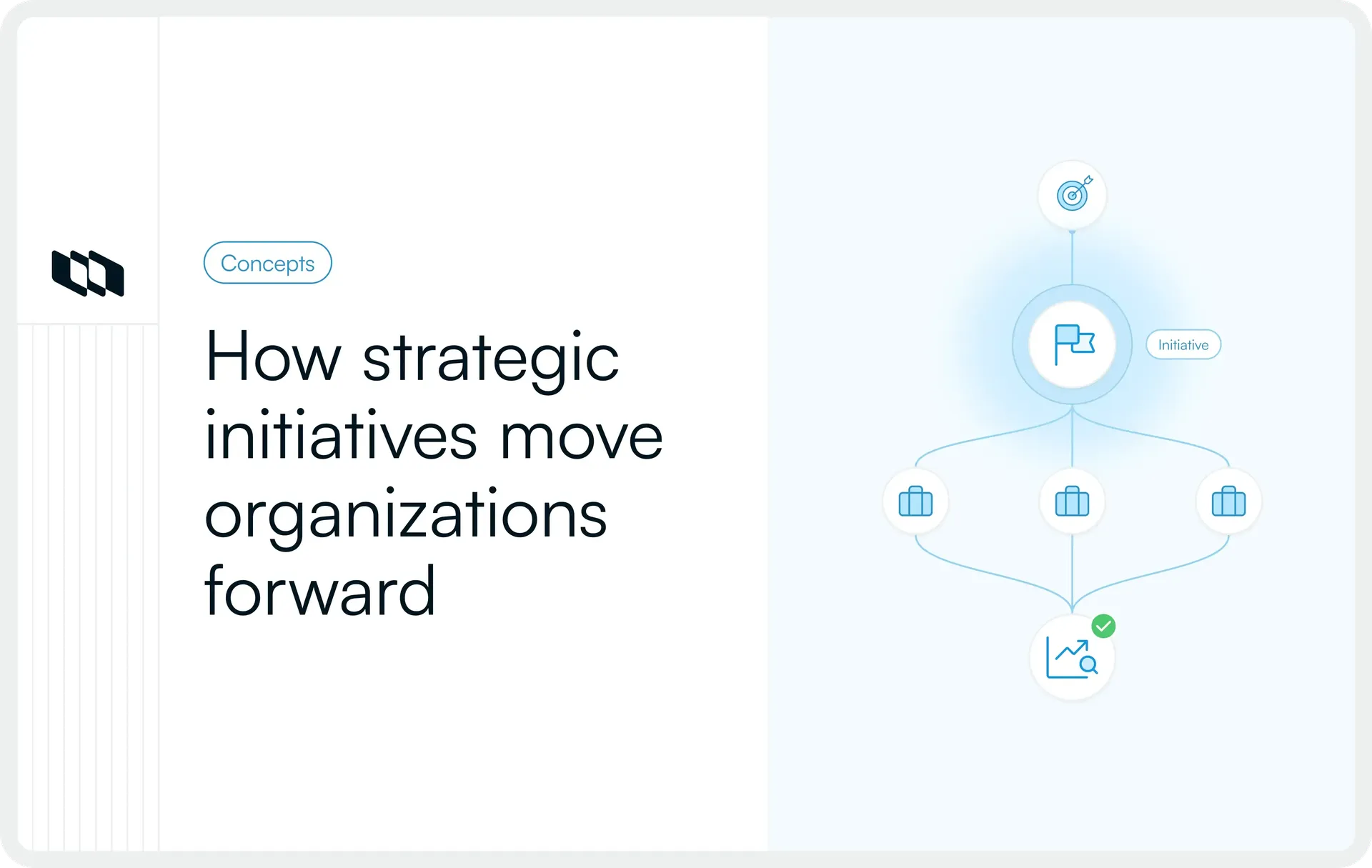
Organizations set strategic goals to guide growth, improve performance, and respond to changing business needs. Achieving these goals often requires several teams to coordinate their efforts, manage shared resources, and deliver outcomes beyond individual projects. Strategic initiatives provide a way to organize this work around specific business priorities.
Understanding how initiatives are defined, prioritized, and managed helps organizations connect strategic planning with execution. This guide explores the characteristics, types, and examples of strategic initiatives, along with their lifecycle, performance measurement, and common management challenges.
What is a strategic initiative?
A strategic initiative is a planned, coordinated effort designed to achieve a specific organizational objective through focused activities, resources, and measurable outcomes. It translates broader business priorities into work that teams can execute and evaluate.
Strategic initiatives typically address significant opportunities, challenges, or changes within an organization. Depending on their scope, they may involve a single major project, several related projects, or multiple workstreams spanning different departments.
For example, a software company aiming to increase enterprise adoption might launch an initiative to improve its enterprise readiness. This could involve strengthening identity management, expanding administrative capabilities, improving security controls, and developing implementation resources.
Each activity contributes to a common business objective, while the initiative provides a structure for managing the overall effort.
A strategic initiative generally has a defined purpose, accountable ownership, an expected timeframe, and criteria for evaluating its success.
How do strategic initiatives differ from strategic goals, programs, and projects?
Strategic goals, initiatives, programs, and projects serve related purposes within organizational planning. Understanding their differences helps teams establish the appropriate scope, responsibilities, and expectations for their work.
Concept | Definition | Primary focus | Example |
Strategic goal | A desired organizational outcome that guides business priorities | Long-term business direction | Improve product reliability |
Strategic initiative | A significant effort undertaken to advance a strategic objective | Strategic change and business outcomes | Modernize software delivery infrastructure |
Program | A coordinated group of related projects and activities managed to achieve combined benefits | Coordinated delivery and benefits | Engineering modernization program |
Project | A temporary effort undertaken to deliver a defined product, service, or result | Specific outputs and deliverables | Implement automated regression testing |
Strategic initiative vs. strategic goal
A strategic goal establishes the result an organization wants to achieve, while a strategic initiative identifies a major effort intended to advance that result.
For instance, a company may establish improving customer retention as a strategic goal and launch an onboarding transformation initiative to address early customer drop-off.
Several initiatives may contribute to the same strategic goal, especially when the objective requires improvements across different business functions.
Strategic initiative vs. program
A program coordinates related projects and activities to deliver outcomes that benefit the organization. Programs are particularly useful when several interdependent projects require shared oversight.
Strategic initiatives and programs can overlap. An organization may manage a complex initiative as a formal program, while another may organize similar work directly under an initiative. The distinction depends on the scope of the effort and the organization's management approach.
Strategic initiative vs. project
A project focuses on delivering a defined result within an agreed scope. A strategic initiative connects substantial work to a broader business objective.
For example, implementing automated testing is a project. An initiative to improve software delivery reliability may include automated testing alongside infrastructure upgrades, deployment improvements, and incident management changes.
A common planning structure looks like this:
Organizational strategy → Strategic goals → Strategic initiatives → Projects and workstreams → Tasks
This hierarchy provides one way to connect business strategy with execution, although organizations may structure initiatives and programs differently.
What are the key characteristics of a strategic initiative?
Strategic initiatives have several characteristics that help organizations identify which efforts require dedicated planning, investment, and oversight. These characteristics also provide the foundation for evaluating whether a proposed initiative is sufficiently defined to proceed.
1. Alignment with organizational strategy
Every initiative should support an identifiable business priority. This connection establishes its strategic relevance and helps decision-makers understand why the effort deserves organizational investment.
2. Clear and measurable objectives
An initiative needs a defined outcome that can be evaluated through relevant performance indicators. For example, a customer experience initiative might target improved activation rates or reduced onboarding time.
3. Defined scope and timeframe
Strategic initiatives require boundaries that establish the work involved, expected deliverables, and approximate execution period. These boundaries support realistic planning and help teams assess proposed changes.
4. Executive sponsorship and accountability
An initiative typically has an accountable owner responsible for coordinating the effort. Executive sponsors may provide strategic direction, support investment decisions, and resolve issues that require senior leadership involvement.
5. Dedicated resources and investment
Execution depends on appropriate funding, team capacity, technical capabilities, and other resources. These commitments should reflect the initiative's expected value and implementation requirements.
6. Cross-functional collaboration
Many initiatives involve teams with different responsibilities. Product expansion, for example, may require coordinated contributions from product management, engineering, marketing, sales, and customer support.
7. Performance measurement and adaptability
Initiatives need mechanisms for monitoring performance and revisiting assumptions. Progress reviews help teams recognize when adjustments are necessary to maintain the initiative's relevance and effectiveness.
These characteristics make strategic initiatives easier to evaluate, govern, and distinguish from recurring operational responsibilities.
Why are strategic initiatives important for organizations?
Strategic initiatives help organizations decide where to invest their resources and how to coordinate significant work across teams. Their value becomes particularly apparent when business priorities compete for funding, capacity, and leadership attention.
1. Translate strategic priorities into investments
Business strategy identifies areas where the organization wants to improve or grow. Initiatives help leaders turn these priorities into defined investments with an agreed purpose and expected value.
2. Establish shared direction across teams
Different departments often have their own targets and delivery commitments. A strategic initiative gives participating teams a common business objective, helping them understand how their individual contributions fit together.
3. Improve resource allocation and prioritization
Organizations have limited capacity to pursue every opportunity simultaneously. Evaluating initiatives alongside one another helps leaders compare expected returns, resource requirements, risks, and competing priorities.
4. Coordinate organizational change
Significant business improvements often require changes across systems, processes, and teams. Initiatives help organizations sequence related activities and manage the dependencies involved in implementing those changes.
5. Strengthen strategic decision-making
Organizing major investments into identifiable initiatives gives leadership a clearer view of ongoing commitments. This supports decisions about accelerating, adjusting, postponing, or discontinuing work.
6. Provide visibility into long-term progress
Initiatives make it possible to review how significant organizational efforts are advancing over time. Leaders can examine the contribution of individual workstreams while maintaining visibility into the broader strategic objective.
What are the different types of strategic initiatives?
Strategic initiatives can be categorized according to their organizational scope and the purpose they are intended to serve. These classifications help explain where an initiative operates and the nature of the change it addresses.
They represent practical ways of organizing strategic work rather than one universally prescribed classification system.
Types based on organizational level
1. Corporate-level strategic initiatives
Corporate-level initiatives address priorities that affect the organization as a whole. They may involve geographic expansion, business diversification, restructuring, or enterprise-wide transformation.
Example: Expanding operations into a new international market.
2. Business-level strategic initiatives
Business-level initiatives focus on improving the performance, growth, or competitive position of a particular business unit, product line, or market.
Example: Developing a new enterprise product offering to reach a different customer segment.
3. Functional-level strategic initiatives
Functional-level initiatives strengthen the capabilities or performance of a specific department in support of broader organizational goals.
Example: An engineering team modernizing its deployment infrastructure to improve release reliability.
Types based on strategic purpose
1. Corrective initiatives
Corrective initiatives address existing problems, performance gaps, or operational weaknesses affecting organizational results.
Example: Redesigning a customer support escalation process to reduce resolution delays.
2. Constructive initiatives
Constructive initiatives focus on developing capabilities, improving existing processes, or strengthening organizational foundations.
Example: Establishing a centralized engineering knowledge management system.
3. Innovative initiatives
Innovative initiatives introduce new products, technologies, business models, or approaches to creating value.
Example: Developing a new AI-assisted capability to address an emerging customer requirement.
4. Defensive initiatives
Defensive initiatives aim to protect business continuity, strengthen organizational resilience, or reduce exposure to significant risks.
Example: Improving disaster recovery capabilities and access controls across critical systems.
These categories can overlap. An enterprise-wide cybersecurity improvement initiative, for instance, may be both corporate-level and defensive.
What are some examples of strategic initiatives?
Strategic initiatives can support business growth, product innovation, operational improvement, and organizational resilience. Their structure depends on the objective being pursued and the activities required to achieve it.
The following hypothetical scenarios show how different objectives can translate into strategic initiatives and supporting projects.
Strategic objective | Strategic initiative | Supporting projects | Expected business outcome |
Expand into new markets | Regional market expansion | Product localization, payment integration, regional marketing | Customer acquisition and revenue growth |
Increase product adoption | New product offering development | Customer research, product design, engineering development | Product adoption and revenue contribution |
Improve technical scalability | Infrastructure modernization | Architecture upgrades, automated testing, deployment improvements | Improved performance and reliability |
Improve customer retention | Customer onboarding transformation | Onboarding redesign, activation analytics, customer education | Higher activation and early retention |
Reduce operating costs | Workflow optimization and automation | Process mapping, workflow redesign, automation implementation | Lower processing costs and improved efficiency |
Strengthen security posture | Enterprise security improvement | Access controls, vulnerability remediation, incident response preparation | Reduced exposure to identified security risks |
Example: Customer onboarding transformation
Consider a subscription-based software company where new customers frequently struggle to complete the initial setup process. Product analytics indicates that many users leave before reaching an important activation milestone.
The organization launches a strategic initiative to improve the onboarding experience and increase early customer retention.
The initiative includes three supporting projects:
- Onboarding redesign: Simplify setup activities and improve guidance within the product.
- Activation analytics: Identify where users encounter difficulty and measure changes in onboarding behavior.
- Customer education: Develop tutorials, documentation, and support resources that help customers adopt essential capabilities.
Each project has its own responsibilities and deliverables. The initiative brings them together around a shared business outcome, with activation rates, time to first value, and early customer retention serving as relevant success measures.
This example illustrates how strategic planning translates into coordinated work. The next section examines how such an initiative progresses from an initial proposal through execution and evaluation.
What are the six stages of the strategic initiative lifecycle?
A practical lifecycle can be divided into six stages: identification, evaluation, planning, execution, monitoring, and outcome evaluation. These stages form a useful framework, although organizations may revisit earlier decisions as new information becomes available.
Stage 1: Identify strategic opportunities and objectives
The lifecycle begins with recognizing a business problem, opportunity, or organizational priority that requires strategic action.
Teams may identify these opportunities through performance reviews, customer feedback, market analysis, operational assessments, or leadership planning discussions.
The purpose of this stage is to establish the strategic need and determine the outcome the organization wants to achieve.
Key activities include:
- Identify the business problem, opportunity, or performance gap.
- Examine relevant data and organizational priorities.
- Define the intended strategic outcome.
- Identify affected stakeholders and business functions.
- Establish the initial rationale for pursuing the initiative.
Example: A software company discovers that many new customers abandon onboarding before completing essential setup activities. Product and customer success teams propose an initiative to improve activation and early retention.
Stage outcome: A clearly defined strategic opportunity and initial initiative proposal.
Stage 2: Evaluate and prioritize initiatives
Organizations generally have more potential initiatives than they can support with their available resources. Proposed initiatives therefore need to be assessed before significant commitments are made.
Evaluation helps leaders determine which opportunities offer sufficient strategic value and whether the organization can execute them effectively.
Consider five factors:
- Strategic alignment: How directly does the initiative support current organizational objectives?
- Expected business impact: What meaningful improvement could the initiative produce?
- Feasibility: Are the technical, operational, and organizational requirements achievable?
- Investment requirements: What funding, people, and capabilities will be needed?
- Risks and dependencies: What circumstances could affect delivery or expected outcomes?
Organizations can use consistent scoring criteria or structured decision discussions to compare competing initiatives.
Example: Leadership evaluates the onboarding initiative alongside other product investments. Based on customer impact, feasibility, and available capacity, the initiative receives approval.
Stage outcome: An approved and prioritized initiative with an agreed strategic justification.
Stage 3: Plan the initiative and allocate resources
Once approved, the initiative needs an execution plan that establishes how the intended business outcome will be pursued.
Planning should provide enough detail for participating teams to understand their responsibilities, commitments, and the relationships between different workstreams.
Key planning activities include:
- Define scope: Establish the boundaries of the initiative and identify major deliverables.
- Set success criteria: Select relevant performance measures and establish baseline conditions.
- Identify contributing projects: Organize the work into manageable projects or workstreams.
- Assign ownership: Define responsibility for the overall initiative and its individual components.
- Allocate resources: Confirm funding, team capacity, and specialist requirements.
- Map milestones and dependencies: Identify important checkpoints and relationships between activities.
Complex initiatives may also require specific governance arrangements, escalation procedures, and approval criteria for major changes.
Example: The onboarding initiative is divided into product experience, analytics, and customer education projects. Each receives an owner, planned deliverables, and delivery milestones.
Stage outcome: A coordinated initiative plan with defined responsibilities, resources, and success criteria.
Stage 4: Execute projects and coordinate teams
Execution begins when participating teams start delivering the work established during planning.
Individual project teams manage their assigned responsibilities, while the initiative owner coordinates activities that affect the broader effort.
Execution typically involves:
- Breaking project deliverables into actionable tasks.
- Sequencing work according to dependencies.
- Coordinating handoffs between teams.
- Resolving delivery blockers and resource conflicts.
- Communicating decisions that affect multiple workstreams.
Dependencies deserve particular attention because delays in one project can affect the progress of others.
Example: Engineering implements onboarding improvements while the analytics team introduces updated event tracking. Customer success prepares educational material that reflects the new product experience.
Stage outcome: Delivery of the planned capabilities, process changes, and other initiative outputs.
Stage 5: Monitor progress and adapt execution
Monitoring helps organizations understand how an initiative is performing and whether changes are needed to protect its expected value.
Although represented as a lifecycle stage, monitoring takes place throughout execution. Reviews should consider both delivery performance and early evidence of business impact.
Key monitoring areas include:
- Project and milestone progress.
- Budget and resource utilization.
- Risks, blockers, and cross-project dependencies.
- Changes in relevant performance indicators.
- Emerging information that affects strategic assumptions.
Monitoring becomes valuable when findings lead to informed decisions. Teams may adjust scope, reallocate resources, revise delivery priorities, or reconsider whether the initiative remains worthwhile.
Example: After releasing the first onboarding improvements, the company observes higher onboarding completion but limited change in customer activation. The product team investigates the remaining difficulties and adjusts its next planned improvements.
Stage outcome: Updated performance assessments and execution decisions informed by current evidence.
Stage 6: Evaluate outcomes and close the initiative
The final stage determines what the initiative achieved and whether further action is required.
Evaluation considers the business results, completed work, investment performance, and lessons that can inform future strategic decisions.
Key activities include:
- Compare actual outcomes with the original objectives.
- Evaluate performance against agreed success criteria.
- Review the contribution of supporting projects.
- Document significant decisions and lessons learned.
- Identify benefits or risks requiring continued attention.
- Decide whether to close, extend, redesign, or transition the initiative.
Example: The company reviews customer activation and early retention after implementing the onboarding improvements. It compares the results with its original baseline and determines whether the initiative achieved its intended outcomes.
Some results may require additional time to become measurable. In such cases, the organization can close the delivery effort while assigning responsibility for continued benefits tracking.
Stage outcome: A documented evaluation of the initiative's results and a formal decision about its next state.
The six-stage lifecycle provides a repeatable structure for strategic initiative management while allowing organizations to adjust their approach as business conditions change.
How do you measure the success of a strategic initiative?
Measuring strategic initiative success requires an understanding of delivery progress, resource performance, and the business outcomes produced by the work.
The most useful measures depend on the initiative's original objective. They should be established during planning and reviewed at appropriate points throughout execution.
1. Strategic objective achievement
Evaluate whether the initiative has advanced the organizational goal it was intended to support.
For example, an infrastructure modernization initiative might be assessed through improvements in system availability, performance, or operational efficiency.
2. Key performance indicators and OKRs
Key performance indicators (KPIs) provide measurable information about relevant areas of business performance.
Organizations using objectives and key results (OKRs) can also connect initiatives to measurable key results associated with their strategic objectives.
Success measures should have clear definitions, baselines, and appropriate review periods.
3. Milestone and deliverable completion
Milestones indicate whether important execution commitments are being achieved according to the initiative plan.
Relevant measures may include completed project phases, implemented capabilities, or achieved approval checkpoints.
These indicators help teams assess delivery performance and identify emerging delays.
4. Budget and resource performance
Compare actual spending and resource utilization with the approved plan.
This helps decision-makers understand the initiative's execution costs, resource constraints, and the implications of changes in scope or investment.
5. Business impact and benefits realization
Evaluate the improvements created through the initiative's outputs and resulting organizational changes.
Depending on the objective, this may involve:
- Revenue growth or customer acquisition.
- Customer activation and retention.
- Reduced operating costs.
- Improved engineering efficiency or service reliability.
- Reduced exposure to significant business risks.
Leading vs. lagging indicators
Leading indicators provide early signals of progress, while lagging indicators show results that become observable over a longer period.
Measurement type | Example | Purpose |
Delivery indicator | Redesigned onboarding flow released | Confirm completion of planned work |
Leading outcome indicator | Improved onboarding completion and activation | Assess early customer behavior |
Lagging outcome indicator | Improved retention among newly onboarded customers | Evaluate longer-term business impact |
Using these measures together helps organizations assess whether execution is progressing and whether the work is producing the desired business results.
Teams should also consider other factors influencing performance before attributing observed changes to an initiative.
What are the common challenges in managing strategic initiatives?
Strategic initiatives often involve complex decisions, shared resources, and dependencies across teams. Challenges arise when the structure used to manage these efforts becomes insufficient for their scope or changing circumstances.
The following issues deserve particular attention.
1. Misalignment with changing strategic priorities
An initiative may continue consuming resources even after business conditions or organizational priorities have changed.
How to address it: Review the initiative's strategic relevance at meaningful decision points and reassess whether continued investment is justified.
2. Unclear ownership and decision-making responsibilities
Cross-functional work can slow down when teams lack clarity about who can approve changes, resolve disagreements, or make priority decisions.
How to address it: Establish accountability, decision rights, and escalation procedures before execution begins.
3. Competing priorities and resource constraints
Multiple initiatives may depend on the same engineering teams, specialist capabilities, or funding, creating unrealistic delivery commitments.
How to address it: Review initiative demands against actual organizational capacity and sequence competing investments accordingly.
4. Scope creep and uncontrolled changes
New requirements can expand the initiative beyond its original boundaries, affecting costs, timelines, and the expected return on investment.
How to address it: Assess significant scope changes against their strategic value, resource implications, and effect on agreed success criteria.
5. Poor coordination across teams
Contributing projects may use different planning cycles, communication practices, and reporting processes, making shared dependencies difficult to manage.
How to address it: Maintain visibility into related workstreams and establish clear coordination responsibilities for cross-project dependencies.
6. Inadequate performance measurement
Teams may report positive delivery progress without sufficient evidence of meaningful business improvement.
How to address it: Review relevant outcome indicators alongside execution metrics and investigate differences between expected and observed performance.
7. Limited adaptability during execution
Initiatives can lose effectiveness when teams continue following plans based on outdated assumptions.
How to address it: Establish review points and clear criteria for revising, pausing, or discontinuing work when new information changes the investment case.
Effective initiative management requires clear decision-making, realistic commitments, and the ability to respond when strategic conditions change.
Final thoughts
Strategic initiatives help organizations pursue important business objectives through coordinated investments, projects, and operational changes. Their success depends on selecting valuable opportunities, maintaining visibility into execution, and evaluating the outcomes those efforts produce.
For teams coordinating work across multiple projects, Plane's Initiatives provides a shared view of related projects and work items, initiative ownership, timelines, and execution progress. Available on Pro and higher plans, it helps teams organize strategic work across projects. Talk to sales to explore how Plane can support your organization's initiatives.
Frequently asked questions
1. What is an example of a strategic initiative?
An example of a strategic initiative is a software company's plan to expand into a new regional market. It might coordinate projects for product localization, payment integration, regional marketing, and customer support, with customer acquisition and regional revenue as expected outcomes.
2. What makes an initiative strategic?
An initiative is strategic when it directly supports an important organizational objective and involves a deliberate effort to achieve a meaningful business outcome. It generally has defined ownership, scope, resources, and measurable success criteria.
3. What is the difference between a strategic initiative and a project?
A strategic initiative focuses on achieving a business objective and may involve one or several projects. A project is a temporary effort focused on delivering a defined product, service, or result. Initiatives connect those deliverables to their intended strategic outcomes.
4. What are the main types of strategic initiatives?
Strategic initiatives can be classified by organizational level, including corporate, business, and functional initiatives, or by strategic purpose, including corrective, constructive, innovative, and defensive initiatives. These categories can overlap depending on an initiative's scope.
5. Who is responsible for managing strategic initiatives?
An initiative owner typically oversees overall coordination and performance, while an executive sponsor may support investment decisions and strategic direction. Project managers or workstream owners remain responsible for their respective areas of execution.
Recommended for you



 Download for Mac
 Download for Android