What is Large Scale Scrum (LeSS)? How it compares to SAFe
Introduction
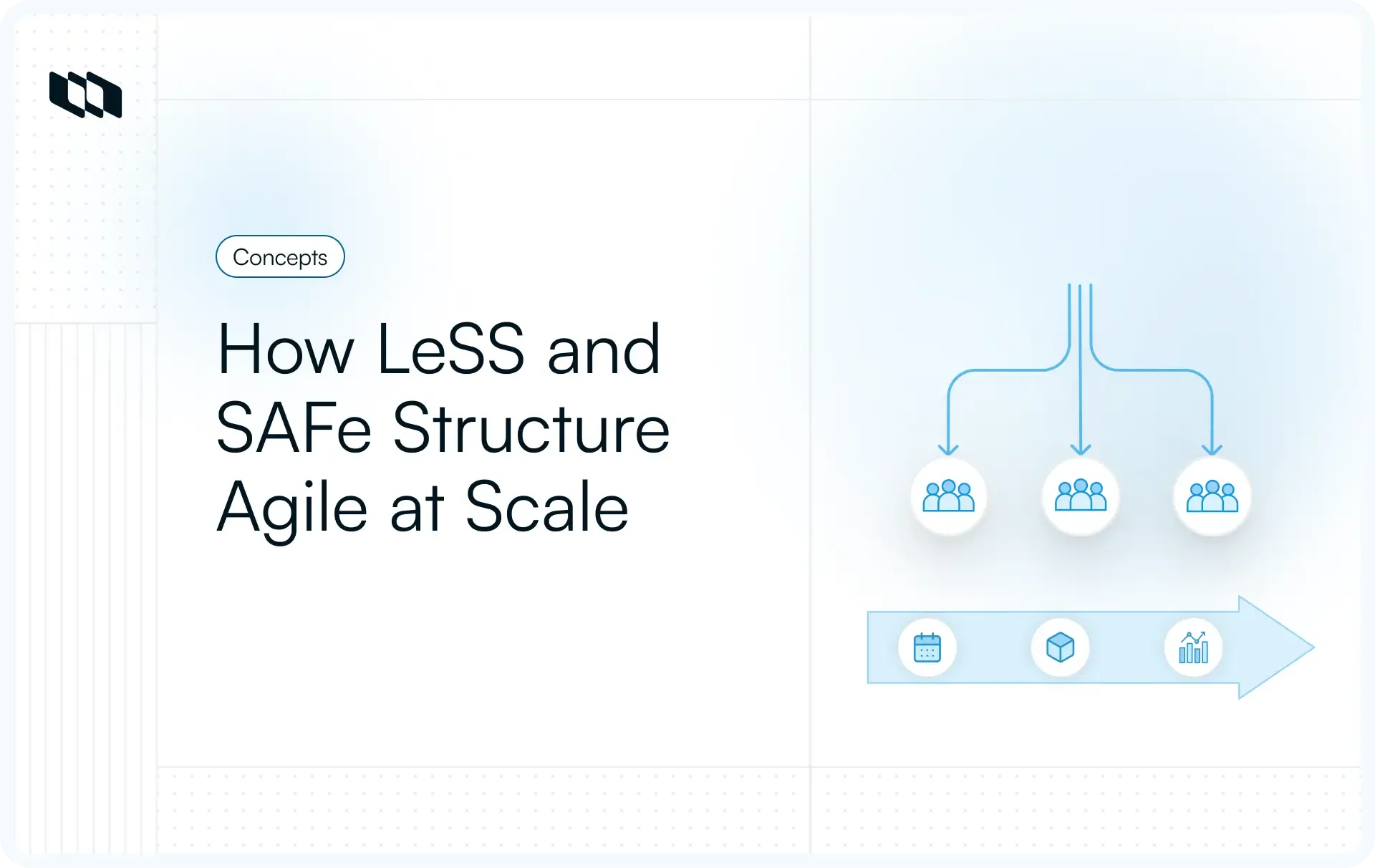
Scrum feels simple when one team owns the work. The real test begins when five, eight, or ten teams start building the same product together. Priorities overlap, dependencies slow delivery, and product ownership gets harder to manage. Large Scale Scrum, or LeSS, gives teams a way to scale Scrum while keeping the system lean. But LeSS is only one path. Many organizations also compare it with SAFe, a more structured scaled Agile framework built for enterprise coordination.
In this blog, we will look at what Large Scale Scrum is, how the LeSS framework works, what changes in LeSS Huge, and how LeSS vs. SAFe compares across structure, planning, roles, and governance.
What is Large Scale Scrum (LeSS)?
Large Scale Scrum, or LeSS, is a framework for scaling Scrum across multiple teams working on the same product. It helps organizations expand Scrum without moving too far away from the original framework. Teams still work in Sprints, plan from a shared backlog, and deliver one product increment together.
What does LeSS stand for?
LeSS stands for Large Scale Scrum. It is a scaled Agile framework designed for organizations in which several Scrum teams contribute to a single product. The LeSS framework keeps the core structure of Scrum intact while extending it across teams. Instead of separate planning systems for every team, LeSS focuses on shared product ownership and coordinated delivery.
Why LeSS was created
Scrum works smoothly when one team owns the product work. As products grow, organizations often add more teams to handle increasing feature development, infrastructure, integrations, and customer requests. A product that once had one Scrum team may eventually grow into four or five teams working on the same roadmap. At that point, coordination becomes harder. Teams depend on each other’s work; priorities overlap, and delivery slows as alignment takes more effort.
Large-scale Scrum was created to solve this problem. It gives organizations a way to scale Scrum while keeping the process relatively lightweight.
The core idea behind LeSS
LeSS scales Scrum by maintaining simplicity: one Product Backlog, one Product Owner, and one shared Sprint. It replaces complex process layers with cross-team collaboration and shared ownership to deliver a single integrated product increment.
Why scaling Scrum becomes difficult
Scrum helps teams move quickly because communication stays simple, priorities stay visible, and ownership stays clear. As organizations grow, that simplicity becomes harder to maintain. Several teams may work on the same product, release cycles become more connected, and product decisions start affecting multiple teams at once. This is where scaling challenges begin to appear.
What changes when more teams work on one product?
A single Scrum team usually shares the same goals, backlog priorities, and understanding of the product. Coordination happens naturally because everyone works closely together.
The situation changes when several Scrum teams contribute to the same product. Teams may handle different parts of the customer experience, different services, or different feature areas, but they still depend on one another to deliver a complete product experience.
A change made by one team can affect another team’s Sprint goals, release timelines, or technical decisions. Product ownership also becomes harder because several teams now compete for shared priorities and engineering capacity.
Common problems teams face at scale
As more teams join the product environment, coordination overhead increases. Teams often spend more time managing dependencies, aligning roadmaps, and resolving planning conflicts.
Some of the most common scaling problems include:
- Dependencies between teams are slowing delivery
- Duplicated work across teams
- Conflicting backlog priorities
- Fragmented visibility into product progress
- Slower decision-making
- Inconsistent delivery practices across teams
For example, one team may build a reporting feature while another team updates the same data structure for analytics. Without shared coordination, both teams may move in different directions, leading to rework later in the Sprint cycle.
Why adding more teams does not automatically increase speed
Organizations often assume more Scrum teams equal faster delivery, but increased communication and dependency management often slow progress. Frameworks like Large Scale Scrum (LeSS) address this by aligning multiple teams to function as a single, coordinated product system.
How LeSS works at a high level
Large Scale Scrum keeps the foundations of Scrum familiar even as more teams join the product environment. Instead of creating separate planning systems for every team, LeSS scales coordination around one product structure. This is why many teams describe LeSS as Scrum with multiple teams rather than a completely separate framework.
1. One product, one backlog
In Large-Scale Scrum, all teams work from a single shared Product Backlog. Every feature, improvement, bug fix, and technical task lives in the same backlog, so priorities stay visible across the product. This shared backlog helps teams align on a single product direction rather than managing disconnected team-level roadmaps. It also reduces the risk of teams optimizing for local goals while missing broader product priorities.
2. One Product Owner
LeSS keeps product ownership centralized with one Product Owner per product. The Product Owner remains responsible for prioritization, product direction, and backlog ordering across all teams. This structure helps maintain consistency in decision-making as the organization scales. Teams still collaborate closely with stakeholders and customers, but the overall product direction remains aligned under a single ownership model.
3. One Sprint across teams
All teams in LeSS follow the same Sprint cadence. They start and finish Sprints together, plan within the same delivery cycle, and review progress at the same time. A shared Sprint rhythm makes coordination easier because teams can align dependencies, discuss blockers earlier, and integrate work continuously throughout the Sprint. It also creates better visibility into product progress across the organization.
4. One integrated product increment
The goal of LeSS remains the same as Scrum: deliver a potentially shippable product increment at the end of every Sprint. Instead of teams delivering isolated outputs, all teams contribute toward one integrated product increment. This encourages closer collaboration between teams and reinforces the idea that everyone is building one product together, not separate pieces moving independently.
The core principles behind LeSS
Large Scale Scrum is built around a small set of principles that shape how teams coordinate, plan, and deliver work at scale. These principles help organizations scale Scrum while keeping the system collaborative, transparent, and product-focused.
1. LeSS is Scrum
The LeSS framework extends Scrum instead of replacing it with a completely new delivery model. Teams still work in Sprints, plan from a Product Backlog, review progress regularly, and improve through retrospectives. This principle matters because many scaled Agile frameworks introduce additional layers of roles, planning structures, and governance. LeSS keeps the focus on the original Scrum foundations while adapting them to multiple teams working on a single product.
2. More with less
One of the central ideas behind Large Scale Scrum is reducing unnecessary complexity. As organizations grow, processes often grow with them. More approval layers, coordination meetings, reporting structures, and management overhead can slow delivery across teams. LeSS approaches scaling differently. Instead of adding more structure everywhere, it encourages organizations to simplify workflows, reduce handoffs, and improve collaboration directly between teams. The goal is to make scaling more efficient without turning coordination into its own system of work.
3. Whole-product focus
LeSS encourages teams to think beyond isolated feature ownership or technical components. Teams work together around one product vision, one backlog, and one shared outcome. This whole-product mindset helps teams make decisions that improve the customer experience across the entire product, rather than optimizing only for their own area of work. It also encourages stronger collaboration between engineering, product, design, and operations teams.
4. Transparency and empirical improvement
Transparency remains central in Large Scale Scrum. Teams share visibility into backlog priorities, Sprint goals, delivery progress, and product outcomes across the organization. This transparency supports empirical improvement, where teams inspect results frequently and adapt based on real feedback. Shared Sprint Reviews, retrospectives, and backlog discussions help teams continuously improve both delivery practices and product decisions.
5. Systems thinking and customer-centricity
LeSS treats scaling as an organizational system challenge rather than only a project management challenge. Instead of focusing solely on team-level efficiency, the framework encourages organizations to improve how the entire product system functions. This includes communication flow, dependency management, decision-making, and customer value delivery.
Customer-centricity also plays a major role in the LeSS framework. Teams align on delivering product value rather than simply completing isolated tasks or feature requests.
Basic LeSS vs. LeSS Huge
Large Scale Scrum includes two framework variants: Basic LeSS and LeSS Huge. Both follow the same core principles of shared product ownership, shared Sprint cadence, and product-focused delivery. The difference lies in how they handle scale and coordination complexity as more teams join the product environment.
Area | Basic LeSS | LeSS Huge |
Team scale | Designed for a smaller number of teams | Designed for very large product groups |
Product structure | One shared product structure | Product divided into requirement areas |
Coordination model | Direct coordination between teams | Area-based coordination |
Product ownership | One Product Owner | One Product Owner with Area Product Owners |
Complexity level | Lower coordination complexity | Higher coordination complexity |
Best fit | Growing product organizations | Large enterprise-scale environments |
What is Basic LeSS?
Basic LeSS works best when a smaller group of Scrum teams contributes to one product. Teams coordinate through shared planning, Sprint cycles, and a single Product Backlog. Since the number of teams remains relatively manageable, collaboration stays direct, and communication paths remain shorter. Teams can align closely around product priorities without introducing additional organizational layers. Basic LeSS is often a strong fit for companies scaling from one Scrum team to several product teams while still wanting a lightweight Agile scaling framework.
What is LeSS Huge?
LeSS Huge is designed for organizations where product scale and coordination become significantly larger. In these environments, dozens of teams may contribute to different areas of the same product ecosystem. Direct coordination across all teams becomes harder as product scope, customer workflows, and delivery dependencies increase. LeSS Huge introduces a structure that helps organizations scale coordination without moving too far away from the original LeSS principles.
What changes in LeSS Huge?
LeSS Huge introduces Requirement Areas, major product domains such as infrastructure or analytics, in which teams align on specific goals. Managed by Area Product Owners, this structure coordinates complex priorities while maintaining shared product ownership across the organization.
When should a team move from Basic LeSS to LeSS Huge?
The move from Basic LeSS to LeSS Huge usually occurs when product complexity outpaces direct coordination. A company with four or five Scrum teams may still operate effectively through shared planning and close collaboration. A product organization with twenty or more teams often needs stronger coordination around different product domains.
The decision depends less on a fixed number of teams and more on factors such as:
- Coordination overhead across teams
- Product complexity
- Dependency management
- Communication flow
- Backlog ownership across multiple domains
Organizations typically adopt LeSS Huge when scaling requires a clearer structure around large product areas while still keeping the overall Agile system relatively lightweight.
Roles in Large Scale Scrum
Large Scale Scrum keeps the role structure intentionally lean. Instead of introducing several management layers or coordination-heavy roles, LeSS builds around a small set of responsibilities focused on product alignment, delivery collaboration, and continuous improvement.
The goal is to help multiple Scrum teams operate as one product-focused system.
1. The Product Owner in LeSS
The Product Owner in Large Scale Scrum owns the overall product direction and backlog prioritization across all teams.
Instead of separate Product Owners managing individual team backlogs, LeSS uses one Product Owner for one product. This structure helps maintain consistent priorities, clearer decision-making, and stronger alignment across teams working on the same roadmap.
The Product Owner works closely with stakeholders, customers, engineering teams, and business leaders to ensure the Product Backlog reflects the most valuable work for the product as a whole.
2. The Scrum Master in LeSS
Scrum Masters in LeSS support team effectiveness while also helping improve the broader organizational system.
Their role extends beyond facilitating Scrum ceremonies. They help teams improve collaboration, remove delivery bottlenecks, strengthen Agile practices, and identify coordination issues affecting multiple teams.
In Large Scale Scrum, Scrum Masters often contribute to system-level improvements such as:
- improving cross-team collaboration
- reducing workflow inefficiencies
- helping teams manage dependencies
- supporting continuous improvement across the product environment
This wider focus becomes increasingly important as more teams contribute to the same product.
3. Cross-functional feature teams
LeSS strongly encourages cross-functional feature teams instead of narrow specialist or component-based teams.
A feature team includes the skills needed to design, build, test, and deliver customer-facing functionality. This structure helps teams deliver complete product outcomes without relying heavily on handoffs between isolated technical groups.
For example, instead of having separate frontend, backend, and QA teams working independently, a feature team combines those capabilities into one collaborative unit.
This approach improves:
- product ownership
- delivery speed
- customer focus
- collaboration across disciplines
It also reduces coordination overhead between highly specialized teams.
4. Area Product Owner in LeSS Huge
The Area Product Owner role exists only within LeSS Huge environments. As product scale increases, organizations often divide work into requirements areas that represent large product domains, such as analytics, billing, collaboration, or platform infrastructure. Area Product Owners help manage priorities within those specific areas while staying aligned with the overall product direction.
Even in LeSS Huge, the structure remains lighter than many enterprise Agile scaling frameworks. Area Product Owners support coordination at a larger scale without turning the product organization into a heavily layered hierarchy.
Events and artifacts in LeSS
Large Scale Scrum retains the familiar Scrum structure while extending it across multiple teams. Teams still plan, refine, review, and improve continuously, but these activities now occur in a shared product environment, where coordination across teams is equally important.
The goal is to maintain alignment without creating unnecessary process overhead.
1. Sprint Planning across multiple teams
In LeSS, all teams operate within the same Sprint cycle and participate in Sprint Planning together. Planning usually starts with a shared discussion around product priorities, Sprint goals, dependencies, and backlog items. Teams then break into smaller planning discussions to decide how they will handle their own work during the Sprint.
This structure gives teams ownership of delivery while maintaining visibility into the broader product effort. It also helps teams identify dependencies early before they become delivery blockers later in the Sprint.
2. Backlog refinement in LeSS
Backlog refinement in Large Scale Scrum happens continuously across teams. Since all teams work from one Product Backlog, refinement discussions help maintain a shared understanding of priorities, technical requirements, and product direction. Teams collaborate with the Product Owner to clarify backlog items, estimate effort, and surface coordination risks earlier.
Shared backlog refinement also reduces the likelihood that teams interpret requirements differently or build overlapping solutions for the same product area.
3. Sprint Review and overall retrospective
Sprint Reviews in LeSS focus on the product as a whole rather than on isolated team outputs. At the end of the Sprint, teams review the integrated product increment together and discuss delivery progress, customer value, product feedback, and upcoming priorities. This shared review creates stronger visibility into how work across teams contributes to the broader product experience.
LeSS also includes overall retrospectives where teams reflect on system-level improvements across the organization. These discussions often focus on collaboration challenges, workflow bottlenecks, dependency management, and opportunities to improve coordination between teams.
4. Shared artifacts that keep teams aligned
LeSS relies on a small set of shared artifacts to keep teams coordinated around one product system. The Product Backlog acts as the central source of priorities for all teams. Every feature, improvement, and technical initiative lives within the same backlog structure, so product direction stays visible across the organization.
Teams may still manage their own Sprint-level work, but planning remains connected to the shared product goals rather than isolated team objectives.
The Definition of Done also stays shared across teams. This ensures that every team follows the same quality standards when contributing to the integrated product increment. Shared quality expectations become especially important as more teams participate in the same release cycle.
Benefits of using LeSS
Large Scale Scrum appeals to organizations that want to scale Agile without turning delivery into a heavily layered process system. The framework keeps coordination relatively lightweight while helping multiple teams stay aligned around one product.
1. Keeps scaling close to Scrum
LeSS works well for teams that already use Scrum and want to scale it without switching to a completely different operating model. Teams still work in shared Sprints, plan from one Product Backlog, and follow familiar Scrum practices across the product environment.
2. Reduces process overhead
Many scaled Agile frameworks introduce additional planning layers, governance structures, and coordination roles as organizations grow. LeSS takes a lighter approach by simplifying collaboration around shared ownership and shared product planning. This helps teams spend more time delivering work and less time managing process complexity.
3. Improves product alignment
One Product Backlog and one product view help teams stay aligned around shared priorities. Instead of separate teams optimizing for disconnected goals, LeSS encourages teams to work toward the same product outcomes and customer value.
4. Encourages stronger team ownership
LeSS relies heavily on cross-functional feature teams with shared accountability for delivery. Teams own customer-facing outcomes more directly because they collaborate across engineering, testing, design, and product work instead of operating through isolated specialist groups.
Large Scale Scrum (LeSS) vs SAFe: Key differences
Large Scale Scrum and SAFe both help organizations scale Agile across multiple teams, but they approach coordination, planning, and organizational structure very differently. LeSS focuses on keeping Scrum as simple and product-centered as possible. SAFe introduces a more structured system with additional roles, planning layers, and governance models to coordinate work at enterprise scale.
The table below highlights the major differences between LeSS vs. SAFe.
Area | Large Scale Scrum (LeSS) | SAFe |
Scaling philosophy | Extends Scrum with minimal added structure | Uses layered coordination for enterprise scale |
Organizational approach | Lightweight and product-centered | Structured and governance-oriented |
Roles | Fewer roles and a flatter structure | More defined roles and hierarchy |
Planning model | Shared Scrum events and backlog alignment | Formal planning structures across levels |
Product ownership | One Product Owner and one backlog | Distributed ownership across teams and programs |
Governance | Adaptive and lightweight | More standardized and process-driven |
Adoption complexity | Simpler framework with strong cultural demands | More prescriptive and operationally heavier |
Best fit | Agile product organizations | Large enterprises needing stronger coordination |
1. Philosophy and approach to scaling
The biggest difference between Large Scale Scrum and SAFe is how they think about scaling Agile. LeSS scales by simplifying coordination around a single product, a single backlog, and shared Scrum practices. The framework assumes organizations can improve delivery by reducing unnecessary complexity and strengthening collaboration between teams.
SAFe takes a more structured approach. It introduces additional planning systems, coordination layers, and governance models to manage large product environments across departments and business units.
2. Roles and hierarchy
LeSS keeps the role structure relatively lean. The framework primarily centers on Product Owners, Scrum Masters, and cross-functional feature teams. Even in LeSS Huge, the hierarchy remains lighter compared with many enterprise Agile frameworks.
SAFe introduces a broader set of defined roles, such as Release Train Engineers, Solution Managers, Product Management roles, System Architects, and program-level leadership responsibilities. This structure supports coordination at a larger scale but also increases operational complexity.
3. Planning and coordination
Large Scale Scrum relies heavily on shared Sprint cycles, shared backlog refinement, and collaborative planning across teams. Coordination happens through direct communication and product-level alignment rather than through several planning layers.
SAFe uses more formalized planning structures, including Program Increment planning and broader coordination frameworks designed for enterprise-scale delivery environments. This gives organizations stronger planning control across large groups of teams.
4. Governance and decision-making
LeSS encourages adaptive decision-making with lighter governance structures. Teams collaborate closely around product goals, and improvements emerge through continuous inspection and adaptation. The framework supports flexibility and faster organizational learning.
SAFe places greater emphasis on standardized governance, planning consistency, and operational alignment across large organizations. This structure often works well in environments with strict compliance requirements, multiple business units, or large-scale coordination needs.
5. Product ownership and backlog structure
Large Scale Scrum centers around one Product Owner and one shared Product Backlog for the product. This structure helps maintain consistent priorities and stronger product alignment across teams. SAFe distributes ownership more broadly across multiple levels of the organization. Product planning often involves several backlog layers, program-level coordination, and additional ownership roles supporting different areas of delivery.
6. Complexity of adoption
LeSS may appear simpler because the framework introduces fewer structures and roles. In practice, successful adoption requires strong Scrum maturity, cross-functional collaboration, and organizational discipline. Teams need to work closely together without relying heavily on additional coordination layers.
SAFe provides more prescriptive guidance for planning, coordination, and governance. This can help large enterprises standardize delivery practices more quickly, although the framework itself becomes heavier to implement and manage over time.
7. Best-fit organizations
LeSS often fits organizations that:
- Already have strong Scrum foundations
- Want lightweight Agile scaling
- Prefer flatter product organizations
- Value product ownership and team autonomy
SAFe often fits organizations that:
- Operate at a very large enterprise scale
- Require stronger governance and planning structures
- Coordinate across multiple departments or business units
- Need higher operational standardization across teams
The decision between LeSS vs SAFe usually depends on how much organizational structure, coordination, and process control the company needs as it scales Agile delivery.
Conclusion
Large Scale Scrum helps organizations scale Scrum without moving too far away from its original principles. By focusing on one product, one backlog, shared Sprint cycles, and cross-functional collaboration, the LeSS framework keeps scaling relatively lightweight while improving alignment across teams.
The comparison between LeSS vs SAFe ultimately comes down to how an organization wants to operate at scale. LeSS works well for product organizations that value simplicity, shared ownership, and team autonomy. SAFe often fits enterprises that need stronger governance, structured planning, and broader coordination across large delivery environments.
For growing product and engineering teams, the right framework depends less on team count alone and more on organizational complexity, delivery structure, and the level of coordination required across the business.
Frequently asked questions
Q1. What is the LeSS framework?
The LeSS framework, short for Large Scale Scrum, is a scaled Agile framework used to apply Scrum across multiple teams working on one product. It maintains the core Scrum structure while helping teams coordinate around a single Product Backlog, a single Product Owner, and shared Sprint cycles.
Q2. What are the 4 frameworks of Agile?
Some of the most widely used Agile frameworks include Scrum, Kanban, SAFe, and Large Scale Scrum (LeSS). Scrum focuses on iterative team delivery, Kanban improves workflow visibility, SAFe supports enterprise-scale coordination, and LeSS scales Scrum across multiple teams working on the same product.
Q3. What is the LeSS method?
The LeSS method is an approach to scaling Scrum while keeping the system lightweight and product-focused. Instead of introducing several management layers, Large Scale Scrum emphasizes shared ownership, cross-functional feature teams, continuous improvement, and coordinated delivery across teams.
Q4. What are the 4 stages of Scrum?
The four common stages of Scrum include Sprint Planning, Sprint execution, Sprint Review, and Sprint Retrospective. Teams plan work at the start of the Sprint, deliver product increments during the Sprint, review outcomes with stakeholders, and improve delivery practices through retrospectives.
Q5. What is one key focus of the LeSS framework?
One key focus of the LeSS framework is improving coordination across multiple Scrum teams while maintaining simplicity. LeSS encourages organizations to scale around one product vision, one backlog, and shared collaboration instead of adding excessive process overhead.
Recommended for you


 Download for Mac
 Download for Android